
TL;DR:
- Personalised events are experiences designed around individual attendee preferences to increase engagement and revenue. Data-driven tools enable real-time adaptation, making sessions and networking relevant and impactful. Personalisation is now a standard expectation, not an extra, greatly improving business outcomes and attendee satisfaction.
Personalised events are defined as experiences deliberately shaped around individual attendee preferences, goals, and behaviours rather than a one-size-fits-all programme. Understanding why personalised events matter is no longer optional for planners. 96% of marketers report that personalised experiences increase sales, and 64% of attendees consider personalised recommendations critical to a positive event experience. Tools such as AI-driven platforms, CRM systems, and smart event apps now make this level of tailoring achievable at almost any scale. The industry term for this discipline is event personalisation, and it sits at the centre of every high-performing event strategy in 2026.
Why personalised events matter for engagement and revenue
The business case for tailored experiences is concrete and measurable. Organisations that implement sophisticated personalisation see 28% more revenue and 35% higher attendee retention compared with those running generic events. That retention figure is particularly significant: retaining an attendee costs far less than acquiring a new one.
Emotional connection is the mechanism behind those numbers. When an attendee feels that a programme was built for them, they are far more likely to return, upgrade to a premium ticket tier, and refer colleagues or friends. Personalisation drives repeat attendance and premium upgrades precisely because it replaces indifference with genuine relevance.
The benefits of custom events extend beyond revenue. Consider the following outcomes planners consistently report:
- Higher net promoter scores. Attendees who feel seen recommend the event to peers, generating word-of-mouth that no paid campaign can replicate.
- Stronger sponsor ROI. Sponsors gain access to segmented, engaged audiences rather than a passive crowd, making their investment more defensible.
- Reduced no-show rates. When content aligns with individual goals, attendees prioritise attendance even when competing demands arise.
- Increased on-site spend. Personalised upsell prompts, delivered at the right moment, convert at higher rates than generic announcements.
The significance of bespoke events is not limited to large corporate gatherings. A 50-person wedding where every table arrangement reflects the couple’s shared history produces the same emotional effect as a 5,000-delegate conference with AI-curated session tracks. Scale changes the tools; the principle does not change.
How does data management and technology enhance personalisation?
Data is the raw material of personalisation, but volume is not the goal. Tracking under 50 well-defined data points yields 3.7 times higher data utilisation than tracking 200 or more scattered metrics. Fewer, sharper data points produce clearer decisions and faster adaptations.

The table below contrasts two approaches to event data collection.
| Approach | Data points tracked | Outcome |
|---|---|---|
| Broad tracking | 200+ scattered metrics | Low utilisation, slow decisions |
| Focused tracking | Under 50 defined metrics | 3.7x higher utilisation, faster personalisation |
AI-driven personalisation takes focused data and acts on it in real time. Platforms such as Bizzabo use AI to analyse attendee behaviour continuously, refining session recommendations, networking suggestions, and content delivery without manual segmentation. The result is an experience that improves as the event progresses rather than remaining static from the opening keynote.
Real-time adaptation is where most events fall short. Failing to adjust messaging and sessions dynamically leaves personalisation incomplete, even when the pre-event planning was thorough. CRM integration, smart registration platforms, and live event apps close that gap by feeding live behavioural signals back to the planning team.
Pro Tip: Set your data collection strategy before registration opens. Define the 10–15 attendee attributes that will directly inform your session tracks, networking matches, and catering choices. Every additional data point beyond that should justify its cost in planning time.
Personalised vs generic events: what is the real difference?
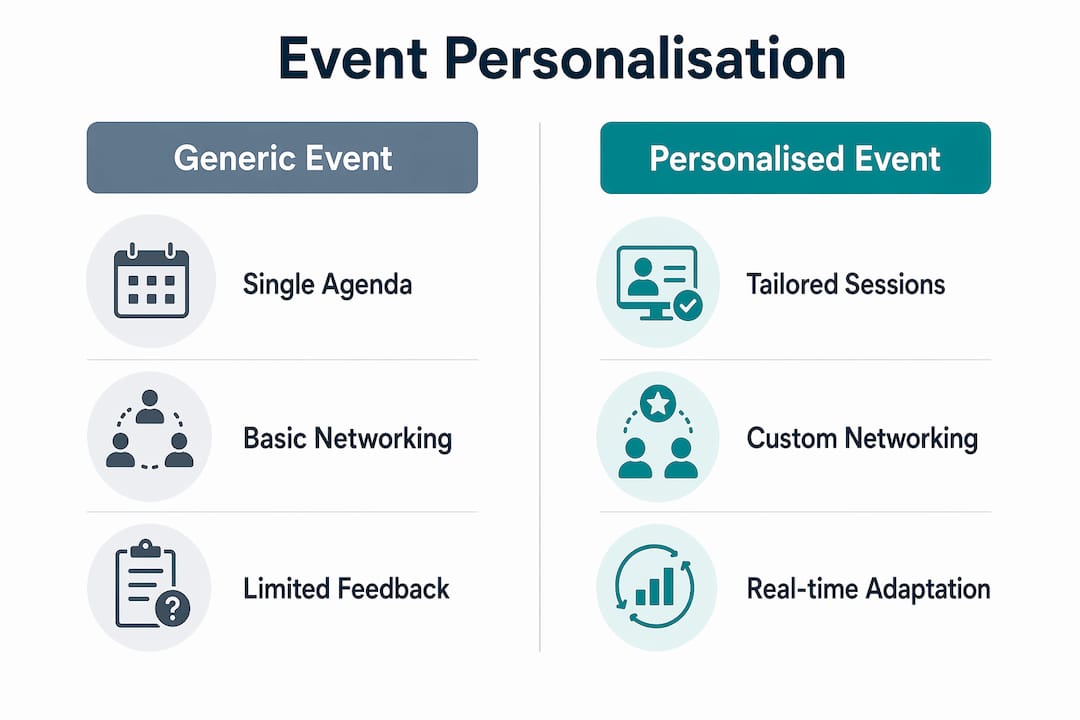
The contrast between a tailored experience and a generic one is felt within the first 30 minutes of an event. Generic events deliver the same agenda to every attendee regardless of their role, interest, or reason for attending. Personalisation makes events feel intentional and worthwhile, cutting through the noise that overloaded decision-makers face daily.
| Factor | Generic event | Personalised event |
|---|---|---|
| Content delivery | Single agenda for all | Session tracks matched to attendee goals |
| Networking | Open, unstructured mingling | Data-matched small groups or one-on-one meetings |
| Attendee satisfaction | Variable, often low | Consistently higher, tied to relevance |
| Business impact | Difficult to attribute | Measurable via retention and revenue uplift |
| Cost perception | Assumed cheaper | Can be cost-effective with AI and automation |
A common misconception is that personalisation requires a large budget. Personalisation can be cost-effective even for smaller events when AI and data analytics handle the heavy lifting. The goal is relevance and precision, not a higher spend per head.
The impact of tailored experiences on networking quality deserves particular attention. Forcing networking in large, unstructured settings undermines value and creates anxiety for many attendees. Data-driven matchmaking, by contrast, creates high-value connections because both parties already share a relevant context before they meet.
What practical steps deliver effective personalised event experiences?
Effective personalisation starts before the venue is booked. The following steps give planners a repeatable framework.
-
Build attendee personas before designing the programme. Segment your expected audience into three to five distinct profiles based on role, goal, and experience level. Designing agendas around specific personas rather than generic agendas is the single most reliable way to avoid surface-level personalisation that attendees see through immediately.
-
Use smart registration to collect the right data. Ask two or three targeted questions at registration: what the attendee wants to achieve, which topics are most relevant, and whether they prefer structured or informal networking. Keep it brief. Long registration forms reduce completion rates.
-
Integrate your CRM with your event platform. CRM integration means that every attendee arrives with a history. A returning guest at a Winelandsfunction corporate event, for example, should receive a programme that acknowledges their previous attendance and builds on it rather than repeating the same experience.
-
Plan for real-time adaptation. Assign a team member to monitor live engagement data during the event. Events that leverage live data and adjust sessions, room layouts, or speaker Q&A formats on the day consistently outperform those that stick rigidly to the original run sheet.
-
Orchestrate networking deliberately. Replace open cocktail hours with small-group tailored interactions based on shared interests or complementary business needs. A table of six people who all want to solve the same problem will generate more value than a room of 200 strangers with name badges.
-
Measure Return on Experience, not just attendance. Events are now measured by what they deliver in terms of Return on Experience. Collect post-event data on session satisfaction, connection quality, and goal achievement rather than relying solely on headcount.
Pro Tip: Avoid the trap of superficial personalisation. Printing a guest’s name on a programme cover is not personalisation. True personalisation changes what they experience, not just how it is labelled.
For planners working on luxury event customisation, the same principles apply at a higher level of detail. Every sensory element, from the scent in the room to the order of speeches, can be calibrated to the guest of honour’s preferences.
Key takeaways
Personalised events consistently outperform generic ones because relevance drives emotional connection, and emotional connection drives measurable business outcomes.
| Point | Details |
|---|---|
| Revenue and retention gains | Sophisticated personalisation delivers 28% more revenue and 35% higher attendee retention. |
| Data focus over data volume | Tracking under 50 defined data points produces 3.7x higher utilisation than broad tracking. |
| Real-time adaptation is non-negotiable | Events that adjust content and sessions dynamically during the day outperform static programmes. |
| Networking quality over quantity | Data-matched small groups create stronger connections than unstructured open networking. |
| Cost is not a barrier | AI and automation make personalisation accessible and cost-effective at any event scale. |
Personalisation is the baseline, not the bonus
I have planned and attended enough events to know the exact moment a guest realises an event was built for them. Their posture changes. They stop checking their phone. That shift is not accidental. It is the result of deliberate choices made weeks before the doors opened.
The industry has moved on from treating personalisation as a premium add-on. Personalisation is now the baseline for event success. Planners who still design around a generic agenda are not saving money. They are spending the same budget to produce a weaker result.
What I find most planners underestimate is the role of empathy in making data useful. Data tells you that an attendee is a senior finance director who attended last year. Empathy tells you that she left early because the afternoon sessions were not relevant to her level. Combining technology with empathy is what separates a genuinely personalised experience from a technically personalised one.
The planners I respect most treat personalisation as a design constraint, not a feature. They ask “does this decision serve a specific attendee?” before committing to any element of the programme. That discipline produces events people talk about for years. Everything else produces events people forget by the following monday.
For anyone planning a bespoke celebration or a corporate gathering, the question is not whether to personalise. The question is how deeply you are willing to go.
— Coert
Winelandsfunction’s approach to personalised luxury events
Winelandsfunction specialises in creating luxury personalised events in Cape Town and the Winelands, where every detail is calibrated to the client’s vision and their guests’ expectations. From intimate weddings to large-scale corporate launches, the team applies the same discipline: understand the attendee first, then design the experience.
The event management services at Winelandsfunction cover the full planning cycle, including smart registration, CRM-informed guest profiling, real-time programme adaptation, and curated networking. Clients working with Winelandsfunction gain a planning partner who treats personalisation as the foundation of every decision, not an afterthought. If you are planning an event that needs to leave a lasting impression, the team is ready to help you build it from the ground up.
FAQ
What is a personalised event?
A personalised event is one where the content, environment, and networking are deliberately shaped around individual attendee preferences and goals rather than a single generic programme.
How much does event personalisation cost?
Personalisation does not require a large budget. AI and data analytics automation make it cost-effective and feasible for smaller events, with the focus on relevance and precision rather than higher spend per head.
Why do personalised events produce better business results?
Organisations implementing sophisticated personalisation see 28% more revenue and 35% higher attendee retention, because relevant experiences create emotional connections that drive repeat attendance and referrals.
What data should planners collect to personalise an event?
Planners should track under 50 well-defined data points, such as attendee role, goals, and topic preferences, as focused tracking yields 3.7 times higher data utilisation than broad metric collection.
How does personalised networking differ from standard networking?
Personalised networking uses attendee data to orchestrate small-group or one-on-one meetings based on shared interests, removing the stress of unstructured mingling and producing higher-quality connections.
Recommended
- Personalization in event planning: your 2026 guide – Winelands Function – For Every Occasion, Your Celebration
- How to customise event experiences: your 2026 guide – Winelands Function – For Every Occasion, Your Celebration
- Why personalised events drive real guest impact – Winelands Function – For Every Occasion, Your Celebration
- Why Hire Event Planner: Complete Guide for 2025 – Winelands Function – For Every Occasion, Your Celebration