
TL;DR:
- Creativity shapes how guests feel, connect, and return, making it essential in event planning. It enhances engagement by designing for emotions and sensory experiences throughout the attendee journey. Applying creativity strategically improves business outcomes, builds loyalty, and mitigates risks during events.
Creativity is the single most important factor separating a forgettable event from one that guests talk about for years. The role of creativity in event planning extends far beyond choosing a colour palette or a floral arrangement. It shapes how guests feel, how they connect with one another, and whether they return. Experiential marketing events that use creativity result in 70% of attendees becoming repeat customers. That figure alone makes creativity a business imperative, not a decorative afterthought.
How does creativity enhance guest engagement and emotional connection at events?
Creativity in events works by designing for feelings first and aesthetics second. Nearly 90% of event attendees continue collaborating or networking when events are designed for human connection. That statistic tells you something profound: the physical environment and programme structure directly determine whether relationships form or dissolve after the final session.
The industry term for this approach is experience design, and it differs sharply from traditional event production. Experience design choreographs the emotional arc of an attendee’s time at an event, from arrival to departure. Every touchpoint, including registration, seating, catering breaks, and the closing moment, becomes a deliberate design decision rather than a logistical necessity.
Multisensory and behavioural design sit at the heart of this discipline. Scent, sound, temperature, and spatial flow all influence how guests perceive and remember an event. A well-chosen ambient soundtrack during a networking break lowers social anxiety and increases conversation. A deliberately dim, warm-lit corner signals that a space is for quieter, more intimate exchange.
- Design for emotional states, not just visual impressions
- Map the attendee journey from arrival to departure as a narrative arc
- Use sensory cues, including sound, scent, and lighting, to guide mood
- Build in moments of surprise or delight at predictable low-energy points
- Measure emotional impact through post-event feedback, not just attendance numbers
Pro Tip: Focus your creative brief on the feeling you want guests to carry home, then work backwards to the production decisions. Visual production follows emotional intent, not the other way around.
What operational and strategic benefits does creativity bring to event planning?
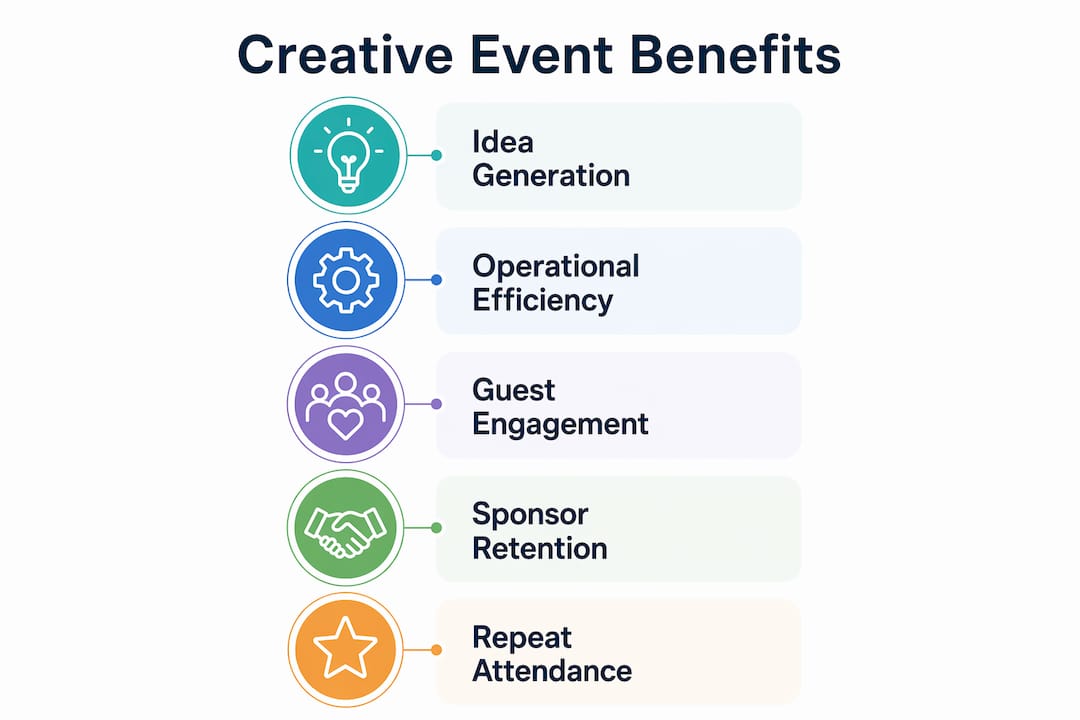
Creativity is an operational tool, not a luxury add-on. Creative event design involves operational techniques that reduce friction, such as making queues engaging rather than simply trying to eliminate them. That reframe matters because it shifts creativity from the budget’s “nice to have” column into the risk management column.
Data should be used proactively to inspire creative solutions, helping planners navigate audience needs and iterate on design decisions in real time. Attendee flow data, for instance, can reveal where energy drops during a conference, prompting a creative intervention such as a pop-up activation or a change in room configuration.
The strategic benefits compound over time. Framing creativity as risk mitigation addresses declining engagement and sponsor attrition directly. Sponsors renew contracts when their brand appears within a memorable, well-designed experience. They withdraw when their logo sits on a banner in a room nobody remembers.
| Strategic benefit | Creative mechanism |
|---|---|
| Higher repeat attendance | Emotional journey design builds loyalty |
| Reduced sponsor attrition | Memorable brand integration within creative concepts |
| Lower attendee fatigue | Focused creativity on 2–3 key moments, not every minute |
| Stronger post-event recall | Multisensory design anchors memory formation |
| Improved ROI measurement | Data-informed creative iteration during the event |
Events that integrate creative design from the outset achieve cohesive, intentional experiences that improve measurable outcomes. Creativity added late, as decoration, rarely shifts the numbers.
Pro Tip: Identify 2–3 moments in your event where you will invest the deepest creative effort. A welcome experience, a keynote transition, and a closing ritual will do more for guest memory than a uniformly “produced” event.
How can event planners practically apply creativity to elevate guest experiences?
Practical creative event strategies begin with the floor plan, not the mood board. Room layout, stage height, and lighting influence attendee behaviour and perception in ways that most planners underestimate. A stage set too high creates distance between speaker and audience. Circular seating arrangements increase participation rates compared to theatre-style rows.
Apply creativity through these concrete steps:
- Choreograph transitions. The moments between sessions, meals, and activities are critical design opportunities. A well-timed piece of music, a visual reveal, or a brief interactive prompt prevents energy from dropping and keeps guests present.
- Use lighting as a narrative tool. Shift colour temperature and intensity to signal changes in programme tone. Cooler, brighter light suits high-energy keynotes. Warmer, lower light works for networking and dining.
- Design calm alongside immersion. Over-designing events causes cognitive fatigue. Build deliberate pauses and quieter zones into the programme so guests can process and recharge.
- Align every creative decision with the event’s core goal. A product launch demands different emotional cues than a charity gala. Creativity without alignment to purpose produces spectacle, not impact.
- Personalise at scale. Name cards, curated welcome gifts, and tailored breakout sessions signal to guests that the event was designed with them specifically in mind. This perception of personalisation drives both satisfaction and loyalty. Winelandsfunction applies this principle across every bespoke celebration it produces, treating personalisation as a structural decision rather than a finishing touch.
- Test creative concepts with a small pilot group. Run a creative activation past a trusted subset of your audience before the event. Their reactions will tell you whether the concept lands emotionally or merely looks good on a brief.
Designing emotional journeys rather than visual production elements is the defining shift in modern event planning. Planners who make this shift consistently report stronger post-event feedback and higher rebooking rates.
What challenges exist in adopting creativity, and how can planners overcome them?

The event industry has a well-documented creativity problem. Formulaic, recycled formats dominate conference and corporate event calendars because they feel safe and familiar to decision-makers. The result is a cycle of declining engagement that planners then try to fix with bigger production budgets rather than better ideas.
The most common barriers are:
- Creativity mistaken for decoration. Stakeholders often equate creativity with floral installations or themed table settings. The fix is to reframe creativity as experience architecture, a structural discipline with measurable outcomes.
- Budget resistance. Creative investment is cut first when costs rise. Counter this by tying creative proposals to specific business metrics, such as sponsor renewal rates or attendee satisfaction scores.
- Risk aversion. New formats feel risky to clients who have run the same event for a decade. Propose a pilot creative project within a familiar structure to build credibility without threatening the whole programme.
- Bandwidth constraints. Planners buried in logistics have no mental space for creative thinking. Technology that automates routine tasks, such as registration management and vendor communications, frees time for the design work that actually differentiates an event.
Pro Tip: Present your creative concept alongside a risk register. Show what happens if you do not change the format, including projected engagement decline and sponsor feedback trends. Creativity framed as risk mitigation gets approved far more often than creativity framed as ambition.
82% of B2B marketers regard participant engagement as essential and are increasingly adopting creative interactive elements such as virtual reality to achieve it. That level of industry consensus removes the argument that creativity is optional. The question is no longer whether to invest in creative event concepts, but where to focus that investment for maximum return.
The guest experience in hospitality literature reinforces this point consistently: events that feel generic produce generic loyalty. Events that feel designed produce advocates.
Key takeaways
Creativity in event planning is an operational and strategic discipline that directly drives attendee loyalty, sponsor retention, and measurable business outcomes.
| Point | Details |
|---|---|
| Creativity drives repeat attendance | Experiential events built on creative design achieve a 70% repeat attendee rate. |
| Design for emotion, not aesthetics | Attendee emotional journeys produce stronger engagement than visual production alone. |
| Focus on 2–3 key moments | Concentrated creative investment prevents cognitive fatigue and sharpens memory. |
| Integrate creativity from the outset | Late-stage creative additions rarely improve measurable outcomes. |
| Frame creativity as risk mitigation | Tying creative proposals to business metrics overcomes stakeholder resistance. |
What I have learned from designing events that actually work
The shift I have witnessed most clearly over the past decade is the move away from asking “what will this look like?” towards asking “what will this feel like?” Those are fundamentally different questions, and they produce fundamentally different events.
Early in my career, I spent enormous energy on visual production. The results looked impressive in photographs and felt hollow in the room. The turning point came when I started mapping the attendee journey as a series of emotional states rather than a schedule of activities. That single change in thinking altered every decision that followed, from how we briefed suppliers to how we structured the run-of-show.
The practical lesson I keep returning to is this: embed your creative team in the planning process from the first briefing, not the final production meeting. Creative decisions made late are expensive, compromised, and disconnected from the event’s purpose. Creative decisions made early shape everything else, including logistics, budget allocation, and vendor selection.
Balancing creativity with budget is real work, not a platitude. My approach is to protect three moments of genuine creative investment and let the rest of the event be well-executed rather than spectacular. Guests remember peaks and endings. They forget the middle. Design accordingly.
— Coert
How Winelandsfunction brings creative event planning to life
Winelandsfunction designs luxury events in Cape Town where creativity is built into the planning process from the first conversation, not added as a finishing layer.
Every wedding, corporate event, and bespoke celebration the team produces begins with an emotional brief: what should guests feel, and when? That question drives venue selection, programme design, catering concepts, and sensory details in a way that generic event production never achieves. Whether you are planning an intimate gathering or a large-scale corporate launch, the event planning process at Winelandsfunction treats creativity as the foundation, not the flourish. For those seeking a dedicated luxury event coordinator who understands both the emotional and operational demands of high-end celebrations, Winelandsfunction offers the expertise to make it happen.
FAQ
What is the role of creativity in event planning?
Creativity in event planning is the discipline of designing attendee experiences that produce specific emotional states, drive engagement, and build loyalty. It operates at every level, from spatial layout and lighting to programme structure and transition moments.
How does creativity affect attendee engagement?
Events designed for human connection result in nearly 90% of attendees continuing to collaborate or network after the event. Creative design directly increases the quality and duration of attendee engagement.
Is creativity only relevant for large-scale events?
Creativity applies equally to intimate gatherings and large corporate events. The scale changes the budget, not the principle. A well-designed welcome moment at a dinner for 20 guests produces the same loyalty effect as a creative activation at a conference for 2,000.
How do I justify creative investment to stakeholders?
Frame creativity as risk mitigation rather than ambition. Present projected engagement decline and sponsor attrition data alongside your creative proposal. Creativity positioned as a business solution gains approval far more readily than creativity positioned as an aesthetic preference.
Where should I focus creative effort in an event?
Focus on 2–3 critical moments: the welcome experience, a key programme transition, and the closing. Over-designing every moment causes cognitive fatigue and dilutes the impact of your strongest ideas.
Recommended
- Complete Guide to Why Use Event Designers – Winelands Function – For Every Occasion, Your Celebration
- Your event styling workflow: a planner’s guide – Winelands Function – For Every Occasion, Your Celebration
- Understanding the Role of Event Designers in Success – Winelands Function – For Every Occasion, Your Celebration
- Role of Floral Design: Elevating Event Experiences – Winelands Function – For Every Occasion, Your Celebration