

The most effective corporate hospitality events share four qualities: measurable objectives, tailored guest experiences, strict compliance with UK anti-bribery law, and budgets allocated by category rather than as a lump sum. Get those four right, and everything else, from venue selection to post-event follow-up, falls into place. Here is what that looks like in practice:
- Set measurable objectives aligned to specific business goals before any venue is booked.
- Prioritise the guest experience through personalised, thoughtfully curated activities.
- Maintain compliance with the UK Bribery Act 2010 and your organisation’s hospitality policy.
- Allocate budget by category, covering venue, catering, AV, travel, and a contingency reserve.
- Align internal stakeholders early so that every team member understands the event’s purpose.
- Embed sustainability and ethical considerations into every planning decision.
What types of corporate hospitality events work best in the UK?
The UK corporate calendar offers a rich variety of formats, each suited to a different relationship stage or business objective. Choosing the right format is as consequential as choosing the right venue.
- Sporting events. Rugby at Twickenham, Test cricket at Lord’s, or Premier League football hospitality suites remain perennial favourites. They combine spectacle with relaxed conversation, making them ideal for deepening existing client relationships.
- Luxury dining and gala dinners. A bespoke tasting menu at a Michelin-starred restaurant or a grand gala dinner signals prestige. These settings suit high-value client appreciation and award ceremonies where formality reinforces the brand.
- Product launches and brand activations. These events place the product at the centre of the experience. The venue, AV, and layout must all direct attention to what is being launched, not distract from it.
- Conferences, seminars, and networking receptions. Structured knowledge-sharing events position your organisation as a thought leader. A well-run networking reception at the close of a conference can generate more pipeline than the conference itself.
- Team-building retreats and incentive trips. Outdoor challenges, culinary workshops, or destination retreats reward high performers and build cross-functional relationships. These work best when the activity genuinely reflects the company’s culture.
- Award ceremonies and client appreciation events. Recognising clients or partners publicly creates loyalty that is difficult to replicate through any other means. The format signals that the relationship matters beyond the transaction.
Understanding corporate hospitality event types in depth helps you match format to objective from the outset, rather than retrofitting a purpose onto a venue you already love.
Why corporate hospitality delivers real value for UK businesses
Corporate hospitality is not a discretionary expense. When planned with clear intent, it strengthens client relationships and delivers returns that conventional marketing channels rarely match.
- Stronger client and stakeholder relationships. Face-to-face experiences build trust at a depth that emails and video calls cannot replicate. A well-hosted afternoon at a sporting event can advance a relationship by months.
- Enhanced brand reputation. The quality of your hospitality communicates the quality of your organisation. Guests draw direct inferences about your attention to detail and your values from how they are treated.
- Business development and customer loyalty. Hospitality creates the conditions for candid commercial conversations. Clients who feel genuinely valued are more likely to renew, refer, and expand their relationship with you.
- Improved employee engagement and retention. Incentive events and team retreats signal to your people that their contribution is recognised. That signal has a measurable effect on morale and retention.
- Networking and collaboration. Bringing clients, partners, and internal teams into the same room accelerates introductions and surfaces opportunities that would otherwise take months to materialise.
- Measurable ROI. When objectives are defined before the event, success becomes trackable. Pipeline acceleration, contract renewals, and post-event survey scores all provide concrete evidence of return.
How to plan and execute corporate hospitality that actually works
Successful corporate event planning rests on a handful of disciplines that, when applied together, produce experiences guests remember and results organisations can measure. Aligning the event’s purpose with measurable business outcomes during early stakeholder sessions is the single most important step, because it guides every subsequent decision from vendor selection to success measurement.
- Define goals before anything else. One to three specific outcomes, stated clearly, shape the entire event. Without them, you cannot evaluate whether the event worked.
- Budget by category, not by top-line number. Allocating spend across venue, catering, AV, travel, and contingency gives you fiscal control and transparency throughout the planning cycle.
- Tailor the experience to your guests. A technology company’s senior leadership team has different expectations from a group of regional sales partners; understanding business travel meal planning can help cater appropriately to travelling guests’ needs. Dietary requirements, accessibility needs, and preferred formats all deserve attention before invitations go out.
- Use technology where it adds genuine value. Automation handles routine tasks such as registration and standard guest communications efficiently, freeing your team to focus on the high-touch moments that guests actually remember.
- Manage onsite logistics with a run-of-show document. A minute-by-minute schedule, shared with every vendor and team member at least a week before the event, eliminates the ambiguity that causes delays.
- Build contingency plans for every critical element. What happens if the keynote speaker cancels? If AV fails? If weather forces an indoor pivot? Answering those questions before the event day is what separates polished execution from visible panic.
- Measure and gather feedback promptly. A post-event survey sent within 24–48 hours, kept to five to seven questions, captures honest impressions before they fade. Track quantitative metrics against the objectives set at the outset.
- Train your staff thoroughly. Every team member present at the event should understand the event’s purpose, the guest list’s composition, and their specific responsibilities. Briefed staff deliver consistent, confident hospitality.
Pro Tip: Create a single point-of-contact sheet listing every vendor and staff member with their phone numbers. Print it. On event day, your phone battery and your Wi-Fi connection are both unreliable.
Budgeting and compliance: what UK organisations need to know
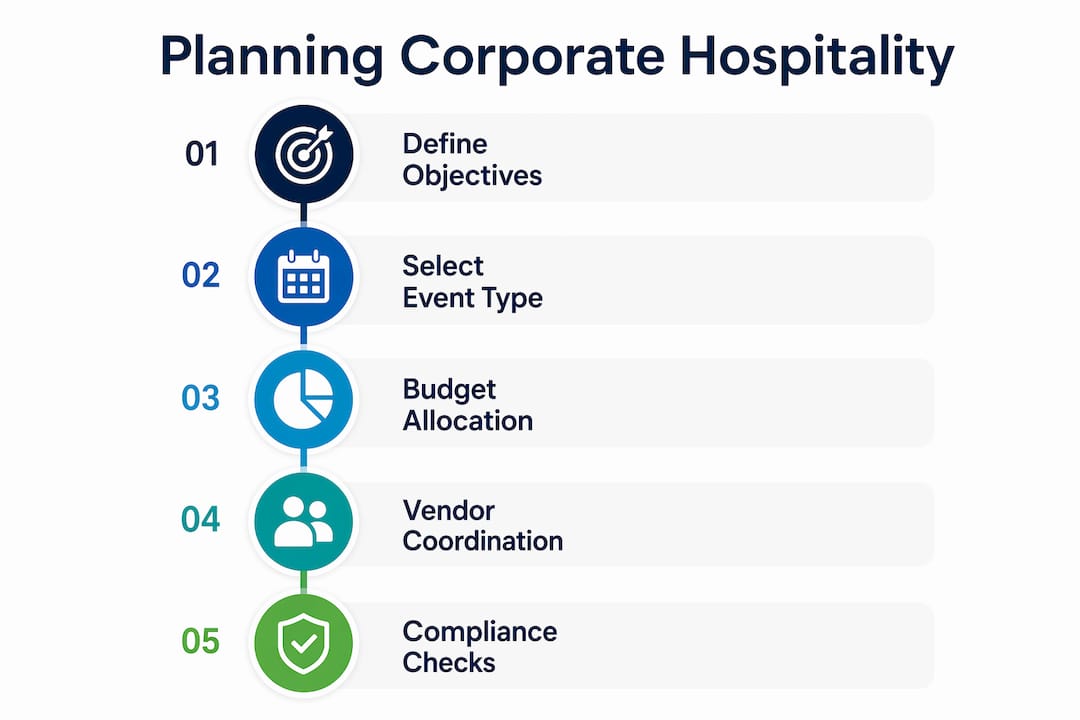
Budget discipline and legal compliance are not separate concerns in corporate hospitality. They are two sides of the same governance framework, and both demand the same rigour.

Allocating your budget by category
Allocating a corporate event budget by category rather than setting a single top-line figure produces better fiscal control and transparency. The recommended proportions are:
- Venue: 30–40% of the total budget
- Catering: 20–25%
- AV and production: 10–15%
- Travel and lodging: 15–20% (where applicable)
- Contingency buffer: 10–15%
For detailed guidance on building a sound financial framework, Winelandsfunction’s event budgeting guide covers the process from first principles.
The contingency line is the one most frequently cut and the one most frequently regretted. Surprises compound. A supplier who cancels two weeks before the event, a venue that requires additional insurance, or a last-minute guest list change will consume that buffer before you notice it is gone. For detailed guidance on building a sound financial framework, Winelandsfunction’s event budgeting guide covers the process from first principles.
Staying compliant with UK anti-bribery requirements
The UK Bribery Act 2010 applies directly to corporate hospitality, and the consequences of getting it wrong extend well beyond reputational damage. UK government anti-bribery policy guidance makes clear that multinational organisations must establish hospitality policies with tiered approval thresholds, local currency limits, and explicit guidance on red flags, including what constitutes a bribery request and how to report one internally.

Undeclared hospitality is a persistent compliance risk. Routine cross-checking of guest lists against expense reimbursements uncovers instances that declared registers miss entirely. Organisations that treat this as a periodic audit exercise rather than a continuous control tend to discover problems only after they have become serious.
Scenario-based compliance training is particularly effective for employees in sales and supplier management roles, where the boundary between relationship-building and improper influence is most easily blurred. Training that presents realistic situations, rather than abstract policy statements, produces better ethical decision-making in practice.
A few additional controls worth embedding:
- Monitor hospitality frequency and timing, particularly around tender discussions or contract renewals, where patterns of frequent entertainment can indicate a compliance problem.
- Maintain a hospitality register and review entries regularly, not just at year-end.
- Apply enhanced scrutiny to hospitality involving government officials or public sector procurement contacts.
- Where charitable donations replace traditional gifting, conduct due diligence on the recipient organisation to avoid any perception of indirect influence.
What is corporate hospitality?
Corporate hospitality refers to the organised entertainment and hosting activities that businesses provide to clients, partners, employees, and other stakeholders to build and maintain commercial relationships. It encompasses everything from a private dining experience for a key account to a full-scale conference for several hundred delegates.
The most useful way to think about it is not as entertainment but as a connected experience designed to drive business goals, whether that is pipeline acceleration, customer retention, or internal culture alignment. Viewed through that lens, hospitality becomes a strategic investment rather than a line item to justify at budget review. The global hospitality market was estimated at USD 839 billion in 2024, which reflects how central these activities are to commercial life across every sector and geography.
For a deeper grounding in the discipline, Winelandsfunction’s guide to corporate hospitality explained covers the full scope of what the practice involves and how to approach it with genuine expertise.
Why corporate hospitality belongs at the centre of your business strategy
Corporate hospitality works best when it is treated as an ongoing investment rather than a series of one-off productions. Organisations that plan a single annual event and consider the job done miss the compounding effect that consistent, well-executed hospitality creates over time.
The most commercially successful programmes connect each event to a broader relationship strategy. A product launch introduces a new capability to existing clients. A gala dinner reinforces loyalty at the end of a contract cycle. A team-building retreat rebuilds cohesion after a period of organisational change. Each event serves a distinct purpose, and together they form a narrative about how the organisation values its relationships.
Internally, corporate hospitality also signals to employees that their contribution is recognised and that the organisation invests in its people. That signal has a direct effect on engagement, and engaged employees deliver better client experiences, which closes the loop between internal culture and external reputation. The discipline of corporate event planning at a high standard is, ultimately, an expression of how seriously an organisation takes every relationship it holds.
Key takeaways
Successful corporate hospitality in the UK requires clear objectives, category-based budgeting, and continuous compliance monitoring, applied consistently across every event in your programme.
| Point | Details |
|---|---|
| Define objectives first | Set one to three measurable business outcomes before booking any venue or vendor. |
| Budget by category | Allocate across venue (30–40%), catering (20–25%), AV (10–15%), travel (15–20%), and contingency (10–15%). |
| Compliance is continuous | Cross-check guest lists against expense reports regularly; undeclared hospitality is the most common oversight. |
| Tailor every experience | Match the event format, activities, and catering to the specific guest demographic and relationship stage. |
| Treat hospitality as strategy | Consistent, connected events build compounding returns; one-off productions rarely do. |
Ready to create extraordinary corporate experiences that reflect your brand at its finest? Winelandsfunction brings bespoke expertise and meticulous attention to detail to every event, from intimate client dinners to grand corporate launches.
Explore how Winelandsfunction’s luxury event coordination and corporate event management services can bring your next corporate hospitality programme to life with elegance and precision.
Recommended
- Corporate Hospitality Explained: Elevating Brand Experiences – Winelands Function – For Every Occasion, Your Celebration
- Corporate Event Best Practices: Elevating Luxury Experiences – Winelands Function – For Every Occasion, Your Celebration
- Corporate Event Preparation Guide for Elegance and Impact – Winelands Function – For Every Occasion, Your Celebration
- Guest Service Experience: Elevating Luxury Events – Winelands Function – For Every Occasion, Your Celebration