
TL;DR:
- Professional event management involves planning, coordinating, and executing events to meet specific goals and achieve measurable impact. It provides strategic oversight, vendor negotiation, and risk management, preventing costly mistakes and saving time and money. Using professional services improves event quality, strengthens brand perception, and enhances business outcomes compared to DIY planning.
Professional event management is the expert-led process of planning, coordinating, and executing events to achieve specific goals with measurable impact. Whether you are organising a wedding in the Cape Winelands or a corporate product launch in Cape Town, the difference between a forgettable event and a genuinely successful one almost always comes down to who is managing it. Teams using strategic event management report a 23% increase in profitability, and 84% of marketers say events help them stand out from competitors. Those figures tell you something important: events are not just occasions. They are business tools, and they require professional handling.
Why professional event management goes far beyond coordination
The industry term for what professionals do is “event management,” which covers the full lifecycle of an event from concept through post-event evaluation. Many clients confuse this with simple coordination, which is a costly misunderstanding. Coordination handles logistics on the day. Event management handles strategy, budgeting, vendor contracts, risk planning, creative direction, and execution across weeks or months.
A professional event manager brings expertise that replaces trial-and-error learning. When you plan an event internally, your team spends time learning what professionals already know. That learning curve costs money in rework, last-minute bookings, and avoidable mistakes.
The scope of professional event management includes:
- Strategic planning aligned with your event objectives and audience expectations
- Budget development with transparent line items and contingency allowances
- Vendor sourcing and contract negotiation with suppliers your team has never worked with before
- Risk assessment covering weather, technical failures, no-shows, and crowd management
- On-the-day execution using detailed run sheets that sequence every dependency
Pro Tip: Ask your event manager for a single point of contact. Professional firms consolidate communication so you receive one update where you would otherwise manage dozens of separate supplier conversations.
That single point of contact is not a convenience. It is a structural advantage that prevents miscommunication from cascading into expensive problems on the day.
How does professional event management save time and money?
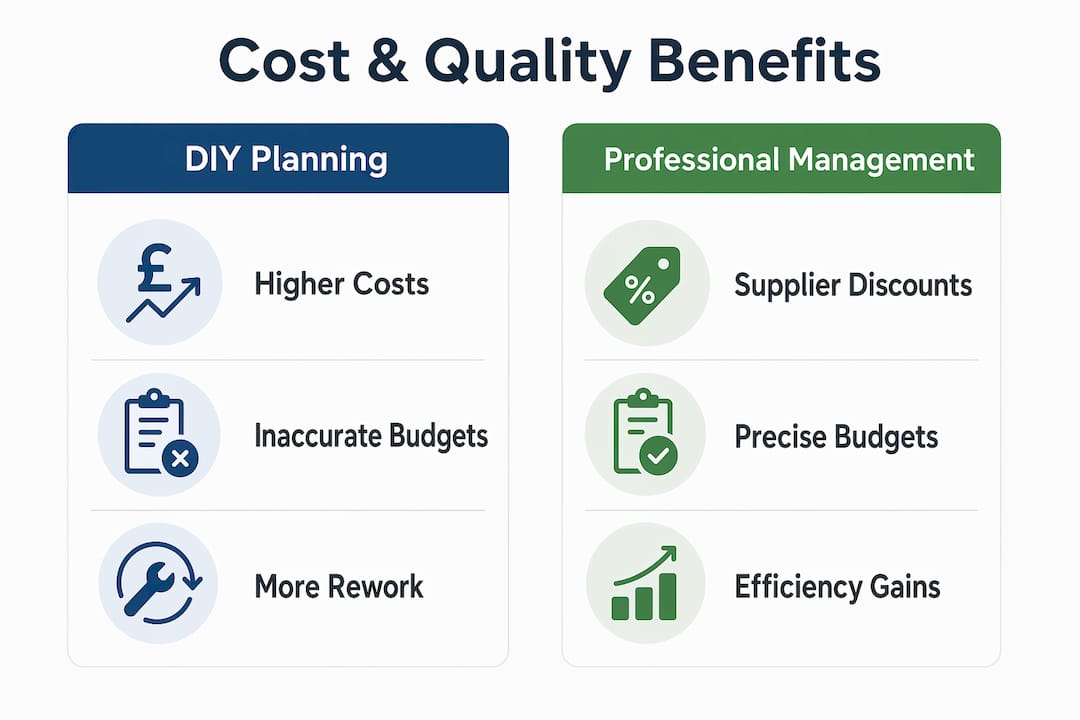
The most common objection to hiring professionals is cost. The reality is that negotiated supplier discounts often offset management fees entirely, leading to net savings compared with DIY planning. Professionals use volume-based contracts and long-standing vendor relationships to secure pricing that individual clients cannot access.
Transparent, detailed budgets created by professionals avoid the last-minute price spikes and hidden charges that frequently derail self-managed events. A venue that quotes one figure in january may add charges for staffing, cleaning, and equipment hire that an experienced planner would have negotiated upfront.
The operational savings are equally significant:
- Reduced administrative overhead: your internal team is not pulled away from their core responsibilities for weeks
- Fewer supplier emails: professional management consolidates all vendor communication into a single workflow
- No rework costs: experienced planners anticipate problems before they occur, eliminating expensive fixes
- Better catering decisions: working with specialists who understand festive meal offerings and supplier options helps you allocate food and beverage budgets where they create the most impact
The true cost of poor event planning includes lost internal productivity, rework, and expensive last-minute vendor bookings. These costs rarely appear on a post-event invoice, but they are real and they accumulate quickly.
Pro Tip: Use a simple cost-benefit framework: estimate the hourly cost of every internal team member involved in planning, multiply by the hours spent, and add any rework or emergency supplier costs. That total is your true DIY cost. Compare it honestly against a professional management fee before deciding.
For a detailed breakdown of where savings typically occur, the event cost optimisation guide from Winelandsfunction covers the key categories worth examining before you commit to a budget.
What impact does professional planning have on event quality?
Quality in event management is not about decoration. It is about whether the event achieves its purpose. 95% of top event teams prioritise demonstrating commercial ROI, which means the best professionals measure success against objectives, not just against guest satisfaction scores.

Professionally designed corporate events influence brand perception, employee engagement, and authentic alignment with organisational goals. That is a significant claim, and it holds up in practice. A product launch that feels disorganised signals the same about the product. A wedding that runs smoothly creates an emotional memory that lasts for decades.
The table below compares typical outcomes across key quality indicators:
| Quality indicator | DIY or internal planning | Professional event management |
|---|---|---|
| Budget accuracy | Often over by 15–30% due to hidden costs | Transparent from the outset with contingency built in |
| Supplier reliability | Variable; limited leverage | High; backed by established relationships |
| Day-of-event execution | Reactive; issues handled as they arise | Proactive; run sheets prevent most failures |
| Brand or theme alignment | Inconsistent across suppliers | Coordinated across every touchpoint |
| Post-event evaluation | Rarely conducted | Integral to the planning process |
Successful event planning aligns business objectives early and uses post-event evaluation as a strategic input. That feedback loop is what separates a one-off event from a programme that builds brand equity over time.
Pro Tip: Request a post-event report from your management team. It should include attendance data, budget variance, supplier performance ratings, and guest feedback. That document becomes the foundation for your next event.
Professional planners also use detailed run sheets that capture every sequential dependency across the event day. Without this document, a delayed caterer can push back speeches, which delays the entertainment, which runs into venue curfew. With it, every supplier knows exactly when they are needed and what triggers their next action.
How do you choose the right event management partner?
Choosing the right firm is as important as choosing to hire one. A poor event management partner creates more problems than it solves. Use the following criteria to evaluate any provider before signing a contract.
- Verify their portfolio. Ask for case studies from events similar in scale, format, and budget to yours. A firm that excels at intimate weddings may not have the operational depth for a 500-person corporate conference.
- Assess communication style early. How quickly do they respond to your initial enquiry? Do they ask intelligent questions about your objectives, or do they jump straight to package options? Communication quality in the sales process predicts communication quality during planning.
- Confirm budget transparency. Ask for a sample budget document. It should show line items, supplier costs, management fees, and contingency allocations separately. Vague estimates are a warning sign.
- Understand their vendor relationships. Ask which suppliers they work with regularly and why. Firms with deep vendor networks deliver better pricing and reliability. Firms that subcontract everything to third parties lose operational control.
- Clarify project ownership. Who is your named point of contact? Will that person be present on the day? Some firms sell the relationship with a senior planner and deliver the event through a junior team member you have never met.
- Align on objectives, not just aesthetics. The best partners ask what you want guests to feel, think, or do after the event. That question separates event management companies that think strategically from those that simply execute a brief.
Professional event managers provide calm operational control and risk mitigation, preventing the costly errors that untrained, reactive planning produces. That calm is not accidental. It comes from having managed the same category of problem dozens of times before.
Key takeaways
Professional event management delivers measurable advantages in cost control, operational quality, and strategic outcomes that DIY planning consistently fails to match.
| Point | Details |
|---|---|
| Expertise replaces trial and error | Professionals prevent costly mistakes that internal teams make while learning on the job. |
| Management fees are often offset | Negotiated supplier discounts frequently cover the cost of hiring a professional firm. |
| Run sheets prevent day-of failures | Sequential dependency planning stops one delay from cascading across the entire event. |
| Post-event evaluation drives ROI | Structured feedback loops turn each event into a strategic input for the next one. |
| Partner selection determines outcomes | Verify portfolio, communication, and vendor relationships before signing any contract. |
Why I think “it’s just logistics” is the most expensive misconception in events
People often treat event management as a support function. Book the venue, hire the caterer, send the invitations. The thinking is that anyone organised enough can manage it. That view costs organisations far more than a professional fee ever would.
What I have seen repeatedly is that the real value of a skilled event manager is not what they do. It is what they prevent. A missed venue clause that triggers a penalty. A caterer who arrives 40 minutes late because nobody confirmed the load-in time. A keynote speaker who needs AV equipment that was never specified in the brief. These are not rare disasters. They are the predictable consequences of underestimating logistical complexity.
Professional event management is frequently mischaracterised as a luxury, when the operational and risk management value it delivers often lowers overall project costs. The misconception persists because the savings are invisible. You never see the crisis that did not happen.
The longer-term benefit is even less discussed. Events shape how employees feel about their organisation, how clients perceive a brand, and how a couple remembers the most significant day of their lives. That is not logistics. That is culture and identity, and it deserves professional attention.
— Coert
How Winelandsfunction approaches professional event management
Winelandsfunction brings together creative direction, vendor expertise, and operational precision for weddings, corporate events, and bespoke celebrations across Cape Town and the Winelands. Every event begins with a clear brief, a transparent budget, and a named point of contact who remains accountable from the first planning call through to post-event review.
The team at Winelandsfunction works with an established network of trusted suppliers, which means better pricing, greater reliability, and creative options that self-managed planning rarely uncovers. For corporate clients, the focus on corporate event strategy ensures every element connects back to your business objectives. For couples, the luxury event management approach means no detail is left to chance. If you are ready to plan an event that delivers real results, Winelandsfunction is the place to start.
FAQ
What does professional event management include?
Professional event management covers strategic planning, budget development, vendor sourcing, risk assessment, on-the-day coordination, and post-event evaluation. It is the full lifecycle of an event, not just day-of logistics.
Is hiring an event management company worth the cost?
Negotiated supplier discounts frequently offset management fees, meaning the net cost is often lower than DIY planning. The hidden costs of poor planning, including rework and last-minute bookings, typically exceed a professional fee.
How do professional event managers control budgets?
Professionals create transparent, itemised budgets from the outset, with contingency allocations built in. This approach avoids the hidden charges and last-minute price spikes that commonly affect self-managed events.
What is a run sheet and why does it matter?
A run sheet is a detailed document that sequences every element of an event day, capturing timings and dependencies for all suppliers. Without it, a single delay can cascade and disrupt the entire event programme.
How does professional planning improve business outcomes?
Strategically designed events influence brand perception, employee engagement, and stakeholder alignment. Teams using professional event management report measurable increases in profitability and commercial ROI compared with unmanaged approaches.
Recommended
- Why invest in event professionals for luxury occasions – Winelands Function – For Every Occasion, Your Celebration
- Benefits of professional event planning for luxury events – Winelands Function – For Every Occasion, Your Celebration
- Why hire premium event services for major occasions – Winelands Function – For Every Occasion, Your Celebration
- The role of event management companies in luxury celebrations – Winelands Function – For Every Occasion, Your Celebration