

TL;DR:
- Planning a wedding in three months is possible with quick decisions, a flexible approach, and prioritizing vendor bookings.
- Limiting the guest list, choosing off-peak dates, and applying strict response time rules help manage the tight timeline effectively.
According to The Knot Real Wedding Study, 5% of couples successfully plan their wedding in three months or less. That figure is not a cautionary tale. It is proof that a 90-day timeline produces real, beautiful weddings when couples commit to decisive action and clear priorities. Planning a wedding in 3 months in the UK is absolutely achievable provided you accept two things from the outset: you will not get your first choice of every vendor, and speed of decision-making is your most valuable skill throughout the entire process.
The conditions that make it work are straightforward:
- Set a flexible budget from day one. Wedding planner Lindsay Parrott-Masiewicz notes that rush fees and unexpected last-minute costs are inherent to compressed timelines, so build in a contingency from the start.
- Keep the guest list tight. A smaller guest list dramatically expands your venue and vendor options while simplifying every logistical decision.
- Embrace weekday and off-peak dates. Weekday or off-peak dates significantly increase venue and vendor availability, particularly during peak UK wedding seasons.
- Make decisions and move on. Short timelines actually reduce decision fatigue by forcing you to focus on what genuinely matters for your celebration.
The mindset shift is this: you are not planning a compressed version of a 12-month wedding. You are planning a different kind of wedding entirely, one built on clarity, trust, and the confidence to say yes quickly.
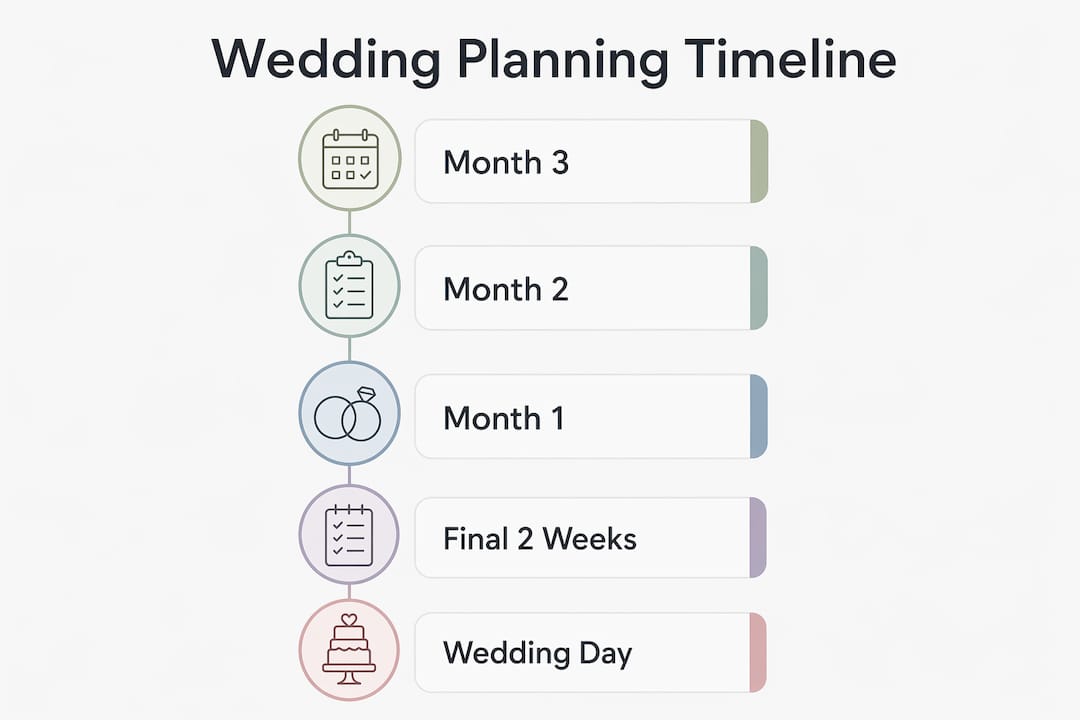
How do you start planning a wedding in 3 months?
The first 72 hours set the entire trajectory. Do not spend them researching. Spend them contacting and booking.

On day one, establish your absolute maximum budget and your approximate guest count. These two figures determine every subsequent decision, from venue capacity to catering costs. Be honest rather than optimistic. Wedding planner Parrott-Masiewicz puts it plainly: a flexible budget is easier to work with than a rigid one, especially during peak season when rush fees are unavoidable.
Once those figures are fixed, begin contacting venues and photographers simultaneously. Do not wait until the venue is confirmed before approaching photographers. Peak-season Saturdays at dedicated wedding venues in the UK are typically booked 12–18 months in advance, so widen your search immediately. Restaurants, art galleries, private estates, and botanical gardens often carry far more availability at short notice. Friday and Sunday weddings tend to be easier to book on short notice and typically cost 20–40% less than Saturday events.
Apply the 36-hour rule without exception: if a vendor does not respond within 36 hours of your first contact, move to the next option. A slow-to-respond vendor on a three-month timeline is a risk you cannot afford. This applies to venues, photographers, caterers, and every other supplier.
Pro Tip: Limit venue visits to three at most. Touring more than three venues creates analysis paralysis. Book the first venue that meets your core budget and guest requirements. Securing a date is more important than finding the perfect space.
For venue selection strategies tailored to tight timelines, focus on all-inclusive packages wherever possible. A venue that provides catering, bar service, tables, and chairs in a single contract eliminates five to seven separate vendor searches in one booking.
Hiring a wedding coordinator at this stage is one of the highest-value decisions you can make. A day-of coordinator or wedding planner on a short timeline provides access to vendor availability that is not publicly listed, negotiated pricing, and weeks of research compressed into days. If full planning is outside your budget, a day-of coordinator is the minimum recommended hire.
What vendors should you book at two months out?
With your venue secured and your date confirmed, the two-month mark is when your vendor team takes shape. Prioritise in this order: photographer, officiant, caterer (if not venue-provided), and entertainment.
- Photographer: Book the first photographer whose portfolio you genuinely admire and who falls within budget. Do not wait for a fourth or fifth quote. Strong photographers in most UK markets book peak dates well in advance, so availability narrows fast.
- Officiant: Contact two or three options and confirm availability before discussing details. Apply the 36-hour rule here as with every other vendor.
- Entertainment: Live bands typically book 9–12 months ahead. At three months out, plan for a DJ as your primary option. A skilled DJ shapes the reception atmosphere just as effectively.
- Florist and caterer: These vendors generally carry more flexibility at short notice. Contact two options maximum and book the first that meets your standards.
For attire, custom wedding dresses are not feasible on a three-month timeline. Focus exclusively on sample sale gowns, off-the-rack dresses, and designers offering expedited production. Budget four to six weeks for alterations, and book your seamstress at the same time you purchase the dress. Suits and morning wear are considerably more straightforward, with most menswear retailers holding stock for immediate purchase.
Send digital invitations immediately rather than printed save-the-dates. A beautifully designed email invitation or a wedding website with built-in RSVP tracking is perfectly acceptable and gives guests maximum notice. Set your RSVP deadline approximately five weeks from the send date, giving you enough time to finalise headcount with your caterer. Call or text immediate family directly; an email alone can feel impersonal for your closest guests.
Secure hotel room blocks for out-of-town guests this week. Hotels book up quickly, and your guests will appreciate having accommodation options ready when the invitation arrives. For catering options that work within hospitality-sector timelines, prioritise menus that your caterer can execute confidently rather than elaborate bespoke offerings that require extended lead times.
How do you manage guest coordination at one month out?
The final month is about confirmation, not discovery. Every major decision should already be made. Your energy now goes into tightening the details.
- Track RSVPs daily and follow up personally with anyone who has not responded within a week of the deadline. Outstanding RSVPs delay your seating plan and your final headcount submission to the caterer.
- Finalise your seating plan as responses arrive. Start a rough draft early and adjust as confirmations come in rather than waiting until the deadline has passed.
- Confirm all vendor contracts and deposits. Review payment schedules and flag any outstanding balances. Provide every vendor with a day-of timeline covering arrival times, setup requirements, and your point of contact on the day.
- Schedule dress fittings. Your first fitting should happen this month if it has not already. Alterations in the UK typically take four to six weeks, so book your seamstress promptly.
- Apply for your marriage licence. In England and Wales, couples must give notice at their local register office at least 28 days before the ceremony. Scotland and Northern Ireland operate under different rules, so check your jurisdiction’s specific requirements and processing times early. Do not leave this step until the final fortnight.
- Begin writing your vows if you are personalising them. Starting now gives you time to refine and practise without the pressure of the final week.
Arrange transport logistics for the day itself, including any vehicles for the wedding party and accommodation transfers for guests travelling from a distance. The more of this you confirm in writing this month, the calmer the final two weeks will feel.
What needs to happen in the final two weeks?
The last fortnight is about execution, not planning. If decisions are still being made at this stage, something has slipped. Use this period to confirm, delegate, and rest.
- Finalise and distribute the wedding day timeline to every vendor, your wedding party, and any family members with responsibilities on the day. Include arrival times, setup windows, ceremony start, and reception flow. Every participant should have a written copy they can access from their phone.
- Call every vendor to reconfirm. Verify arrival times, setup requirements, and payment schedules. A brief confirmation call prevents the misunderstandings that cause day-of disruption.
- Hold your rehearsal. Walk through the ceremony with your officiant and wedding party. Delegate day-of responsibilities clearly so that your coordinator, not you, is the point of contact for vendor questions on the day itself.
- Prepare your emergency kit. Include safety pins, stain remover, pain relief, blister plasters, a phone charger, and any personal items you may need during the getting-ready period.
- Prepare vendor gratuity envelopes in advance. Having these ready removes a task from the morning of the wedding.
- Pack for your honeymoon and confirm all travel details. If you are departing immediately after the wedding, have bags packed and stored before the ceremony day begins.
Manage any last-minute guest communications through a single point of contact, ideally your coordinator or a trusted family member. Your phone should not be your primary communication tool on the wedding morning.
How do you stay present and enjoy the day itself?
Your one job on the wedding day is to be present. Everything else belongs to your coordinator and your vendors.
- Stick to the timeline but hold it lightly. Minor delays are normal and rarely visible to guests.
- Let your coordinator handle crises. That is precisely what they are there for. Trust the professionals you have hired and resist the urge to manage logistics yourself.
- Take deliberate moments to look around, connect with your partner, and absorb the atmosphere. The day moves quickly. Pause intentionally.
- Trust your vendors. You hired them because their work impressed you. Give them the space to deliver it.
- Communicate through your coordinator. If something needs adjusting, relay it through your point of contact rather than approaching vendors directly during the event.
Minor hiccups are a feature of every wedding, regardless of how long it was planned. Guests notice the warmth of the celebration, the quality of the food, and the joy of the couple. They do not notice the napkin fold that was slightly different from the mock-up.
How can friends and family help you plan faster?
Delegation is one of the most underused tools in short-timeline planning. You do not need to carry every task yourself, and trying to do so is the fastest route to exhaustion.

Assign specific, bounded tasks to people you trust completely. Vague requests produce vague results. Instead of asking someone to “help with flowers,” ask them to collect the floral order from the supplier at a specific time and deliver it to the venue by a specific hour. Precision makes delegation work.
Practical tasks that translate well to trusted helpers include: managing the RSVP spreadsheet and chasing non-responders, coordinating hotel room block communications with out-of-town guests, assembling welcome bags or favour packaging, and handling the rehearsal dinner logistics entirely. The rehearsal dinner, in particular, is an ideal candidate for full delegation to a family member or close friend who wants to contribute meaningfully.
For vendor coordination across multiple suppliers, a single point of contact on the day prevents the confusion that arises when vendors receive conflicting instructions from different people. Designate one person, ideally your coordinator, as the sole day-of contact for all vendor queries.
What backup plans do you need for fast bookings?
Contingency planning on a short timeline is not pessimism. It is the difference between a minor inconvenience and a genuine crisis on the day.
Build a backup option for every critical vendor category before you need it. If your primary photographer cancels, you want a shortlist of two alternatives already identified, not a frantic search 48 hours before the ceremony. The same logic applies to your caterer, your officiant, and your entertainment.
Wedding insurance is worth purchasing early in the process. UK policies typically cover vendor cancellation, venue failure, and adverse weather for outdoor events. The cost is modest relative to the protection it provides, and it is far easier to arrange at the two-month mark than in the final fortnight.
For outdoor or partially outdoor venues, confirm your wet-weather contingency with the venue in writing. Marquee options, indoor backup spaces, and covered areas should all be agreed and documented before the day. Verbal assurances are not sufficient.
Keep a list of local suppliers who can fulfil last-minute orders. Florists who work with walk-in clients, bakeries that produce cakes with two to three weeks’ notice, and hire companies with flexible cancellation terms are all worth identifying early. Grocery store and supermarket flowers, arranged simply in clean vases, are a genuinely beautiful and practical backup for floral elements that fall through. The wedding planning services at Winelandsfunction are built around exactly this kind of contingency-aware coordination, ensuring that every element of your celebration has a plan B in place before it is ever needed.

When you want expert support to bring your celebration together with confidence and elegance, Winelandsfunction’s luxury event coordination team is ready to help you create an extraordinary day, whatever your timeline.
Key takeaways
Planning a wedding in 3 months is achievable in the UK when you prioritise venue and vendor bookings immediately, keep the guest list tight, and make decisions quickly without revisiting them.
| Point | Details |
|---|---|
| Feasibility is confirmed | 5% of couples successfully plan their wedding in three months or less, producing real and joyful celebrations. |
| Off-peak dates save money | Friday and Sunday weddings typically cost 20–40% less than Saturday events and carry greater availability. |
| Apply the 36-hour rule | Drop any vendor who does not respond within 36 hours; slow communication on a tight timeline signals future problems. |
| Skip custom attire | Custom dresses are not feasible in three months; off-the-rack and sample sale gowns with four to six weeks for alterations are the practical choice. |
| Delegate with precision | Assign specific, bounded tasks to trusted helpers and appoint one coordinator as the sole day-of vendor contact. |
Recommended
- Wedding Planning Step by Step: Your Complete Guide – Winelands Function – For Every Occasion, Your Celebration
- Wedding planning check list: your step-by-step guide – Winelands Function – For Every Occasion, Your Celebration
- Wedding Planners Cape Town | Winelands Function
- 8 Essential Wedding Planning Tips for 2025 Success – Winelands Function – For Every Occasion, Your Celebration