

TL;DR:
- Corporate retreats are strategic events designed to improve team cohesion, increase employee engagement, and deliver measurable organizational benefits. They foster trust through shared experiences, enhance collaboration across departments, and reduce costs associated with disengagement and turnover. Properly planned retreats with clear objectives and follow-up activities create lasting positive impacts on organizational culture and performance.
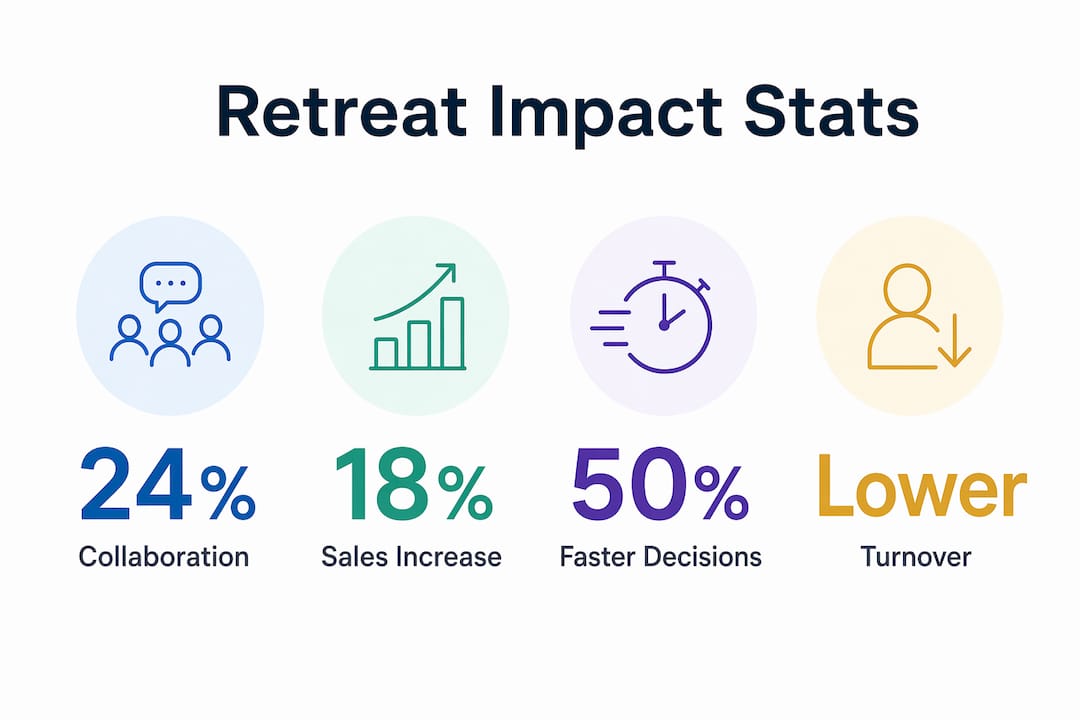
Corporate retreats are purposeful, structured gatherings designed to strengthen team cohesion, improve employee engagement, and drive measurable organisational outcomes. The question of why corporate retreats matter is no longer a soft HR debate. Research shows that retreat attendance raises internal collaboration by 24% within two months, and high-engagement teams generate an 18% increase in sales per employee. These are not incidental benefits. They are the direct result of investing in deliberate, well-planned time away from the office. For corporate leaders and HR professionals, retreats represent one of the clearest paths to building the trust and culture that daily operations rarely create on their own.
Why corporate retreats matter for team building
Team building is the recognised industry term for the structured process of improving how groups work together. Corporate retreats are one of the most effective vehicles for it. The reason is simple: shared experience creates trust faster than any workshop or memo.
Retreat attendance increases collaboration requests by 24% within two months of the event. That figure is significant because collaboration is not just a cultural nicety. It directly affects how quickly decisions get made and how well cross-functional projects succeed. What is equally striking is that 17% of new professional relationships formed during retreats persist for over two years. Retreats do not just create a temporary buzz. They build lasting professional networks inside the organisation.
Structured activities play a specific role here. Problem-solving exercises, creative workshops, and facilitated group discussions give colleagues a reason to interact outside their usual reporting lines. Informal interactions, meals, and evening conversations do the rest. Both types of contact matter. Formal activities create shared reference points. Informal ones create genuine rapport.
Cross-departmental collaboration is where retreats deliver the most overlooked value. Finance professionals rarely speak to product teams in daily operations. A retreat puts them in the same room, working on the same challenge. That contact changes how they communicate when they return to their desks.
- Structured activities build shared reference points across teams
- Informal interactions create rapport that survives the return to the office
- Cross-departmental exposure reduces friction in future collaboration
- New professional relationships formed at retreats outlast the event itself
Pro Tip: Design at least one activity that mixes departments deliberately. Seating colleagues from different functions together at meals is one of the simplest and most effective ways to build cross-team relationships.
How do retreats improve employee engagement and performance?
Employee engagement is the degree to which staff feel committed to their work and their organisation. Retreats are a direct intervention that raises engagement, and the business case for doing so is substantial.

High-engagement teams generate an 18% increase in sales per employee and are 87% less likely to experience staff turnover. That combination of revenue growth and retention improvement makes retreats one of the highest-return investments available to HR leaders. The cost of replacing a single employee typically runs to several months of their salary. Preventing that loss through a well-run retreat is straightforward arithmetic.
Disengagement carries a cost that most organisations underestimate. Employee disengagement costs $1.9 trillion annually in lost production across the global economy. That figure reframes the conversation. Retreats are not a discretionary spend. They are a defence against a measurable and ongoing financial drain.
“Leaders who prioritise in-person retreats protect culture and productivity. Skipping these risks burnout and costly turnover. Retreats are strategic necessities, not luxury expenses.”
Teams with interpersonal trust make decisions 50% faster with less friction. Retreats build that trust directly. When colleagues understand each other as people rather than job titles, they communicate more honestly, escalate problems sooner, and resolve conflict more efficiently. The productivity gains that follow are real and sustained.
Burnout is another dimension that retreats address. Teams returning from retreats report enhanced energy, focus, and renewed purpose. That cognitive reset translates into improved problem-solving and creativity in the weeks that follow. For organisations running lean teams under sustained pressure, that renewal is not a luxury. It is a necessity.
| Outcome | Evidence |
|---|---|
| Sales per employee | 18% increase in high-engagement teams |
| Staff turnover risk | 87% reduction for engaged employees |
| Decision-making speed | 50% faster in high-trust teams |
| Global disengagement cost | $1.9 trillion in annual lost production |
| Staff turnover reduction | Up to 25% lower with wellbeing investment |
The benefits of corporate retreats extend well beyond the event itself. The engagement lift, the trust built, and the renewed focus all compound over time when the retreat is followed up properly.
What makes a corporate retreat actually work?
A retreat without clear objectives is a team outing. The distinction matters because objectives determine every other decision: the venue, the activities, the facilitation style, and the follow-up process.
The most effective retreats align their goals directly with business priorities. If the organisation is navigating a restructure, the retreat should address communication and uncertainty. If the goal is cross-functional collaboration, the programme should create structured contact between departments. Vague goals produce vague outcomes.
- Define specific objectives before booking anything. Identify the one or two outcomes the organisation needs most. Write them down and share them with attendees in advance.
- Choose a venue that supports the goal. Inspiring locations away from the office lift creativity and signal that the event is worth taking seriously. The corporate event preparation guide from Winelandsfunction covers venue selection in detail for leaders planning high-impact events.
- Involve leadership visibly and authentically. Leaders who attend, participate, and listen send a clear signal about the organisation’s values. Leaders who appear briefly and leave early send the opposite signal.
- Segregate groups by role for at least one session. This encourages less vocal employees to speak honestly. Transparent dialogue with genuine follow-through is far more likely when junior staff are not sitting next to their line managers.
- Celebrate milestones and recognise contributions. Acknowledging individual and team achievements during the retreat creates meaningful loyalty. Recognition linked to retention is one of the most cost-effective tools available to HR leaders.
- Measure impact with pulse surveys. Run a baseline survey before the retreat and a follow-up 6–8 weeks after to capture changes in collaboration, morale, and communication. Without measurement, the return on investment remains invisible.
Pro Tip: Keep the agenda focused. A packed schedule of back-to-back sessions exhausts attendees and crowds out the informal conversations where the most valuable connections happen. Build in unstructured time deliberately.
The guest experience at corporate retreats shapes how attendees perceive the organisation’s commitment to their wellbeing. Thoughtful hospitality, from catering to accommodation, communicates respect and sets the tone for the entire event.
Common misconceptions about corporate retreats
The most damaging misconception is that retreats are a reward for good performance rather than a mechanism for producing it. This framing leads organisations to cut retreats during difficult periods, precisely when the need for cohesion and morale is greatest.
Retreats are strategic necessities that protect productivity and prevent cultural drift. Cutting them to reduce costs is a false economy. The disengagement, turnover, and communication breakdown that follow cost far more than the retreat itself.
A second misconception is that any gathering counts. A poorly planned retreat with a random agenda, no clear purpose, and no follow-up produces little measurable benefit. The quality of the retreat design matters as much as the decision to hold one.
- Retreats are not holidays. They require clear objectives, structured facilitation, and post-event accountability to deliver results.
- Budget concerns are valid but misframed. The cost of a retreat is fixed. The cost of disengagement and turnover is ongoing and compounding.
- Presentations are not retreats. A day of PowerPoint slides in a hotel conference room does not build trust or improve collaboration. Meaningful conversation and shared experience do.
- Remote teams need retreats more, not less. Shared experiences create positive currency that improves remote collaboration substantially. Distributed teams that never meet in person accumulate communication debt that retreats can clear.
- Without disciplined follow-up,](https://use.expensify.com/blog/plan-the-perfect-company-retreat) the positive effects fade within weeks. The retreat is the catalyst. The follow-up is what converts the energy into lasting change.
The 2026 business case for hosting retreats is clear. Organisations that treat retreats as optional extras will consistently underperform those that treat them as planned investments in their people.
Key takeaways
Corporate retreats are one of the highest-return investments available to HR leaders, delivering measurable gains in collaboration, retention, and sales performance when planned with clear objectives and proper follow-up.
| Point | Details |
|---|---|
| Collaboration gains | Retreat attendance raises internal collaboration requests by 24% within two months. |
| Retention and sales | Engaged teams are 87% less likely to leave and generate 18% more sales per employee. |
| Follow-up is non-negotiable | Pulse surveys at 6–8 weeks post-retreat are needed to capture and sustain the impact. |
| Objective-led planning | Retreats without clear business goals produce vague outcomes and wasted budget. |
| Disengagement has a price | Global disengagement costs $1.9 trillion annually, making retreats a financial defence, not a perk. |
The trust you cannot put in a spreadsheet
I have seen organisations spend months debating whether a retreat is worth the budget, then watch the same budget disappear quietly into recruitment fees six months later. The maths is not complicated. What is harder to quantify is what actually happens in the room.
The data on collaboration and retention is real and worth citing. But the thing that changes after a well-run retreat is subtler. Colleagues stop treating each other as job titles. A finance director who spent an afternoon cooking with the product team will pick up the phone differently the next time there is a disagreement over resource allocation. That shift in tone does not show up in a pulse survey. It shows up in how the organisation actually functions day to day.
The retreats I have seen fail share a common pattern. Leadership attends the opening dinner and disappears. The agenda is packed with presentations. There is no time for genuine conversation, and no follow-up after the event. The team returns to the office, the goodwill evaporates within a fortnight, and the organisation concludes that retreats do not work.
The retreats that work are the ones where the agenda is built around conversation rather than content delivery. Where leaders stay, listen, and are visibly changed by what they hear. Where the follow-up is planned before the event begins. The location matters less than the intention behind it.
— Coert
Planning a corporate retreat in Cape Town with Winelandsfunction
Cape Town’s Winelands region offers one of the most compelling settings for a corporate retreat anywhere in the world. The combination of natural beauty, world-class hospitality, and proximity to the city makes it a practical choice for both local and international teams.
Winelandsfunction specialises in luxury corporate event management for organisations that want their retreats to reflect the same standard of care they bring to their business. From venue selection and catering to facilitation logistics and guest experience, every detail is coordinated to align with your retreat’s specific objectives. The team understands that a corporate retreat is not a party. It is a business investment, and it deserves the same attention to detail. Contact Winelandsfunction to discuss a bespoke retreat experience built around your organisation’s goals.
FAQ
What is a corporate retreat?
A corporate retreat is a structured, off-site gathering designed to improve team cohesion, employee engagement, and organisational alignment. Unlike standard conferences, retreats prioritise relationship-building and open dialogue alongside any formal agenda.
How do retreats improve team performance?
Retreat attendance raises internal collaboration requests by 24% within two months, and high-engagement teams generate 18% more sales per employee. The combination of shared experience and structured interaction builds the trust that drives faster decisions and better outcomes.
How often should organisations hold corporate retreats?
Most organisations benefit from at least one annual retreat, with additional sessions tied to significant business changes such as restructures, new strategy launches, or rapid team growth. Frequency depends on team size, distribution, and the pace of organisational change.
How do you measure the return on investment of a retreat?
Run pulse surveys before the retreat and again 6–8 weeks afterwards to measure changes in collaboration, morale, and communication. Track retention rates and cross-functional project outcomes in the months that follow to build a fuller picture of impact.
Are corporate retreats worth the cost for remote teams?
Retreats are particularly valuable for distributed teams. Shared in-person experiences create a foundation of trust that improves remote collaboration substantially, reducing the communication friction that accumulates when colleagues have never met face to face.
Recommended
- Why host corporate retreats: the 2026 business case – Winelands Function – For Every Occasion, Your Celebration
- Benefits of Corporate Retreats for Team Success – Winelands Function – For Every Occasion, Your Celebration
- 7 Inspiring Corporate Event Ideas 2025 for Elite Gatherings – Winelands Function – For Every Occasion, Your Celebration
- 7 Inspiring Corporate Event Ideas 2025 for Elite Gatherings – Winelands Function – For Every Occasion, Your Celebration