

TL;DR:
- Effective venue selection involves defining your event needs and budget before visiting spaces. Comparing all-in costs and assessing logistics ensures better value and fewer surprises. Starting early and focusing on audience needs lead to a more successful event outcome.
Venue selection is defined as the systematic process of matching a physical space to the specific requirements of your event, including capacity, budget, location, and guest experience. Done well, it is the single decision that shapes every other element of your event. Venue costs typically represent 25–30% of the total event budget, and hidden charges can push that figure considerably higher. Following a clear, step by step venue selection process protects you from costly surprises and emotional choices that look appealing in the moment but fail on the day.
What prerequisites should you define before searching for a venue?
The most common venue selection mistake is starting with a tour. Premature tours lead to expensive compromises because you fall in love with a space before confirming it fits your budget or guest count. Define your requirements first, and every subsequent step becomes faster and more objective.
Start by clarifying your event type and objectives. A corporate product launch has different spatial and technical needs than a wedding reception or a milestone birthday dinner. Write down the primary goal of the event in one sentence. That sentence becomes your filter for every venue you assess.
Next, establish your guest count with a realistic buffer for no-shows. Venue capacity must account for your specific seating style and any additional space required for staging, a dance floor, or activations. A room that holds 200 for a standing reception may only seat 120 for a formal dinner with a top table and presentation screen.
Set your total venue budget before you speak to a single venue coordinator. The base rental fee is rarely the final number. Factor in catering minimums, audiovisual hire, service charges, overtime fees, and corkage. Audience-centric venue choices improve attendance and satisfaction, so also consider your guests’ demographics, mobility requirements, and travel habits when setting location criteria.
- Define event type, objectives, and format in writing before searching
- Set a firm guest count with a buffer of 10–15% for no-shows
- Establish an all-in budget that includes hidden venue costs beyond base rental
- Identify accessibility requirements for guests with mobility needs
- Confirm date flexibility, as popular venues book 12–18 months out for peak dates
Pro Tip: Write your non-negotiables on a single page before contacting any venue. If a space cannot meet those criteria, remove it from your list immediately, regardless of how impressive it looks.
How do you research and shortlist suitable venues?
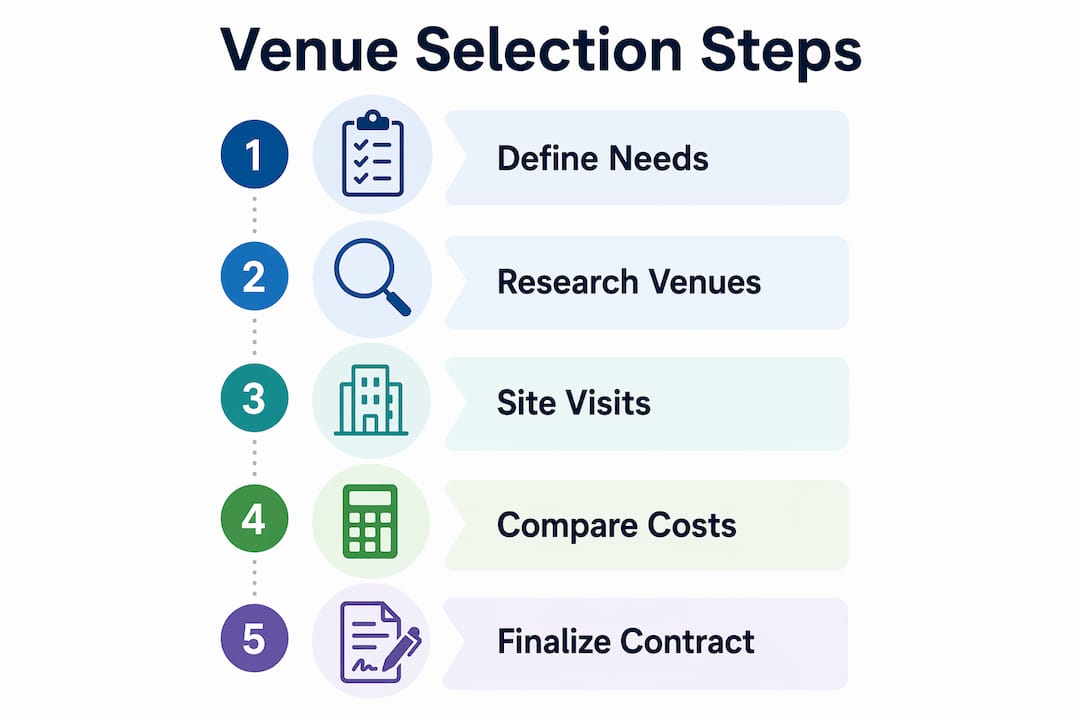
Effective venue research uses multiple channels simultaneously. Online venue directories, event industry associations, and personal recommendations from trusted suppliers each surface different options. Cross-referencing these sources gives you a broader shortlist than any single channel provides.

Prioritise venues that meet your prerequisites on paper before investing time in visits. Check capacity, location, accessibility, and general layout from the venue’s website or brochure. If a venue cannot confirm it meets your minimum criteria in writing, remove it from consideration.
Build a shortlist of three to five venues that genuinely match your core requirements. A longer list wastes time. A shorter list risks leaving you with no viable alternative if your first choice is unavailable or overpriced.
- Search online venue directories and industry association listings for your event type and location
- Ask trusted suppliers, such as caterers and AV technicians, for venue recommendations based on operational experience
- Check availability for your preferred dates before investing further time in any venue
- Request a detailed proposal or quote from each shortlisted venue, including all mandatory fees
- Compare proposals against your prerequisites to eliminate venues that do not meet your criteria on paper
When reviewing catering options, festive meal offerings for event planners vary significantly between venues, and understanding what is included versus charged separately affects your total cost comparison. Request menu flexibility details and outside vendor policies in writing at this stage, not during the site visit.
What should you evaluate during venue tours and site visits?
A site visit is a structured inspection, not a sales experience. Arrive with a written checklist and take photographs of every area relevant to your event. Notes taken on the day are far more reliable than memory when you are comparing three venues a week later.
Assess the flow of the space for your specific event format. Walk the route your guests will take from arrival to their seats. Identify where bottlenecks could form, whether breakout areas are genuinely separate from the main room, and whether the staging position gives clear sightlines from every seat.
Verify that audiovisual, lighting, and technical support are available on-site. Ask whether the venue has dedicated AV staff or whether you must hire an external supplier. Inadequate technical infrastructure is one of the most common causes of event delays and guest dissatisfaction.
- Confirm parking capacity and calculate whether it meets the standard of one space per three to four attendees
- Inspect catering facilities and clarify whether outside vendors are permitted
- Ask about setup and teardown windows and whether these are included in the hire fee
- Request the venue’s cancellation policy, insurance requirements, and health and safety compliance documentation
- Check mobile signal strength and Wi-Fi capacity throughout the space, particularly if your event involves live streaming or digital registration
Pro Tip: Visit the venue at the same time of day as your event. Lighting, noise levels, and car park availability change significantly between morning and evening.
The venue selection process involves far more than aesthetics. Operational details confirmed during a site visit prevent the majority of day-of problems.
How do you compare costs and negotiate the venue contract?
Cost comparison is where most event planners lose money. Venues quote base rental fees that look reasonable until mandatory add-ons appear in the contract. Request a fully itemised, all-in cost estimate for your exact guest count before scheduling any site visit. This single habit eliminates venues that cannot deliver within your budget before you invest time in touring them.
Negotiating venue terms requires understanding common hidden fees and being prepared to request flexibility. Catering minimums, overtime charges, and mandatory service fees are the most frequent sources of budget overrun. Ask each venue to confirm these in writing, and compare the totals rather than the headline figures.
Use a structured comparison to evaluate your shortlisted venues objectively. The table below illustrates the categories to assess.
| Category | What to compare |
|---|---|
| Base hire fee | Full-day vs. half-day rate, setup and teardown included or charged separately |
| Catering | Minimum spend, per-head cost, outside vendor policy |
| Audiovisual | Included equipment, additional hire costs, dedicated technician |
| Parking | On-site capacity, valet or shuttle options, overflow costs |
| Cancellation terms | Deposit amount, refund policy, force majeure clause |
Negotiate on the areas where venues have the most flexibility: food and beverage minimums, complimentary extras such as a tasting session or additional hour of hire, and payment schedule timing. Avoid negotiating on safety or insurance requirements. The event cost optimisation guide from Winelandsfunction covers AV, service fees, and catering charges in detail for planners managing complex budgets.
Make your final decision on total value, not emotional appeal. A venue that costs 15% more but includes AV, parking, and a dedicated coordinator may represent better value than a cheaper space requiring all of those elements to be sourced and managed separately.
What are the most common venue selection pitfalls?
The pitfalls in venue selection are predictable, which means they are avoidable. The most expensive mistakes share a common cause: skipping the preparation steps and making decisions based on how a space looks rather than how it functions.
- Touring before defining requirements. Visiting venues without a confirmed budget and guest count creates emotional attachment to spaces that do not fit your actual needs.
- Accepting headline pricing. A base rental fee without a full cost breakdown is not a real quote. Venues that resist providing itemised costs before a visit are a warning sign.
- Ignoring accessibility. A venue that is difficult to reach by public transport or lacks step-free access will reduce attendance and create a poor experience for guests with mobility needs.
- Booking too late. Leaving venue search until six months before a peak-season event severely limits your options and increases costs.
- Underestimating hidden costs. Service charges, overtime fees, and mandatory catering minimums regularly add 20–40% to the base rental figure.
Pro Tip: Use a standardised venue checklist for every site visit and score each venue against the same criteria. Objective scoring prevents the most visually impressive venue from winning by default.
The venue selection 2025 guide from Winelandsfunction provides a practical framework for planners who want to apply these principles to specific event types, from intimate celebrations to large corporate launches.
Key takeaways
Effective venue selection requires defining your requirements before you tour a single space, comparing all-in costs rather than base fees, and making decisions on function rather than aesthetics.
| Point | Details |
|---|---|
| Define prerequisites first | Confirm event type, guest count, budget, and non-negotiables before contacting any venue. |
| Request itemised costs upfront | Ask for a full cost breakdown including catering minimums and service charges before any site visit. |
| Shortlist three to five venues | A focused shortlist saves time and enables objective comparison across consistent criteria. |
| Evaluate on-site logistics | Assess parking, AV, flow, and accessibility during a structured visit with a written checklist. |
| Negotiate on total value | Compare all-in costs and negotiate on catering, extras, and payment terms, not just base rental. |
What I have learned from watching clients choose venues
The clients who struggle most with venue selection are not the ones with the smallest budgets. They are the ones who start with a vision of the space before they have defined what the space needs to do. I have seen couples book a stunning wine estate that could not accommodate their caterer of choice, and corporate teams commit to a city-centre hotel that had no dedicated parking for a 200-person conference.
The structured approach works because it forces you to separate what you want from what you need. Once your non-negotiables are written down, every venue either meets them or it does not. That clarity removes the paralysis that comes from comparing venues on gut feeling alone.
Starting early is the single most practical piece of advice I can offer. The best venues for popular dates in the Cape Winelands fill up well over a year in advance. Planners who begin their search with a clear brief and a realistic budget consistently secure better venues at better prices than those who begin with inspiration boards and no confirmed guest count.
Audience-focused decisions also matter more than most planners expect. A venue that is convenient for you to visit during planning is not necessarily convenient for your guests on the day. Consider where the majority of your attendees are travelling from, and weight that factor heavily in your final comparison.
— Coert
How Winelandsfunction supports your venue selection process
Winelandsfunction brings years of luxury event planning experience to every stage of the venue selection and coordination process, from defining your brief to managing contracts and logistics on the day.
The team at Winelandsfunction works with clients planning weddings, corporate events, and bespoke celebrations across the Cape Winelands and beyond. Their elegant event planning service guides you through every step, including venue research, site visits, cost comparison, and contract negotiation, so no detail is left to chance. For clients who want expert coordination from concept to execution, the luxury event management service provides full-service support tailored to your event’s scale and style. Contact Winelandsfunction to discuss your requirements with a specialist who understands both the local venue market and the standards your guests expect.
FAQ
What does step by step venue selection involve?
Step by step venue selection is a structured process that begins with defining your event requirements, budget, and guest count, then moves through research, site visits, cost comparison, and contract negotiation before a final decision is made.
How early should you start searching for a venue?
Popular venues book 12–18 months in advance for peak dates. Starting your search at least 12 months before your event gives you the widest choice and the strongest negotiating position.
What hidden costs should you watch for in venue contracts?
The most common hidden costs are catering minimums, mandatory service charges, overtime fees, and audiovisual hire. Always request a fully itemised, all-in quote before committing to a site visit.
How many venues should you shortlist?
A shortlist of three to five venues is the standard best practice. Fewer options limit your negotiating position; more options make objective comparison difficult and waste time.
Why does audience-centric venue selection matter?
Choosing a venue based on your attendees’ demographics, travel habits, and accessibility needs directly reduces no-shows and improves the overall guest experience on the day.
Recommended
- Expert Wedding Venue Selection Guide for Unforgettable Events – Winelands Function – For Every Occasion, Your Celebration
- Venue Selection 2025: Elevate Events with Smart Choices – Winelands Function – For Every Occasion, Your Celebration
- How to choose event vendors: a practical guide – Winelands Function – For Every Occasion, Your Celebration
- Wedding Planning Step by Step: Your Complete Guide – Winelands Function – For Every Occasion, Your Celebration