

TL;DR:
- Personalising client experiences involves tailoring interactions and services to each client’s preferences and goals to build trust and loyalty. Event planners should collect structured, voluntary data through progressive profiling and use a CRM to ensure consistency across touchpoints. Treating personalisation as a systematic operating process improves retention, referrals, and overall client satisfaction.
Personalising client experiences is defined as tailoring every planning interaction, communication, and service decision to each client’s unique preferences, goals, and behaviours. 83% of consumers willingly share personal data when it leads to genuinely tailored experiences. That figure signals a clear opportunity for event planners and business owners: clients want to be known, not just served. The industry term for this practice is client experience design, and when applied with intention, it builds the trust, loyalty, and referrals that sustain premium event businesses.
How to personalise client experiences: the data and tools you need
Effective personalisation starts with the right information. Without structured client data, even the most attentive planner defaults to guesswork. The most reliable data type is zero-party data: information clients share voluntarily, such as event goals, aesthetic preferences, dietary requirements, and communication styles.

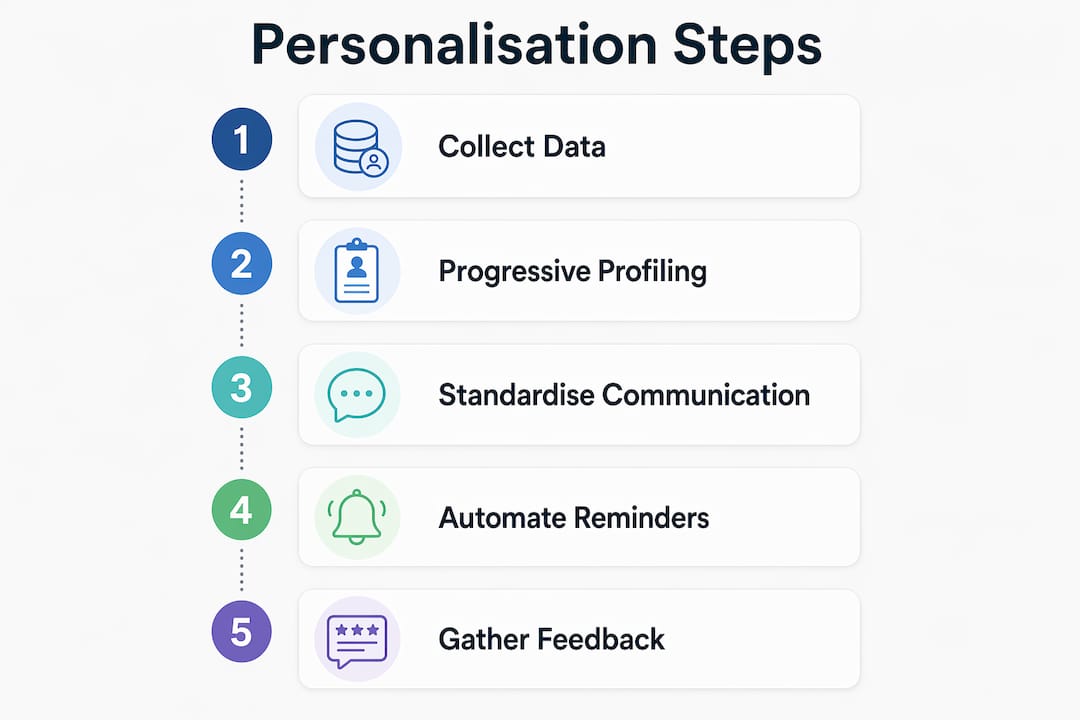
Progressive profiling is the most practical method for collecting this data without overwhelming clients. Instead of sending a 40-question intake form on day one, you ask one relevant question per touchpoint. Over several interactions, you build a detailed, accurate client profile without creating friction at the start of the relationship.
A centralised CRM system is the tool that makes this data useful. CRM systems build client personas from demographic and behavioural data, tracking every interaction in one place. That context means your team never asks a client to repeat themselves, and every communication feels informed rather than generic.
Key data types to collect at each stage:
- Onboarding: Event type, budget range, vision, and non-negotiables
- Planning phase: Vendor preferences, communication frequency, decision-making style
- Pre-event: Guest profile, logistical concerns, personal touches requested
- Post-event: Satisfaction feedback, referral likelihood, future event interest
Standardising communication channels reduces client friction, which is one of the leading causes of dissatisfaction. Decide early whether you communicate via email, a client portal, or scheduled calls, and document that agreement. Clients who know exactly how and when to reach you feel more secure throughout the process.
Pro Tip: Create a one-page “client communication agreement” at onboarding. It sets expectations on response times, preferred channels, and meeting cadence. Clients who receive this document report feeling more confident from day one.
| Data type | Collection method | Planning benefit |
|---|---|---|
| Event goals | Intake questionnaire | Aligns all decisions to client outcomes |
| Communication preference | Onboarding call | Reduces misunderstandings and missed messages |
| Aesthetic preferences | Progressive profiling | Informs vendor and design choices |
| Post-event feedback | Survey within 48 hours | Identifies gaps and strengthens future service |
What does a personalised client journey look like in practice?
A personalised client journey is a documented sequence of touchpoints, each designed to reflect what you know about that specific client. Without documentation, personalisation becomes inconsistent. With it, every team member delivers the same quality of attentiveness regardless of who handles a given interaction.
Follow this process to build your personalised client journey:
-
Map your existing touchpoints. List every moment of client contact from first enquiry to post-event follow-up. Journey mapping reveals the drop-off zones where clients disengage or feel uncertain.
-
Assign a personalisation action to each touchpoint. For example, the first follow-up email after a consultation should reference a specific detail the client mentioned, not a generic template. This signals that you listened.
-
Build anticipatory service into your workflow. Anticipatory service uses client history and event stage to offer solutions before clients realise they need them. If a client mentioned anxiety about catering logistics in a previous event, address that proactively in your planning timeline.
-
Communicate proactively at every stage. Send a brief update before clients ask for one. This single habit removes the most common source of client anxiety: not knowing what is happening.
-
Personalise the post-event experience. A handwritten note, a curated photo selection, or a follow-up call referencing specific event highlights turns a satisfied client into an active advocate.
“Client experience is an intentional design, not a by-product of goodwill or responsiveness. The planners who build loyal client bases treat every touchpoint as a deliberate choice, not a reaction.”
Pro Tip: Use your CRM to set automated reminders tied to client milestones. If a wedding anniversary is approaching, a brief personal message costs you nothing and reinforces the relationship long after the event.
Luxury planners treat the client journey as a structured system with standardised onboarding and communication frameworks. That structure does not reduce warmth. It protects it by removing the chaos that makes personalisation inconsistent.
What are the most common personalisation mistakes event planners make?
The most damaging personalisation mistake is surface-level personalisation: using a client’s first name in an email while sending content that has nothing to do with their event type or preferences. Clients notice the gap between the gesture and the substance.
Client perception of reliability is shaped more by communication clarity and organisational signals than by the quality of the event itself. A beautifully executed event preceded by disorganised communication still leaves clients with doubt. The inverse is also true: clear, consistent communication builds confidence even when minor issues arise.
Common pitfalls to avoid:
- Relying on memory instead of systems. Memory fails under pressure. If a client’s preference is not recorded in your CRM, it does not exist when you need it most.
- Inconsistent communication. Switching between WhatsApp, email, and phone calls without a clear protocol creates confusion and erodes trust.
- Generic milestone messages. Sending the same “one month to go” email to every client regardless of their event type or emotional state misses the point of personalisation entirely.
- Overloading clients with information. Sending every detail at once overwhelms rather than reassures. Drip information in line with the client’s planning stage.
- Failing to close the loop. If a client raises a concern, confirm in writing that it has been resolved. Verbal reassurance alone is not enough.
The role of customer service in hospitality reinforces this point: clients in premium service environments judge the entire experience by its weakest moment. One unclear email or missed follow-up can undo weeks of excellent service.
Strong client experiences are a direct marketing asset. Consistent, clear communication drives retention and referrals far more reliably than over-delivering on event day alone.
How do you measure and improve personalised client experiences?
Measurement turns personalisation from a feeling into a system. Without tracking, you cannot know which touchpoints are working and which are causing clients to disengage.
Metrics worth tracking:
- Client satisfaction score: Collected via a post-event survey with a simple 1–10 rating and one open question
- Referral rate: The percentage of new clients who came through an existing client recommendation
- Retention rate: How many past clients return for a second event or recommend you within 12 months
- Response-to-booking conversion: How many initial enquiries convert to signed contracts, which reflects the quality of your early personalisation
Feedback surveys work best when they combine a quantitative rating with one qualitative question such as “What was the most memorable part of working with us?” That open question surfaces insights no rating scale can capture.
Guest experience personalisation in hospitality shows that clients who feel genuinely understood are significantly more likely to refer others. Referrals from satisfied clients carry more weight than any marketing channel because they arrive with built-in trust.
Use your CRM data to identify patterns. If multiple clients disengage after the second planning meeting, that meeting is a drop-off zone. Redesign that touchpoint with a more personalised agenda, a clearer next-steps document, or a check-in call the following day.
| Metric | Measurement method | Improvement action |
|---|---|---|
| Client satisfaction | Post-event survey (1–10 scale) | Address recurring themes in service delivery |
| Referral rate | Track source at enquiry stage | Strengthen post-event follow-up process |
| Conversion rate | Enquiry to contract ratio | Improve early personalisation and response speed |
| Drop-off zones | CRM journey analytics | Redesign the touchpoint causing disengagement |
Pro Tip: Send your post-event survey within 48 hours of the event. Client recall is sharpest then, and the emotional high of a successful event increases the likelihood of a detailed, positive response.
Key takeaways
Personalising client experiences is the most reliable growth strategy available to event planners, built on data, documented systems, and consistent communication.
| Point | Details |
|---|---|
| Start with zero-party data | Collect client preferences voluntarily through progressive profiling at each touchpoint. |
| Use a CRM as your foundation | Centralise all client data so every interaction is informed and consistent. |
| Map and design the client journey | Document every touchpoint and assign a specific personalisation action to each one. |
| Avoid surface-level personalisation | Name use alone is not personalisation; align every message to the client’s actual context. |
| Measure referral and retention rates | Track these two metrics to know whether your personalisation strategy is working. |
Why personalisation is an operating system, not a gesture
I have worked with event planners who genuinely care about their clients and still lose them to competitors. The reason is almost always the same: care without structure does not scale. When you rely on goodwill and memory to personalise service, you deliver brilliantly for two clients and inconsistently for ten.
The shift that changes everything is treating personalisation in event planning as an operating system. That means documented workflows, CRM records updated after every call, and communication protocols that every team member follows. It sounds clinical, but the result is the opposite: clients feel more seen, not less, because nothing falls through the cracks.
The planners I have seen build genuinely loyal client bases share one habit. They anticipate. They do not wait for a client to ask about catering logistics or venue access times. They send a brief, personalised update before the question forms. That single behaviour, repeated consistently, creates a reputation that no marketing budget can buy.
Delivering client experience with clarity and consistency builds a premium reputation that fuels referrals. The clients who refer you are not the ones who received the most elaborate event. They are the ones who felt the most confident throughout the process.
— Coert
Winelandsfunction’s approach to tailored event planning
Winelandsfunction specialises in luxury event management across weddings, corporate events, and bespoke celebrations in Cape Town. Every client engagement begins with a structured onboarding process designed to capture preferences, goals, and communication styles from the first conversation.
The team at Winelandsfunction builds personalised client journeys that reflect each client’s vision, from intimate gatherings to large-scale corporate launches. If you are ready to move from reactive service to intentional client experience design, explore how Winelandsfunction’s bespoke event planning process can support your next event from concept through to execution.
FAQ
What does it mean to personalise a client experience?
Personalising a client experience means tailoring every interaction, communication, and service decision to that client’s specific preferences, goals, and behaviours. It goes beyond using a client’s name and requires structured data collection and consistent delivery.
What is zero-party data and why does it matter for event planners?
Zero-party data is information clients share voluntarily, such as event goals and aesthetic preferences. It is the most reliable foundation for personalisation because it reflects what clients actually want, not what you assume they want.
How does progressive profiling work in event planning?
Progressive profiling collects one relevant piece of client information per touchpoint rather than overwhelming clients with a lengthy intake form. Over time, this builds a detailed client profile that informs every planning decision.
Which metrics show whether personalisation is working?
Referral rate and client retention rate are the two clearest indicators. When clients feel genuinely understood, they return and recommend you to others, which reflects the quality of your personalised service.
How often should event planners update client records in a CRM?
Update client records after every significant interaction, including calls, meetings, and email exchanges. Current records are what make anticipatory service possible and prevent the inconsistency that erodes client trust.
Recommended
- How to customise event experiences: your 2026 guide – Winelands Function – For Every Occasion, Your Celebration
- Why personalised events matter: the 2026 planner’s guide – Winelands Function – For Every Occasion, Your Celebration
- Why personalised events drive real guest impact – Winelands Function – For Every Occasion, Your Celebration
- Personalization in event planning: your 2026 guide – Winelands Function – For Every Occasion, Your Celebration