
TL;DR:
- Cultural wedding elements carry deep social and spiritual meanings that should be understood before they are included in a ceremony.
- Integrating multiple traditions requires framing rituals around universal themes and emphasizing clear storytelling to create emotional coherence.
Cultural wedding elements are the heritage rituals, symbols, and customs that define how couples publicly commit to each other, reflecting identity and family unity. Understanding cultural wedding elements means going beyond décor choices. It means recognising that a tea cup, a betel leaf, or a praise singer carries centuries of meaning. Couples planning multicultural or culturally rich weddings face a genuine creative challenge: how do you honour two or more traditions without the ceremony feeling like a series of disconnected performances? This guide gives you the practical knowledge to choose, sequence, and present cultural traditions with clarity and intention.
What are common cultural wedding elements and their meanings?
Cultural wedding elements are the rituals, objects, attire, and customs that a community uses to mark the transition into marriage. They are not interchangeable with general wedding décor. Each element carries a specific social or spiritual function, and using one without understanding its purpose reduces it to costume.
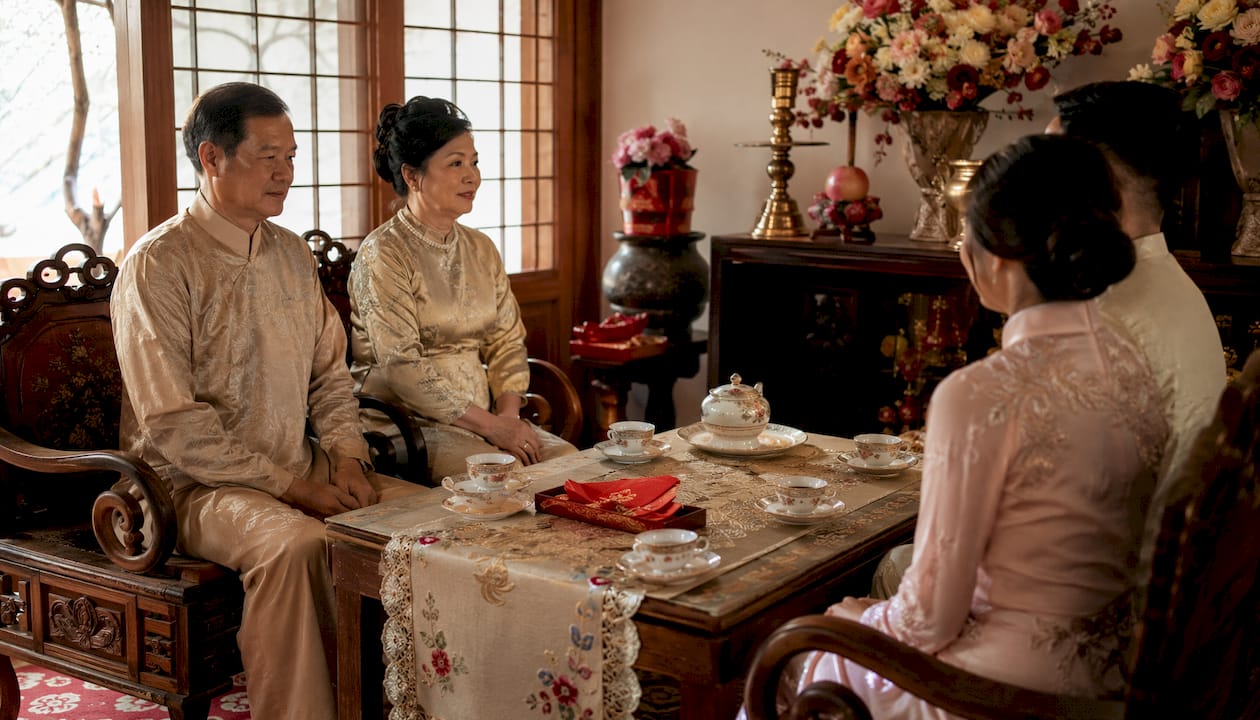
The Chinese tea ceremony, known as Jing Cha, is one of the most widely recognised examples. The couple serves tea to elders in order of seniority, and each elder responds with blessings and gifts. The ritual communicates filial respect in a way that no speech can replicate.
Nigerian Yoruba weddings centre on the Alaga, a praise singer who also acts as master of ceremonies. The Alaga guides the proceedings through traditional rites, ensuring that each step is performed correctly and in the right order. Without the Alaga, the ceremony loses both its structure and its cultural authority.
Vietnamese traditional weddings feature multi-stage ceremonies built around family connection. Gift processions carry symbolic items such as betel leaves and areca nuts, which represent prosperity and family unity. These are not decorative choices. They are a formal language between two families.
South Asian weddings bring Mehndi and Haldi rituals into the pre-wedding programme. Mehndi, the application of henna, symbolises protection and joy, while Haldi involves turmeric paste applied to purify and bless the couple. Both rituals also serve a social function, gathering the women of both families before the wedding day itself.
| Cultural tradition | Key element | Core meaning |
|---|---|---|
| Chinese Jing Cha | Tea ceremony | Filial respect and elder blessings |
| Nigerian Yoruba | Alaga (praise singer) | Cultural authority and correct rites |
| Vietnamese | Betel leaf gift procession | Prosperity and family unity |
| South Asian | Mehndi and Haldi | Protection, purification, and joy |
| Western | Exchange of rings | Commitment and continuity |
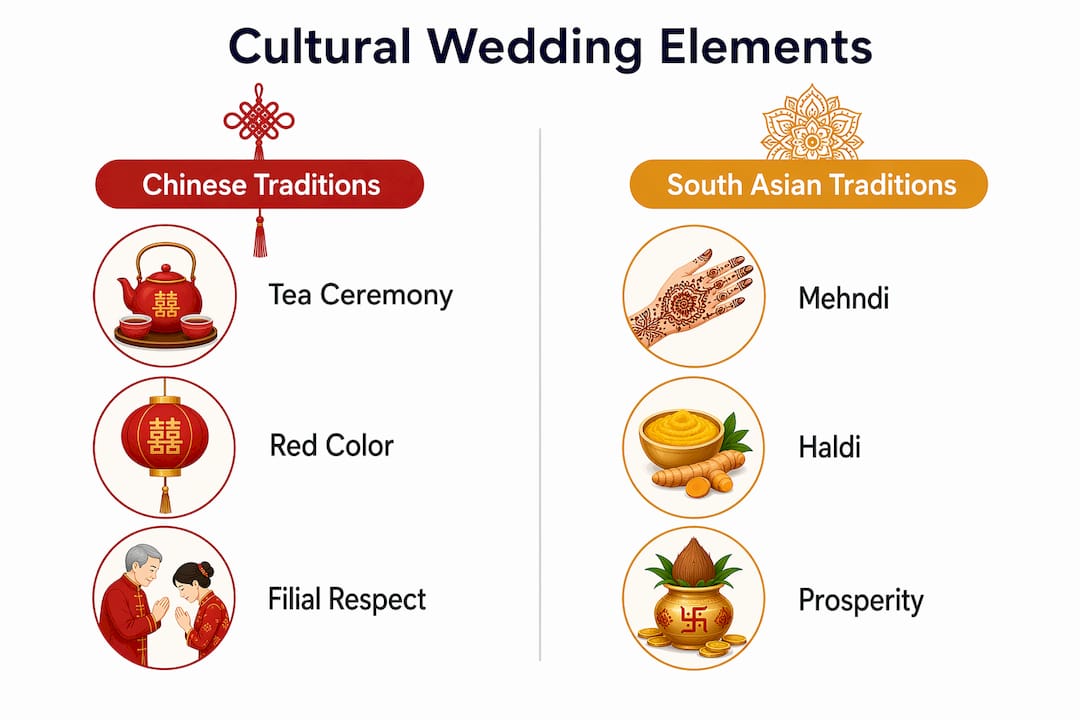
Colour carries meaning too. Red in Chinese and South Asian traditions signals luck and prosperity. White in many Western ceremonies signals purity. Wearing the wrong colour at the wrong moment is not a minor faux pas. It communicates the opposite of what you intend.
Pro Tip: Before including any cultural element, ask a family elder or cultural adviser to explain its original purpose. That conversation will shape how you present it to guests and how authentically it lands.
The symbolic purpose of cultural elements must be explained to guests. When guests understand what they are witnessing, they connect emotionally. When they do not, the ritual becomes spectacle.
How do you thoughtfully integrate diverse cultural traditions?
Integrating diverse wedding customs works best when you treat the ceremony as a single story rather than a playlist of rituals. Framing traditions around universal themes such as welcome, commitment, and family unity gives each element a clear role in a larger narrative. Guests follow the emotional logic even when they are unfamiliar with the specific practice.
The first practical step is distinguishing which rituals are obligatory and which are optional. Mandatory versus optional cultural practices differ by family expectation, religious requirement, and community standing. Knowing this distinction stops you from treating a sacred rite as a styling choice, and it gives you permission to adapt the optional elements without guilt.
Here are four strategies that work consistently for multicultural couples:
- Sequence by emotional arc. Open with a welcoming ritual, move through commitment rituals, and close with a celebration or blessing. This mirrors the natural shape of a ceremony regardless of culture.
- Use bilingual elements deliberately. Including vows or greetings in a partner’s mother tongue creates immediate emotional resonance for that family. Even a single sentence in a second language signals respect.
- Brief your celebrant or officiant fully. They need to understand the meaning of each ritual, not just the mechanics. A celebrant who can explain the Jing Cha to a Western audience in two sentences is worth their fee.
- Provide a printed or projected order of ceremony. Short explanations of each ritual, written in plain language, let guests follow along without feeling excluded.
Pro Tip: Rehearsing the practical mechanics of rituals matters as much as rehearsing vows. Timing, positioning, and movement all affect whether a ritual feels authentic or awkward. Run through each one at least once with all participants present.
The wedding themes framework is a useful tool here. A clear theme gives every cultural element a home within the ceremony’s visual and emotional world.
What challenges come with planning a multicultural wedding?
Multicultural weddings carry specific planning pressures that a single-culture ceremony does not. The most common source of tension is family expectation. Each family arrives with a clear idea of what a “proper” wedding looks like, and those ideas rarely match.
Traditional ceremonies are often considered the real marriage in many cultures, independent of any legal or church acknowledgement. This affects planning priorities significantly. For Nigerian families, the traditional engagement rites and family recognition carry more social weight than the civil ceremony. Couples who do not understand this dynamic risk unintentionally signalling disrespect.
The following numbered steps help couples navigate the most common multicultural planning challenges:
- Hold separate conversations with each family early. Ask which rituals are non-negotiable and why. Write down the answers. This prevents misunderstandings from compounding later.
- Agree on ceremony length before booking a venue. Multiple rituals add time. A ceremony that runs past 90 minutes without a clear structure will lose guests emotionally, regardless of how meaningful the content is.
- Clarify attire requirements for each ritual. Some traditions require specific colours or garments at specific moments. Venue logistics, changing facilities, and timing all need to account for this.
- Address conflicting symbolism directly. If one tradition uses white for mourning and another for celebration, decide together how to handle it. Ignoring the conflict does not make it disappear.
- Appoint a cultural liaison for each family. This person fields questions from their side and communicates decisions back. It reduces the pressure on the couple and keeps communication respectful.
Vietnamese and Nigerian weddings historically spanned two to three days. Many couples now adapt these into a single weekend while preserving the core rituals. That compression requires careful scheduling and clear communication with all participants.
What do elegant multicultural weddings look like in practice?
The most successful multicultural weddings share one quality: every element feels chosen, not collected. The couple has made deliberate decisions about what to include, what to adapt, and what to leave out. The result is a ceremony that feels personal rather than encyclopaedic.
A couple blending Vietnamese and South African traditions might open with a condensed gift procession, presenting symbolic items to the bride’s family before the ceremony begins. The main ceremony then follows a Western structure, with vows exchanged in both English and Vietnamese. A Haldi gathering the evening before replaces a traditional hen party. Each element has a clear place in the weekend’s programme.
Modern adaptations of traditional ceremonies work when the core meaning is preserved. A condensed Vietnamese ceremony that takes 20 minutes rather than two days still communicates family connection and ancestral respect if the symbolic items are present and the words are spoken correctly. The length is not the point. The intention is.
Music is one of the most powerful and underused tools for cultural integration. Live drumming during a Nigerian procession, a Chinese erhu piece during the tea ceremony, or a Carnatic vocal during a South Asian blessing each signal to guests that this moment is different. Music marks transitions without requiring explanation.
Vows and readings offer another opportunity. A couple might write vows that reference both families’ proverbs, or choose a reading from a poet whose work belongs to one partner’s heritage. These inclusions are subtle, but they personalise ceremonies in ways that guests remember long after the day.
Pro Tip: Wedding rings are themselves a cultural element with deep symbolic history. If you are incorporating multiple traditions, consider how your choice of ring design reflects that. Custom wedding ring sets can incorporate motifs from both partners’ heritages, making the exchange itself a moment of cultural unity.
Key takeaways
Cultural wedding elements carry specific social and spiritual meanings that require understanding before inclusion, not after.
| Point | Details |
|---|---|
| Define before you decorate | Every cultural element has a function; understand its meaning before placing it in your ceremony. |
| Distinguish mandatory from optional | Identify which rituals are obligatory for family or religious reasons before adapting anything. |
| Frame traditions as a story | Organise rituals around themes like welcome and commitment to create emotional coherence for guests. |
| Rehearse the mechanics | Timing, positioning, and movement determine whether a ritual feels authentic or staged. |
| Use language deliberately | Even a single line in a partner’s mother tongue creates significant emotional resonance for their family. |
What I have learned from watching couples get this right and wrong
The couples who get multicultural weddings right are not the ones with the longest list of traditions. They are the ones who made hard choices. They decided what mattered most and built the ceremony around that, rather than trying to include everything out of obligation or guilt.
The most common mistake I see is treating cultural rituals as a sequence of separate performances. The tea ceremony happens, then the Alaga speaks, then the vows are exchanged, and the ceremony never quite coheres. Guests applaud politely but do not feel moved. The problem is not the traditions themselves. It is the absence of a connecting thread.
Storytelling fixes this. When a celebrant opens by saying “today you will witness three families becoming one, through rituals that have marked this moment for generations,” every subsequent element lands differently. Guests are primed to look for meaning. They find it.
I also think couples underestimate the power of explanation. Guests who understand what they are watching participate emotionally. A brief printed note explaining that the betel leaf represents the couple’s promise to remain together through hardship transforms a gift exchange into something guests carry home with them. That is the difference between a ceremony and an experience.
Respect is the non-negotiable foundation. Cultural traditions belong to communities. Borrowing from a tradition you are not part of requires care, consultation, and humility. The ceremony planning process should always include voices from within the cultures being represented, not just the couple’s own interpretation.
— Coert
Planning a multicultural wedding in Cape Town and the Winelands
Multicultural weddings require coordination that goes well beyond booking a venue and a caterer. Each cultural element brings its own timing, its own participants, and its own logistical requirements. Getting all of that to flow within a single day or weekend takes experience.
Winelandsfunction specialises in luxury wedding planning for couples who want their cultural traditions presented with care and precision. The team coordinates every element of the ceremony programme, from the sequencing of rituals to the briefing of officiants and cultural advisers. For couples planning celebrations in Cape Town and the Winelands, Winelandsfunction offers bespoke event coordination that treats every tradition as the meaningful act it is. Reach out to begin planning a ceremony that honours your heritage and moves your guests.
FAQ
What are cultural wedding elements?
Cultural wedding elements are the rituals, symbols, attire, and customs that a community uses to mark the transition into marriage. They express family identity, spiritual values, and social bonds specific to a culture or heritage.
How do you blend two cultural traditions in one ceremony?
Frame both traditions around shared themes such as commitment and family unity, then sequence rituals to create a single emotional arc. Distinguish which practices are obligatory and which can be adapted to fit the shared programme.
Why does explaining rituals to guests matter?
Explaining the symbolic purpose of each element to guests fosters genuine connection and prevents cultural traditions from becoming mere decoration. Even a short printed explanation transforms a ritual into a shared experience.
Are traditional ceremonies legally recognised?
Legal recognition varies by country and culture. In many communities, the traditional ceremony is considered the real marriage regardless of legal status, which affects how couples and families prioritise planning.
How long should a multicultural ceremony run?
A multicultural ceremony with two to three cultural elements typically runs between 60 and 90 minutes. Beyond that, guests lose focus. Prioritise the rituals with the greatest family significance and adapt or remove the rest.
Recommended
- Ceremony Tips for a Seamless Wedding Day – Winelands Function – For Every Occasion, Your Celebration
- Why Wedding Themes Matter: Complete Event Guide – Winelands Function – For Every Occasion, Your Celebration
- Wedding Design Workflow: Complete Guide – Winelands Function – For Every Occasion, Your Celebration
- Custom weddings: a guide to bespoke luxury in South Africa – Winelands Function – For Every Occasion, Your Celebration