

Planning an exquisite celebration in Cape Town’s sought-after Winelands presents a unique blend of excitement and complexity. For couples and corporate hosts who value time and sophistication, managing every detail of a luxury event goes well beyond booking a venue or selecting flowers. Understanding the true value behind professional event coordination means recognising the intricacies only a seasoned wedding planner brings—artful design, expert logistics, and exclusive vendor relationships. This guide clarifies the real essence of high-end wedding planner services and the factors that shape their investment, helping you prioritise peace of mind and memorable perfection.
Table of Contents
- Defining Wedding Planner Charges And Services
- Types Of Wedding Planning Packages Available
- Key Factors Impacting Cost For Luxury Events
- How Pricing And Payment Models Work
- Maximising Value From Your Planner Investment
Key Takeaways
| Point | Details |
|---|---|
| Understanding Services | Couples should recognise the differences between full-service, partial planning, and day-of coordination to choose the right package for their needs. |
| Cost Variability | Wedding planner charges can vary significantly based on experience, location, and the complexities of the event being planned. |
| Fee Structures | Familiarise yourself with different pricing models such as flat fees, percentage-based fees, and hourly rates to avoid budget surprises. |
| Prioritise Communication | Clear communication and alignment of priorities with your planner are key to maximising the value of the services you receive. |
Defining Wedding Planner Charges and Services
A wedding planner is a professional who designs, plans, and manages your wedding from conception through execution. Unlike a coordinator who typically focuses on day-of logistics, a planner handles the entire journey—from vision to celebration. This distinction matters when understanding what you’ll actually be paying for.
Wedding planners address a fundamental challenge: crafting an elegant, bespoke celebration whilst managing hundreds of moving parts. Your time is valuable, and the coordination required for a luxury event in Cape Town’s Winelands region demands expertise most couples simply don’t have bandwidth to develop.
What Services Are Included
The scope of wedding planner services varies significantly depending on your package structure. Most planners offer three primary service models:
- Full-service planning: Complete management from initial consultation through final walk-through
- Partial planning: Specific areas like vendor coordination, design consultation, or budget management
- Day-of coordination: Execution and logistics management on your wedding day
These professionals handle responsibilities that extend far beyond scheduling. Event planners coordinate vendors, negotiate contracts, manage budgets, arrange venue logistics, and provide artistic direction for your celebration. For high-net-worth individuals, this often includes emotional support and strategic decision-making guidance.
The Value Beyond the Invoice
Understanding wedding planner charges requires recognising what you’re actually purchasing. You’re not simply buying hours; you’re acquiring institutional knowledge, vendor relationships, and risk mitigation.
A professional planner brings established relationships with Cape Town’s premium venues, caterers, florists, and entertainment providers. These connections translate into better pricing, priority availability, and access to curated options unavailable to the general public. Your planner acts as your trusted advisor, filtering possibilities and presenting only options aligned with your vision and budget.
A skilled wedding planner transforms logistical complexity into a seamless experience, allowing you to focus on what matters most: your celebration.
Why Charges Vary Considerably
Wedding planner costs aren’t standardised because services aren’t standardised. Two planners quoting different prices likely offer substantially different scope, experience levels, and service depth.
A planner managing intimate 50-person garden celebrations operates differently than one orchestrating 300-guest black-tie affairs. Geographic location influences costs—luxury planning in the Winelands differs from urban planning. Your planner’s experience with similar events, their vendor network depth, and their team size all affect pricing.
Individual planners operating solo typically charge less than boutique firms with dedicated coordinators, designers, and administrative support. This doesn’t indicate quality difference; it reflects operational structure and what gets included in the service.
Transparency in What You’re Paying For
Reputable planners clearly articulate what their fees cover. Some charge percentage-based fees (typically 10–20% of total wedding budget), whilst others use flat rates or hourly fees. Understanding which model applies to you prevents surprises later.
Certain services might incur separate charges: rush fees for abbreviated timelines, destination wedding premiums, or additional support during complex vendor coordination. Professional planners disclose these upfront rather than burying them in contracts.
Pro tip: Request a detailed service breakdown before committing—specify which tasks the planner handles directly versus delegates, and clarify whether vendor communication, site visits, and design consultation all fall within quoted fees.
Types of Wedding Planning Packages Available
Wedding planning packages aren’t one-size-fits-all. The market offers distinct options tailored to different budgets, timelines, and levels of involvement. Understanding what each package typically includes helps you match your needs with the right service model.
Package structures vary because couples have vastly different requirements. Some want complete hand-holding from engagement to honeymoon; others simply need someone to coordinate vendors on their wedding day. Your choice directly influences what you’ll pay.
The Package Models
Most luxury wedding planners in the Cape Town region offer variations of these core packages:
- Full planning and design: End-to-end management including creative vision, vendor selection, budget oversight, and day-of coordination
- Design and coordination: Focus on aesthetic direction and logistics without initial consultation phases
- Coordination only: Management of confirmed plans and execution on your wedding day
- Partial planning: Targeted support for specific areas like vendor sourcing or budget management
- A la carte services: Individual tasks booked separately based on your needs
Each model serves a distinct purpose. A couple planning a destination celebration in the Winelands might select full planning, whilst those with established vendors prefer day-of coordination.
Below is a summary table comparing wedding planning service models and their typical suitability:
| Service Model | Best For | Timeline Required | Typical Investment Level |
|---|---|---|---|
| Full Planning | Couples abroad or time-poor | 9–18 months | Highest |
| Partial Planning | DIY-focused but need support | 3–12 months | Moderate |
| Day-of Coordination | Confident, hands-on couples | <3 months pre-wedding | Entry level |
| A La Carte Services | Flexible, specific needs | As required | Variable, pay-per-task |
What Gets Included
Professional wedding packages typically include planning assistance and vendor coordination, though specifics vary considerably. Full-service packages generally cover initial consultations, venue sourcing, vendor interviews, contract review, budget management, design development, and timeline creation.
Coordination packages focus purely on execution: vendor communication on wedding day, guest management, timeline adherence, and problem-solving. These don’t include the creative planning phases.
Partial packages might cover just vendor coordination, design consultation, or budget planning—whatever you need most. This flexibility appeals to engaged couples who’ve already made certain decisions but need expert guidance elsewhere.
Customisation and Scaling
Reputable planners understand that cookie-cutter packages rarely fit perfectly. Most accommodate customisation, allowing you to add or remove services. Rush fees, destination premiums, or additional design consultations can scale your investment based on complexity.
Some planners charge base package fees, then layer add-ons. Others quote total fees that encompass everything. Understanding which model applies prevents budget surprises.
Package selection should reflect your actual needs, not what sounds impressive or what your friend chose for their wedding.
Timeline and Budget Alignment
Packages scale with your budget and timeline. Intimate 40-person celebrations typically require less coordination than 250-guest black-tie affairs. Rushed timelines command premium pricing because they demand compressed work cycles and reduced flexibility.
Your planner’s experience level also influences package pricing. A boutique firm managing luxury Winelands weddings charges differently than a solo coordinator handling smaller events.
Pro tip: Request sample package structures from three planners, then customise each based on your specific priorities—this reveals which planner understands your vision and offers genuine flexibility rather than rigid, standardised offerings.
Key Factors Impacting Cost for Luxury Events
Luxury wedding costs don’t exist in a vacuum. They’re shaped by a complex web of external forces, market conditions, and logistical realities that extend far beyond your planner’s hourly rate. Understanding these factors helps you anticipate expenses and allocate your budget wisely.
The price tag on your celebration reflects more than aesthetic choices. It encompasses supply chain pressures, talent availability, sustainability standards, and the sheer operational complexity of orchestrating a bespoke event in Cape Town’s Winelands region.
Market and Supply Chain Pressures
Luxury event costs are influenced by economic uncertainty, inflation, and supply chain disruptions. When global tariffs increase or transportation costs spike, florists, caterers, and décor suppliers pass those expenses directly to planners. A vendor paying more for imported linens or premium ingredients raises their quotes accordingly.
Inflation compounds this reality. The cost to staff an event with skilled personnel has climbed considerably. Premium catering teams, experienced coordinators, and specialised service providers command higher rates when demand outpaces supply.
Guest Count and Event Scale
This one’s straightforward: 50 guests cost significantly less to feed, seat, and entertain than 250 guests. But scale impacts more than just headcount multiplication.
Larger celebrations require:
- Bigger venues with premium facilities
- Expanded vendor teams and support staff
- Enhanced logistics and traffic management
- More sophisticated audio-visual and entertainment setup
- Increased insurance and security requirements
Intimate 40-person garden gatherings operate on entirely different cost structures than black-tie 300-guest affairs.
Venue Selection and Location
Your venue choice anchors your entire budget. Iconic Winelands estates command premium pricing for their prestige and established infrastructure. A luxury five-star hotel venue includes built-in services, staff, and facilities that smaller or unconventional venues don’t provide.

Destination weddings in remote locations inflate costs further. Transportation, accommodation for vendors and staff, and logistics complexity all increase significantly.
Vendor Quality and Specialisation
Luxury-focused vendors cost more because they’ve invested in expertise, relationships, and reputation. A florist specialising in elaborate bridal installations charges differently than one doing basic arrangements. High-end catering teams with Michelin-trained chefs aren’t priced like standard caterers.
Your planner’s vendor network directly influences your costs. Established relationships can yield better pricing, but seeking truly bespoke, high-end talent invariably means premium investment.
Timeline and Complexity
Rushed planning demands premium pricing. Compressed timelines reduce flexibility and demand intensive coordinator hours. A six-month engagement allows measured decision-making; a three-month engagement requires expedited processes and often commands rush fees.
Unusual requests—elaborate custom designs, complex cultural ceremonies, or innovative concepts—increase planning hours and vendor coordination demands.
The most expensive weddings aren’t always the most beautiful; they’re the ones trying to be extraordinary under unrealistic constraints.
Sustainability and Modern Standards
High-end clients increasingly demand sustainable practices. Eco-conscious catering, waste reduction systems, and ethical vendor sourcing cost more than standard approaches. These expectations drive up operational complexity and vendor pricing.
Technology integration—livestreaming, interactive installations, or sophisticated guest management systems—adds additional expense.
The table below outlines how various key cost factors influence luxury wedding budgets:
| Cost Factor | How It Impacts Budget | Common Examples |
|---|---|---|
| Guest Count | Increases total outlay linearly | More catering, larger venue |
| Venue Location | Affects logistics and staffing | Winelands estate, remote site |
| Vendor Specialisation | Raises per-service costs | Designer florists, star chefs |
| Planning Timeline | Alters required resources | Rush fees for 3-month plans |
| Sustainability Demands | Adds premium to suppliers | Zero waste, ethical sourcing |
Pro tip: Identify your three non-negotiable priorities early (venue, guest experience, or aesthetic vision), then build your budget framework around those anchors rather than spreading resources equally across every category.
How Pricing and Payment Models Work
Wedding planner pricing isn’t standardised because wedding planning isn’t standardised work. Different fee structures suit different situations, and understanding which model applies to your engagement prevents budget confusion and misaligned expectations.
Think of pricing like choosing a restaurant model: some charge per item, others charge by the plate, and some offer prix-fixe menus. Each approach has distinct advantages depending on what you’re actually purchasing.
The Four Primary Fee Models
Wedding planners use flat fees, percentage-based fees, hourly rates, or hybrid models depending on the service scope and client needs. Each model offers different benefits and suits different circumstances.
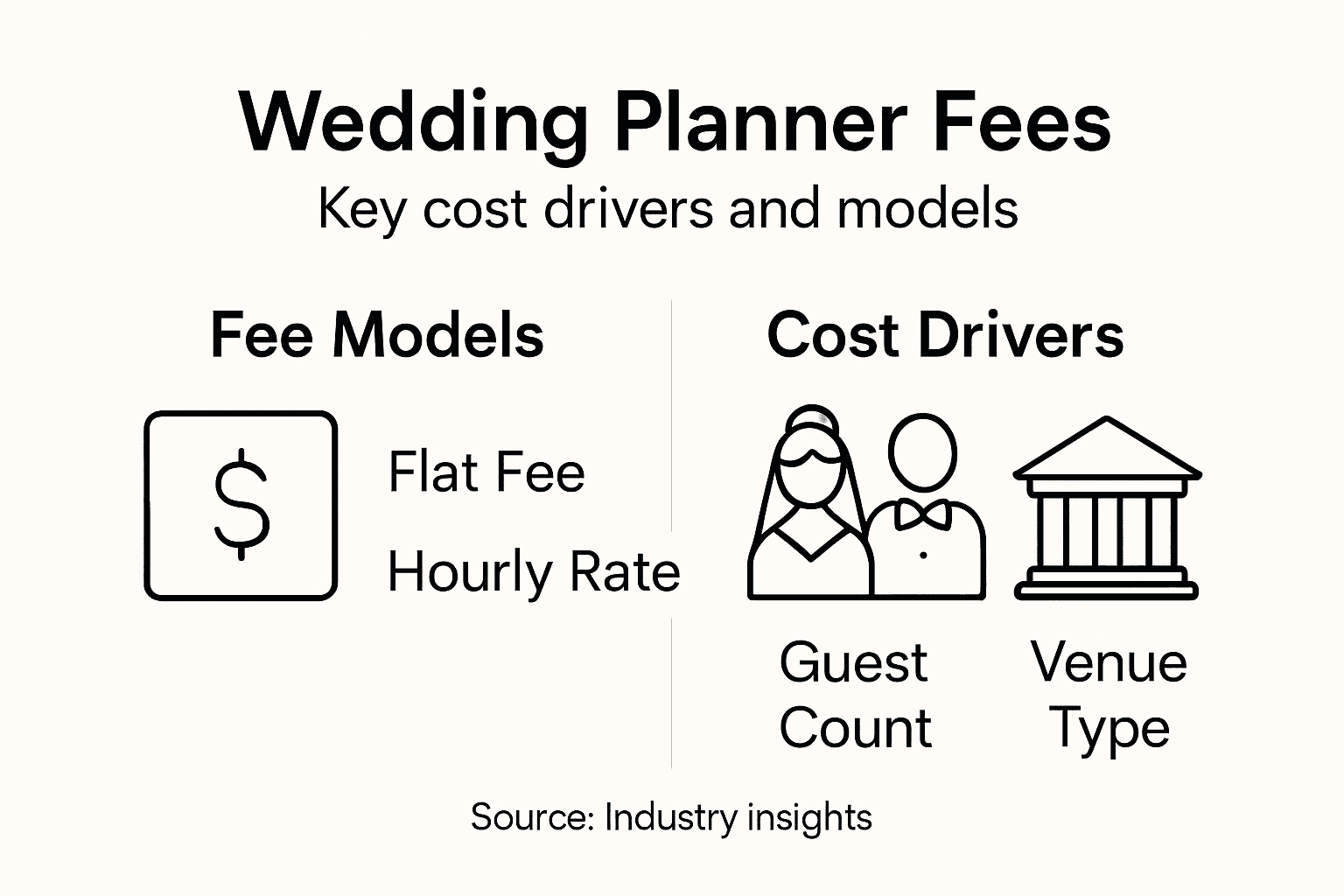
Flat fee structures offer complete predictability. You pay a set amount regardless of your final wedding budget. This works beautifully for couples wanting clarity—you know exactly what you’ll owe.
Percentage-based fees typically range from 10-20% of your total wedding budget. This aligns the planner’s incentive with yours: as your celebration expands, their compensation grows proportionally. This model suits couples with flexible budgets.
Hourly rates work well for consultation-only services or partial planning. You pay for actual hours invested rather than committing to a package.
Hybrid models combine elements—perhaps a base flat fee plus percentage on vendor coordination, or hourly rates for certain services with package pricing elsewhere.
Payment Schedules and Deposits
How you actually pay depends on the agreement structure:
- Initial deposit: Typically 25-50% at contract signature, securing your date
- Staged payments: Divided throughout planning phases (after vendor selection, pre-wedding, final)
- Final balance: Due shortly before your wedding date
- Vendor payments: Some planners collect these separately; others include them in their fees
Understanding the payment timeline prevents cash flow surprises. A planner might require significant funds months in advance to secure vendors.
What Affects Your Specific Quote
Your actual price depends on numerous variables. Service scope matters enormously—full planning costs more than coordination. Timeline impacts pricing; rushed engagements command premiums. Guest count, venue type, and event complexity all influence the final quote.
A luxury Winelands celebration with 200 guests, elaborate design requirements, and a compressed timeline will cost considerably more than a 50-person intimate gathering planned over twelve months.
Don’t compare quotes from different planners directly—you’re often comparing fundamentally different service scopes, experience levels, and operational models.
Transparency Matters
Reputable planners provide detailed breakdowns showing what their fees cover. Does their price include vendor communication, site visits, design consultation, or day-of coordination? Are there additional charges for rush services, destination premiums, or specialised coordination?
Misunderstandings arise when clients assume fees are all-inclusive when they’re actually partial. Clarify exactly what’s included before signing contracts.
Pro tip: Request three planners’ fee structures in writing, then create a comparison spreadsheet listing what each price actually encompasses—this reveals whether a lower quote reflects genuine savings or simply reduced scope.
Maximising Value from Your Planner Investment
Paying for a wedding planner isn’t just an expense—it’s an investment in your peace of mind, your time, and ultimately, the quality of your celebration. But getting genuine value requires active engagement, clear communication, and realistic expectations about what your planner can deliver.
Value from your investment comes through aligning your priorities with your planner’s expertise, then trusting their guidance. It’s not about getting the cheapest service; it’s about ensuring every pound spent contributes meaningfully to your experience.
Define Your Non-Negotiable Priorities
Before signing any contract, identify the three to five elements that matter most to you. Is it the aesthetic vision? The guest experience? The logistics running flawlessly? Your planner’s time allocation should reflect these priorities.
When you communicate clearly about what matters, your planner invests energy accordingly. A couple prioritising cuisine will benefit from a planner with exceptional catering relationships. One focused on design aesthetics needs a planner with strong creative vision and vendor networks.
Misaligned priorities breed disappointment. If you hire a logistics specialist but expect elaborate design direction, you’ll feel you overpaid. Choose planners whose strengths match your needs.
Leverage Their Vendor Relationships
Maximising value from planning investments requires understanding how resources generate meaningful outcomes. Your planner’s established vendor relationships directly translate into tangible benefits:
- Better pricing: Negotiated rates unavailable to the general public
- Priority access: First availability at premium venues and services
- Curated options: Pre-vetted vendors meeting your planner’s quality standards
- Problem-solving: Strong relationships mean vendors prioritise resolving issues quickly
Don’t view your planner as simply booking vendors you could find independently. Their network represents years of vetting, relationship-building, and trust—assets you’re directly accessing.
Communication and Responsiveness
Value deteriorates when communication breaks down. A planner charging premium fees but responding slowly to queries delivers poor value. Conversely, an accessible planner who promptly addresses concerns justifies their investment.
Establish clear communication expectations upfront. How often will you meet? What’s the response timeframe for questions? Are decisions made via email, calls, or scheduled meetings? Clarity prevents frustration later.
Your planner’s value multiplies when you treat them as a collaborative partner, not a service vendor you’re extracting work from.
Strategic Decision-Making Support
The best planners offer guidance beyond logistics. They challenge scope creep, prevent budget disasters, and suggest creative solutions you hadn’t considered. This advisory role justifies significant investment.
When a planner suggests scaling back an element that’s consuming 30% of your budget for minimal impact, or proposes an innovative alternative you hadn’t imagined, they’re delivering value beyond coordination.
Value-focused planners help you achieve your vision within constraints rather than simply executing whatever you request regardless of feasibility.
Realistic Expectations
No planner controls weather, vendor illness, or supply chain disruptions. Value includes how they navigate inevitable challenges, not whether challenges occur. A skilled planner’s real worth emerges when problems arise.
Expect professional problem-solving, not perfection. Your planner’s experience handling unexpected situations protects your celebration far more than flawless initial planning.
Pro tip: After selecting your planner, schedule a mid-planning review meeting specifically to assess whether expectations are being met and priorities remain aligned, allowing adjustments before significant resources are committed.
Unlock Transparent Luxury Planning with Winelands Function
Navigating the complexities of wedding planner charges can feel overwhelming. You want clarity on what influences costs and assurance that every pound brings true value. Whether considering full-service planning, partial support, or day-of coordination, understanding fee structures and service scope is critical to achieving your dream celebration without unexpected surprises.
At Winelands Function, we specialise in tailoring luxury event planning services to your unique priorities and timeline. Our expertise in the Cape Town Winelands region means you access trusted vendor relationships, transparent pricing models, and personalised care from conception to execution. Discover how our customised planning solutions align perfectly with your vision and budget, ensuring peace of mind throughout your journey. Take the first step towards an elegant, flawlessly managed event—visit our site and start your bespoke planning experience today.
Frequently Asked Questions
What factors influence wedding planner charges?
Wedding planner charges are influenced by various factors including the scope of services provided, the planner’s experience, the complexity of the wedding, and the geographical location. Larger guest counts, premium venues, and custom design requests also impact the overall cost.
What types of service models do wedding planners offer?
Most wedding planners offer three primary service models: full-service planning, which manages everything from start to finish; partial planning, which focuses on specific tasks; and day-of coordination, which handles logistics on the wedding day itself.
How can I determine if a wedding planner’s fees are worth it?
To assess the value of a wedding planner’s fees, consider their expertise, the range of services they provide, and their established vendor relationships. A skilled planner can save you time, reduce stress, and potentially secure better pricing with trusted vendors.
Are there additional charges I should be aware of when hiring a wedding planner?
Yes, additional charges may apply for services like rush fees for short timelines, destination wedding premiums, or extra consultations. It’s important to request a detailed breakdown of all potential costs before committing to ensure transparency and avoid surprises.
Recommended
- Wedding Planner Pay Rate – Attracting Luxury Talent – Winelands Function – For Every Occasion, Your Celebration
- What Is a Cheap Wedding and Who Benefits? – Winelands Function – For Every Occasion, Your Celebration
- Why Hire a Wedding Coordinator: Complete Guide – Winelands Function – For Every Occasion, Your Celebration
- Understanding Why Hire Wedding Planners for Your Event