

A wedding cost checklist works because it forces every expense into the open before a contract gets signed, not after. The single rule that matters more than any other: set a firm total ceiling and reserve 10%–15% of it as an untouchable buffer. Venue and catering will claim the largest single share of your budget, and the biggest overruns almost always come from what wasn’t written down.
TL;DR:
- Venue and catering typically account for 30% to 50% of the wedding budget, with larger budgets proportionally increasing absolute costs.
- Most unexpected expenses stem from small charges like overtime, setup fees, or postage, making a 10% to 15% contingency essential.
- Guest count heavily influences costs, especially for catering and favors, so reducing invites can significantly lower overall expenditure.
- An itemized checklist tracking each expense as budgeted, quoted, committed, and paid helps prevent overspending by flagging variances early.
- Professional planning and negotiation ensure hidden costs are identified upfront, preventing surprises on final invoices and protecting your budget.
Table of Contents
- What a realistic wedding budget breakdown looks like by category
- The itemised wedding cost checklist for your spreadsheet
- Where hidden costs come from and why your buffer must stay untouched
- How to set your total ceiling and fund your wedding
- Guest count and what it actually costs per person
- Building a budget tracker you’ll actually update
- Winelands Function’s perspective: what actually protects your budget
- Let Winelands Function protect your budget from the first quote
- Sources
What a realistic wedding budget breakdown looks like by category
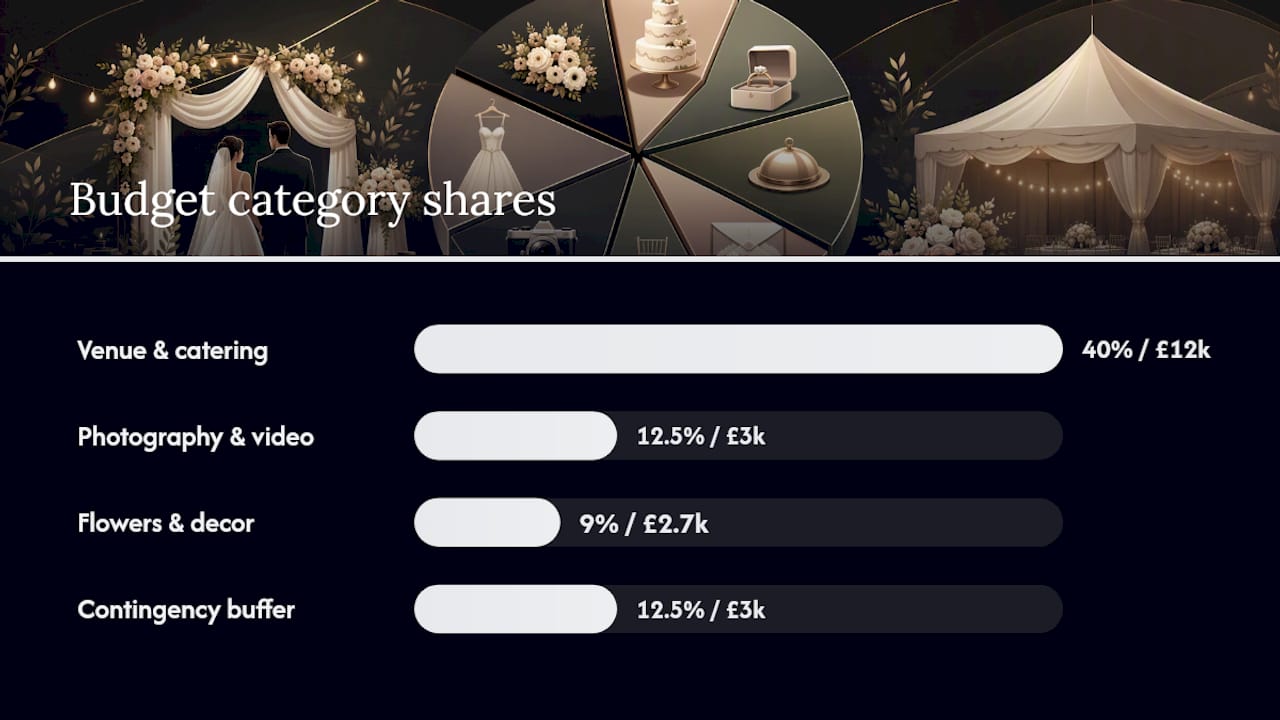
Every budget conversation should start with percentages, not a wish list. Industry data consistently shows venue and catering combined absorbing 30%–50% of total spend, with venue and rentals typically a significant portion and catering another substantial share. The exact split depends on whether your venue package already bundles catering, staffing, and rentals, or whether you’re paying for each separately.
Here’s how the remaining categories usually break down once venue and catering take their share:
- Photography and videography: 10%–15%
- Flowers and decor: 8%–10%
- Music and entertainment: 5%–8%
- Attire and beauty: 5%–8%
- Wedding planner: 4%–6%
- Rings: 3%–5%
- Stationery and transport: 2%–3%
- Contingency buffer: 10%–15%
Pro Tip: If your venue package already includes catering, tables, linen, and staffing, you may find that single line consumes closer to 50% of your ceiling on its own. When that happens, don’t panic. It simply means your “separate” catering and rentals lines shrink to nearly zero, and the percentages above shift accordingly rather than stacking on top of each other.
Translated into cash terms, the percentages hold their shape whether your ceiling is modest or generous. A couple working with a £15,000 ceiling might allocate roughly £6,000 to venue and catering, £1,800 to photography, £1,200 to flowers, and £1,800–£2,250 to the buffer. A couple at £30,000 could be looking at £12,000–£15,000 for venue and catering alone, with photography landing between £3,000 and £4,500. At £60,000, that top category can reach £24,000–£30,000, which is precisely why couples with larger ceilings still feel squeezed if they haven’t protected their contingency line from day one.
Per-guest cost is the real engine behind most of these figures. Add ten guests to a plated dinner and you’ve just added a proportional slice to catering, bar, stationery, and favours, all in one move. That’s the multiplier most couples underestimate until the caterer’s revised quote lands in their inbox. The Knot’s guidance on wedding budgeting treats guest count as the single most controllable lever in the entire budget, and it’s worth building your percentages around that assumption from the start.
If you’re weighing venue packages that fold catering into one number, browsing sample budget structures for Cape Town packages shows how bundled pricing changes the shape of every other category.
The itemised wedding cost checklist for your spreadsheet
A percentage breakdown tells you how much to allocate. An itemised checklist tells you what actually belongs in each slice. Copy the following into your tracker and mark every row with one of four statuses: budgeted, quoted, committed, or paid. That single habit does more to prevent overspending than any spreadsheet formula.
- Venue — hire fee, ceremony fee (often separate from reception hire), refundable damage deposit, setup and breakdown fees, overtime rate per hour, parking or valet charges.
- Catering and drinks — per-head meal cost, bar package or corkage fee, cake-cutting fee if you’re bringing an outside baker, service charge (typically 20%–22% on food and beverage), staffing gratuities.
- Photography and video — package fee, second shooter add-on, engagement shoot, album printing, raw footage or extended editing fees, travel costs if your venue is remote.
- Flowers and decor — bridal bouquet, bridesmaids’ bouquets, ceremony arch or backdrop, centrepieces, delivery and setup fees, breakdown and collection charges. A detailed decor line-item guide is worth working through if florals are a priority category for you.
- Attire and beauty — dress or suit, alterations (frequently underestimated by hundreds of pounds), shoes, accessories, hair and make-up trials, day-of styling.
- Stationery — save-the-dates, invitations, RSVP cards, seating charts, menus, thank-you cards, and postage for all of the above.
- Transport — bridal party transport, guest shuttles if the venue is remote, getaway car.
- Rehearsal dinner — venue or restaurant hire, catering, drinks. Approaches that work for budget-conscious pre-wedding catering translate well here too.
- Rings — engagement ring if not already purchased, wedding bands, insurance and resizing.
- Gifts and favours — wedding party gifts, parent gifts, guest favours.
- Day-of kit — emergency kit, tips envelope cash, signage, welcome bags for out-of-town guests.
- Permits and insurance — noise permits, alcohol licences if required by your venue, event or liability insurance, wet-weather contingency (marquee or indoor backup).
Every one of those subitems, cake-cutting fees, setup and breakdown charges, alteration costs, delivery fees, postage, is where a checklist earns its keep. They rarely appear on a venue’s headline quote, and they’re exactly what turns a tidy budget into a stressful final invoice.
Where hidden costs come from and why your buffer must stay untouched
Most wedding overspends don’t come from one dramatic mistake. They come from five or six small charges that never made it onto the original quote. Service charges of 20%–22% on food and beverage are standard at most venues, and they’re distinct from the gratuities you’ll want to leave for individual vendors on the day. Confusing the two is one of the most common budgeting errors couples make.
The usual culprits are predictable once you know to look for them:
- Overtime charges when the reception runs past the contracted end time
- Setup and breakdown fees, especially for décor or furniture rented separately from the venue
- Cake-cutting fees when an outside baker supplies the cake
- Dress and suit alterations, which can add several hundred pounds beyond the garment price
- Postage on invitations, save-the-dates, and thank-you cards
- Parking, valet, and delivery charges tacked onto vendor invoices after the fact
Unaccounted service charges and gratuities are consistently cited as the single biggest source of surprise spend, which is exactly why the 10%–15% contingency isn’t optional padding. Reserving that buffer and treating it as genuinely off-limits until a real emergency arises, not a tempting upgrade, is what separates couples who finish under budget from those who don’t.
Pro Tip: Build gratuity line items into your “committed” column from the moment you sign a contract, not the week of the wedding. Treating tips as a known cost rather than a surprise is the easiest way to protect your buffer.
How to set your total ceiling and fund your wedding
- Calculate your ceiling honestly. Add secured savings, confirmed family contributions, and a realistic monthly savings figure between now and the wedding date. Leave out loans or emergency funds unless you’re deliberately choosing to use them; borrowing to hit a number you can’t actually afford defeats the purpose of a ceiling.
- Set a monthly savings target. Take the gap between what you have now and your target ceiling, divide it by the months remaining, and treat that figure as a fixed monthly transfer into a dedicated sinking fund.
- Allocate 85%–90% of your ceiling across categories using the percentage breakdown above, and reserve the remaining 10%–15% as your buffer.
- Pre-commit your cut order. Decide now, before any vendor calls, which categories you’d trim first if costs run over: is it the flowers, the favours, or the guest list? Deciding under pressure almost always costs more than deciding in advance.
- Request three quotes per major category. Venue, catering, photography, and flowers each deserve at least three comparable quotes before you commit to anything.
- Update your tracker the moment a contract is signed. Deposits typically run 25%–50% of the total, with final balances due two to four weeks before the wedding, so record both the deposit and the due date immediately.
Choosing your top three non-negotiable priorities early and protecting their allocation is what makes every later trade-off painless instead of a fight. If those priorities involve a destination element, reviewing what drives venue pricing for couples planning from abroad will help you set a more accurate ceiling from the outset.
Guest count and what it actually costs per person
Guest count is the single number that moves every other figure on your spreadsheet. Per-guest catering estimates typically fall between roughly £200 and £350, depending on menu format and bar service, and that range compounds fast once you multiply it across a guest list.

Catering, bar, stationery, and favours scale directly with headcount. Venue hire, photography packages, and your planner’s fee generally stay fixed regardless of whether you invite 50 people or 150. That’s why cutting guest numbers tends to move the needle more than cutting vendor quality: trimming twenty guests can save more than downgrading your florist ever would.
Building a budget tracker you’ll actually update
A checklist only works if it’s a living document, not a spreadsheet you fill in once and abandon. Structure your tracker with eight columns: category, line item, budgeted amount, quoted amount, committed amount, paid amount, due date, and variance. That variance column, the gap between what you budgeted and what you’re actually paying, is what flags problems early enough to fix them.
A workable rhythm looks like this:
- Enter a vendor’s quote within 24 hours of receiving it, even if you haven’t decided yet
- Move a quote to “committed” only once a contract is signed and a deposit paid
- Review the full tracker weekly, not monthly, so drift gets caught while it’s still small
- Record every deposit due date alongside the final balance date
Free templates from The Knot’s Budget Advisor and WeddingWire’s planner both distribute a total ceiling across categories using industry averages, which makes either a sensible starting point before you customise it to your own priorities. Opening a dedicated savings account for wedding funds, separate from everyday spending, also makes it far easier to see exactly what’s available at a glance.
Winelands Function’s perspective: what actually protects your budget
Spreadsheets catch mistakes after they happen. A planner catches them before they’re signed. Part of what makes professional budget oversight valuable isn’t just tracking numbers, it’s cross-checking every vendor quote against your remaining ceiling and flagging exclusions before they force a compromise elsewhere in the plan.
That means confirming service charges up front rather than discovering them on the final invoice, scheduling the day tightly enough that overtime fees never materialise, and negotiating supplier bundles that individual couples rarely have access to on their own. Deciding early where to splurge and where to save is far easier with someone who has already seen where hidden costs tend to hide.
— Coert
Let Winelands Function protect your budget from the first quote
Winelands Function gives you what a spreadsheet alone can’t: someone in the room negotiating with suppliers, confirming what’s actually included in every quote, and scheduling the day so overtime fees never appear on your final invoice. Full planning, budget oversight, supplier negotiation, and on-the-day coordination are handled together, which is precisely how hidden costs get caught before they land on you.

Rather than piecing together templates and hoping nothing was missed, you get a planner cross-checking every contract against your ceiling before you sign. If you’re ready to see what a fully protected budget looks like for your own wedding, start with our wedding planning service in Cape Town and request a consultation to map your ceiling, priorities, and buffer before you book a single supplier.
Sources
- Wedding budget breakdown and ways to save (The Knot)
- Wedding budget template 2026, full breakdown + hidden costs checklist (StartWeddingPlanning)
- Wedding budget: how to plan + tips on how to save (The Penny Hoarder)
- WeddingWire wedding budget planner
Recommended
- How to cut wedding costs without cutting the joy – Winelands Function – For Every Occasion, Your Celebration
- 7 Essential Wedding Budgeting Tips for Stress-Free Planning – Winelands Function – For Every Occasion, Your Celebration
- Wedding planning check list: your step-by-step guide – Winelands Function – For Every Occasion, Your Celebration
- Wedding checklist spreadsheet for luxury weddings in 2026 – Winelands Function – For Every Occasion, Your Celebration