

When hiring a professional wedding planner, insist on six things: a clearly defined service scope, a signed contract, proof of both general liability and professional indemnity insurance, a curated luxury portfolio, established vendor relationships, and a named staffing and contingency plan for the day itself. Some professional planners publish duties checklists and offer full-service coordination that reflect these exact standards, and treating them as your baseline protects both your budget and your event.
TL;DR:
- Confirm the planner provides a detailed service scope, portfolio of comparable events, and proof of both general liability and professional indemnity insurance before paying any retainer.
- Ensure the contract explicitly states the scope of services, payment terms, cancellation policies, and a change-order process to prevent disputes.
- Verify that the insurance coverage limits are active, match your event dates, and that subcontractors are properly covered under the planner’s policies.
- Evaluate experience based on consistent quality across similar-scale events, proof of established vendor relationships, and editorial features, rather than on volume alone.
- Use the initial consultation to clarify staffing, vendor approval processes, and transparency on costs, watching for evasive answers or missing documentation as red flags.
Table of Contents
- Requirements to be a wedding planner: what clients should check first
- What must the contract cover and how are fees structured?
- Which insurance and liability proofs actually matter?
- How do you assess experience, portfolio and vendor relationships?
- What should you ask at the consultation?
- Red flags versus signs of excellent service
- Winelands Function perspective: meeting these requirements in practice
- How Winelands Function can help with your next event
- Sources
Requirements to be a wedding planner: what clients should check first
Before you sign anything, build a shortlist file for each candidate planner. Treat it like due diligence, not paperwork.
The strongest evaluation happens before money changes hands. Ask each planner to provide six items: a written service scope, a portfolio with comparable case studies, a certificate of insurance, a signed contract template, a sample event timeline, and a staffing plan with references you can actually contact.
- Service scope: a one-page document stating exactly what’s included (full planning, partial planning, or day-of coordination) and what isn’t.
- Portfolio and case studies: photos and write-ups from events of similar scale, ideally with named venues and guest counts, not just styled shoots.
- Certificate of insurance (COI): proof of active general liability and professional indemnity coverage, dated within the current policy year.
- Signed contract template: the actual document they’ll ask you to sign, not a verbal summary of terms.
- Sample timeline: a detailed run-of-show from a past event showing vendor call times, ceremony to reception transitions, and buffer periods.
- Staffing plan and references: names of on-site team members plus two or three past clients willing to speak with you directly.
Request the scope, portfolio, and COI before you pay any retainer. Contracts, timelines, and reference contacts can reasonably wait for a secure client portal once you’ve narrowed your list to two or three finalists. A planner who hesitates to share any of these six items before the deposit stage is telling you something worth hearing.
What must the contract cover and how are fees structured?
A wedding planner agreement should itemise services, fees, deposits, payment terms, cancellation procedures, and both parties’ obligations in plain language. Anything vaguer than that shifts risk onto you.
Check that the contract explicitly states the service tier (full-service, partial, or day-of), spells out vendor-management responsibilities, and sets a clear billing schedule. Look for these clauses specifically:
- Exact scope of services, with inclusions and exclusions named separately.
- Payment schedule, deposit amount, and what triggers the retainer.
- Reimbursement terms for travel, samples, and third-party costs.
- Cancellation and postponement policy, including what’s refundable.
- A written change-order process for any work added after signing.
- Dispute resolution and governing law, particularly for destination weddings.
Fee structures vary by market, but luxury planners commonly charge a flat fee, a percentage of total budget (often 10 to 15 percent), a minimum fee regardless of budget size, or a day rate for coordination-only work. Ask which model applies and get the total estimated cost in writing.
Red flags include scope described in a single vague sentence, no ceiling on additional charges, and no formal process for approving extra work. A clear itemised scope with an explicit change-order clause is what prevents the most common disputes between planners and clients, according to contract guidance from LegalClarity.
Which insurance and liability proofs actually matter?
General liability and professional indemnity are not the same thing, and you need both. General liability covers physical accidents at the venue, a guest tripping over a cable, a broken glass, a fallen arch. Professional indemnity, also called errors and omissions cover, protects you if the planner’s own mistake, a missed vendor booking, a scheduling error, jeopardises the event.
Ask for coverage limits in writing, then verify them independently. Request a sample certificate naming the venue as an additional insured, and confirm whether subcontractors like AV, tenting, or transport are covered under the planner’s own policy or need separate proof.
- Request a COI directly from the insurer, not just a screenshot from the planner.
- Confirm the policy period covers your actual event date.
- Ask whether subcontracted vendors carry their own coverage or fall under the planner’s policy.
- Share the COI with your venue’s events team before final booking.
Pro Tip: Call the insurer listed on the certificate directly. A five-minute call confirming the policy is active costs you nothing and eliminates the single most common gap in wedding insurance claims.
How do you assess experience, portfolio and vendor relationships?
Consistency matters more than volume. A planner with fifteen polished, similar-scale events tells you more than one with fifty scattered, budget-mismatched jobs.
Look for portfolios showing repeated design quality across comparable budgets and venues, not a single standout shoot surrounded by uneven work. Editorial features or press placements are a useful signal, since publications rarely credit planners who can’t deliver consistently. Reviewing portfolios for large-scale production evidence and proven vendor access remains the clearest way to judge capability with high-budget events.
- Photos crediting the same florist, caterer, or décor house across multiple events suggest genuine repeat partnerships.
- Priority booking access or trade-only supplier relationships indicate real standing in the local market, not just a contacts list.
- Editorial features that name vendors alongside the planner confirm those relationships are documented, not claimed.
- Multi-day or destination event experience shows in guest transport logistics, not just ceremony styling.
Luxury planners typically limit their annual bookings to sustain this level of personalised service, so a candidate juggling forty weddings a year in your peak season deserves closer questioning.
What should you ask at the consultation?
Your first meeting should surface staffing gaps, timeline assumptions, and cost transparency before you commit to anything.
- How many weddings or events do you take on per year, and how many fall in my season?
- Who specifically will be on site on the day, and what happens if that person is unavailable?
- Walk me through your typical planning timeline and how often you report progress.
- How do you select vendors, and do I have final approval on each one?
- What is included in your fee, and what counts as an extra cost?
- What are your deposit terms, invoice schedule, and cancellation policy?
A robust consultation should draw out contingency thinking as much as creative vision. If a planner answers the staffing question vaguely, or can’t name a backup for their own absence, that’s information worth weighing heavily.
Red flags versus signs of excellent service
Trust your instincts here, but back them with paperwork. The gap between a confident planner and an evasive one usually shows up in the first two meetings.
Warning signs include no written scope document, absent or unverifiable insurance proof, vague or deflective answers about past events, and pressure to commit to a single vendor without explanation. Excellent planners show the opposite: itemised proposals, sample timelines offered unprompted, references who actually pick up the phone, and a documented backup staffing plan.
- No written scope, only verbal promises about what’s included.
- Insurance claims that can’t be verified with an insurer.
- Reluctance to share contactable references from recent events.
- One clear positive counterpart: a proposal broken down line by line, with contingency planning already built in.
Insurance and contract discipline exist for a reason. Insurers note that planning mistakes, not just physical accidents, are among the most common triggers for professional liability claims in the events industry.
Winelands Function perspective: meeting these requirements in practice
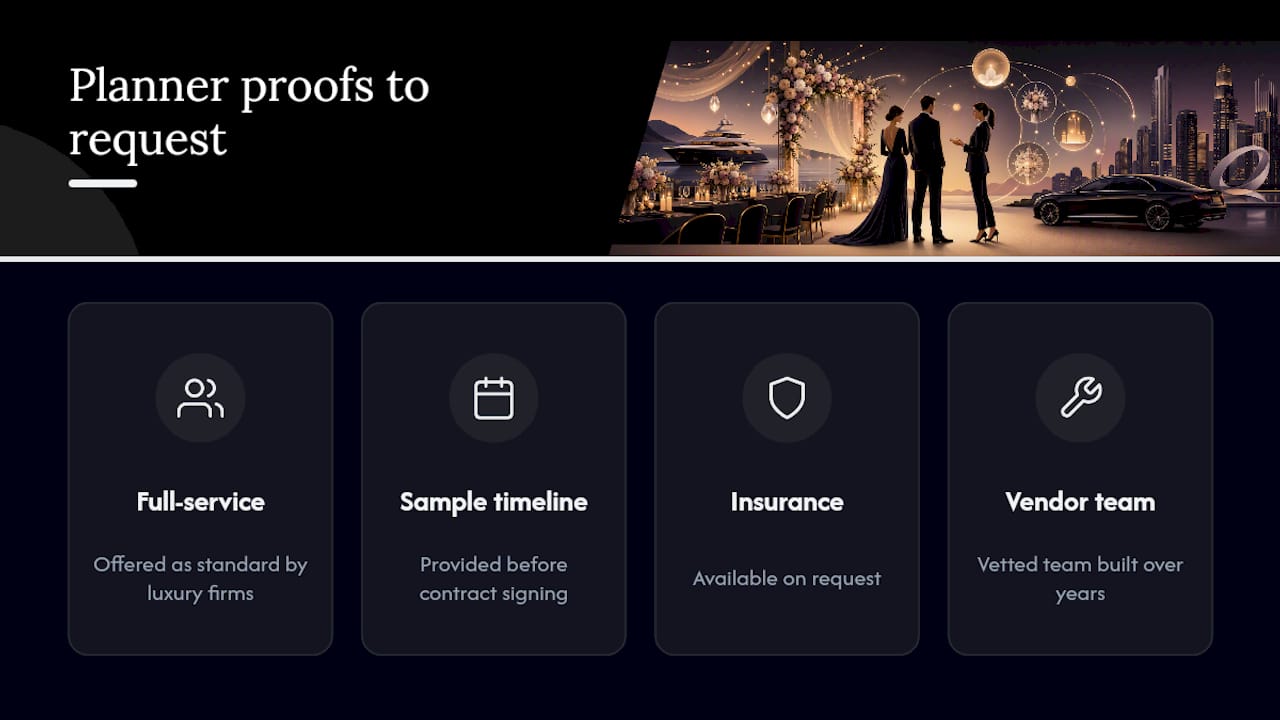
We built our wedding planner duties checklist because too many couples told us they didn’t know what to ask for until something went wrong. Some luxury planning firms routinely provide the items this article covers as standard: full-service coordination, a sample timeline before contract signing, insurance confirmation on request, and a curated vendor team built over years, not assembled per booking.
Our view is simple. If a planner can’t produce these proofs quickly, that hesitation is the answer. Ask for them anyway, from us or from anyone you’re considering, and shortlist accordingly.
— Coert
How Winelands Function can help with your next event
Some event planning services handle full-service planning, supplier and venue management, and on-the-day coordination for weddings and corporate celebrations. Every one of the requirements covered above, scope, contract, insurance, portfolio, staffing, is something you should ask about directly.

At first contact, request our portfolio examples from comparable-scale events, a certificate of insurance, our standard contract template, and the staffing plan for your event date. We’d rather answer those questions upfront than have you discover gaps three months before your wedding. Visit our wedding planning services page to check availability for your date and start that conversation.
Sources
- Wedding planner agreement — Rocket Lawyer
- Wedding planner insurance — Next Insurance
- What should a wedding planner contract include? — LegalClarity
- How to choose the perfect luxury wedding planner — Luxury Weddings UK
- What Is a Luxury Wedding Planner? Here’s What to Look For — The Knot