
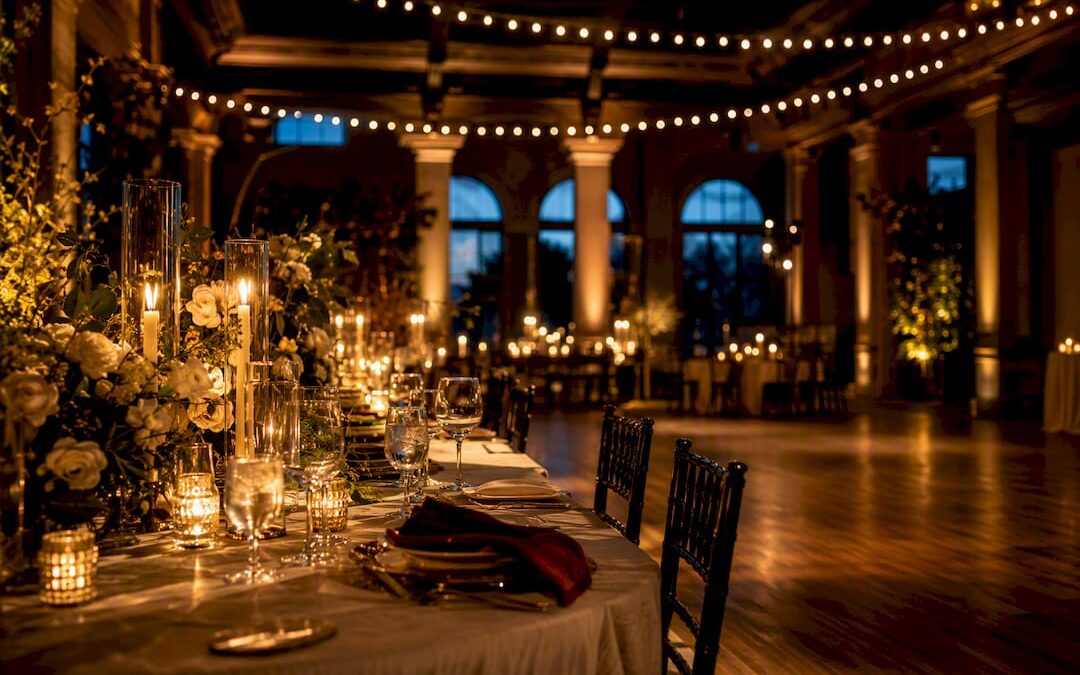
Three moves carry the most weight at any reception: layered lighting, a coherent tablescape, and one statement vertical installation, whether that’s a floral cloud or a fabric canopy. These are the elements guests remember, cameras favour, and photographers ask for by name. Prioritise them in that order, because lighting shapes every photograph taken after dark, and much of what follows can be rented or made by hand rather than bought outright.
TL;DR:
- Prioritize layered lighting, coherent tablescapes, and one vertical installation to capture guest attention and create impactful photographs.
- Focus on entrance and welcome signage that matches your wedding’s formality, avoiding clutter by choosing one signage style.
- Use varying table heights, preservative florals, and textured linens to achieve elegant, well-photographed tablescapes within a limited budget.
- Invest in layered lighting schemes like string canopies, candle clusters, and uplighting, while confirming venue policies beforehand.
- Reserve most of your decoration budget for the zones guests interact with the most, especially entry, tables, and dance floors.
Table of Contents
- Wedding reception decoration ideas for your entrance and welcome area
- Table centrepieces and tablescape styling that photograph well
- Lighting and atmosphere: string lights, candles, and uplighting
- Hanging installations and ceiling decor that create vertical drama
- Lounge, bar and dance-floor styling for social zones that feel curated
- DIY wedding decorations and budget-friendly swaps worth your time
- Venue logistics and setup checklist for wedding reception decorations
- Wedding decor trends for 2026 and how to use them without overdoing it
- Incorporating seasonal flowers and natural elements
- Personalisation ideas for decorations
- Coordinating decorations with your wedding attire and overall style
- How Winelands Function prioritises decor for client events
- Bring your reception decor ideas to life with Winelands Function
- Sources
- FAQ
Wedding reception decoration ideas for your entrance and welcome area
The entrance sets the tone before a single course is served, and it’s the easiest zone to get wrong through neglect rather than bad taste. Guests form their first impression here, often while queueing for a seating chart or signature drink, so this small footprint deserves proportional attention.
Welcome signage works best when it matches the formality of the day. A freestanding framed print suits a classic, editorial-style wedding; an oversized mirror with hand-lettered script feels romantic and slightly undone in the right way; a custom neon sign (increasingly available to rent rather than commission outright) suits a modern or maximalist reception where you want a bold graphic moment. Choose one, not all three: layering competing signage styles is the fastest way to make an entrance look cluttered rather than curated.
Escort card and seating displays double as decor if you treat them as a design opportunity rather than an administrative necessity:
- A large antique mirror with names written in white pen creates an elegant, low-cost focal point.
- A greenery wall with cards tucked into stems adds texture without extra furniture.
- Vintage suitcases stacked and labelled by table number suit rustic wedding themes particularly well.
- A vertical ladder hung with tags works for both farmhouse and industrial-loft venues.
Your bar deserves the same care as your entrance. A styled signature-drink station, complete with a small sign naming the cocktail and a cluster of fresh or dried garnish, gives guests an obvious first photo opportunity and takes pressure off the head table as the only “arrival” moment.
If budget is tight, the swaps here are genuinely effective rather than a compromise: printable signage from a home printer mounted on foamboard reads as professionally finished from more than a metre away, and rented greenery panels cost a fraction of a built floral wall while photographing almost identically.
Pro Tip: Test your signage font size against the actual distance guests will stand from it. A script that looks elegant on a laptop screen often becomes unreadable at three metres, which defeats the purpose entirely.
Table centrepieces and tablescape styling that photograph well
Scale is the first decision, and it’s one many couples get backwards. Low centrepieces that do not obstruct sightlines suit rounds where guests need to see and talk across the table; tall arrangements with slender stems suit long banquet tables where height reads as drama rather than obstruction. For long tables, mix low and tall pieces in a repeating rhythm rather than running one uniform height down the entire length. It reads as considered rather than budget-driven, even when it’s the cheaper option.
Fresh flowers aren’t the only route to an elegant table. Dried and preserved florals have become a serious design choice in their own right, not a fallback, because they photograph well and hold their shape through a full evening without wilting under warm lighting. Fruit and vegetable still-life arrangements, think trailing grapes, quince, or fig branches, are having a genuine moment for 2026 and suit autumn or vineyard-adjacent venues especially well. Candle clusters at varying heights and lanterns filled with foliage give you a non-floral option that costs less and needs zero maintenance on the day.
Linens and place settings do more heavy lifting than most couples budget for. A textured runner over a plain cloth, a charger plate under each setting, and a napkin fold with a sprig of herb tucked in can lift a modest floral budget considerably; these are the details a table stylist reaches for first when working within a limited spend, and they’re covered in more depth in Winelands Function’s guide to wedding table decorations.
Practical ways to blend rentals and DIY without the seams showing:
- Rent chargers and glassware (breakage risk makes this worth it), but make your own napkin ties from ribbon offcuts.
- Buy dried flower stems in bulk and arrange them yourself; hire a florist only for the fresh focal blooms on the top table.
- Rent a single statement candelabra for the head table and use simple votives everywhere else.
- Source vintage bud vases from second-hand shops for an eclectic, collected-over-time look at a fraction of rental cost.
Table styling extends to the dining experience itself, and how food is presented on the table is worth planning alongside the decor rather than after it, particularly for festive-style shared plates and grazing boards, which need extra surface space factored into your centrepiece scale from the start.
Pro Tip: Do a full mock-up of one table, linens, centrepiece, place setting and all, roughly two weeks before the wedding. It’s the only way to catch scale problems while there’s still time to fix them.
Lighting and atmosphere: string lights, candles, and uplighting
Lighting is consistently rated among the highest-return decor investments relative to cost, because it changes how every other element in the room reads once the sun goes down. A beautifully dressed table under flat fluorescent venue lighting looks flat in photos; the same table under warm string lights and candlelight looks intimate and expensive.
Warm colour temperature that flatters skin tones and makes florals glow rather than look washed out is recommended, as found in most fairy lights and candle-style bulbs. Cool white lighting, by contrast, tends to make a reception feel more like a corporate function than a celebration, so avoid it in any zone guests will be photographed in.
For genuine transformation, a few combinations do most of the work:
- A string light canopy over the dance floor or dining area, either rented and rigged professionally or DIY’d with battery-powered fairy lights on a lightweight frame.
- Candle clusters of varying heights down the table centre, mixed with taller pillar candles for depth.
- Wall or ceiling uplighting, which a hired lighting supplier can programme in a single wash colour or shift subtly through the evening with DMX controls.
- Clusters of small table lamps, an emerging alternative to string lights that gives a warm, lived-in glow closer to restaurant dining design than a typical event space.
Hiring a lighting supplier makes sense when you want rigging, colour-changing capability, or coverage across a large room; a simple battery-operated fairy light string or a handful of flameless LED pillar candles gets you most of the atmosphere for a fraction of the cost in a smaller or more intimate venue.
Before you commit to open flame anywhere, confirm the venue’s policy directly. Many venues restrict or ban naked flames entirely, and flameless LED alternatives are worth planning for as your default rather than your backup, particularly for marquees, tented receptions, and any space with fabric draping nearby.
Hanging installations and ceiling decor that create vertical drama
A floral cloud suspended above the dance floor, a cluster of hanging bud vases over the top table, or a fabric canopy draped from a central rig point does something a tablescape alone cannot: it fills the vertical space guests see in every wide shot, and it’s usually the single image a photographer leads with when telling the story of the room.
Suspended hoops wrapped in greenery and trailing stems are a lower-cost alternative to a full floral installation and still deliver serious visual impact when hung at the right height, roughly 2 to 2.4 metres, low enough to read clearly, high enough that nobody brushes it walking past.
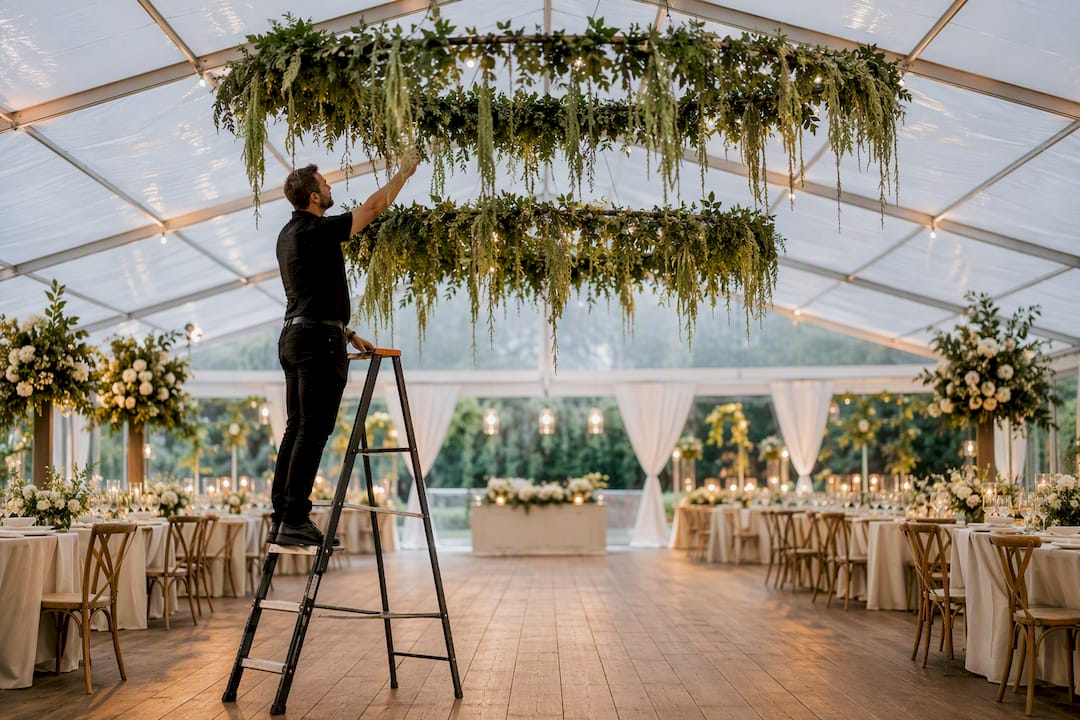
Rigging is where good intentions meet venue reality. Confirm ceiling load limits, permitted mounting hardware, and whether professional rigging is required before you order anything overhead; many historic or marquee venues have strict limits, and a florist or décor hire company will usually need written sign-off before installing.
Material choice shapes both cost and longevity: fresh installations look the most lush but need same-day assembly and won’t survive a long reception in heat; dried and preserved florals cost less, install earlier, and hold their form for the entire event; silk alternatives are the most budget-friendly and entirely reusable, useful if you’re styling on a tight schedule.
Pro Tip: Ask your photographer to walk the room before the wedding and flag where a hanging installation will actually appear in their standard shot list. An arrangement that looks stunning from below can vanish entirely from a wide reception shot if it’s positioned too far from the main sightline.
Lounge, bar and dance-floor styling for social zones that feel curated
A lounge area earns its keep when guests actually sit in it, which means comfort has to come before styling. Mix low sofas or vintage armchairs with a patterned rug underneath, a scattering of cushions, and a side table with a lamp rather than an overhead light, the same warm-glow logic that works on your dining tables applies here too.
Bar styling benefits from one clear focal point rather than several competing ones: a single hanging sign naming your signature cocktails, a cluster of dried flowers or trailing greenery along the bar front, and glassware chosen to match your overall palette rather than whatever the venue has in stock.
Dance-floor upgrades are where couples increasingly spend a disproportionate but justified share of budget, since it’s the one zone guests interact with for hours rather than minutes:
- A monogram gobo light projecting your initials onto the floor or a nearby wall.
- A patterned vinyl dance floor overlay, from checkerboard to marble effect.
- A disco ball paired with programmed uplighting for a moment of genuine drama during the first dance.
- Simple string light framing around the floor’s edge if a full canopy isn’t in budget.
If you’re allocating a limited decor budget across all three zones, weight it towards whichever space your guest list will actually use most. A younger, dance-heavy crowd justifies more spend on floor and lighting; an older or more conversational guest list rewards a larger, better-furnished lounge instead.
DIY wedding decorations and budget-friendly swaps worth your time
Not every DIY project deserves your evenings. The strongest candidates share one trait: they’re durable enough to survive being made weeks in advance, which removes the risk of a last-minute scramble.
- Dried-flower centrepieces. Buy stems in bulk, arrange in batches over a weekend, and store flat until the week of the wedding.
- Candle clusters. Source varying heights of pillar and taper candles from a craft shop; no skill required beyond grouping them well.
- Ribbon or tulle backdrops. Ideal for a ceremony arch repurposed behind the top table, and genuinely quick to assemble with a staple gun and a frame.
- Paper-fan photo walls. A recognised DIY favourite precisely because paper holds its shape and colour for months, unlike anything fresh.
- Favours and place-setting details. Small, repetitive tasks that suit an evening of assembly-line production with a friend and a bottle of wine.
Timing makes or breaks a DIY plan. Non-perishable projects, dried flowers, paper crafts, fabric backdrops, should be finished two to three months out. Anything involving fresh materials or final assembly belongs in the final two to four days before the wedding, never earlier. The one to three month window before that is for buying materials, testing colour combinations, and building any structural elements (frames, backdrops, signage mounts) that don’t rely on perishable content.
For cost-saving swaps beyond DIY, renting linens, signage, and light fixtures rather than buying almost always works out cheaper unless you’re planning multiple events. Winelands Function’s guide to stylish wedding decorations on a budget breaks down where rental typically beats purchase.
Some tasks are worth handing to a professional regardless of budget: overhead rigging, large fresh floral installations that need same-day assembly, and any lighting setup involving programmed colour changes or extensive cabling. These carry real safety and structural risk that a DIY approach can’t responsibly absorb.
Pro Tip: Complete one full “trial run” of your most complex DIY item at least a month out. If it takes three times longer than expected, you’ll still have time to simplify it or call in help.
Venue logistics and setup checklist for wedding reception decorations
Beautiful decor plans fall apart at the logistics stage more often than at the design stage. A short checklist, done in this order, avoids most of the common failures:
- Confirm venue rules first, before buying or renting anything. Ask specifically about open flame policy, adhesive and mounting restrictions, and ceiling or rigging load limits. Securing this in writing from the venue manager prevents an expensive last-minute substitution.
- Allocate budget to impact zones in priority order. Entrance, tables, dance floor, lighting, and signage should be funded before lounge furniture or secondary bar styling, which is where planners recommend cutting first if the budget tightens.
- Map your supplier schedule and assign responsibility at each stage. Typical timelines run: venue team clears and preps the space first, lighting and rigging suppliers install next (since their work often sits behind or above other decor), florists and stylists follow, and a final walkthrough happens roughly an hour before doors open.
- Build a short contingency plan. Have a flameless backup for every candle-based element, a substitute florist contact if your primary supplier falls through, and one spare pair of hands on standby for last-minute styling gaps.
Practical items to have confirmed on paper before the week of the wedding:
- Written sign-off on ceiling load limits and permitted hardware
- A clear delivery and strike-out schedule with named suppliers
- A weather contingency for any outdoor lighting or fabric elements
- Confirmation of who handles “day-of” adjustments if something looks off on arrival
This is also where treating decor as an immersive extension of the venue’s own architecture pays off logistically as well as aesthetically: working with existing features (a fireplace, exposed beams, a striking floor) generally needs less rigging and fewer permissions than building height and drama from scratch.
Wedding decor trends for 2026 and how to use them without overdoing it
The dominant threads for 2026 lean towards richness rather than minimalism: heavy drapery and luxe fabric backdrops, tablescapes influenced by 80s glamour and Rococo ornamentation, shell motifs on stationery and glassware, fruit and vegetable centrepieces, and layered warm lighting schemes that stack multiple light sources rather than relying on one overhead fixture.
The mistake couples make with trend lists is trying to include all of them. A tablescape carrying maximalist florals, Rococo-style silverware, drapery, and shell motifs simultaneously reads as busy rather than intentional. Pick one trend as your focal point, drapery on the top table backdrop, say, and let the rest of the room stay comparatively restrained. That restraint is what makes the one bold choice register as deliberate.
Layered lighting deserves particular attention because it’s rated repeatedly by planners as one of the highest-return investments relative to cost of anything on this list, and it pairs naturally with almost every other 2026 trend without competing for attention.
If sustainability matters to you, most of 2026’s biggest trends are naturally rental-friendly and reusable:
- Preserved and dried florals let you buy trend-driven fruit-and-foliage arrangements that last well beyond the wedding day.
- Fabric drapery and signage are almost always rented rather than bought, so the “luxe fabric” trend carries minimal waste.
- Reusable signage (chalkboard, acrylic, framed prints) avoids the single-use paper signage of previous years.
For a more detailed breakdown of how these trends translate specifically to a South African setting, Winelands Function’s guide to luxury wedding trends covers regional adaptations worth reading alongside this list.
Incorporating seasonal flowers and natural elements
Working with what’s naturally in season does two things at once: it lowers your floral cost, and it guarantees your blooms actually look their best, out-of-season flowers are typically flown in and noticeably shorter-lived on the day. Spring receptions suit ranunculus, peony, and sweet pea; summer favours dahlia, garden rose, and stock; autumn leans into dahlia still, alongside chrysanthemum, amaranthus, and foraged foliage like eucalyptus seed pods; winter works well with anemone, amaryllis, and evergreen textures such as pine and olive branch.
Natural elements beyond cut flowers add texture without adding floral spend. Foraged branches, dried grasses, moss, and citrus or fig slices worked into a centrepiece all read as considered rather than sparse, and they suit rustic wedding themes especially well when paired with linen runners and unpolished wood.
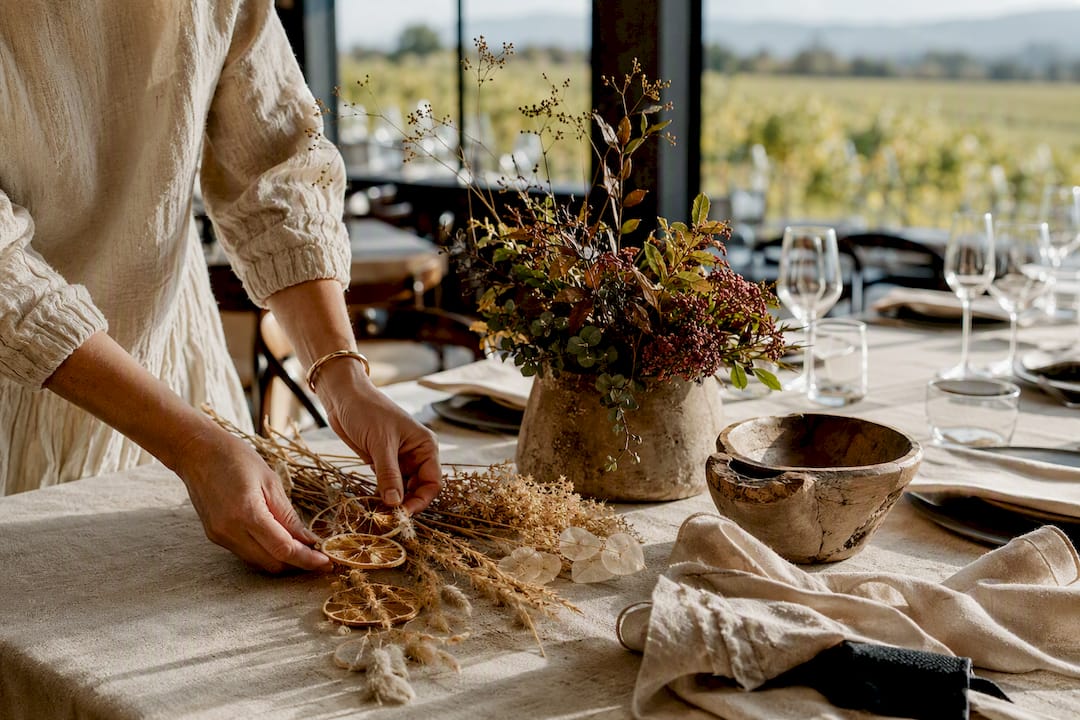
If your venue has its own mature garden, orchard, or vineyard setting, lean on it rather than importing a look that fights the surroundings. A vineyard reception barely needs floral height when the vines themselves provide the backdrop; a coastal venue benefits more from simple grasses and driftwood than from an elaborate tropical arrangement that feels imported and out of place.
Personalisation ideas for decorations
A monogram, whether projected onto the dance floor, embroidered into napkins, or stitched onto a hanging backdrop, remains one of the simplest ways to make a rented or borrowed setup feel unmistakably yours. It costs comparatively little for the amount of “this is our day” impact it delivers.
Photo displays work best when curated rather than exhaustive. A single well-edited timeline, five or six images spanning childhood to engagement, hung along one feature wall, reads far better than dozens of loose prints scattered across side tables. Guests actually stop and look at a curated wall; they tend to skim past clutter.
Couple-specific themes, built around a shared hobby, a travel destination that matters to you, or even a favourite film or era, give your florist or stylist something concrete to design around rather than a generic brief. Winelands Function’s guide to customising wedding decor covers how to brief a stylist on a personal theme without it tipping into novelty-party territory. The goal is always a detail guests notice and remember, not a gimmick that dominates the room.
Coordinating decorations with your wedding attire and overall style
Decor and attire should be reading from the same brief, not fighting for attention in photographs. A structured, formal gown with a long train suits equally structured tablescapes, tall centrepieces, crisp linen, symmetrical florals, while a flowing, bohemian dress pairs more naturally with looser, asymmetric arrangements and mismatched vintage vessels.
Colour palette is the easiest coordination point and the one most frequently overlooked. If your bridal party is in a rich jewel tone, echo a note of that colour somewhere in your centrepieces or linen rather than defaulting to all-white florals; the visual link between attire and table settings is what makes wedding photography feel cohesive rather than assembled from two separate events.
Texture matters as much as colour. A lace or beaded gown suits textured napkins, chargers, and candle holders with some visual weight to them; a sleek, minimal silhouette pairs better with clean glassware and simple, uncluttered table settings that don’t compete with the dress’s own lines. The same logic extends to suits and groomsmen’s attire, tweed and rustic wedding themes belong together, just as sharp tailoring suits a more architectural, modern wedding decor approach.
How Winelands Function prioritises decor for client events
Every reception we style starts with the same question: which zones will guests actually spend time in, and which will the camera find first? That’s usually the entrance, the tables, and one vertical feature, exactly the order this guide follows. On a recent Winelands vineyard reception, we shifted spend away from an elaborate ceiling installation and into layered table lighting instead; the tables became the visual anchor in every photograph, and the client’s guests remembered the warmth of the room more than any single decor piece.
If you take one thing from this article, draft a rough impact-zone budget this week, even a simple split across entrance, tables, and one statement feature. It forces the right priorities before a single deposit is paid.
— Coert
Bring your reception decor ideas to life with Winelands Function
Winelands Function turns the ideas in this guide into a room you don’t have to build yourself: full-service styling, supplier coordination, and on-the-day management, so no one on your guest list is holding a staple gun an hour before the ceremony. Where a DIY approach demands your evenings for months, our process replaces that workload with a single point of contact who manages florists, lighting riggers, and venue teams on your behalf.
A first consultation typically covers your priorities and budget across impact zones, a moodboard reflecting your chosen palette and trend focus, and a clear quote before any supplier is booked. If you’d like the tablescapes, lighting, and hanging installations described above coordinated by people who do this every week, get in touch through Winelands Function’s wedding planning page to check availability for your date.
Sources
- Wedding reception decoration ideas | Paperlust
- Wedding decor checklist | Brides
- Transform your wedding reception space | The Knot
- DIY wedding decor ideas | Bespoke Bride
FAQ
What are some good ideas for decorating a wedding reception?
Start with the three highest-impact zones: layered lighting (string canopies, candle clusters, uplighting), a coherent tablescape with mixed-height centrepieces, and one statement vertical feature such as a floral cloud or fabric canopy above the dance floor.
What are some simple decorations for a wedding reception?
Candle clusters at varying heights, a textured table runner with a charger plate, and printable signage mounted on foamboard all deliver a polished look without requiring rigging, hired equipment, or a large budget.
What are the wedding decor trends for 2026?
Heavy drapery and luxe fabric backdrops, 80s-glamour and Rococo-influenced tablescapes, shell motifs, fruit and vegetable centrepieces, and layered warm lighting are the leading 2026 trends; pick one as your focal point rather than combining them all.
What are some DIY ideas for decorating a wedding reception?
Dried-flower centrepieces, candle clusters, ribbon or tulle backdrops, and paper-fan photo walls are the most practical DIY projects because they hold up well when made weeks or months in advance, unlike fresh floral work.
How much should I budget for reception decorations?
There’s no universal figure, but planners consistently recommend funding entrance styling, tables, dance floor, and lighting first, and trimming lounge furniture or secondary bar styling before cutting spend on those core zones.