
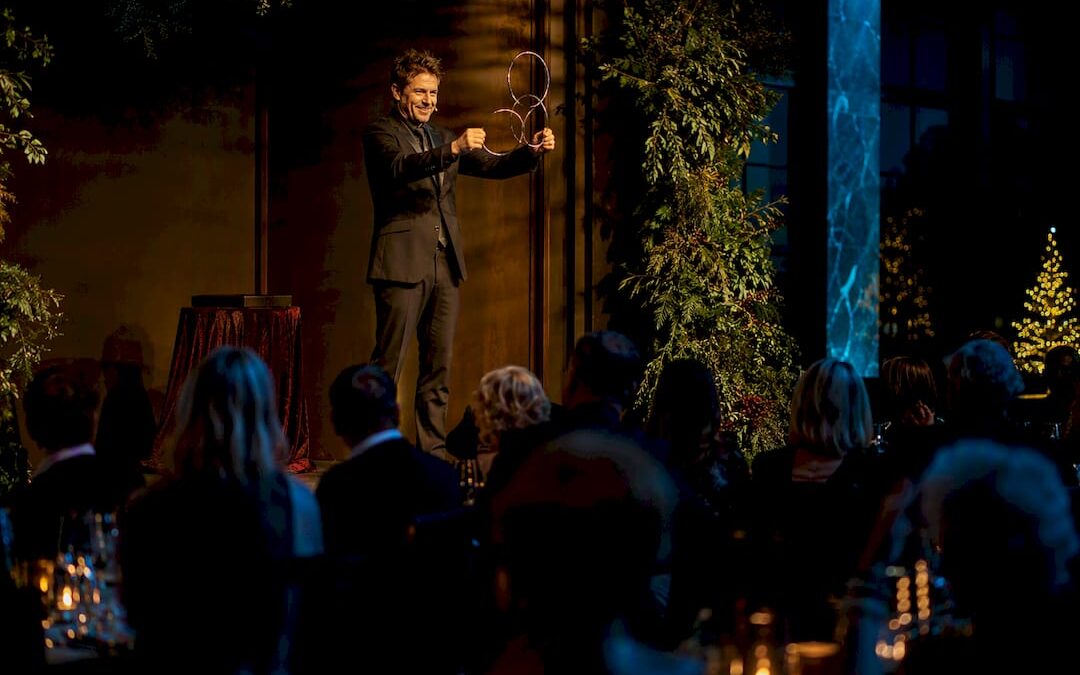
The formula that works every time: pair a roaming visual act during arrival with one concise shared main event lasting 20 to 45 minutes, then close the evening with music and dancing. Entertainment only needs to do three things well: break the ice, deliver one moment everyone experiences together, and give the night a clear, satisfying finish.
TL;DR:
- Roaming acts during arrival help break the ice and should be booked for 60 to 90 minutes, timed with the drinks reception.
- The main stage entertainment should last no more than 20 to 45 minutes to maintain audience engagement, ideally combining visual and verbal acts.
- Interactive stations like photo booths or team trivia enable guests to participate at their comfort level and can serve as conversation starters.
- Music should transition from background to full dance set, with a DJ or hybrid live band providing flexibility for different moments.
- Booking entertainment several months in advance, especially for prime December weekends, is essential to secure availability and manage technical requirements.
Table of Contents
- Corporate Christmas party entertainment ideas by evening slot
- How do you choose the right entertainment for your event?
- When should entertainment happen during the party?
- What should you budget for logistics and timing?
- The Winelands Function perspective on corporate entertainment
- A planner’s note on getting this right
- Bring in Winelands Function to run the whole evening
- Sources
- FAQ
Corporate Christmas party entertainment ideas by evening slot
Choosing entertainment becomes far simpler once you stop thinking of it as one decision and start thinking of it as four smaller ones, each tied to a different part of the evening.
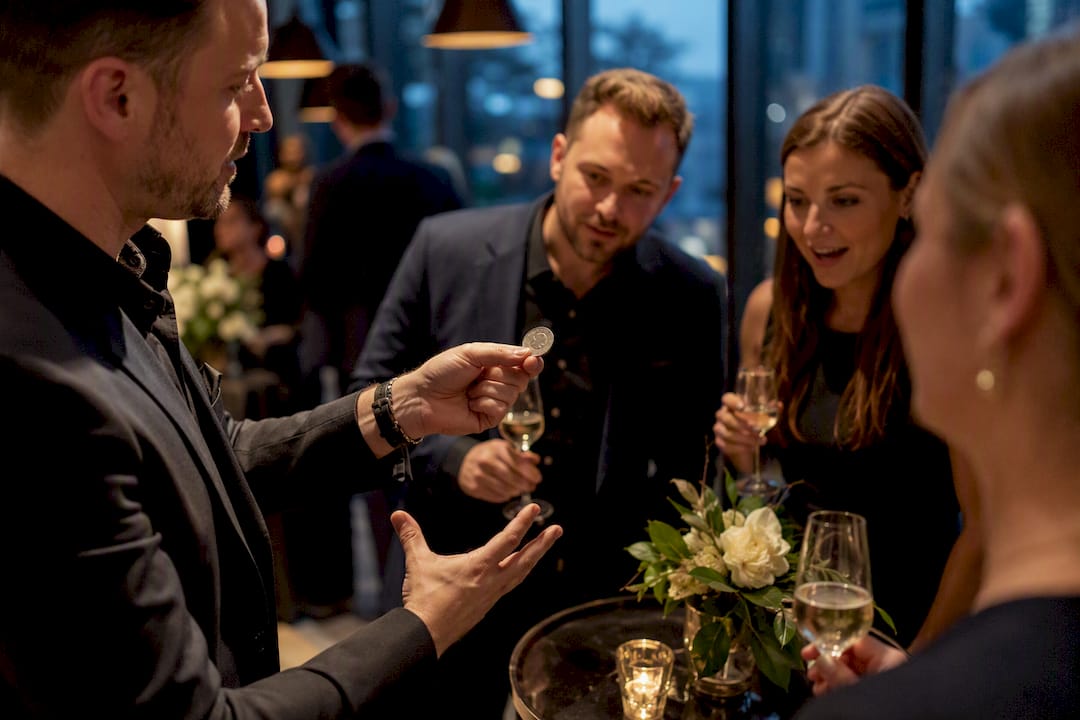
Cocktail hour: roaming acts that spark conversation. Close-up magicians working table to table, strolling musicians, or a living statue near the entrance all solve the same problem: guests who don’t know each other well and need a reason to talk. Roaming close-up magic during arrivals reliably breaks the ice for groups of 50 to 150 guests, because it gives strangers a shared reaction rather than forcing small talk from nothing. Book a strolling act for 60 to 90 minutes, timed to the drinks reception rather than the whole evening.
Main stage: one shared moment, not several. A short comedy set, a stage magic and variety act, or a tight theatrical piece all work, provided they run for 20 to 45 minutes. Longer than that and attention drifts, especially with an open bar in play. Keep material clean and broadly appealing. A planner’s most useful rule here is to combine one visual act and one verbal act, such as magic paired with a DJ, or a band paired with a comedian, so the evening covers different tastes without competing for the spotlight.
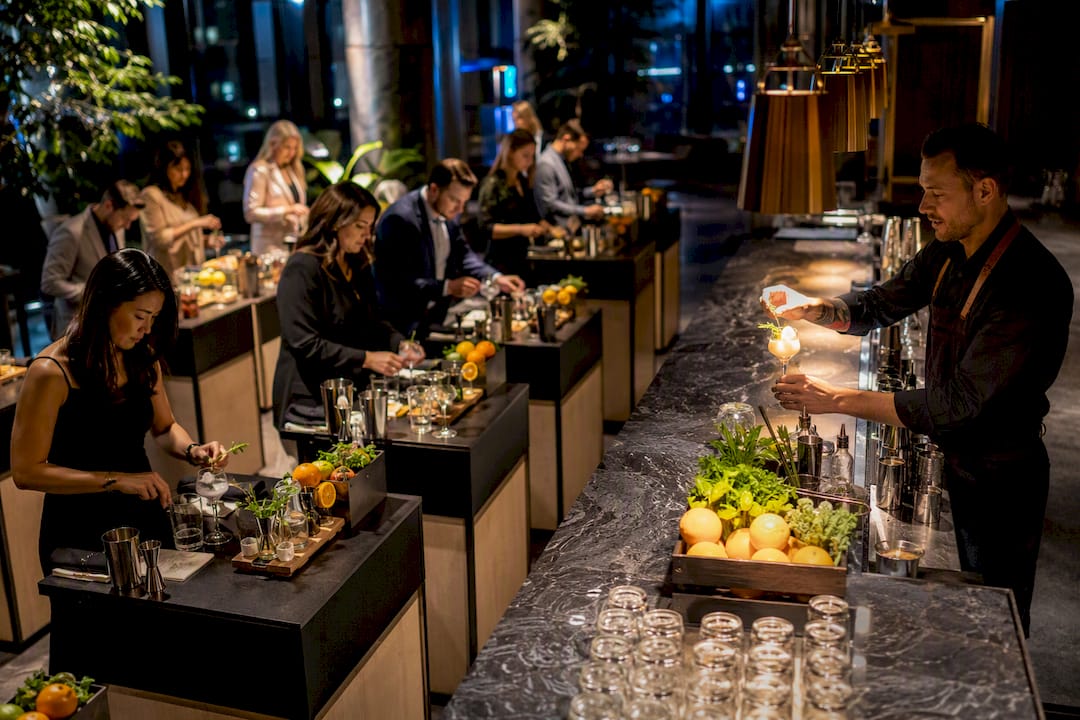
Interactive stations: entertainment guests can opt into. Photo booths, cocktail or cookie-decorating workshops, casino tables, and team trivia or game-show formats all scale well and let guests self-select their level of participation. For photography, a roaming photographer often captures more usable, candid images across the whole night than a fixed photo booth, particularly if you want a gallery that reflects the whole room rather than just the people who queued. For a genuinely large or client-facing event, an interactive luxury activity built around a tasting or workshop theme can double as a talking point long after the party ends.
Music: DJ, live band, or both. A DJ alone is the most flexible, lowest-risk option and works for almost any guest list. A live band adds energy but needs more stage space and load-in time. The middle path, a DJ with one or two live players, keeps the room conversational during dinner and still opens into a full dance set later, without the cost of a full band.
Virtual and hybrid options. For distributed teams or a scaled-back budget year, mailed cocktail, cooking, or chocolate-making kits paired with a live host work well, typically running from $45 to $195 per person depending on kit contents and how much live instruction is included. Hybrid trivia, where in-room and remote teams compete on the same leaderboard, is another format that doesn’t leave remote staff watching from the sidelines.
- Roaming magic or music for arrivals (60 to 90 minutes)
- One main-stage act as the shared high point (20 to 45 minutes)
- At least one interactive station guests can opt into
- Music that flexes from background to full dance set
- A virtual or hybrid layer if any staff are remote
Pro Tip: Book your visual act (magician, living statue, roaming photographer) and your verbal act (comedian, band frontperson) from different suppliers. If one cancels, you still have a functioning evening rather than a gap where the entertainment used to be.
For catering that matches the tone of your entertainment lineup, festive menu concepts are worth reviewing alongside your entertainment shortlist, since food and performance timing often overlap more than planners expect.
How do you choose the right entertainment for your event?
Three questions narrow the field faster than any style guide:
- What is the goal of the party? A thank-you event for a close-knit team wants warmth and shared laughter. A client-facing celebration wants polish and a visible “wow” moment.
- Who is in the room? A young, informal team leans towards interactive and music-heavy formats. A mixed-seniority crowd with partners and clients present benefits from clean comedy and elegant staging over anything audience-participation-heavy.
- What does the venue allow? Sound curfews, low ceilings, and fire code capacity limits can rule out live bands or drone displays before you’ve even opened a quote.
Budget expectations vary widely, but three rough tiers help set the conversation:
- Modest: DJ plus one roaming act, no stage production
- Mid-range: DJ or hybrid band, main-stage act, one interactive station
- Premium: Full production with staging, live band, multiple interactive zones, and a scripted run of show
Before booking anyone, confirm availability for your exact date, any technical or dressing-room requirements (the rider), travel costs if the act is coming from out of town, public liability insurance, and the cancellation policy in writing.
When should entertainment happen during the party?
Sequencing determines whether entertainment feels like a highlight or an interruption. Roaming acts belong in the arrival and cocktail window, when guests are still finding their seats and welcome a reason to linger. The main show should land after the meal, once glasses are topped up but before energy dips, never squeezed between courses. Speeches sit either just before or just after the main act, never competing with it for attention. Dancing opens last, once the formal part of the night is done and guests are free to leave the floor without feeling they’ve missed anything.
A few durations to plan against: mingling magic runs comfortably for 60 to 90 minutes, a main show should rarely exceed 45 minutes, and the dance floor should open with at least 90 minutes of runway before last orders.
- Dinner-plus-dance format: Arrival drinks with roaming act (60 min) → seated dinner → main-stage act (30 min) → speeches (15 min) → DJ and dancing (remainder of night)
- Cocktail-to-dance format: Roaming acts and interactive stations run concurrently (90 min) → main-stage act (20 to 30 min) → DJ transitions straight into dancing
Pro Tip: Never schedule the main act immediately after speeches. Attention drops sharply once formal remarks finish, and even a strong performer struggles to win the room back within the first five minutes.
What should you budget for logistics and timing?
High-demand December weekends book out early, and planners typically secure entertainment several months in advance, with many vendor bookings clustering 30 to 60 days before the event for less competitive dates. If your event falls on a prime Friday or Saturday in December, treat October as your latest realistic booking deadline.
- Confirm power, staging, and load-in access with the venue before booking any act requiring equipment
- Ask hotels and ballrooms about noise curfews and union labour rules for AV setup
- Budget a premium finale, such as a drone light show, only for large or client-facing events, since these typically start around $15,000 to $20,000
- Interactive experience buyouts scale with guest count, and many venues offer weekday discounts worth asking about directly
The best return on spend rarely sits with the flashiest single act. It sits with paying for a professional to sequence the night properly, since a party planned around its entertainment consistently outperforms one where acts are bolted on as an afterthought.
The Winelands Function perspective on corporate entertainment
Winelands Function is a luxury event planning company based in Cape Town, specialising in high-end weddings, corporate events, and bespoke celebrations built on elegance and close attention to detail. The portfolio and industry insights on the Winelands Function site reflect a full-service approach to matching entertainment, staging, and guest experience to a company’s brand and budget, from intimate gatherings to large corporate launches.
A planner’s note on getting this right
The mingling-plus-main-event-plus-dancing formula works because it respects how attention actually moves through a room, not how an agenda looks on paper. My tactical tip: choose entertainment that creates a moment for colleagues to be recognised, a toast, a shout-out, a team award folded into the show, rather than one that puts nervous staff on the spot.
— Coert
Bring in Winelands Function to run the whole evening
Winelands Function is the alternative to piecing together entertainment yourself, act by act, supplier by supplier. Where the sections above give you the framework, a full-service planner handles the execution: supplier coordination, a bespoke run of show built around your guest list and venue, and staging that carries your company’s tone from the welcome drink through to the last dance.
Winelands Function’s corporate event management service covers everything from initial concept through on-the-day delivery, so you’re not the one chasing riders, cancellation policies, or load-in times the week before the party. Planning lead times for premium December dates fill quickly, so enquire early if you want a specific weekend secured. Request a proposal through the corporate event management page to start the conversation about your 2026 celebration.
Sources
- Corporate Christmas Party Entertainment Ideas: What Actually Works in 2026
- Top entertainment for corporate holiday parties
- 2026 Company Holiday Party Entertainment: 8 Ideas + Costs
- 14 activities, experiences and entertainment ideas for corporate holiday parties
FAQ
What are some good ideas for a corporate Christmas party?
Pair a roaming act such as a close-up magician or strolling musician during arrivals with one main-stage moment of 20 to 45 minutes, then move into music and dancing once formalities are done.
What entertainment works best for an office Christmas party?
For smaller office parties, interactive stations like cocktail-making workshops, casino tables, or team trivia work well because they scale to any group size and don’t require a stage.
What are some fun and interactive corporate games for a Christmas party?
Team trivia and game-show formats, hybrid trivia for mixed in-person and remote teams, and casino-style tables all give guests a reason to interact without forced audience participation.
How much should we budget for Christmas party entertainment?
Costs range widely: a DJ and roaming act sits at the modest end, hybrid live music and a main-stage act sit mid-range, and premium options like drone finales typically start around $15,000 to $20,000. Winelands Function can advise on a realistic budget once your guest count and venue are confirmed.
When should we book entertainment for a December party?
Book as early as possible for prime December weekends, since high-demand dates fill months ahead and many vendor bookings cluster 30 to 60 days before less competitive dates.