

Planning and coordination for a luxury event means hiring a lead planner who combines creative direction, project management and on-the-day coordination, turning you into a guest at your own celebration. The right partner protects your budget, curates a handful of exceptional vendors, and stays present through every changeover so nothing depends on you. If you take one action after reading this, make it a portfolio review with a planner who limits their annual client list. This process is structured to cover everything from first briefing through to final teardown.
TL;DR:
- A luxury event planner should have a limited annual client list of 6 to 8 to ensure personalized attention and high-quality service.
- They must produce detailed production documents, such as run sheets, vendor contracts, and floorplans, to manage complex multi-day schedules effectively.
- On-the-day coordination requires a consistent lead planner, with staffing ratios of about 1:4 to 1:2, to provide anticipatory service and respond swiftly to unforeseen issues.
- Communication should follow a set schedule, progressing from monthly updates to daily confirmations, with a direct line to the lead coordinator on event day.
- Verify credentials through demonstrated experience, detailed project documents, and client references, rather than certificates or portfolios focused solely on aesthetics.
Table of Contents
- What luxury planning and coordination actually involves
- The core stages of planning and coordination: a practical checklist
- Why on-the-day coordination is decisive at the luxury level
- How to evaluate and hire a luxury planner
- How Winelands Function’s workflow shows planning and coordination in practice
- Why luxury planners limit their client list to 6 to 8 a year
- How often should your planner actually be in touch?
- How a good planner handles the unexpected
- How to check a planner’s credentials and portfolio properly
- Why professional coordination is the smarter investment
- See Winelands Function’s portfolio and start the conversation
- Sources
What luxury planning and coordination actually involves
A luxury planner performs three jobs at once: creative director, project manager and budget steward. As creative director, they translate your taste into a design concept and brief every vendor to that standard. As project manager, they build and hold the timeline across dozens of moving parts. As budget steward, they negotiate contracts and stop overspend before it happens, a triad that Los Angeles Times wedding coverage points to as the reason planner fees run high.
The production realities separate luxury events from standard ones. Multi-day schedules, bespoke builds, technical riders and rehearsal runs are normal, not exceptional.
- Staff-to-guest ratios at the luxury tier often sit between 1:4 and 1:2, well above what a standard event would budget, according to Glion’s analysis of luxury event planning.
- Anticipatory service, where staff act before a guest asks, is the hallmark of white-glove hospitality.
- Full-service luxury planners commonly cap intake at 6 to 8 weddings a year to protect that level of attention.
This is service as a standard of quality, not a price tag attached to a guest list.
The core stages of planning and coordination: a practical checklist
Every luxury event moves through the same sequence, whether it is a wedding or a corporate product launch. Knowing the stages lets you judge whether a planner’s proposal is thorough or thin.
- Briefing and priorities. The planner spends real time understanding your guest experience objectives, not just your colour palette. This session sets the design brief and the non-negotiables.
- Design concept and vendor curation. Rather than handing you a long preferred list, a genuine luxury planner hand-selects two or three vendors who fit your aesthetic and operational needs.
- Budget stewardship and contracts. Expect transparent line items, negotiated vendor rates and a payment schedule you can check against deliverables at each stage.
- Production planning. Floorplans, technical riders and run sheets get built here, often using AutoCAD, SketchUp or VR walkthroughs so you can see the room before it exists.
- On-the-day execution. Staffing rosters, radio or app-based communication channels, and contingency plans for weather, transport or vendor delays all sit under one coordinator.
- Post-event wrap. Vendor invoices get reconciled, deposits returned where due, and a short report closes the loop.
Pro Tip: Ask to see an actual run sheet from a past event of similar scale. A planner who cannot produce one on request likely hasn’t built a proper production plan for your date either.
Rehearsals matter more than most clients expect. zkipster’s guidance on world-class luxury events treats a full team walkthrough as essential, not optional, for anything with live entertainment, multiple vendor handoffs or a tight ceremony-to-reception turnaround.
Why on-the-day coordination is decisive at the luxury level
Design work is only half the job. What happens on the day determines whether the vision survives contact with a real guest list, a live band running late and a caterer short one server.
Anticipatory service is the clearest expression of this. A coordinator who has walked the venue twice already knows where the step-down is before a guest in heels finds it. VIP management works the same way: quiet redirection of a wandering keynote speaker, a discreet second exit for the bridal party, none of it visible to anyone but the person being managed.
- Staffing ratios prove the point. Glion reports ratios of roughly 1:4 to 1:2 at the luxury tier, compared with far thinner coverage at standard events.
- Lead-partner continuity matters just as much. The same person who ran your briefing should be the person holding the earpiece on the day. Handing the file to a junior for execution is where information gets lost and design intent gets diluted.
Luxury event staffing typically runs at a 1:4 to 1:2 staff-to-guest ratio, enabling the kind of anticipatory attention that standard event staffing cannot match.
That continuity is not a nicety. It is the difference between a planner who designed your event and a planner who is still present when it happens.
How to evaluate and hire a luxury planner
Treat the hiring conversation as due diligence, not a sales pitch. A planner worth retaining will welcome direct questions about capacity, process and cost.
Questions worth asking in the first meeting:
- Ask how many events the planner personally leads annually and who will be your point of contact on the event day.
- Can you show recent portfolio work at a comparable budget, not just your best-ever event?
- How do you vet and select vendors, and how many will you actually propose?
- What is your contingency plan if a headline vendor cancels close to the date?
Red flags to walk away from:
- A planner with total availability at a bargain rate for your peak-season date.
- Vague answers about who is physically present at your event.
- No references, no in-house production plan, and no willingness to share a sample run sheet.
Pricing: Full-service luxury planning is typically priced as a percentage of total spend, commonly cited in the 15 to 20% range, with 18% referenced as a common industry figure. That fee usually covers design, vendor negotiation, full production management and on-the-day staffing, reflecting the hundreds of hours behind a single event day. Flat fees appear too, particularly for corporate work with a fixed scope.
Contract essentials to require:
- A detailed scope of work naming every deliverable, not a vague summary.
- A staged payment schedule tied to milestones.
- Force majeure and cancellation terms spelled out in plain language.
- Clarity on who pays vendors directly, the planner or you.
How Winelands Function’s workflow shows planning and coordination in practice
Luxury weddings, corporate launches and bespoke celebrations in Cape Town and the Western Cape are planned following the process described above.
- Every engagement starts with a design brief tied to your guest experience goals, not a template questionnaire.
- Vendor selection follows the curation model: a short, hand-picked shortlist rather than a generic directory.
- Production planning, timelines and floorplans are documented in a step-by-step coordination workflow you can review before signing anything.
- On-the-day staffing and communication protocols sit within our event planning coordinator service.
…
Why luxury planners limit their client list to 6 to 8 a year
The 6 to 8 client figure isn’t a marketing flourish. It reflects the arithmetic of genuine bespoke service: a planner overseeing a dozen or more weddings a year cannot personally attend every site visit, negotiate every contract, or be the one holding the earpiece on your day.
Capacity limits protect three things at once. First, design originality. A planner juggling too many clients starts reusing the same vendors, the same floral formulas, the same run sheets, because there isn’t time to build fresh concepts for each one. Second, responsiveness. A smaller roster means your calls get answered by the actual decision-maker, not a rotating assistant. Third, on-the-day presence. Lead-partner continuity, the model where the same senior planner runs your briefing and stands beside you during execution, only works at scale if that person isn’t double-booked across three venues on your date.
This is worth asking about directly during your first consultation. A planner who cannot tell you, without hesitation, how many events they’re committed to in your target month is either overextended or hasn’t thought about it, and neither answer inspires confidence for a date you cannot reschedule.
For corporate clients, the equivalent question is simpler: ask how many concurrent launches or activations the team is running that quarter, and whether your account gets a dedicated lead or a shared one.
How often should your planner actually be in touch?
Communication cadence separates a planner who is managing your event from one who is merely tracking it. Expect a documented rhythm, not sporadic updates when something goes wrong.
Most full-service luxury planners work to a tiered schedule. In the early months after signing, monthly check-ins are typical, covering design decisions, vendor shortlists and budget tracking against the original estimate. As the date approaches, usually inside the final 8 to 12 weeks, that cadence tightens to fortnightly or weekly calls, alongside a shared planning document you can check anytime rather than waiting for a scheduled update.
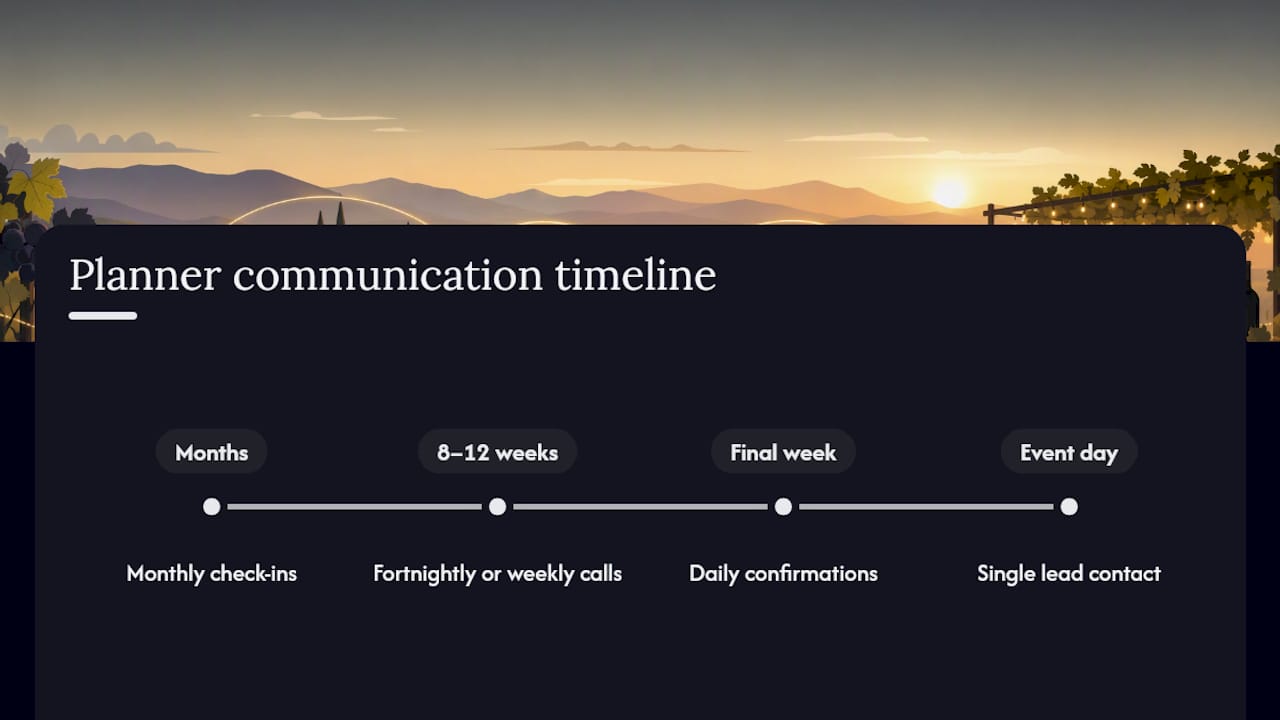
In the final week, communication should shift to daily confirmation: vendor arrival times, final headcounts, weather contingencies if you’re outdoors, and a finalised run sheet everyone involved has seen. On the day itself, you should have one direct line to your lead coordinator and nobody else, so decisions don’t get diluted through a chain of assistants relaying messages.
Ask prospective planners how they report progress. A planner who cannot describe a specific cadence, and instead says “we’ll be in touch as needed,” has not built a communication system. Written updates matter too: a shared document or project tool creates a paper trail on decisions, useful if a dispute arises later over what was agreed and when.
How a good planner handles the unexpected
Nothing goes entirely to plan, and the measure of a luxury planner is not whether problems happen but how invisibly they get resolved. Rehearsals and contingency planning exist precisely because production-level logistics carry real risk once dozens of vendors and hundreds of guests are involved.
Weather is the most common disruptor for outdoor Cape Town celebrations, and a competent planner will have a wet-weather floorplan ready before you ever ask about one, not scrambling for a tent supplier the morning of. Vendor no-shows or late arrivals need a backup contact already briefed on your event, ready to step in without you noticing a gap. Guest-related issues, a delayed flight, a medical concern, a seating conflict, get absorbed by the coordination team rather than escalated to the host.

The structural fix for all of this is the same lead-partner continuity model discussed earlier: one person holding the full picture, empowered to make real-time decisions without phoning you for approval on minor calls. Ask during your interview what decisions your planner can make independently on the day, and what genuinely requires your sign-off. A clear answer here tells you more about crisis readiness than any polished portfolio image.
How to check a planner’s credentials and portfolio properly
Certifications exist in this industry, but they matter less than demonstrated production capability. A portfolio full of beautifully styled photographs tells you about a planner’s aesthetic eye; it tells you nothing about whether they can hold a floorplan together when a marquee delivery runs three hours late.
Look past the photography to the substance behind it. Ask to see a run sheet, a vendor contract template, or a budget tracker from a past event, redacted for privacy if needed. A planner with genuine production experience will have these documents ready and will speak fluently about the logistics behind each image, not just the styling choices.
References matter more than certificates. Speak to at least one recent client whose event was a comparable scale to yours, and ask specifically about communication during the final weeks and how the planner handled anything that went wrong. A planner who cannot offer any reference, or offers only written testimonials with no contact available, warrants caution.
Finally, weigh portfolio range against consistency. A planner who has clearly worked across multiple venues, guest counts and styles, while maintaining the same standard of finish throughout, has proven adaptability. One whose entire portfolio looks identical may simply be repeating a formula rather than designing to your brief.
Why professional coordination is the smarter investment
Affluent hosts underestimate how much of their own event they will actually experience without dedicated coordination. Every unmanaged supplier question, every timeline decision, every “quick word” from a guest pulls you out of the moment you paid to create. A concierge-level planner absorbs all of that, and the return isn’t abstract: it shows up as a calmer host, a guest experience that feels effortless rather than managed, and vendors who perform at their best because someone competent is holding them to the brief.
The real risk of skipping this is not a bad photograph or a late canapé. It is a host who spent a year planning a celebration and remembers none of it because they were managing logistics instead of living it. If that risk sounds familiar, request a consultation or a portfolio review before you commit to a date.
— Coert
See Winelands Function’s portfolio and start the conversation
Luxury weddings, corporate launches and bespoke celebrations across Cape Town and the Western Cape are planned and coordinated, handling everything from the first design brief to the final vendor reconciliation. Rather than a template package, a shortlist of hand-picked vendors tailored to the specific event is built and a dedicated lead partner stays present through every stage on the day itself.
If you recognise your event in anything covered here, start with our event planning coordinator service to see how the process works in detail, or review our step-by-step coordination workflow for a concrete look at how we run production planning and on-the-day execution. Book a consultation when you’re ready to discuss your date, and bring your questions on staffing ratios, vendor curation and fees. We’re used to them.
Sources
- Luxury event planning: crafting unforgettable experiences – Glion
- What Is a Luxury Wedding Planner? Here’s What to Look For – The Knot
- Understanding exactly what it means to be a luxury wedding planner – Style Me Pretty
- How to plan a luxury event like a world-class event planner – zkipster