

Luxury wedding planners typically charge in one of four ways: a percentage of the total budget (commonly in the range of 10% to 20%), a flat fee, an hourly consulting rate, or a hybrid of these. For a full-service luxury wedding, expect a flat-fee band that often starts around $8,000 to $10,000 and climbs well beyond that for multi-day destination events, while day-of coordination tends to sit far lower. Providers typically scope each fee against guest count, venue complexity, and staffing before quoting.
TL;DR:
- Percentage-based fees usually range from 10% to 20% of the wedding budget, with higher rates for ultra-high-budget weddings over $150,000.
- Flat fees for full-service planning generally start around $8,000 to $10,000, rising significantly for destination or multi-day events.
- Additional costs such as travel, custom design, and extended staffing can substantially increase the overall planning fee beyond the base quote.
- Clear scope and staffing details are essential in proposals to avoid unexpected costs and scope creep, especially for complex or multi-day weddings.
- Hybrid fee models combining a fixed base fee with a percentage for design or décor are increasingly popular, offering both predictability and scalability.
Table of Contents
- How much does a wedding planner cost? Pricing models explained
- What will a planner actually cost you? Worked examples
- What actually drives a planner’s fee up or down?
- Comparing proposals: the contract checklist to run through
- The career path into luxury wedding planning
- What venues and firms typically pay planners, and how that varies by market
- Freelance planners versus those employed by agencies or venues
- Do certifications and education actually raise a planner’s fee?
- How wedding planner fees have shifted over recent years
- Where else planner income comes from beyond your fee
- How Winelands Function approaches pricing and scope
- Ready to get a clear, honest quote?
- Sources
How much does a wedding planner cost? Pricing models explained
Every proposal you receive will be built on one of four pricing structures, and knowing which one you’re looking at changes how you should read the number.
Percentage-based fees remain the standard for full-service, luxury and multi-day events, commonly ranging from 10% to 20% of the total event budget. The logic is straightforward: a larger, more complex budget means more suppliers, more contracts, and more hours of coordination, so the fee scales with the work. For ultra-high-budget weddings, some luxury planners charge between 15% and 20% and often set minimum budget thresholds starting at about $150,000, before they’ll quote on a percentage basis at all.
Flat-fee packages have become more common across the wider market because they give clients certainty from day one. Many planners have shifted toward flat fees for predictability, while premium and destination specialists tend to hold onto percentage or hybrid models when a budget is likely to move.
Hourly consulting suits couples who need targeted expertise, perhaps a single design consultation or vendor negotiation, rather than end-to-end management. Hybrid pricing blends a fixed base fee for core planning with a percentage applied only to the design and décor spend, which is increasingly the preferred structure for high-end weddings.
Each model carries trade-offs worth weighing before you sign anything:
- Percentage fees align the planner’s incentive with your budget size but can feel steep on very large spends.
- Flat fees offer cost certainty but risk scope creep if deliverables aren’t tightly defined.
- Hourly rates work well for narrow engagements but poorly for full coordination.
- Hybrid models balance predictability and flexibility, though they demand a clear breakdown of what’s fixed versus variable.
What will a planner actually cost you? Worked examples
Numbers make this easier to plan around. Take a typical planning fee of 15% applied to a $100,000 wedding budget, a mid-range figure within the 10 to 20% band typical for full-service work: that’s $15,000 for the planner. Apply the same 15% fee to a $250,000 budget, and the fee rises to $37,500, which is exactly why percentage models suit fluid, high-value events better than fixed quotes do.
Cost snapshot: Standard-market full-service coordination averages around $4,000, but luxury and destination planning fees can be considerably higher when travel, custom design, and extended staffing are involved.
Sample flat-fee bands, treated as illustrative starting points rather than fixed quotes, tend to look like this:
- Full-service planning: from around $8,000 to $10,000, rising sharply for destination or multi-day celebrations.
- Partial planning: typically lower, aimed at couples who’ve secured a venue and key vendors but want professional coordination from that point forward.
- Day-of (or “month-of”) management: the smallest band, usually covering final logistics, timeline execution and on-site oversight only.
Additional services often increase the overall cost beyond the base fee. International travel for the planning team, multi-day staffing for events spanning a welcome dinner through to a farewell brunch, and large production elements such as custom staging or elaborate floral installations all sit outside a base quote more often than clients expect.
What actually drives a planner’s fee up or down?
Two couples with near-identical budgets can receive wildly different quotes, and the gap almost always traces back to a handful of variables.
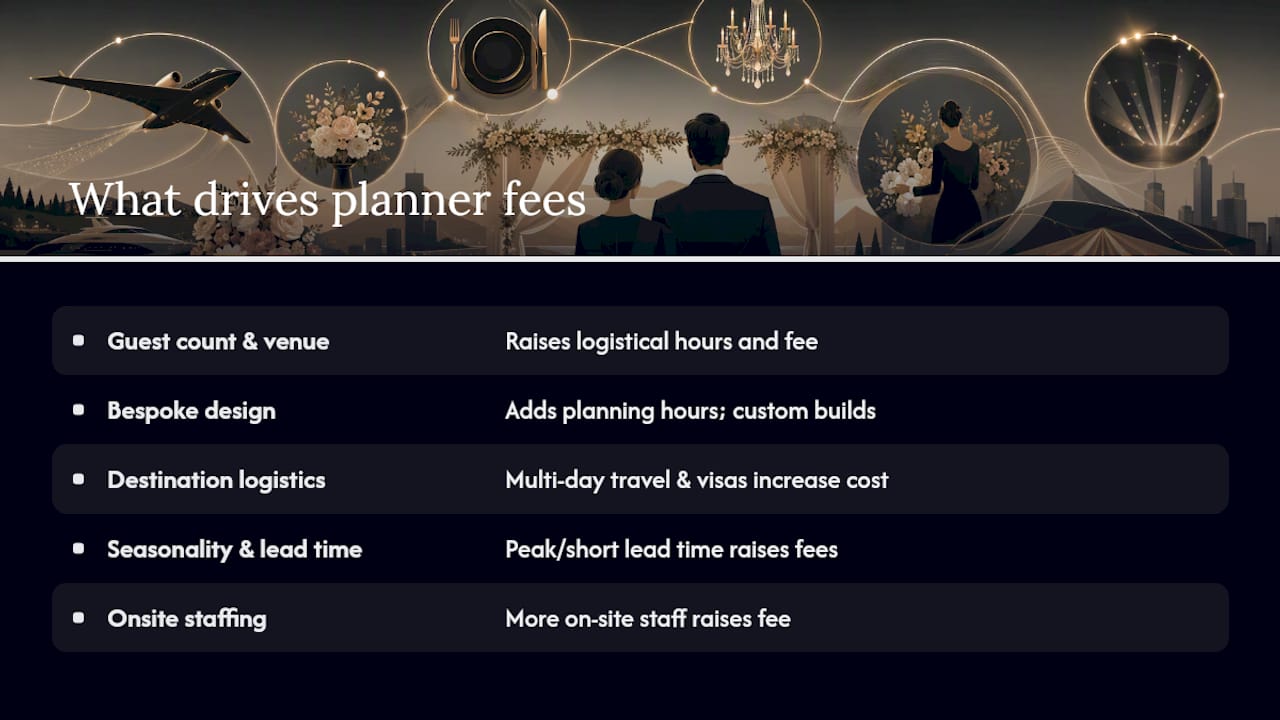
Guest count and venue complexity matter most. A 300-guest celebration across a heritage estate with limited vehicle access demands more logistical hours than a 60-guest dinner in a single ballroom, regardless of the overall spend. Bespoke design work, custom builds, imported florals, layered lighting design, adds hours that a standard package fee was never built to absorb.
Destination logistics change the maths substantially. Multi-day events, visa coordination, guest travel management and on-site staffing across several days all carry costs that a domestic single-day wedding simply doesn’t incur.
Seasonality, lead time and vendor minimums also move the number. Peak-season dates with short lead times reduce a planner’s negotiating room with in-demand suppliers, which can raise both the fee and the underlying vendor costs.
Staffing model deserves particular attention, because it’s the factor clients most often forget to ask about. Request the exact staffing plan for your wedding day: who is your named lead, how many assistants will be present, and whether that lead personally attends your rehearsal. A larger onsite team materially affects both the fee and the coordination effort for destination and multi-day weddings.
Pro Tip: Ask every planner you interview to name their day-of point of contact by title, not just “a member of our team”. If they can’t answer specifically before you’ve signed, that’s a preview of how vague the wedding-day communication will be.
Guest experience standards on the day also shape effort levels; complex venues with high service expectations, of the kind explored in this guide to guest experience in hospitality, typically require more planning hours than a simpler setup.
Comparing proposals: the contract checklist to run through
A proposal that looks cheaper on paper can end up costing more once the gaps surface. Run every quote through this checklist before you decide.
- Scope of work. Ask for a written list of exactly what’s included, because full-service wording is not standardised across the industry, and travel coordination or custom production may be billed separately even under a “full-service” label.
- Staffing detail. Confirm the named lead, assistant count, and rehearsal attendance in writing, not verbally.
- Vendor payment flow. Establish whether the planner pays suppliers directly from your funds or simply coordinates payments you make yourself.
- Overtime and travel rates. Get the hourly overtime rate and any travel surcharge in the contract, not as a verbal estimate.
- Payment structure. Expect a non-refundable retainer followed by scheduled instalments, and clarify which instalments become non-refundable and when.
- Cancellation terms. Read the cancellation and postponement clauses closely; destination weddings often carry stricter terms given non-refundable supplier deposits.
Red flags worth pausing on: a scope document that reads like marketing copy rather than a deliverables list, or a planner who can’t specify staffing when directly asked. Our duties checklist guide breaks down what a fully staffed contract should cover in more detail.
The career path into luxury wedding planning
Most planners working at the luxury end of the market don’t arrive there straight from a course certificate. The typical route runs through hospitality, event production, or hotel and venue operations, often several years spent coordinating logistics for other people’s events before taking on independent client work.
That grounding matters because luxury planning is less about taste and more about supplier negotiation, contract literacy, and crisis management under pressure. Planners who’ve spent time inside venue operations or catering tend to understand vendor minimums, staffing ratios and production timelines far faster than those coming in without that background. Corporate buyers and event organisers evaluating a planner’s credentials should ask specifically about prior event scale and supplier relationships, not just years in business, since a planner who has coordinated twenty 50-guest weddings brings a different skill set to a 300-guest, multi-day destination celebration than one who has run five.
Bespoke and destination work in particular tends to go to planners with a demonstrable portfolio of comparable events, which is why established firms with dedicated wedding planning service pages and visible past work carry weight with discerning clients.
What venues and firms typically pay planners, and how that varies by market
Planners employed directly by venues, hotels or established event firms are usually paid on a salaried or day-rate basis rather than the percentage or flat-fee structures independent planners charge clients. That employed compensation varies considerably by market, city, and the prestige of the employer, with major event hubs and five-star hospitality groups generally paying more than smaller regional operators.
Geography plays a larger role than most people expect. A planner employed by a five-star hotel group in a major international destination city commands different compensation than one working for a boutique venue in a smaller regional market, largely because the volume and budget size of events differs so sharply between the two. Corporate buyers sourcing an in-house event coordinator for a venue partnership should factor this regional variation into their expectations rather than assuming a single national benchmark applies everywhere.
For couples and organisers, the practical takeaway is different: what a venue or firm pays its employed planner has little bearing on what you’ll be quoted as a client, since client-facing fees are structured around your event’s complexity and budget, not the planner’s employment arrangement.
Freelance planners versus those employed by agencies or venues
Independent, freelance planners set their own fee structures directly with clients, whether percentage, flat fee, or hybrid, and keep the full margin on that fee minus their own business overheads. Planners employed by an agency or venue, by contrast, typically earn a fixed salary or day rate regardless of the specific fee that agency charges the client, with the business itself retaining the difference.
This distinction affects clients in a subtle but real way. Freelance and boutique luxury planners generally have more flexibility to customise pricing to your specific event, since they’re not bound by a corporate rate card. Agency-employed planners, meanwhile, often benefit from established supplier relationships and back-office support that a solo freelancer has to build independently, which can matter for complex, multi-vendor destination weddings.
Neither model is inherently better for the client; the right choice depends on whether you value the personalised flexibility of an independent specialist or the institutional infrastructure of a larger firm.
Do certifications and education actually raise a planner’s fee?
Formal certification, from bodies offering wedding and event planning credentials, signals a baseline of contract and industry knowledge, but it rarely functions as the primary driver of a luxury planner’s fee. What tends to move the number far more is a demonstrable portfolio: verified past events at comparable scale, strong supplier relationships, and client references for events similar to yours.
That said, certification and formal event management education can matter indirectly. They often shorten the path to the kind of venue or agency employment that builds the portfolio luxury clients look for, and they give newer planners a credible way to signal competence before they have years of comparable weddings to point to. For an affluent couple or corporate buyer evaluating proposals, it’s more useful to ask about specific past events at your guest count and budget range than to weight a certificate heavily on its own.
How wedding planner fees have shifted over recent years
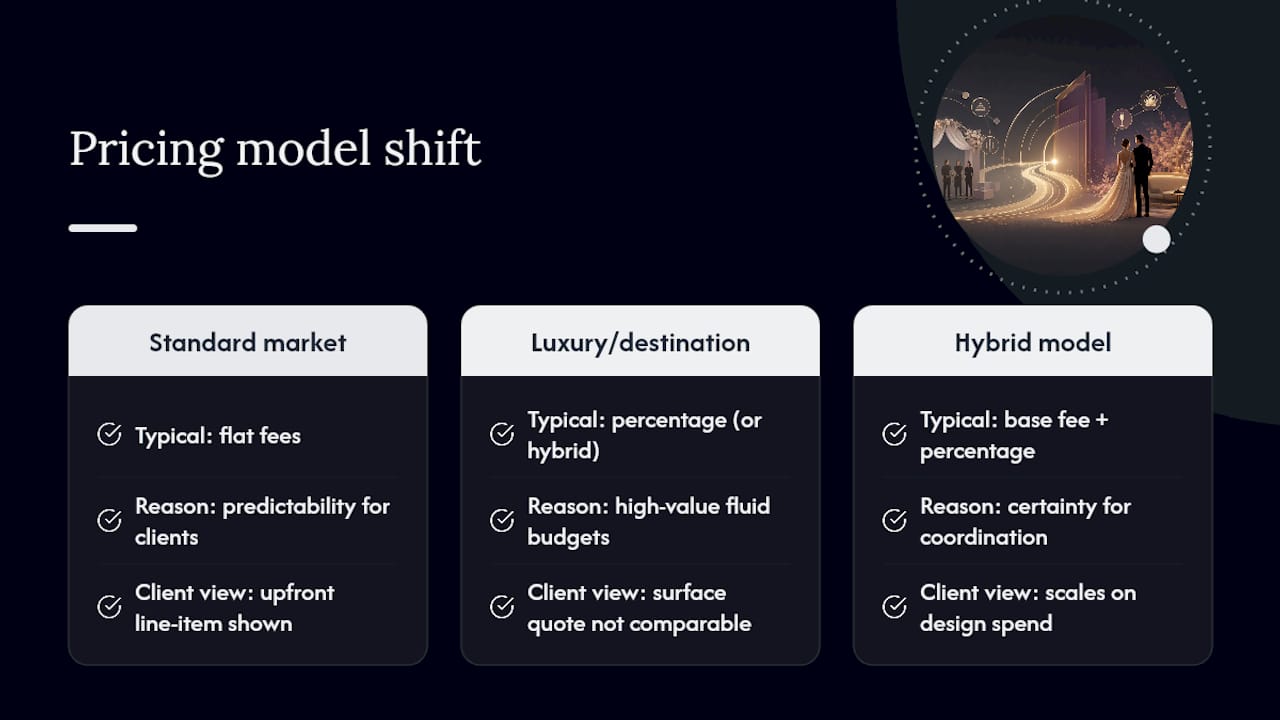
The clearest trend in the market has been a move away from purely percentage-based pricing toward flat fees, largely because flat fees give clients predictability that percentage models don’t offer on a fixed budget. Couples increasingly want to know the planner line item upfront rather than watching it move as their budget evolves.
At the luxury and destination end of the market, that shift has been slower and more partial. High-end and destination planners have largely retained percentage or hybrid structures, because fluid, high-value budgets, where design elements, guest counts and production scale can all shift during planning, don’t sit comfortably inside a fixed flat fee. The hybrid model, a fixed base fee for core planning paired with a percentage applied specifically to design and procurement, has emerged as something of a middle path, letting luxury planners offer certainty on the coordination side while still scaling fairly on the variable design spend.
For clients, the practical implication is that a flat quote from a standard-market planner and a percentage quote from a luxury specialist aren’t really comparable on the surface number alone. The underlying scope, staffing and design complexity behind each figure matters more than the pricing label attached to it.
Where else planner income comes from beyond your fee
Your planner’s income doesn’t stop at the fee they quote you. Vendor commissions, referral arrangements and preferred-supplier partnerships all sit quietly behind the scenes of most planning businesses, and it’s worth understanding how they work rather than assuming your quoted fee is the whole story.
Some planners receive referral fees or commissions from venues, caterers or décor suppliers they recommend, a common practice across the events industry generally. This isn’t necessarily a conflict of interest, an experienced planner’s supplier network is often exactly why you hired them, but it’s reasonable to ask directly whether any recommended vendor relationship involves a commission back to the planner. Transparent operators will tell you plainly.
Other income streams include paid vendor partnerships (where a supplier pays for regular inclusion in a planner’s recommended list), styled-shoot collaborations that generate marketing content in exchange for reduced or waived planning fees, and repeat corporate retainer work for organisers running multiple events annually. None of these should change what you’re quoted, but they’re worth raising in your initial consultation if transparency matters to you, and it should.
How Winelands Function approaches pricing and scope
Transparent scope is the foundation of a fair quote. Some event planning proposals structure quotes around the specific event requirements, guest count, venue, design ambition, and staffing, rather than applying a one-size-figure across every wedding or corporate booking.
Hybrid packages tend to serve luxury clients best: a defined base fee for core coordination, paired with a percentage or itemised cost for design, décor, and procurement that genuinely scales with your ambitions. That structure gives you certainty where it matters and fairness where your budget is still evolving.
Staffing disclosure matters just as much as the number on the quote. Knowing your named point of contact and on-site team size before you sign protects you from the vague scope issues that cause most post-contract disputes. If you’re weighing packages for a wedding or bespoke celebration, our wedding planning team can walk you through a tailored proposal built around your event.
— Coert
Ready to get a clear, honest quote?
Most of the frustration couples describe with wedding planning fees comes down to one thing: vague scope dressed up as a simple number. Some event planning services take the approach of laying out the staffing model, fee structure, and exactly what’s included before you sign anything, so clients compare a real commitment, not a guess.
That matters most for luxury, destination and corporate events, where the gap between a cheap-looking flat fee and a properly staffed, fully scoped package can run into thousands once travel and production costs surface later. We’d rather show you that number upfront.
If you’re planning a wedding, bespoke celebration or corporate event in Cape Town and the Western Cape, get in touch through our wedding planning services page to request a bespoke quote scoped to your guest count, venue and design ambitions. You’ll know exactly what you’re paying for before you commit to anything.
Sources
- Cost of a wedding planner (With Joy)
- Wedding planner pricing strategies (WPIC)
- Luxury wedding planner cost (The Knot)