
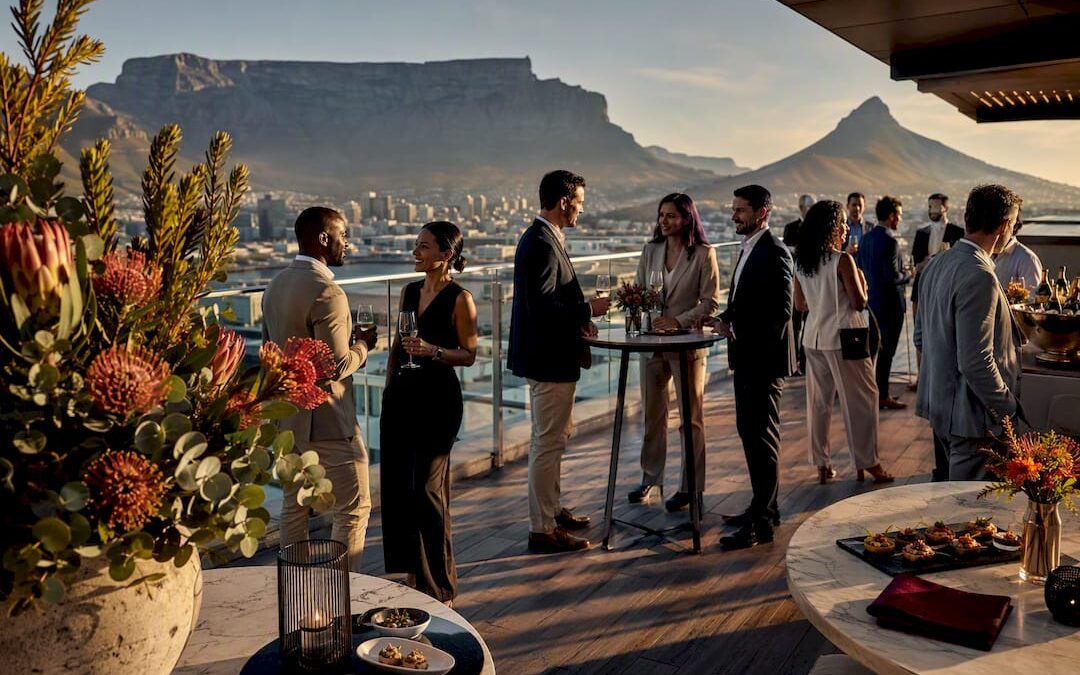
The most reliable corporate summer party format pairs an outdoor anchor event, a garden, rooftop or festival-style setting, with one or two themed or skill-based zones rather than a single static activity. Book your venue several months in advance for larger groups, build in dietary and accessibility choices from the start, and choose a theme you can carry through the menu, music and activities, not just the decor.
TL;DR:
- Larger outdoor events with modular zones, such as festival-style field days or food markets, tend to generate higher engagement across bigger teams.
- Planning should start three to four months in advance for venue-led events or six weeks for smaller gatherings to ensure availability and smooth execution.
- Investing in signature food experiences and guest-flow design significantly enhances event memorability and helps justify higher budgets.
- Contingency plans, including covered spaces and activity flexibility, are crucial for outdoor venues to handle unpredictable weather conditions.
- Hiring a full-service planner becomes worthwhile once the guest count exceeds approximately 80 people or when multiple activity zones and hybrid formats are involved.
Table of Contents
- Corporate summer party ideas: 15 formats worth booking
- How to plan a summer corporate event: timeline, budgets and checklist
- Theme-first execution: four sample programmes
- Making the party inclusive for every guest
- Weather contingency planning for outdoor summer parties
- Legal and safety considerations for corporate summer events
- A planner’s perspective on signature touches that earn their cost
- How Winelands Function can run your summer event
- Sources
- FAQ
Corporate summer party ideas: 15 formats worth booking
The strongest summer events give guests a reason to move between spaces rather than sit through one long programme. Interactive, activity-driven formats such as scavenger hunts and field days consistently increase participation and connection compared with a single seated activity, which is why the ideas below lean towards modular, zone-based experiences.
Pro Tip: Published idea matrices for outdoor corporate events typically map 10 to 21 formats against time, cost and energy level, which is a useful shortcut when you need to shortlist options for a mixed-energy team quickly.
- Rooftop sundown social — A low-effort, high-atmosphere option for 20 to 80 guests. Book a venue with a liquor licence and shade cover; budget: medium.
- Garden party with lawn games — Croquet, giant Jenga and a live acoustic set suit 30 to 150 guests on a private estate or hotel lawn; budget: low to medium.
- Beach or poolside day — Best for teams near the coast wanting a relaxed, half-day event with catering trucks and shaded seating; budget: medium.
- Festival-style field day — Multiple activity stations, a DJ and food trucks work well for 100 or more guests needing room to spread out; budget: medium to high.
- Around-the-world food market — A rotating series of regional food stations replaces a formal sit-down dinner, ideal for 50 to 200 guests; budget: medium.
- Vineyard or wine-estate lunch — A refined, seated option for 20 to 100 senior staff or client-facing teams; budget: high.
- Company picnic with lawn cinema — Classic and cost-effective for 30 to 200 guests, with a projector screen once the sun sets; budget: low.
- Outdoor cooking or mixology masterclass — A hands-on, skill-based session that works for groups of 15 to 40 wanting genuine interaction; budget: medium.
- Field day with team sports — Tug of war, relay races and a mini Olympics suit larger teams of 80 or more; budget: low to medium.
- Wellness and spa social — Yoga, massage stations and mocktails suit smaller, low-intensity groups of 15 to 50; budget: low to medium.
- Rooftop cinema and cocktail evening — A stylish evening option for 30 to 100 guests with a licensed bar and comfortable seating; budget: medium.
- Scavenger hunt through a city precinct or estate — A team-building favourite for 20 to 80 people that needs minimal venue hire; budget: low.
- Garden elegance afternoon tea — A more formal, seated alternative for client entertaining or leadership teams of 15 to 60; budget: high.
- Retro summer carnival — Funfair games, candy stations and a photo booth work for family-inclusive events of any size; budget: medium.
- Boat cruise or harbour social — A premium option for 20 to 100 guests where the venue and transport are one booking; budget: high.
Smaller teams generally do better with low-cost workshops or picnic formats, while larger groups benefit from festival-style layouts with modular stations that let people self-select their energy level, a pattern that holds across most outdoor corporate formats.
How to plan a summer corporate event: timeline, budgets and checklist
Lead time is the single biggest lever you have. Larger festival-style or venue-led events need three to four months of booking runway, while a smaller office social can be arranged in four to six weeks if your venue and caterer have availability.
Budget bands worth planning against:
- Low — Picnic, lawn games or a scavenger hunt with minimal hire costs and in-house catering.
- Medium — Festival-style field day, food market or rooftop social with external catering and a DJ.
- High — Vineyard lunch, boat cruise or fully styled garden elegance event with premium catering and floral design.
A working supplier and permit checklist:
- Confirm venue and outdoor permit requirements at least three months ahead for groups over 100.
- Lock catering and dietary requirements once headcount is confirmed.
- Book entertainment (DJ, live act, activity facilitator) as a separate line item, not bundled with the venue.
- Arrange AV and power for any speeches or projected content.
- Confirm event insurance and liability cover, particularly for outdoor and activity-based formats.
- Check accessibility provisions: step-free access, seating and parking.
A short, well-timed recognition segment of one to five minutes, placed early and followed by open social time, raises the perceived value of the event without eating into the fun.
Theme-first execution: four sample programmes
Decor alone does not make a theme. A theme has to run through the invitation, the menu, the signature activity and the music, or it reads as a party with some props stuck on top, a point event stylists consistently make. Get that alignment right and even a modest budget feels considered rather than thrown together.
Four programmes worth adapting:
- Festival-style social (mid budget) — Food truck stations, a DJ and lawn games, tied together with festival wristbands and a matching playlist.
- Garden elegance afternoon (mid-high budget) — Afternoon tea service, florals matched to invitation design, and a string quartet or acoustic duo.
- Around-the-world food market (mid budget) — Four to six regional food stations, passport-style tasting cards, and world music rotating by region.
- Wellness social (low-mid budget) — Morning yoga, a smoothie or mocktail bar, and light instrumental music throughout.
| Programme | Venue cost | Catering cost | Entertainment cost |
|---|---|---|---|
| Festival-style social | Medium | Medium | Medium |
| Garden elegance afternoon | Medium to high | High | Medium |
| Around-the-world food market | Medium | Medium to high | Low to medium |
| Wellness social | Low to medium | Low to medium | Low |
Food is worth the extra attention here. Investing in one distinctive food moment, a live chef station or a signature tasting, tends to lift how memorable the whole event feels, and it is worth browsing gastronomy trend guidance before finalising a menu.
Making the party inclusive for every guest
Dietary labelling, generous non-alcoholic options and boxed meals for remote staff are the baseline, not an afterthought, and inclusive planning improves both attendance and fairness. Design activities with an opt-out that does not feel like exclusion, and keep any recognition speech under five minutes.
- Label every dish clearly and offer at least two non-alcoholic signature drinks.
- Give remote staff a shipped party kit or meal voucher and one live-streamed segment they can join in real time.
- Offer at least two activity intensities so no one feels forced onto a relay race they cannot manage.
- Check step-free access, seating for those who need it, and clear sightlines to any speeches.
Pro Tip: For genuine hybrid parity, send remote staff the same “takeaway” as in-person guests, a food voucher plus a small physical gift, and schedule one hosted segment they can join live rather than watch back later.
Weather contingency planning for outdoor summer parties
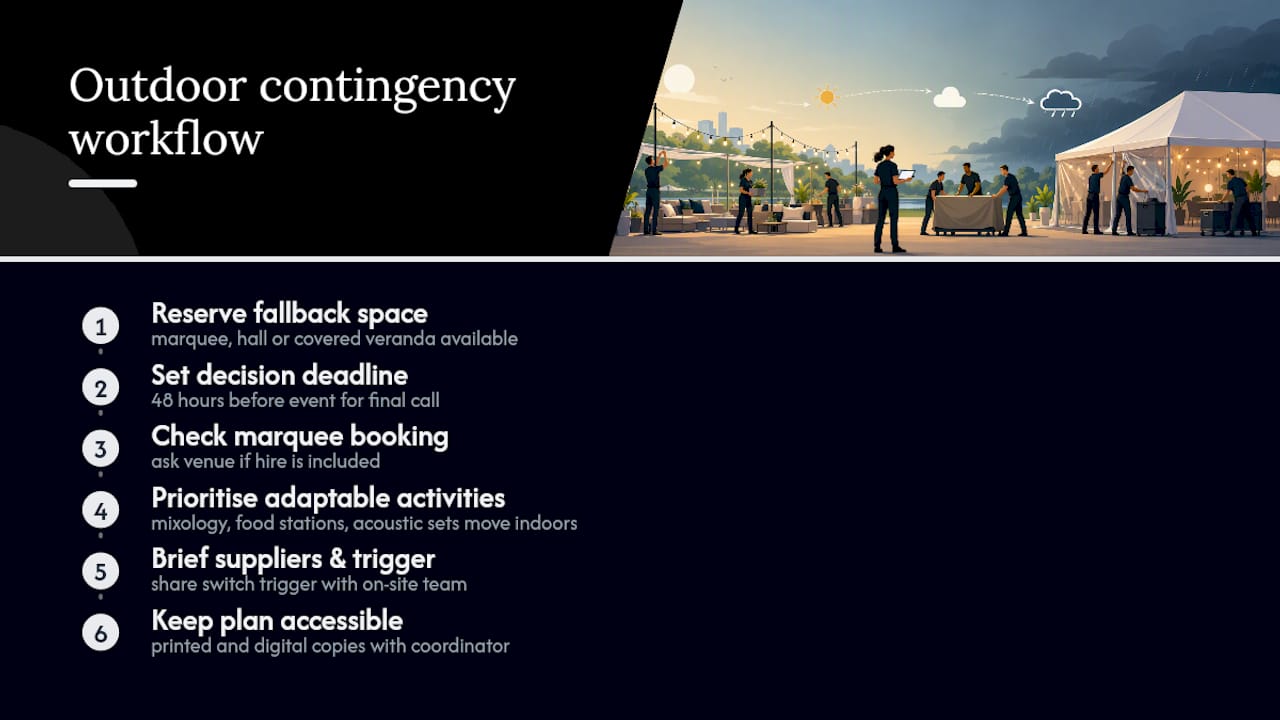
Outdoor formats are the most rewarding and the most exposed to risk, so build the contingency plan before you send the invitations, not after the forecast turns. Every outdoor booking needs a covered fallback space, whether that is a marquee, an indoor hall on standby, or a covered veranda large enough for the full guest count.
Set a decision deadline, ideally 48 hours before the event, so caterers and entertainers can adjust setup rather than scramble on the day. Ask your venue whether marquee hire is included or needs booking separately, since availability tightens fast during peak summer months. For festival-style or field-day formats, plan shaded rest zones regardless of forecast; heat is as disruptive as rain for a full-day outdoor event.
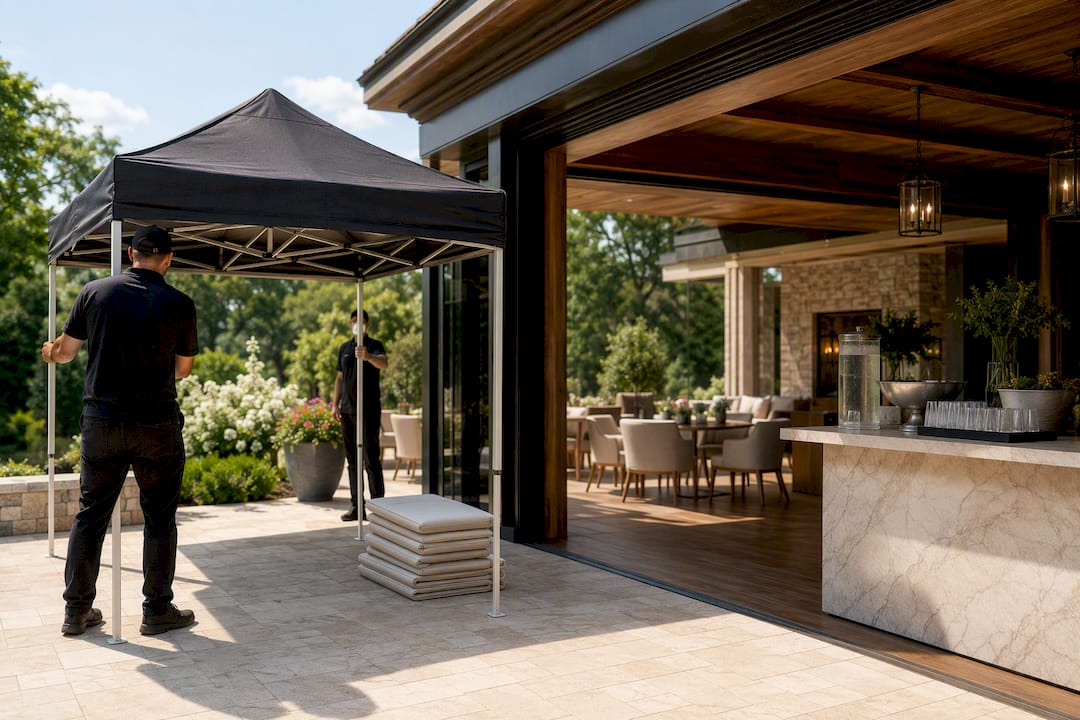
Build flexibility into the run sheet itself: activities that can move indoors with minimal adjustment (mixology masterclasses, food stations, acoustic sets) are more contingency-friendly than lawn games or water-based activities that depend entirely on dry ground. Keep a printed and digital copy of the contingency plan with your on-site coordinator, and brief suppliers on the trigger point for switching plans, so no one is waiting on a decision that should have already been made.
Legal and safety considerations for corporate summer events
Permits, insurance and alcohol policy are not paperwork to rush through the week before the event; they shape which venues and formats are even viable. Confirm whether your chosen outdoor space needs a council or estate permit for amplified music, marquees, or guest numbers over a set threshold, and apply for it as soon as the date is locked.
Event liability insurance should be confirmed in writing, covering both the venue and any activity providers, particularly for anything involving movement, water, or equipment hire. If your caterer is bringing their own staff, check that their public liability cover extends to your event rather than assuming it is automatic.
Alcohol policy deserves its own line in the plan. Decide whether the bar is open, ticketed, or limited by time, and brief bar staff and hosts on a clear cutoff. Wherever alcohol is served, non-alcoholic options need equal visibility and quality, not an afterthought at the end of the bar. If the venue does not hold its own liquor licence, confirm who is responsible for securing a temporary one before you commit to catering.
A planner’s perspective on signature touches that earn their cost
Most corporate summer parties fail on execution, not ideas; the shortlist above is easy, the follow-through is not. Two touches consistently justify their cost: a curated food journey (rotating stations rather than a static buffet) and deliberate guest-flow styling that guides people naturally between activity zones. Once a guest list passes roughly 80 people, or the brief includes multiple zones, catering styles or hybrid staff, a full-service planner earns its fee in reduced risk alone.
— Coert
How Winelands Function can run your summer event
You have the shortlist and the planning framework, now comes the part that actually eats a planner’s week: chasing venues, comparing caterers, and hoping the weather contingency holds. A full-service event planning team can handle the entire brief end to end, from venue sourcing and supplier coordination to on-the-day management, so your team turns up to an event that feels effortless rather than assembled under pressure.
Whether you are planning a 40-person garden social or a 300-guest festival-style celebration with hybrid staff to fold in, our corporate event management service covers the full brief, styling, timeline, budget oversight and supplier vetting, so nothing falls through the cracks on the day. If you want the mechanics explained before you commit, our event management page walks through exactly how we structure a project from first brief to final toast. Get in touch to talk through your date and headcount, and we will tell you plainly whether a full-service build makes sense for your event or whether the checklist above will do the job.
Sources
- summer outdoor corporate event ideas for small teams: 21 Ideas That Actually Work 2026
- Best Summer Work Party Ideas for Teams | TeamBonding
- Incorporating event themes
- 5 ways to create an event that prioritizes diversity, equity and inclusion
FAQ
How do you make a corporate party fun rather than just an obligation?
Give people a choice of activity intensity, run a short recognition moment early, and let the rest of the event stay open and social rather than fully scheduled.
What are some fun ideas for a summer party?
Rooftop socials, garden lawn games, a food market with rotating stations, and a scavenger hunt all perform well because they encourage movement and interaction rather than a single seated activity.
What are good activities for a corporate summer event?
Field-day sports, cooking or mixology masterclasses, and team scavenger hunts consistently drive higher engagement than passive entertainment alone.
What are some good ideas for an office party?
A themed food market or a wellness social with yoga and mocktails both work well indoors or outdoors, and both scale easily from 20 to 200 guests.
How far in advance should I book a corporate summer party?
Book three to four months ahead for larger, venue-led events, and four to six weeks ahead for a smaller office social.
When should I hire a full-service planner instead of organising it myself?
Once your guest list passes roughly 80 people, or the event involves multiple zones, hybrid staff, or bespoke styling, a planner such as Winelands Function typically reduces risk and workload enough to justify the fee.