
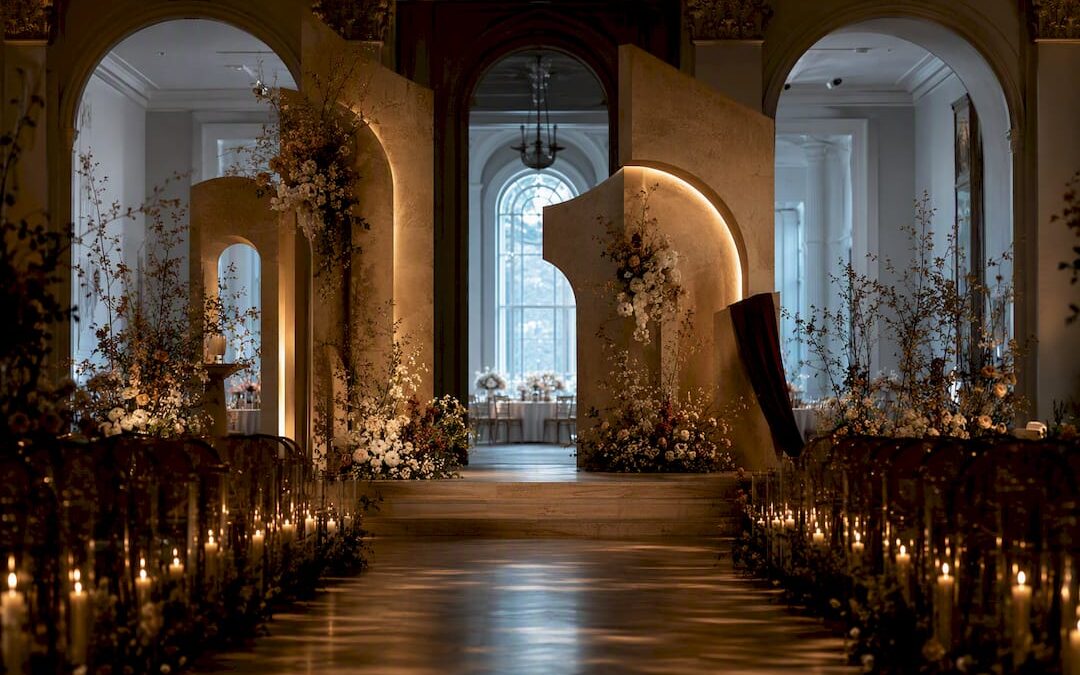
In a luxury context, bridal decorations mean full-service styling and production, not off-the-shelf party décor. That includes concept design, floral and structural installations, lighting, furniture, and the on-the-day management to bring it all together. For most couples with a significant celebration in mind, the right move is to commission a full-service designer or planner rather than assemble décor piecemeal — a specialist firm handles the concept-to-installation process as one coordinated build.
TL;DR:
- Full-service luxury bridal decoration involves a coordinated process starting with concept design and extending through fabrication, installation, and strike management, often requiring several months of preparation.
- Building large, intricate installations like floral or structural pieces can take up to two weeks onsite, with most planning phases lasting from four to eight weeks and fabrication potentially stretching over months.
- Rented assets such as furniture and lighting are cost-effective for common elements, while bespoke pieces should match the event’s unique story, often at a higher price point.
- Design concepts should be anchored around a single idea that guides all sensory and visual elements, with mock-ups or renderings crucial for visualizing the final look at specific times of day.
- Red flags include vague scope and budget descriptions, lack of safety documentation, portfolio inconsistency, and overly optimistic timelines that ignore necessary engineering and rigging work.
Table of Contents
- What do luxury bridal decorations actually include?
- How do designers build a concept for the day?
- How long does a large installation take to build?
- Rentals, bespoke pieces and sustainable choices
- How are luxury decoration fees usually structured?
- What warning signs suggest a decorator isn’t right for your wedding?
- What does a successful luxury decoration project look like?
- How should decorations respond to venue and theme constraints?
- What other services typically come bundled with decorations?
- How Winelands Function approaches bridal decorations
- Author perspective: why decoration is an investment, not an expense
- Sources
- FAQ
What do luxury bridal decorations actually include?
Luxury bridal decorations cover far more ground than tablecloths and centrepieces. The deliverables typically span the entire sensory environment of the celebration, engineered as a single design system rather than a collection of separate purchases.
- Floral installations — from suspended canopies to sculptural altar pieces
- Tablescapes — linen, glassware, place settings, and centrepiece design
- Ceremony backdrops — structural or floral, often the visual anchor of the day
- Lighting and scenography — uplighting, chandeliers, projection, and ambient control
- Signage and stationery integration — welcome boards, menus, seating charts styled to match
- Bespoke furniture and props — custom-built or curated pieces that suit the theme
- Scent and sound curation — often overlooked, but central to atmosphere
- Installation and strike management — building it all, then dismantling it cleanly afterwards
The distinction that matters here is between styling and production. Styling is the visual concept: colour palette, silhouette, mood. Production is the fabrication, engineering, and physical installation that makes that concept stand up in a marquee or a heritage venue. Confusing the two is a common mistake among couples briefing suppliers for the first time.
“Full-service” itself is not a fixed unit. Some planners offer a handful of consultation hours labelled as full-service, while genuinely comprehensive luxury operators can deliver over 1,000 hours of design, sourcing, and production work on a single wedding. Ask exactly what falls inside that scope before signing anything — a wedding decor checklist is a useful starting point for comparing proposals fairly.
How do designers build a concept for the day?
Every strong luxury design starts with a single conceptual anchor: one idea that every other decision answers to. Without it, even beautifully executed elements can feel disconnected once they’re in the same room.
- Intimate candlelit supper → a suspended floral canopy low enough to feel personal, paired with warm, dimmable lighting.
- Cinematic reveal → a sculptural altar or structure positioned as the visual climax guests walk towards.
- Modern minimal opulence → textured metallics, kinetic light installations, and restrained floral moments used sparingly for impact.
Once the anchor is set, designers build outward through sensory layers. Scent might mean fresh eucalyptus at the entrance, shifting to warm vanilla near the reception. Sound could move from a solo cellist during the ceremony to a string quartet at dinner. Taste, touch, and sight are treated the same way — as instruments in one composition, not separate vendor line items.
Digital renderings and mock-ups are worth insisting on before fabrication begins.
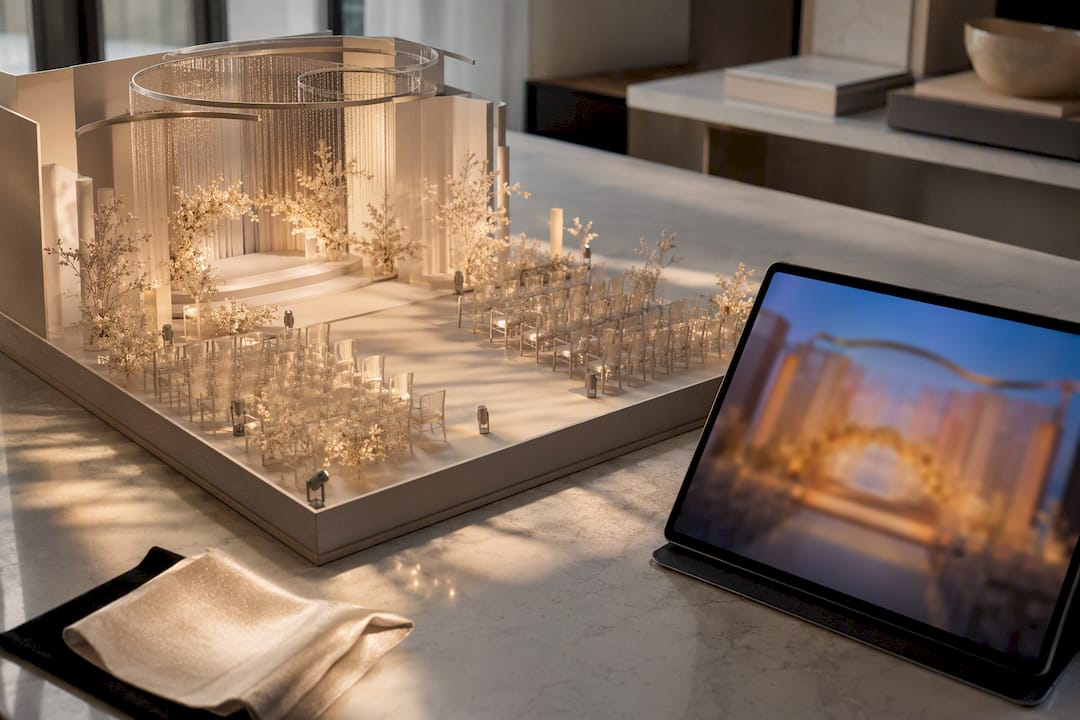
Pro Tip: Ask your designer for a rendering that shows the space at the exact hour your ceremony starts. Light changes everything, and a midday mock-up tells you almost nothing about how a 6pm ceremony will actually look.
How long does a large installation take to build?
Grand installations don’t appear overnight, and treating them as a last-minute add-on is where most timeline problems begin. The realistic phase outline runs roughly like this:
- Briefing (2 to 4 weeks) — concept discussions, mood boards, budget alignment
- Design dossier (4 to 8 weeks) — detailed renderings, material specifications, vendor sourcing
- Fabrication (weeks to months, depending on scale) — custom furniture, structural elements, floral pre-orders
- Onsite build (1 to 5 days for most weddings; up to two weeks for major installations) — assembly, rigging, technical checks
- Strike (usually same night or next morning) — full removal and site restoration
Large floral or structural pieces sometimes require production teams working on-site for up to two weeks before the event, particularly when suspended installations, custom rigging, or heavy lighting rigs are involved. That labour cost is often invisible in a simple quote but very real in the final invoice.
Safety work adds time too, and it’s rarely optional. Structural sign-off for suspended weight, formal rigging plans, and power load calculations for lighting and sound all need lead time from qualified contractors, not just the design team. Skipping this step isn’t a shortcut, it’s a liability, and any credible production firm will insist on it regardless of how tight the schedule feels.
Rentals, bespoke pieces and sustainable choices
Not everything needs to be custom-built, and knowing where to draw that line saves both money and stress. Rented assets make sense for furniture, glassware, and chandeliers, where quality options already exist and reinventing them adds cost without adding meaning. Bespoke commissioning earns its price for sculptural centrepieces, custom furniture that reflects a couple’s story, or anything that needs to match a very specific spatial constraint.
Material choice carries its own trade-offs. Fresh flowers versus preserved is the classic example: fresh florals deliver unmatched vibrancy but demand tight logistics and same-day handling, while preserved or silk alternatives survive transport and storage far better, at some cost to visual softness. Heavy technical lighting and fragile bespoke furniture both raise transport and storage costs, and that should be factored into any comparison between suppliers.
Sustainability is increasingly part of the brief, not an afterthought. Worth requesting:
- Modular builds that can be reconfigured or reused across events
- Locally sourced florals and materials to cut transport impact
- A clear reuse or donation plan for florals and structural elements post-event
Pro Tip: If your ceremony and reception are in the same venue, ask your designer about a “flip” plan that repurposes ceremony florals into reception centrepieces. It cuts cost and waste in one move.
Food presentation deserves a mention here too, since it’s part of the same sensory environment as the florals and lighting around it. Some couples now brief their food presentation alongside their florist, treating the plate as another surface for the day’s visual language.
How are luxury decoration fees usually structured?
Pricing models vary more than most couples expect, and each has different incentives worth understanding before you sign.
- Percentage of total wedding budget — common at the higher end, this aligns the designer’s fee with overall spend but can inflate if the budget grows.
- Fixed creative fee — a flat rate for design and direction, separate from production costs, which gives cost certainty but may exclude fabrication and labour.
- Production budget plus management fee — the client funds materials and build directly, with the designer charging a management percentage on top; transparent, but requires more active client involvement.
Cost is driven primarily by scale, bespoke fabrication, logistics, and the technical demands of the venue itself. A marquee on open land with no existing infrastructure will always cost more to decorate than a venue with built-in lighting rigging and load-bearing points.
Before agreeing terms, ask your designer directly: what falls inside the quoted scope, what contingency exists for weather or supplier failure, what insurance covers the installation, and how payments are staged across the project.
What warning signs suggest a decorator isn’t right for your wedding?
Some red flags show up early, before a contract is even signed. A supplier who won’t put scope in writing, or who describes “full-service” without specifying hours, headcount, or deliverables, is asking you to trust a vague promise with a very large budget attached.
Watch for vague budgeting language too. If a proposal quotes a single lump figure with no breakdown between design fees, materials, labour, and logistics, you have no way to judge where your money is actually going, or to negotiate intelligently if costs shift.
Insurance and safety documentation gaps are a serious concern, not a minor oversight. Any supplier building suspended floral canopies, freestanding structures, or heavy lighting rigs should be able to show liability cover and, where the installation demands it, evidence of structural sign-off. A firm that brushes off this question is gambling with your event and your guests.
Portfolio inconsistency is another signal worth reading carefully. A designer whose past work all looks identical, regardless of the couple’s brief, may be selling you a signature style rather than a bespoke concept built around your story. Ask to see how their design process actually changed between two different weddings, not just the finished photographs.
Finally, be cautious of anyone reluctant to discuss timeline realities. A designer who promises a major structural installation can go from empty venue to fully built in a single afternoon, with no mention of rigging, fabrication lead time, or onsite labour, is either inexperienced with large-scale work or not being straight with you about what it actually takes.
What does a successful luxury decoration project look like?
The strongest projects share a common thread: the conceptual anchor is visible in every element, from the welcome signage to the final centrepiece, without feeling forced or repeated mechanically.
Consider a cinematic reveal concept built around a sculptural altar. The design team doesn’t stop at the ceremony structure. Aisle lighting is dimmed to draw the eye forward, the processional music is chosen to build tension toward the reveal moment, and even the seating chart typography echoes the altar’s material palette. Guests register the coherence even if they couldn’t articulate why the space feels considered.
Another pattern that works consistently is designing backward from the venue’s own architecture rather than against it. A heritage building with existing stone arches doesn’t need a competing floral structure at the same scale. It needs restraint, precise lighting, and materials that complement what’s already there. Couples who insist on their Pinterest board regardless of venue constraints often end up fighting the space rather than working with it.
The projects that generate genuine word-of-mouth tend to involve early trust between couple and designer, established well before fabrication starts. When a couple shares the real story behind their relationship rather than just aesthetic preferences, that narrative becomes the thread a designer can weave through florals, lighting, and even the customisation of individual decor elements. The result reads as personal rather than purchased.
How should decorations respond to venue and theme constraints?
Venue architecture sets the boundaries every decoration decision has to work within, and the best designs treat those constraints as creative material rather than obstacles to fight. A marquee on open land offers a blank canvas but demands you build everything from flooring to lighting rigging from scratch. A heritage venue offers built-in character but restricts what can be hung, mounted, or altered structurally.
Theme and venue need to be negotiated together, not chosen independently. A modern minimalist concept can clash badly with an ornate historic ballroom unless the designer deliberately works with the existing detail rather than trying to mask it. Conversely, a romantic, maximalist floral theme can overwhelm a stark industrial venue unless scaled and placed with real intention.
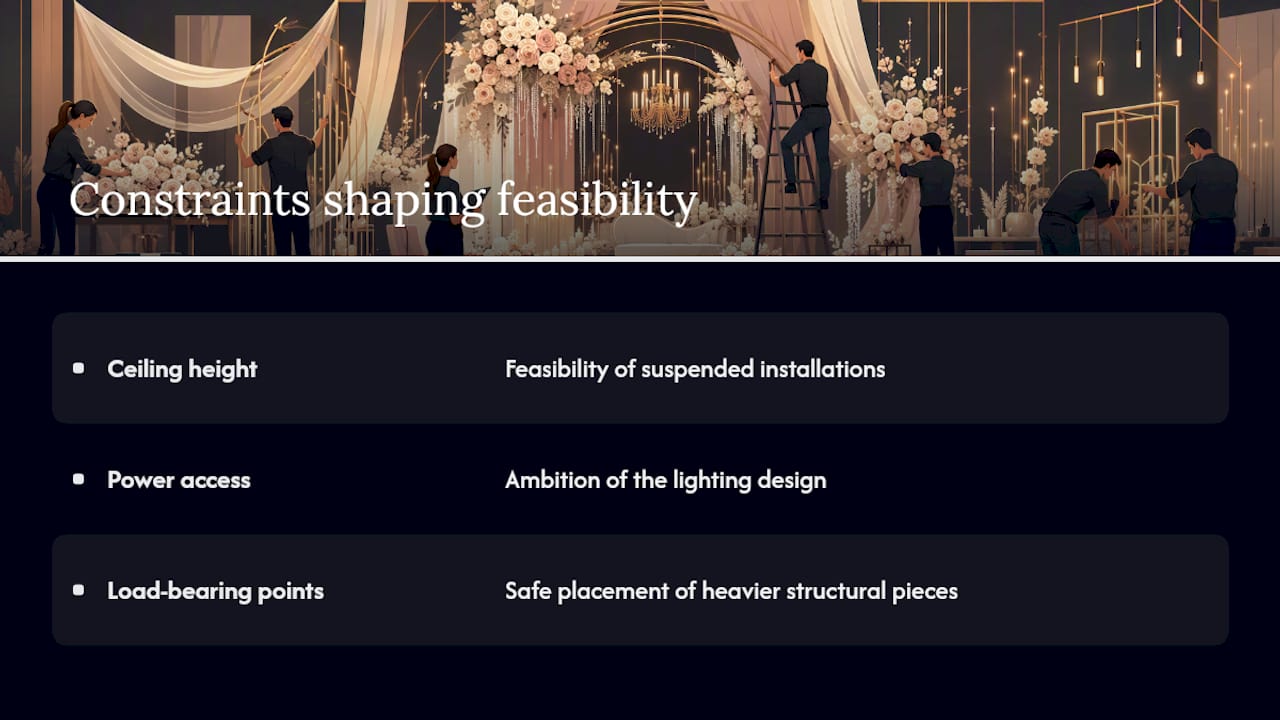
Practical constraints also shape what’s physically possible. Ceiling height determines whether a suspended installation is viable at all. Power access dictates how ambitious the lighting design can be. Load-bearing points affect where heavier structural pieces can sit safely. These aren’t creative limitations so much as the framework any credible designer works from when translating a mood board into something buildable.
The couples who get the best results tend to choose their venue with the decoration concept already loosely in mind, or accept early on that the concept needs to flex to suit the space. Reviewing current stylistic directions before committing to a venue can help clarify which spaces will actually support the look you want.
What other services typically come bundled with decorations?
Decoration rarely arrives as a standalone service in a luxury booking, and understanding what’s usually included, or easily added, helps you compare proposals more accurately.
Lighting design is almost always bundled, since it’s inseparable from how the decorations themselves are perceived after dark. Uplighting, pin-spotting on centrepieces, and ambient colour washes are typically quoted alongside the floral and structural work rather than as a separate line.
Floral installation naturally overlaps with broader event design, covering everything from bouquets and boutonnières through to large-scale ceremony and reception pieces. Many full-service providers coordinate florals directly with the lighting team so that colour temperature and floral tone are chosen to complement each other, rather than clashing under the wrong bulb colour.
Furniture styling, custom signage, and stationery integration are frequently rolled into the same design package, since they all draw from the same colour and material palette established at the concept stage. Some providers also extend into reception-specific lighting treatments that shift mood between dinner and dancing.
On-the-day coordination is the piece most easily overlooked when comparing quotes. Someone needs to manage the installation timeline, oversee the strike, and troubleshoot on-site issues in real time. That role is often bundled into full-service packages precisely because decoration without day-of management is a beautiful room with no one responsible for it once guests arrive.
How Winelands Function approaches bridal decorations
Bridal decorations typically follow a full-service design and production process, not a menu of separate add-ons. That means concept development, sourcing, fabrication, floral and lighting installation, and on-the-day management are handled as one coordinated project from the earliest conversation through to strike.
An initial consultation typically starts with a portfolio review so clients can see how past concepts translated into finished spaces, followed by a scope outline covering what’s included and what sits outside the base package. From there, indicative budget ranges are discussed openly, before any commitment is made, so clients brief suppliers with realistic expectations rather than guesswork.
If you’re weighing a full bespoke and luxury celebration against a lighter styling package, the clearest next step is a direct conversation about your venue, your guest count, and the concept you’re circling. Reach out through the wedding planning page to request a consultation or view a fuller portfolio before you commit to a designer.
Author perspective: why decoration is an investment, not an expense
Good decoration is a translation exercise. Someone takes a couple’s actual story, the way they met, what they value, how they want their guests to feel, and turns it into a physical, walkable space. That’s harder than it sounds, and it’s why the relationship between couple and creative team matters as much as the final render.
The couples who avoid day-of compromises are almost always the ones who engaged their designer early and trusted the process rather than second-guessing every decision at the eleventh hour.
— Coert
Sources
- What does full-service wedding planning mean? — Brides
- From dream to blueprint: how luxury wedding planners craft your perfect Tuscany wedding in 2026 — Bespoke Bride
- Full-service design vs design lite — Candice Coppola blog
FAQ
What Is the Difference Between Styling and Production?
Styling is the visual concept, colour, mood, and silhouette, while production is the fabrication, engineering, and physical installation that brings that concept to life on-site.
How Far in Advance Should I Book a Luxury Decorator?
For large installations, book several months ahead, since fabrication and supplier sourcing for bespoke elements often take longer than couples expect.
Is a Fixed Fee or Percentage-Based Fee Better?
Neither is universally better; a fixed creative fee gives cost certainty, while a percentage model aligns the designer’s incentive with the overall budget, so the right choice depends on how closely you want to manage spend yourself.
Can Winelands Function Handle Both Ceremony and Reception Decor?
Decoration management across the full event typically includes coordinating ceremony backdrops, reception styling, lighting, and on-the-day installation as one connected project rather than separate bookings.
Do I Need to Hire Rentals or Can Everything Be Bespoke?
Most luxury weddings use a mix, renting furniture, glassware, and chandeliers where quality options already exist, while reserving bespoke commissioning for sculptural or highly personal pieces that need to match a specific space.