
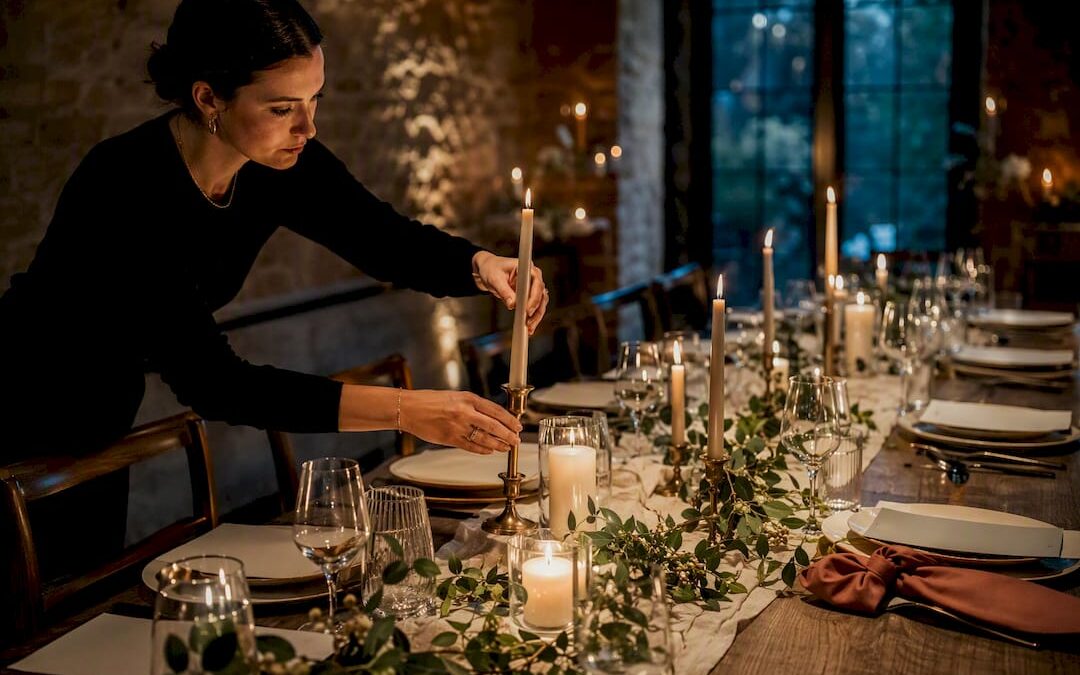
The fastest route to a beautiful rehearsal dinner is a low, conversation-friendly centrepiece, one strong hero element, and warm lighting that does most of the atmosphere-building for you. Arrange your essentials first: place settings, one to two glasses per guest, cloth napkins, and simple welcome signage. Beyond that, decorating for a rehearsal dinner is achievable on a modest budget and can genuinely be finished in under an hour.
TL;DR:
- Using low, cohesive centerpieces under 12 inches tall ensures guests have clear sightlines and easy conversation across the table.
- Prioritizing a single hero element, such as taper candles or a floral arch, creates a polished look and simplifies setup.
- Focusing on lighting and one well-chosen decor piece usually outperforms crowded tablescapes with excessive props and florals.
- For venue-specific decor, leverage existing assets like candles and linens, and adapt your theme to match the space’s character.
- A quick, organized setup on site can be done in under an hour by pre-conditioning flowers, assembling signage, and working table by table.
Table of Contents
- Decorations for a rehearsal dinner: the essentials checklist
- 20 rehearsal-dinner decoration ideas to steal
- Centrepieces that work without blocking conversation
- Adapting your decor to the venue
- Theme tablescapes you can pull together fast
- Budget-friendly hacks and pop-and-plop essentials
- A setup timeline that keeps you under an hour
- Planner notes: luxury styling that stays practical
- What the conventional advice gets wrong
- Get styling help from Winelands Function
- Sources
- FAQ
Decorations for a rehearsal dinner: the essentials checklist
Before any styling decisions, get the functional layer right. A rehearsal dinner table needs plates, cutlery, one to two glasses per guest, and cloth napkins as a baseline, with simple vases and welcome signage lifting the whole table from “set” to “styled.” That distinction matters more than most hosts realise: guests notice the absence of a coherent bar area or a clear seating cue long before they notice a missing floral arrangement.
Build outward from that base in this order:
- Place settings and glassware. Confirm sufficient glassware per guest (such as water and wine glasses) and match napkin colour to your palette rather than defaulting to plain white.
- A welcome or seating sign. A single framed sign at the entrance does more heavy lifting than scattered table cards. Keep the wording warm and brief.
- Bar-area styling. A small runner, a few stems in a jug, and labelled bottles turn a drinks table into a feature rather than an afterthought.
- Table runners or a simple cloth. These anchor everything else and hide venue tables that weren’t chosen with your palette in mind.
- Low centrepieces and lighting. Covered in detail below, but this is where the “wow” actually happens.
Get these five right and you’ve covered most of what guests will remember, whether you’re decorating for a rehearsal dinner in a private dining room or on a borrowed patio.
20 rehearsal-dinner decoration ideas to steal
Pick a direction, then execute it with one hero prop rather than ten small ones. These twenty ideas are grouped loosely by mood, each with an execution note and the single item worth prioritising.
- Wine-country long table — A runner of trailing greenery down the centre, taper candles at intervals. Hero prop: brass candlesticks. Best for vineyard or courtyard venues.
- Candlelit Old World — Mismatched brass candle holders on a dark linen cloth. Hero prop: a dozen taper candles in varying heights. Suits stone-walled or cellar rooms.
- Tuscan long-table with citrus — Whole lemons and olive branches scattered along a runner. Hero prop: a shallow bowl of citrus at the centre. Works for late-summer or early autumn dinners.
- Coastal breezy — Driftwood, white linen, sea-glass blue napkins. Hero prop: a single oversized shell or coral piece as the centrepiece anchor.
- Garden-party pastel — Loose, garden-style florals in soft pinks and creams. Hero prop: a floral arch or hoop over the entrance.
- Rustic-chic barn — Burlap runners, wildflowers in mason jars. Hero prop: a reclaimed wood welcome sign.
- Amalfi citrus and blue — Lemon motifs, cobalt blue glassware. Hero prop: hand-painted ceramic bowls.
- Moody botanical — Deep greens, eucalyptus, and dark florals against black linen. Hero prop: pillar candles in smoked glass.
- Farmhouse gathering — Long communal tables, wooden chargers, simple white flowers. Hero prop: a cast-iron candle chandelier if the venue allows hanging fixtures.
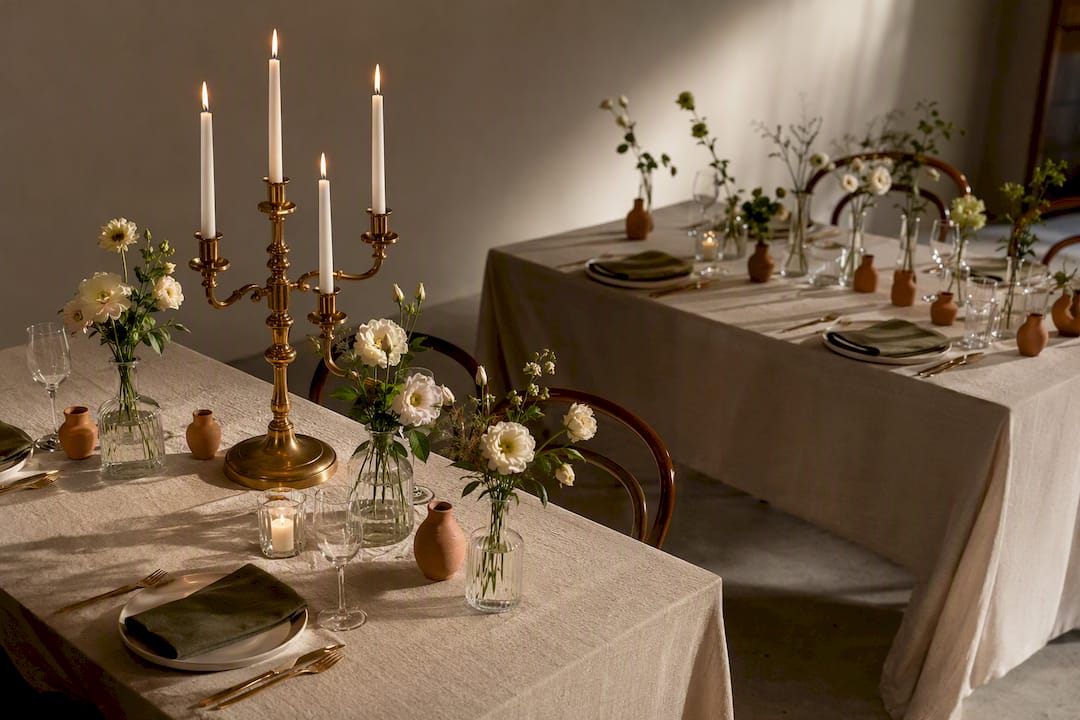
- Minimalist modern — Monochrome linen, single-stem bud vases. Hero prop: sculptural taper candle holders.
- Vintage romance — Lace runners, mismatched china, blush roses. Hero prop: a vintage mirror or tray for the dessert table.
- Desert warm-tone — Terracotta pots, dried pampas grass, amber glassware. Hero prop: a terracotta urn filled with dried florals.
- Nautical classic — Navy and white stripes, rope detailing, anchors as accents. Hero prop: a ship’s lantern.
- Autumn harvest — Pumpkins, wheat stems, warm oranges. Hero prop: a harvest-style centrepiece with candles nestled among gourds.
- Winter elegance — Pine sprigs, silver accents, white candles. Hero prop: a single statement candelabra.
- Tropical escape — Palm leaves, bold pink florals, gold flatware. Hero prop: a monstera-leaf table runner.
- Parisian bistro — Bistro chairs (if hired), small bud vases, candlelight. Hero prop: café-style string lighting overhead.
- Boho desert sunset — Macramé table runners, dried florals, warm-toned candles. Hero prop: a woven wall hanging behind the head table.
- English garden — Roses, peonies, delicate china. Hero prop: a tiered stand for a floral display.
- BBQ and farm-to-table casual — Gingham accents, mason jar drinkware, wildflower jars. Hero prop: a chalkboard menu sign.
Each of these can be built around a single supplier order or a weekend of DIY. Choose one, commit to its palette, and resist the urge to blend two.
Centrepieces that work without blocking conversation
The best rehearsal-dinner centrepieces stay under 12 inches tall, so guests can talk across the table without a floral wall in the way, and votives paired with a single stem or a trio of bud vases consistently outperform taller, showier arrangements. Three rules keep this simple:
- Keep every arrangement under 12 inches so sightlines and conversation stay clear.
- Repeat the same vessel shape across the table, or use one runner, so the look reads as intentional rather than assembled piecemeal.
- Limit yourself to two or three stem types per arrangement. More than that starts to look busy rather than curated.
Pro Tip: Buy or borrow one vessel shape and multiply it. Five identical bud vases with a single stem each look far more polished than five different vases with mixed florals.
Four centrepiece styles cover almost every rehearsal dinner:
| Style | Best for | Assembly time | Typical cost approach |
|---|---|---|---|
| Bud-vase clusters (3 per table) | Long tables, minimalist themes | Under 20 minutes | Cheapest DIY option |
| Hydrangea bowls | Round tables, garden or romantic themes | 20 to 30 minutes | Mid-range, florist-assembled |
| Greenery garland with taper candles | Long tables, wine-country or rustic themes | Under 20 minutes | Low cost, high visual impact |
| Candle-only clusters | Any venue with flame allowance | Under 15 minutes | Lowest cost, highest atmosphere per pound spent |
A greenery garland runner dressed with taper candles is genuinely quick to assemble and photographs like a professional installation despite costing a fraction of a full floral scheme. Florist-arranged hydrangea bowls will cost more per table but need almost no assembly on the day, which matters if you’re short on volunteer hands. Fewer, better-placed arrangements consistently beat spreading many small stems thin across every surface, so put your best floral moment at the entrance or head table and keep the rest simple.
Adapting your decor to the venue
Decorations for a rehearsal dinner should respond to the room you’re actually in, not fight it. Matching your styling to a venue’s existing character, rather than trying to transform it, is the difference between decor that looks effortless and decor that looks like an event kit dropped onto an unrelated space.
- Restaurant. Lean on what’s already there. Restaurants often have candles, linens, and art you can simply ask to use, which saves money and looks more authentic than imported decor. Keep additions small and server-friendly, and check the flame policy before you bring a single taper candle.
- Backyard or picnic setting. String lights overhead do more for atmosphere than any tabletop item. Layer in casual linens, sturdy picnic-friendly tableware, and low lanterns rather than anything that could tip on grass.
- Vineyard or winery. Lean into tactile, refined touches: leather-bound menus, embossed place cards, and natural materials like cork or timber. These venues already carry atmosphere, so your job is to add texture, not compete with the view.
- Barn or beach. Weather is the real decision-maker here. Use battery votives instead of open flame outdoors, and always have a covered contingency area or a plan for wind and sudden rain.
The common thread across every venue type is restraint. A restaurant rehearsal dinner needs the least intervention of all: a few well-placed additions, some signage, and you’re mostly done.
Theme tablescapes you can pull together fast
A rehearsal dinner is your chance to try a mood the wedding day never allowed. Designers regularly recommend using this dinner to test a distinct theme or cultural element that wouldn’t have suited the main ceremony, so use the freedom rather than defaulting to a smaller version of the wedding.
- Tuscan or Amalfi. Palette: terracotta, olive green, lemon yellow. Hero prop: a citrus-filled ceramic bowl. Floral note: olive branches with a few white blooms. Food tie-in: a family-style pasta course.
- Wine-country. Palette: burgundy, sage, gold. Hero prop: brass candlesticks along a runner. Floral note: trailing greenery, minimal blooms. Food tie-in: a cheese and charcuterie station.
- Coastal. Palette: white, sea blue, sand. Hero prop: a driftwood centrepiece base. Floral note: white florals with foraged grasses. Food tie-in: a seafood-forward menu.
- Garden-party. Palette: blush, cream, sage. Hero prop: a floral hoop or arch. Floral note: loose, garden-style arrangements. Food tie-in: a spring salad course.
- BBQ or farm-to-table. Palette: gingham red, warm wood tones. Hero prop: a chalkboard menu sign. Floral note: wildflowers in jars. Food tie-in: a slow-cooked, shareable menu, an approach worth exploring further through seasonal festive menu ideas if you’re planning around a particular season.
- Rustic-chic. Palette: burlap neutrals, sage, cream. Hero prop: a reclaimed wood sign. Floral note: mixed wildflowers. Food tie-in: a communal grazing table.
Pick one theme and let it show up in just two or three touchpoints. A cohesive two or three colour palette paired with one recurring material, whether that’s olive branches, citrus, terracotta, or linen, reads as intentional even on a tight budget. You don’t need to redesign the whole room to make the theme land.
Budget-friendly hacks and pop-and-plop essentials
You don’t need a florist on speed dial to pull off elegant decorations for a rehearsal dinner.
Pack list for the pop-and-plop approach:
- Pre-filled votive candles (real or battery)
- Framed signage, assembled and ready to stand
- Bud vases with stems already trimmed to length
- Simple table runners, pressed and folded for quick unrolling
- Citrus or hydrangea heads, conditioned and ready to drop into vessels
DIY hacks worth knowing: single hydrangea heads dropped into low bowls of water look surprisingly full for almost no cost, and a bowl of whole citrus doubles as both decor and a talking point. Potted herbs make simple, useful favours that guests will actually take home. Don’t be afraid to ask the venue what spare candles, vases, or linens they already hold in storage before buying anything new.
Pro Tip: Spend your budget on lighting and one genuine hero piece, whether that’s a floral arch or a statement candelabra, and save on quantity everywhere else. A dozen tiny stems scattered thin will always look cheaper than three well-placed ones.
A setup timeline that keeps you under an hour
Planners consistently favour pop-and-plop decor with under an hour of on-site work, because it keeps the host relaxed rather than sweating over a ladder ten minutes before guests arrive. Here’s a sequence that holds up in practice:
- The day before: condition any fresh flowers in water, assemble framed signage, and pre-fill votives so nothing needs building on-site.
- On arrival (0 to 15 minutes): lay runners and linens first, since everything else sits on top of them.
- 15 to 30 minutes: place centrepieces and candles, working table by table rather than doing all the runners then all the candles.
- 30 to 45 minutes: hang or position signage, style the bar area, and do a final walk-through for symmetry.
- 45 to 60 minutes: light candles (or switch on battery votives) as your very last step, timed close to guest arrival.
Staging supplies in labelled bins the night before, buckets of water for stems, taped-together spare votives, avoids the last-minute scramble that undoes an otherwise calm setup. Keep a few red flags in mind: avoid anything requiring a ladder without a dedicated person assigned to it, skip open flame anywhere the venue restricts it, and always pack spare batteries for votives. A backup plan costs you nothing and saves the evening if one candle box turns out to be dead on arrival.
Planner notes: luxury styling that stays practical
A good rehearsal dinner design follows the same principle that runs through this whole article: one strong idea, executed with restraint, beats a room full of small gestures competing for attention. A wine-country long table dressed with brass candlesticks and trailing greenery, for instance, needs almost no additional florals once the lighting and runner are right. A candlelit private room in a cellar or stone-walled venue works the same way. Cluster taper candles at varying heights and the room does the rest of the work for you.
For readers who want to run this themselves, the wedding decor checklist walks through the same essentials covered above in printable form, and the wedding table decorations guide is a useful next stop for sourcing tableware. For those who’d rather hand the styling and setup to someone else, Winelands Function’s portfolio shows how these principles translate into full-scale events across the Winelands.
What the conventional advice gets wrong
Most rehearsal-dinner guides push readers toward more: more florals, more props, more tablescape elements to photograph. That advice usually backfires. A room crowded with small decorative gestures reads as busy, not abundant, and it makes service harder for whoever is pouring wine or clearing plates.
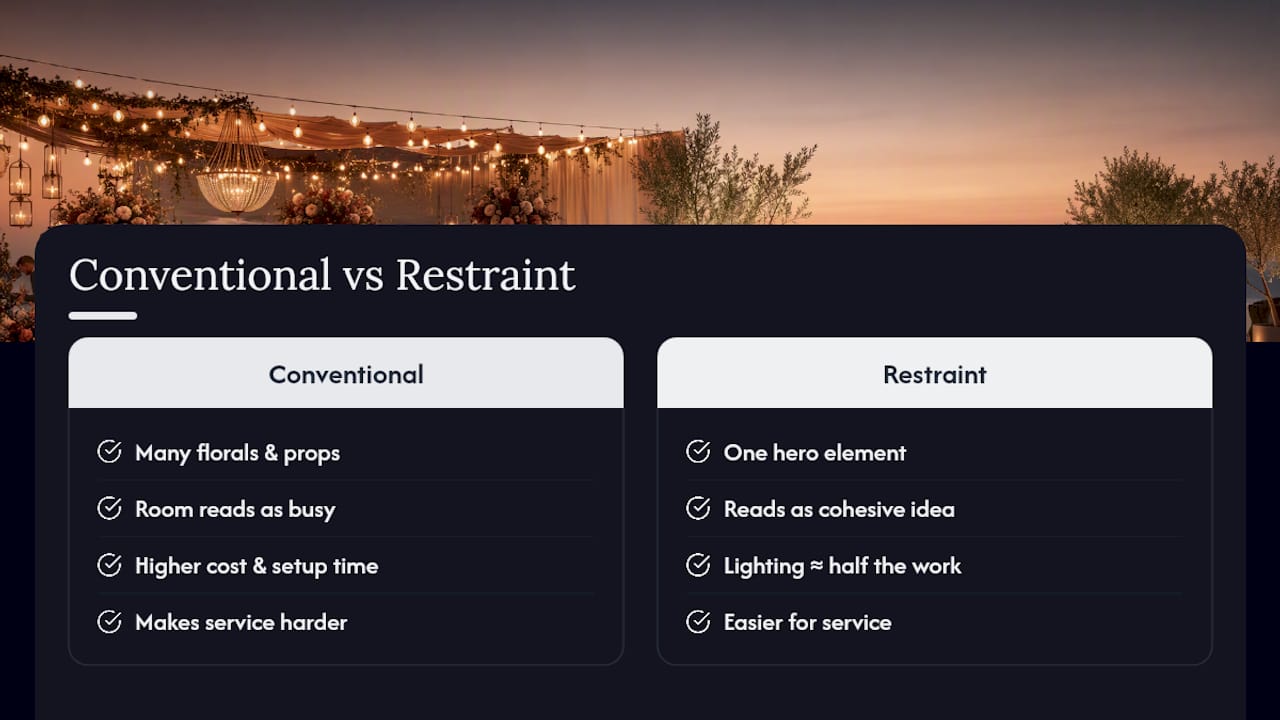
The research behind this article points the other way. Lighting alone does roughly half the styling work that florals do, at a fraction of the cost and setup time. A single greenery runner with taper candles will outperform a table crowded with mismatched vases nine times out of ten, simply because it reads as one cohesive idea rather than a collection of afterthoughts.
If there’s one thing worth prioritising above everything else in this article, it’s restraint: pick one hero element, keep centrepieces low, and let candlelight fill the gaps. Everything else, the theme, the palette, the signage, should support that single idea rather than compete with it. Readers planning their own setup should spend their energy on that one decision before touching anything else on the checklist.
— Coert
Get styling help from Winelands Function
Professional event planners offer an alternative to piecing together decor yourself when the rehearsal dinner is one event among many still on your plate: full styling, supplier coordination, and on-the-day setup, handled by an experienced team familiar with vendor reliability and venue policies.

For couples juggling a rehearsal dinner alongside the wedding itself, Winelands Function offers bespoke styling, floral sourcing, and on-the-day management so nothing needs a last-minute scramble. That includes venue-specific adjustments, whether you’re working with a restaurant’s existing assets or building a wine-country tablescape from scratch, and full coordination with your florist, linen hire, and lighting supplier so every element arrives on time and in place. If you’d like a bespoke quote for rehearsal-dinner or full wedding styling, visit the wedding planning page to enquire and share your date, venue, and vision.
Sources
For readers who want to go deeper on florals, centrepieces, and theme selection:
- Rehearsal dinner decorations | The Knot
- Easy rehearsal dinner decor ideas | Love & Lavender
- Rehearsal dinner centrepieces | Wedding CheckPoint
- 15 rehearsal dinner ideas | Vogue
FAQ
What decor do I need for a rehearsal dinner?
At minimum, you need place settings, one to two glasses per guest, cloth napkins, and simple vases, plus welcome signage and some bar-area styling to lift the room beyond a purely functional setup.
Do people decorate for rehearsal dinners?
Yes. Most hosts add at least low centrepieces, candles, and a welcome sign, even when the venue already provides some decor, because these small touches signal a hosted, intentional event rather than a plain dinner.
What are some good centrepieces for a rehearsal dinner?
Bud-vase clusters, hydrangea bowls, and greenery garlands with taper candles all work well because they stay under 12 inches tall and don’t block conversation across the table.
What are some good decorations for a rehearsal dinner at a restaurant?
Ask the restaurant what candles, linens, or art they already have before bringing your own, since many venues hold decor assets that save money and look more authentic than imported pieces. Add small, server-friendly touches like signage or a runner rather than trying to overhaul the room.
How long does it take to decorate for a rehearsal dinner?
A well-planned pop-and-plop setup, with flowers conditioned and signage pre-assembled the day before, typically takes about an hour or less once you’re on-site.