

An event organiser plans, budgets for, and coordinates suppliers and logistics to deliver an event from initial brief through to wrap-up. The role spans weddings, corporate launches, conferences and charity fundraisers, and the same core skeleton of planning, financial management, supplier coordination, on-the-day delivery and post-event reporting applies to all of them. What changes with the scale and prestige of the event is the depth of attention each phase demands.
TL;DR:
- Client consultation and logistics management are considered more important than creative tasks, as they directly impact the event’s success and risk mitigation.
- The planning timeline varies: several months for large events, with the final two weeks and day being the busiest periods requiring detailed milestone tracking.
- Post-event tasks like invoice reconciliation, feedback collection, and documentation are critical for securing future business and are often overlooked by junior organisers.
- For luxury events, sourcing bespoke suppliers, designing guest experiences, and coordinating high-end logistics significantly extend the scope of standard duties.
- Sustainability practices such as choosing eco-friendly vendors and reducing waste have become essential components in event planning, especially for corporate clients.
Table of Contents
- The core event organiser duties, from brief to wrap-up
- What skills, attributes and qualifications do employers expect?
- How long does event planning actually take, start to finish?
- Risk, compliance and insurance: the duties that carry legal weight
- Building experience before you land the role
- How duties change when the event is a luxury wedding or corporate launch
- Are the sustainability duties worth taking seriously?
- What the standard duty lists get wrong about this job
- Ready to see these duties handled for you?
- Sources
The core event organiser duties, from brief to wrap-up
Every occupational profile of this career, from the Bureau of Labor Statistics to job-site guidance, breaks the role into the same three phases: pre-event planning, live delivery, and post-event closure. Understanding this structure is the fastest way to understand event organiser duties as a whole, rather than as a scattered list of tasks.
Pre-event planning sets the foundations. Get this wrong and no amount of on-the-day energy fixes it.
- Take the client brief and agree the concept, scope and objectives.
- Build the budget, including a contingency line for the unexpected.
- Draft the working timeline and key milestone dates.
- Scout venues and conduct site inspections for capacity, access and technical fit.
- Source suppliers and negotiate contracts covering price, cancellation terms and liability.
- Secure permits and confirm compliance requirements for the venue and activity type.
- Set up registration or ticketing systems for guest or delegate management.
O*NET data on the occupation rates “consult with customers to determine objectives” and “coordinate accommodation and transportation” as highly important tasks. That ordering matters. Client consultation and logistics coordination consistently outrank the more visible creative elements when O*NET’s task list is scored for importance.
Event delivery day is where planning either holds or unravels. This is the phase most people picture when they think of the job, but it is built entirely on the groundwork laid weeks earlier.
- Coordinate vendors as they arrive, set up and strike down.
- Manage staff and volunteer teams, including briefings and role assignments.
- Oversee registration and guest flow to avoid bottlenecks at entry points.
- Run AV and technical checks before doors open.
- Handle real-time logistics and make fast decisions when something shifts.
- Keep stakeholders (the client, venue manager, key suppliers) briefed throughout.
Post-event wrap-up is the phase most junior organisers underestimate. It is also where repeat business and referrals are won or lost.
- Reconcile invoices and process final supplier payments.
- Gather attendee feedback and performance metrics.
- Write a post-event report for the client or internal stakeholders.
- Record lessons learned and archive contracts, timelines and supplier details for future reference.
CareerOneStop’s occupation profile describes the fast-paced nature of the work and the multiple concurrent deadlines organisers juggle, which is exactly why a phased checklist like this one matters more than a vague job title ever could.
What skills, attributes and qualifications do employers expect?
Hiring managers look for a mix of demonstrable hard skills and softer behavioural traits, and they want to see both on a CV, not just claimed in a cover letter.
Hard skills worth listing:
- Budgeting and cost control across multiple supplier lines.
- Procurement and contract negotiation.
- Vendor and supplier management.
- Logistics and timeline planning.
- Basic AV and technical setup knowledge.
- Registration or CRM/AMS system familiarity.
Soft skills employers probe for in interviews:
- Clear, confident communication with clients and suppliers alike.
- Problem solving under time pressure.
- Calm decision-making when plans change on the day.
- Attention to detail across dozens of moving parts.
- Relationship-building with recurring vendors and venues.
Formal routes into the role include hospitality or event management degrees, apprenticeships, and shorter certificate courses. Sector experience, particularly with weddings or corporate events, often carries as much weight as a qualification. Job-site guidance from Indeed reinforces that employers want proof of tasks completed, not just titles held.
Pro Tip: Never write a CV bullet as a bare task. Pair it with the outcome: “Negotiated venue contracts for a 200-guest conference, cutting hire costs by renegotiating cancellation terms” reads far stronger than “Negotiated with venues.”
How long does event planning actually take, start to finish?
Timelines scale with complexity, and knowing the standard windows helps you set realistic expectations with clients or, if you are the one being hired, in an interview.
- A medium conference typically needs several months from brief to delivery.
- A small corporate event or private celebration can run on a shorter time frame of weeks.
- Milestone checkpoints stay consistent regardless of scale: brief sign-off, venue contract signed, supplier confirmations locked, and a final run-through days before the event.
- The final fortnight and the event day itself are consistently the busiest periods, when confirmations, last-minute changes and setup collide.
Templates for run sheets, standing vendor service-level agreements, and clear task delegation to junior staff are the three biggest time-savers experienced organisers rely on. Our event checklist for UK organisers is built around exactly this kind of milestone structure.
Risk, compliance and insurance: the duties that carry legal weight
Some event organiser duties are non-negotiable because they carry legal or financial consequences if skipped. This is where the job stops being purely creative and becomes genuinely operational.
- Permits for the venue, activity type and any licensed elements (alcohol, music, food service).
- Fire safety and food hygiene compliance checks.
- Accessibility provisions for guests with mobility or sensory needs.
- Safeguarding measures and crowd control planning for larger gatherings, an area covered in detail by this guide to event security.
Insurance is usually arranged or advised on by the organiser, covering public liability, employers’ liability, equipment cover, and cancellation or postponement protection. Event Insurance Services’ responsibilities checklist treats contingency and insurance as one of nine core duty areas, not an afterthought.
Contingency budgets are typically sized as a percentage of total event spend, often held back specifically for supplier no-shows, weather disruption, or last-minute technical failures. O*NET’s task-importance data places “consult with customers to determine objectives” at the very top of the occupation’s ranked tasks, ahead of contract negotiation and logistics, underlining why clear briefing underpins every downstream risk decision.
Building experience before you land the role
Nobody hires a first-time organiser to run a 500-guest gala, so the practical path in runs through smaller, real projects that prove you can handle the checklist above.
- Volunteer to run a local charity fundraiser or community fete.
- Offer to coordinate a friend’s small wedding or a corporate breakfast briefing.
- Record every project in a portfolio: brief, budget, supplier list, timeline, and outcome.
- Look into UK apprenticeships and T-levels as structured entry routes, alongside apprenticeship listings on Gov.uk and career pathway detail on National Careers’ events manager profile.
Pro Tip: Treat volunteer events like paid contracts. Write a one-page case study for each one, covering the brief, budget, what went wrong, and how you fixed it. That document does more for an interview than any certificate.
How duties change when the event is a luxury wedding or corporate launch
The checklist above holds for every event type, but luxury work adds a layer most job descriptions never mention. Supplier sourcing shifts from “find a caterer” to vetting three or four bespoke providers against a client’s exact aesthetic and dietary requirements. Guest experience design becomes its own workstream, covering everything from welcome gifts to personalised transport schedules. Styling oversight means checking floral proportions against table settings in person, not from a supplier’s mock-up photo.
A concrete example: coordinating bespoke transport for a destination wedding might mean briefing three separate drivers on staggered pickup windows, confirming vehicle types match the couple’s styling brief, and having a backup vehicle on standby. That single line item barely registers on a standard corporate breakfast but consumes real planning hours on a luxury brief. Our own bespoke and luxury celebrations work reflects exactly this expanded remit, and our guide to wedding planner duties breaks down how the standard checklist stretches for high-end briefs.
Are the sustainability duties worth taking seriously?
Sustainability has moved from a nice-to-have line item to a genuine duty on most event briefs, and organisers who ignore it are increasingly out of step with client expectations. Corporate clients in particular now ask direct questions about waste, carbon footprint and supplier practices before signing off a proposal.
Practical duties in this area include sourcing caterers who commit to low food waste practices, choosing decor and floral suppliers who reuse or compost materials rather than binning single-use arrangements, and selecting venues with genuine energy efficiency credentials rather than a marketing claim. Digital-first registration and ticketing cuts printed material significantly, and organisers increasingly negotiate with transport suppliers to consolidate guest shuttles rather than running multiple near-empty vehicles.
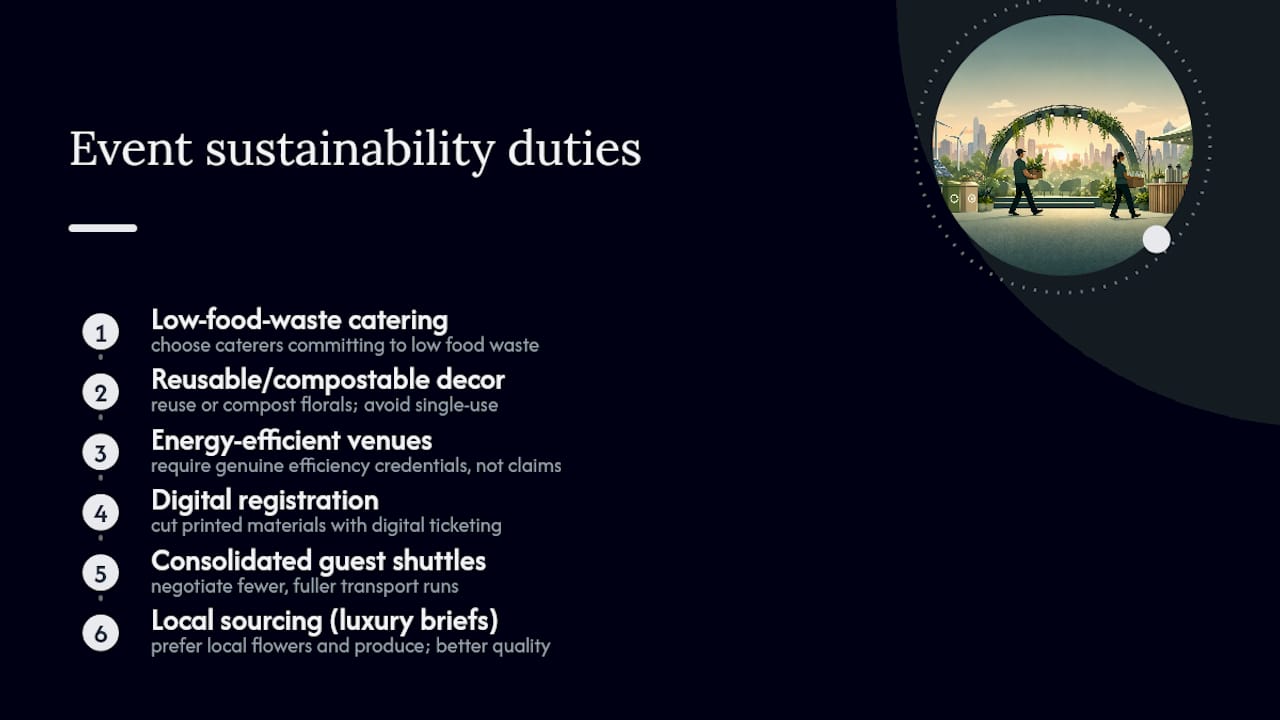
None of this replaces the core checklist. It sits alongside budgeting and supplier negotiation as another criterion organisers weigh when choosing vendors, and it is becoming a standard question in supplier contract negotiations rather than an optional add-on. For a luxury brief, sustainability often means sourcing local flowers and produce instead of imported alternatives, which frequently improves quality as well as environmental impact. Clients rarely ask for a sustainability report on a small private party, but they increasingly expect the organiser to have thought about it without being asked.
What the standard duty lists get wrong about this job
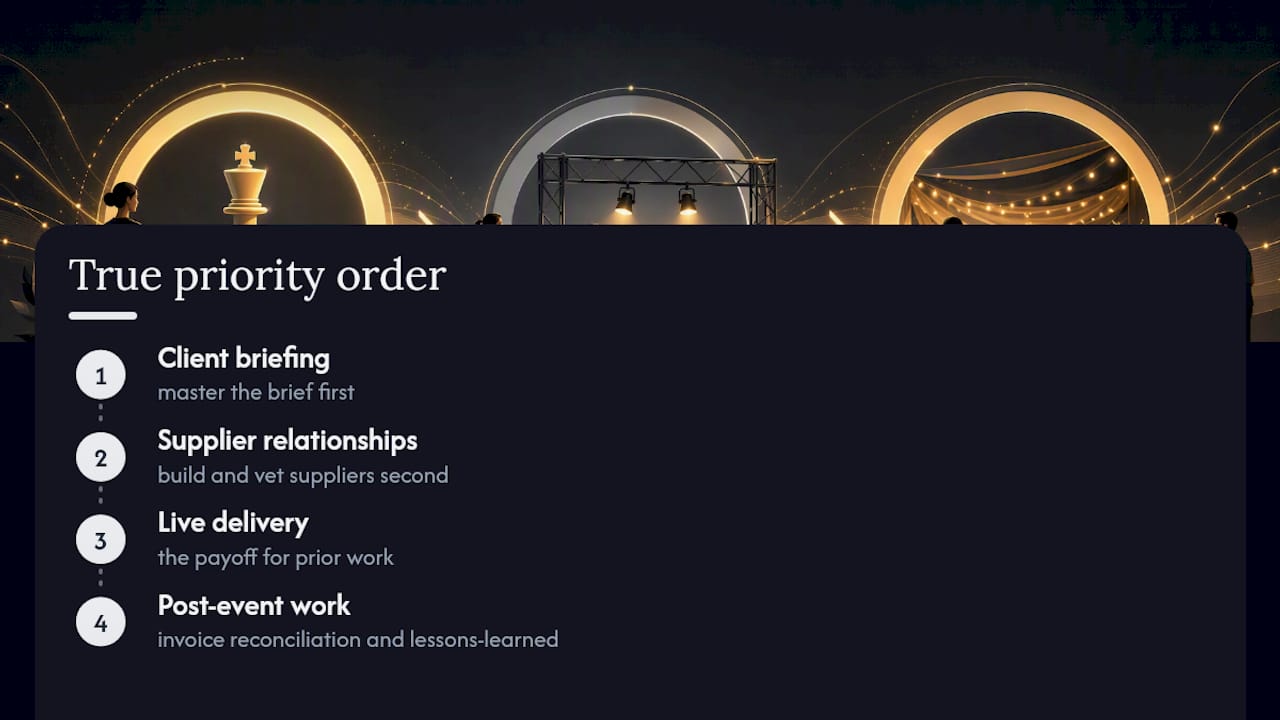
Most occupational descriptions of this role read like a flat list, as if consulting a client and negotiating a supplier contract carry equal weight and equal risk. They do not. The data consistently shows client consultation and logistics coordination ranking above almost everything else in importance, and the reason is simple: get the brief wrong, and every downstream decision, from venue to supplier to timeline, inherits that error.
The conventional advice also underplays how much the post-event phase matters for a career, not just for the client relationship. Early-career organisers chase the visible, glamorous parts of the job, the live delivery, and skip the invoice reconciliation and lessons-learned documentation. That is precisely the material that builds a credible portfolio and separates a one-off helper from someone employers trust with a bigger brief next time.
For anyone weighing whether this career suits them, the honest priority order is: master client briefing first, build supplier relationships second, and treat live delivery as the payoff for work already done rather than the job itself. Luxury events simply raise the stakes on all three, demanding sharper supplier vetting and a guest experience that holds up to far closer scrutiny.
— Coert
Ready to see these duties handled for you?
If you have read this far as someone planning your own wedding or corporate launch rather than pursuing a career in the field, you now know exactly how much sits behind a smooth event, from contingency budgeting to supplier vetting to post-event reconciliation. Winelandsfunction exists precisely so you never have to carry that checklist yourself. We handle every duty covered above, from initial brief through to final supplier payment, with the added layer of attention that luxury weddings and corporate events demand.
Our team manages bespoke supplier sourcing, styling oversight and on-the-day logistics across Cape Town and the Western Cape, so you get the guest experience without the spreadsheet stress. Whether you are planning an intimate celebration or a large-scale corporate launch, our wedding planning service or event management pages set out exactly how we work. Get in touch to check availability for your date and request a tailored quote.
Sources
- Meeting, convention, and event planners : Occupational Outlook Handbook (BLS)
- 13-1121.00 – Meeting, Convention, and Event Planners (O*NET)
- What does an event organiser do? (Indeed)