
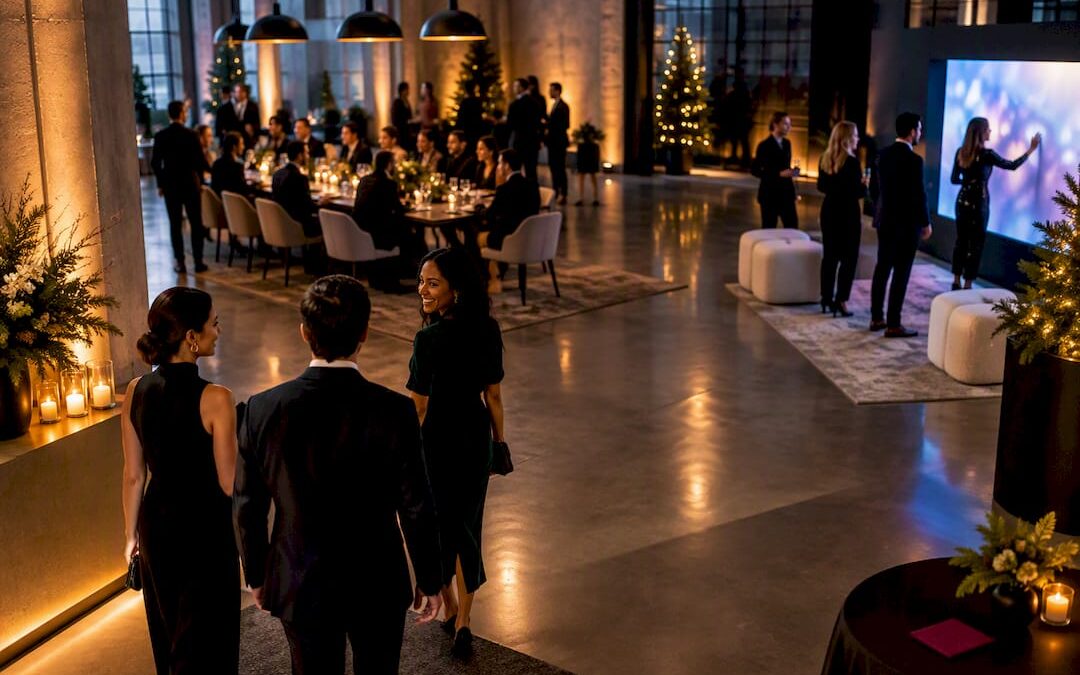
The most reliable way to deliver a unique corporate holiday party is to choose a committed theme and build a multi-zone, activity-led night with a few anchor experiences and continuous stations. This article shows you exactly how, from immersive concepts through every budget tier to hybrid formats, with the planning timelines and venue checks that separate a memorable evening from an expensive dinner nobody talks about again.
TL;DR:
- Using one or two anchor experiences supported by multiple low-cost stations creates a more engaging event than spreading resources thin on many mediocre activities.
- Venue requirements such as ceiling height, rigging points, and load-in access are critical to support immersive themes like winter wonderland or set-heavy productions.
- Hybrid events benefit from dedicated local hubs and central streaming with early gift shipment, professional AV, and a clear timetable for remote participant inclusion.
- Starting planning early—by late September for December events—ensures access to preferred venues, entertainment acts, and suitable production support.
- A consistent theme carried through all touchpoints and executed with quality production makes even simple ideas memorable and highly shareable.
Table of Contents
- Unique corporate holiday party ideas for an immersive evening
- Scaling one theme across low, mid and premium budgets
- Making remote and hybrid teams part of the celebration
- How to choose the right theme for your team
- Venue and production checklist before you sign a contract
- Winelands Function in practice: from brief to delivered evening
- What actually makes a corporate party unforgettable
- Let Winelands Function handle your next corporate holiday party
- Sources
- FAQ
Unique corporate holiday party ideas for an immersive evening
Elevated, immersive themes paired with multi-zone activity formats consistently outperform single-format dinners for employee engagement, and two or three anchor activations tend to work best for a typical mid-size group. That single fact should shape every theme decision you make this year. A themed dinner with a band is pleasant. A themed evening built around movement, discovery, and a handful of unforgettable pinch points is what people are still discussing in January.
Here are the concepts worth building a brief around.
Immersive winter wonderland. Think beyond fairy lights: projection mapping across ceilings and walls, faux snowfall on a timer, and a sound design that shifts from ambient chimes to a live string quartet as the evening progresses. This works best in a venue with a high, unbroken ceiling (5.5 metres or more gives projection room to breathe) and blackout capability, since ambient daylight or house lighting will wash out any mapped visuals. It scales beautifully from 80 guests in a converted warehouse to 400 in a purpose-built event hall.
Black-tie masquerade, old Hollywood, or Art Deco. A strict dress code does the heavy lifting here, but the room has to support it. Uplighting in warm gold or deep jewel tones, a step-and-repeat photo moment with proper backlighting, and a staged arrival sequence turn a cocktail party into a red-carpet evening. This theme rewards a venue with good sightlines to a central stage or dance floor, because the visual drama is meant to be seen from every seat.
Speakeasy or sneak-entrance experience. The arrival moment carries this theme entirely. A hidden door, a password whispered to a host in period dress, or a narrow corridor that opens into a fully dressed 1920s bar creates a sense of occasion before a single drink is poured. Capacity control matters more here than in almost any other format: too many guests through a single entrance point kills the mystery and creates a bottleneck. Cap arrivals in staggered waves of 20 to 30 people every ten minutes if your guest list runs over 150.
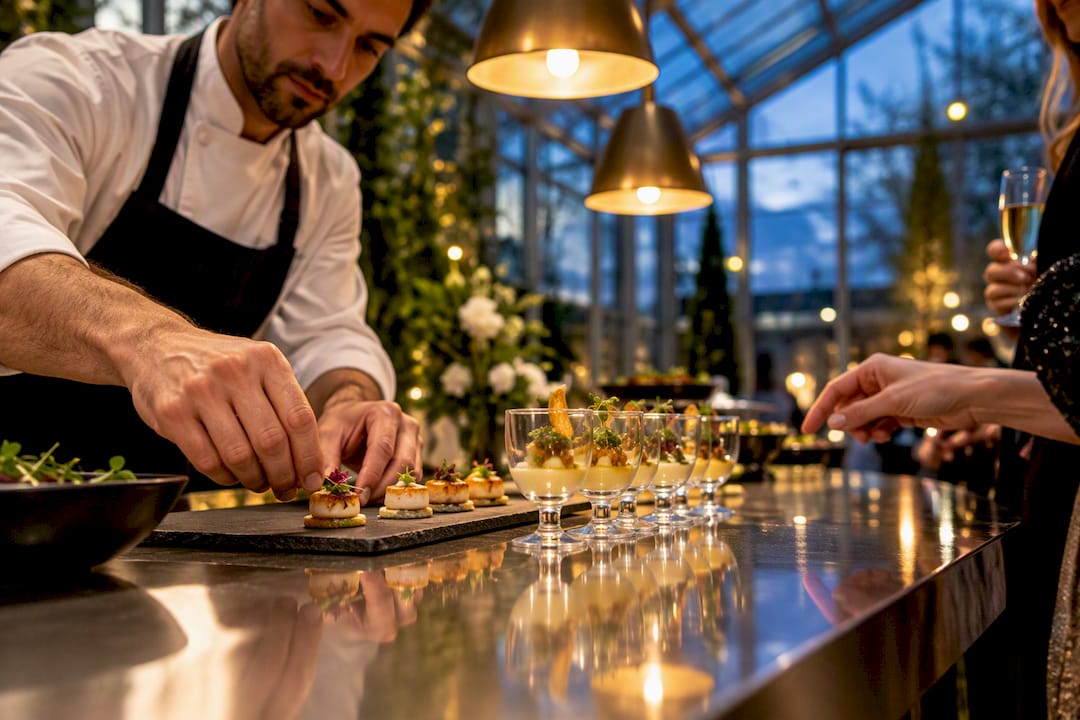
Interactive culinary experiences. Chef-led stations, live shucking bars, tableside flambé, or a build-your-own tasting flight beat a plated dinner for engagement almost every time, and activity-led formats like mixology stations and chef-led experiences reliably drive higher participation than passive dinner shows. If your venue has the right kitchen access, a rotating tasting menu across four or five stations keeps guests moving, talking, and comparing notes rather than sitting through a fixed three-course service. For planners weighing how food and setting work together at a deeper level, this guide to combining lodging and gastronomy is worth a look, particularly if your holiday party sits alongside overnight accommodation for out-of-town staff.
Luxury secret-gifter and curated exchange formats. The traditional Secret Santa gets an upgrade when the exchange becomes an experience in itself: a “reveal wall” where gifts are displayed anonymously before recipients are announced, or a curated gift bar where employees select from a pre-vetted table of options within a set spending band. This removes the awkwardness of mismatched gift values while keeping the surprise element intact.
Live-entertainment anchors. A DJ battle between two performers, a pair of aerialists suspended above the dance floor, or roaming performers who weave through cocktail hour work best as one of your two or three anchors, not as background noise. Choose a DJ battle when your crowd is younger and dance-floor-driven; choose aerialists or roaming characters when the room skews toward a more reserved, cocktail-party energy and you want visual spectacle without demanding participation.
The lesson underneath all of this: production quality decides whether an idea lands, not novelty. An ugly-sweater party is a genuinely tired concept on its own, but add a proper runway, a host running live commentary, three judging categories with real criteria, and prizes with actual value, and the same idea becomes the most photographed moment of the night. The difference between a flat theme and a talked-about one is almost never the concept. It is the execution layer sitting on top of it.
- Winter wonderland needs ceiling height, blackout, and a serious lighting and sound budget
- Masquerade or Art Deco needs uplighting, a dress code communicated well in advance, and strong sightlines
- Speakeasy needs a controllable arrival point and staggered entry timing
- Culinary stations need kitchen access, chef staffing, and a floor plan that lets guests circulate
- Gift-exchange formats need a clear spending band communicated to every department in advance
- Live entertainment anchors need a stage or focal point with unobstructed views from most of the room
For planners looking at examples closer to home, this collection of corporate event ideas for elite gatherings shows how several of these formats translate into real venue layouts.
Pro Tip: Pick one theme and carry it through every touchpoint, invitation copy, signage, the signature cocktail name, even the playlist. A half-committed theme reads as generic no matter how much you spend on the room.
Scaling one theme across low, mid and premium budgets
You do not need three different ideas for three different budgets. You need one strong concept and a clear sense of what to cut, keep, and upgrade as the spend changes. Take the speakeasy theme as a working example.
- Low budget: Skip the built set and lean on lighting, signage, and costume. Dim, warm lighting, a hand-lettered “password” sign at the door, and staff in simple period-appropriate accessories (braces, flat caps, feather headbands) create the mood for a fraction of a full production budget. A single bartender running a two-cocktail menu becomes the anchor; everything else is a normal buffet or plated meal.
- Mid-range: Add a proper hidden-door entrance built from temporary drape and signage, a three-cocktail menu with a mixologist doing tableside garnishing, and one additional low-cost station, a cigar-roller demonstration or a card-table corner, to give guests a second thing to gather around.
- Premium: Full set construction with a period-dressed corridor, a live jazz trio, a dedicated speakeasy bar built as its own room-within-a-room, and a professional host managing the arrival sequence in character. This tier is where hiring in production expertise pays for itself, because the arrival choreography and set build are genuinely difficult to run well without experience.
The rule of thumb that holds across every budget tier: one high-impact anchor experience, supported by two or three low-cost stations, beats spreading a modest budget thin across five mediocre activations. A single excellent photo moment, cocktail bar, or performance does more for how the night is remembered than five average ones. Stretch a small budget with directional lighting, well-designed signage, and prizes that feel considered rather than generic (a bottle of good wine beats a branded mug every time). Once your guest count passes 200, or your theme depends on a built set, custom staging, or choreographed timing, that is the point to stop treating it as a DIY project and bring in production expertise.
Making remote and hybrid teams part of the celebration
Distributed teams need their own version of the anchor-plus-stations structure, not a scaled-down afterthought. A virtual scavenger hunt with a live producer running breakout rooms, or a company-wide trivia tournament with real prizes, gives remote staff the same sense of competition and shared moment that an in-person crowd gets from a live game on stage.
Hybrid setups work best when local hubs (regional offices, or even small home gatherings for five or six colleagues) each run their own mini celebration, tied together by a central live-streamed feature at a fixed time. A practical hybrid approach pairs these local hubs with one central live-streamed segment, rather than trying to stream an entire multi-hour event, which almost always loses remote attendees somewhere around the second hour. For the AV side, budget for a dedicated camera operator (not a laptop propped on a table), a small mixer for clean audio, and an MC whose only job is bridging the in-room and on-screen audiences rather than running the whole show single-handedly.
Gifting needs its own timeline entirely. Ship physical gifts to remote staff at least two weeks before the event so they arrive in time to be opened live during the stream, not days afterward as an anticlimax. Build in dietary and accessibility provisioning at the invitation stage, not as a last-minute scramble, and be deliberate about cultural sensitivity in theme choice: a “holiday” theme that assumes one specific tradition can quietly exclude a meaningful share of the room.
- Run virtual games through a dedicated producer, not whoever is free that afternoon
- Give remote hubs their own budget line, not leftover funds from the main event
- Confirm dietary and accessibility needs at RSVP, not at the door
- Ship gifts early enough that “it’s still in transit” never becomes part of the story
Pro Tip: Ask remote attendees to submit a short video greeting in advance. Playing a handful during the live segment does more for inclusion than any amount of AV spend on the stream itself.
How to choose the right theme for your team
Three questions cut through most theme indecision faster than any brainstorm session:
- Who is actually attending? A 25-person creative agency and a 400-person logistics firm need entirely different production scales, and pretending otherwise wastes budget in one direction or leaves the room feeling flat in the other.
- What do you want them to feel? Impressed and glamorous points you toward masquerade or Art Deco. Playful and competitive points toward a DJ battle or a culinary competition. Relaxed and connected points toward smaller culinary stations over a big stage moment.
- What can the room actually support? A stunning immersive concept means nothing if the venue cannot deliver the ceiling height, power, or floor plan it needs.
Headcount gives you a rough guide for how many activations to plan. Up to 50 guests generally needs just one strong anchor and a single supporting station, anything more spreads people too thin to gather momentum anywhere. Between 50 and 150 guests supports two anchors plus two or three stations. Above 150, and particularly in the 150 to 300 range that most large corporate parties fall into, two or three well-produced anchor activations tend to be optimal for quality engagement: more than that and quality drops across the board as budget and attention get diluted.
Timing matters as much as the concept. For December events, strong venues and sought-after entertainment acts are typically committed by late October, which makes September the realistic deadline for locking in your best options rather than settling for whatever is still available.
Booking reality check: if your December date, venue, and headline entertainment aren’t confirmed by the end of September, you are choosing from what’s left, not what you actually wanted.
Keep the activity list HR-safe: avoid anything that requires physical contact without consent, alcohol-dependent games as the sole entertainment, or competitive formats that single out individuals for public embarrassment. On gift exchanges, set a clear spending band (many companies land somewhere between $20 and $30, or the local equivalent) and put it in writing well ahead of the event, so nobody feels pressure to overspend or embarrassment at underspending. A preparation guide covering timeline and logistics is a useful companion document once you have settled on a direction.
Venue and production checklist before you sign a contract
A theme that looks perfect on a mood board can fail entirely on the night if the venue cannot physically support it. Walk every shortlisted space with this checklist in hand.
- Ceiling height and rigging: confirm clearance for any hanging décor, drape, or aerial performance, and ask specifically what the venue’s rigging points can bear
- Load-in access: check door widths, loading dock availability, and whether large set pieces or catering equipment can actually reach the room without a lift
- Power capacity: confirm amperage against your full AV, lighting, and catering equipment list, and always have a backup power plan for anything projection or stream-dependent
- AV for hybrid moments: plan camera angles, a proper mixer, and internet bandwidth well before the event date, not the week of
- Room flow: map the arrival moment, the timing of your mid-evening anchor activation, and where continuous stations sit so guests are never funnelled through a single narrow point
- Catering rhythm: decide whether food is a seated course, a rotating station format, or both, and confirm the kitchen can actually run your chosen service style
- Accessibility: check step-free access, seating for guests who need it, and clear sightlines from wheelchair-accessible areas to any stage or performance zone
| Checklist area | What to confirm | Why it matters |
|---|---|---|
| Ceiling and rigging | Height clearance, rigging point weight limits | Determines what décor, drape, or aerial acts are physically possible |
| Power | Total amperage vs. equipment draw, backup plan | Prevents blackouts mid-performance or mid-stream |
| Load-in | Door widths, dock access, lift availability | Avoids last-minute set changes because equipment can’t get in |
| Room flow | Arrival point, anchor timing, station placement | Stops bottlenecks and keeps energy moving all evening |
| Hybrid AV | Camera angles, mixer, bandwidth | Determines whether remote guests feel present or forgotten |
A must-have checklist for corporate events covers several of these production points in more depth if you are building your own site-visit template from scratch.
Winelands Function in practice: from brief to delivered evening
A professional planner turns a loose idea into a working document long before the first supplier call. A typical brief moves from a short concept statement (theme, headcount, venue constraints, budget band) through a list of confirmed activations, to a final run sheet that times every anchor moment to the minute.
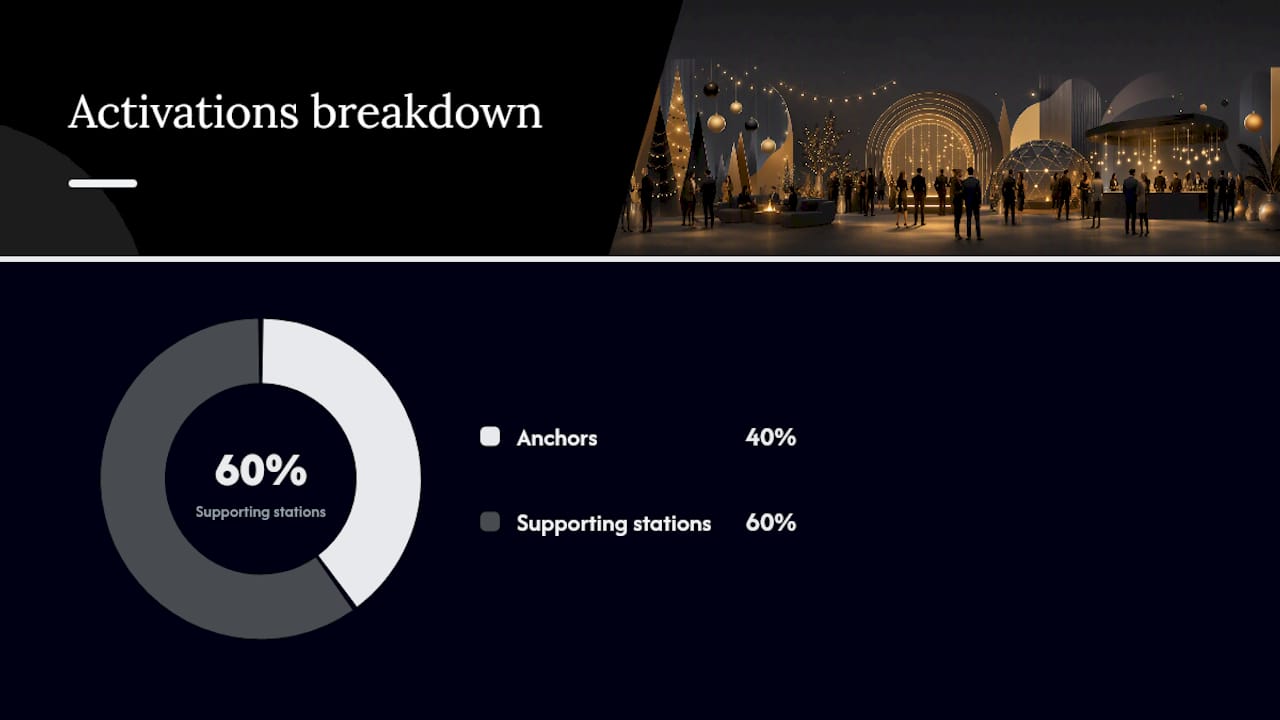
The shape of that document looks roughly like this: a one-line concept (“1920s speakeasy for 180 guests, mid-range budget, staggered arrival”), a list of two anchors and three supporting stations, confirmed supplier bookings against the September deadline, and a run sheet showing exactly when the DJ battle starts relative to when catering service ends.
A professional planner builds this kind of brief for luxury weddings, bespoke celebrations, and corporate functions, working from initial concept through to on-the-day delivery. That includes supplier and venue management, styling and décor, and timeline oversight, the same production discipline that separates a themed dinner from a night people are still talking about in the new year.
- Hire in production expertise once your guest count, venue complexity, or theme ambition genuinely exceeds what your internal team can safely coordinate
- A clear brief (concept, activations, run sheet) is the difference between a smooth night and a scramble on the day
- Case examples across weddings, launches, and bespoke celebrations show the same principle at work: one committed idea, properly produced, beats several half-finished ones
What actually makes a corporate party unforgettable
Here is the uncomfortable truth most planning guides skip over: the theme almost never fails. The execution does. I have read through enough case studies and planner notes to notice the same pattern every time a “boring” idea turns into the story people tell for years, and it is never a bigger budget. It is commitment to one idea, carried consistently through every touchpoint, and a deliberate shift from observation to participation.
Guests do not remember rooms with good lighting. They remember the moment they were handed a mask at the door, or the ten minutes they spent voting on the ugly-sweater runway. Design for doing, not watching. The most common mistake I see is treating entertainment as something that happens near the stage while everyone else eats dinner. Split your budget between one strong anchor and genuine, hands-on stations, and skip anything that asks 300 people to sit quietly and be impressed. That is not what memorable looks like.
— Coert
Let Winelands Function handle your next corporate holiday party
Winelands Function is the alternative to piecing together your own supplier list and hoping the theme, venue, and entertainment all arrive on the same page. We plan corporate functions and launches from initial concept through full delivery, coordinating venue, styling, décor, and timeline so the multi-zone, activity-led evening you have in mind actually comes together on the night rather than unravelling under production pressure.
On first contact, expect a straightforward capability conversation: your headcount, budget band, and the feeling you want the room to have, followed by a clear sense of what’s realistic within your timeline. If you are working toward a December date, the September booking window discussed earlier applies here too, so the earlier that conversation happens, the more options stay open. Explore our corporate functions and launches service to start that conversation and check availability for your date.
Sources
A few sources are worth bookmarking alongside this guide. The corporate holiday event ideas roundup is useful for booking timelines and headcount-to-activation ratios. The Event Solutions guide covers hybrid logistics and activity-led formats in practical detail. For committees that need a fast starting point, an office holiday party theme generator bundles venue, dress code, and activity suggestions into a ready brief, and Random is a genuinely useful, no-cost way to run fair prize draws or contest selections on the night.
- Corporate Holiday Party Ideas 2026 | 20 Unique Concepts
- Corporate Holiday Party Ideas to Plan the Perfect Event | Event Solutions
FAQ
What are some creative ideas for a corporate holiday party?
Immersive themes with committed production, winter wonderlands with projection and sound design, speakeasy arrivals with staggered entry, or interactive culinary stations, consistently outperform a standard dinner-and-DJ format. The strongest results come from choosing two or three anchor activations rather than one big passive show, supported by continuous, low-key stations guests can drift between all night.
How do you make a corporate party genuinely fun rather than just formal?
Shift the balance from watching to doing: activity-led formats like chef-led food stations, live competitions, and interactive bars drive noticeably higher engagement than passive dinner shows. Give people something to participate in within the first thirty minutes, not just a seat and a plate.
What are some unique themes for a holiday party?
Strong options include an immersive winter wonderland with projection mapping, a black-tie masquerade or Art Deco evening, a speakeasy with a hidden arrival sequence, and an interactive culinary experience built around chef-led tasting stations. Each works across very different budgets once you know what to cut and what to protect, covered in detail in the budget-tiering section above.
How far in advance should we book a unique theme for a December party?
For December dates, strong venues and in-demand entertainment acts are usually committed by late October, which makes the end of September the realistic deadline to lock in your first-choice options. Booking later usually means choosing from what’s left rather than what actually fits your brief.
Can Winelands Function help plan a themed corporate holiday party?
Yes. A professional event planning service can coordinate venue selection, styling, décor, and full-day timeline management for corporate functions and launches from initial concept through delivery. Pricing is available on request through the corporate functions and launches page.