

TL;DR:
- Meticulous planning and structured workflows are essential for extraordinary luxury events, not a larger budget.
- Personalisation, authenticity, and seamless invisible logistics create memorable guest experiences.
- Effective risk management and disciplined budgeting are crucial for event success and client satisfaction.
The most persistent myth in luxury event planning is that a larger budget guarantees a more memorable occasion. It does not. What separates a truly extraordinary wedding in the Cape Winelands from an expensive but forgettable gathering is rarely the floral budget or the champagne label. It is the rigour behind every decision, the discipline of structured workflows, and the quiet confidence of a team that has anticipated every possible complication. As corporate event best practices confirm, restraint and authenticity consistently outperform raw opulence. This article unpacks exactly how meticulous planning transforms high-end events in South Africa.
Table of Contents
- Why meticulous planning is the backbone of luxury South African events
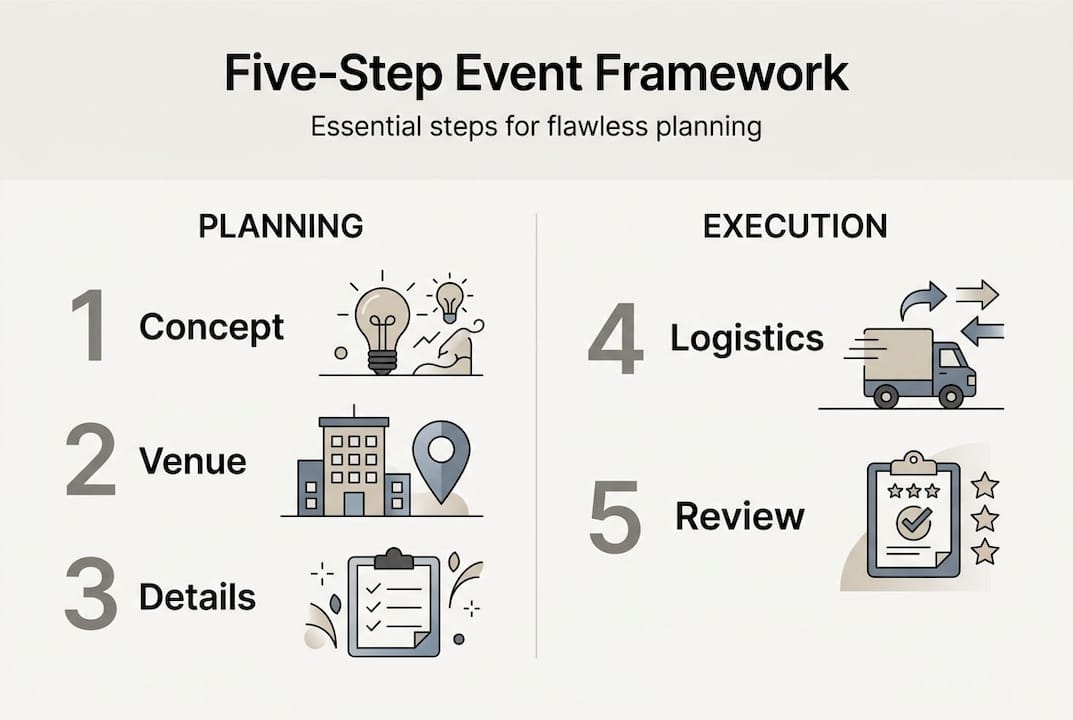
- The five-step framework for flawless events
- Mastering the art of event budgeting and risk management
- Personalisation, authenticity, and why luxury means more
- Our perspective: The truth about luxury and planning most miss
- Ready to elevate your next event?
- Frequently asked questions
Key Takeaways
| Point | Details |
|---|---|
| Structure beats spend | A clearly defined, step-by-step process is more impactful than a large budget when planning elite events. |
| Plan for risk | Embedding 10–15% contingency and formal risk management is essential to handle unpredictables. |
| Personalisation wins | Events that reflect authenticity and the client’s unique story create the most lasting impressions. |
| Local expertise matters | Incorporating South African culture and trusted local vendors elevates exclusivity and guest experience. |
Why meticulous planning is the backbone of luxury South African events
South Africa’s events industry is not a niche pursuit. It contributes R91 billion to GDP and supports roughly 250,000 jobs, with destination weddings alone accounting for 8% of Western Cape tourism. This is a serious, high-stakes sector where the expectations of affluent clients and blue-chip corporates are exceptionally demanding. Getting it wrong is not simply an inconvenience; it can damage reputations and relationships that took years to build.
Meticulous planning, in this context, means far more than ticking boxes on a to-do list. It is a deliberate, structured approach that covers vision alignment, vendor workflows, logistics choreography, contingency planning, and quality verification at every stage. It is the difference between an event that flows effortlessly and one where guests sense something is slightly off, even if they cannot name it.
The evidence supports this emphatically. Structured planning increases corporate engagement by 65%, while personalised elements boost luxury wedding satisfaction by 70%. These are not marginal gains. They represent the gap between an event that achieves its purpose and one that exceeds every expectation.
“The most flawless events are not the ones with the biggest budgets. They are the ones where every detail has been thought through twice, and the guest never notices the effort.”
Where wealthy individuals and corporates most often go wrong is in underestimating the complexity of coordination. They invest heavily in visible elements such as décor and catering, while neglecting the invisible architecture that holds everything together. A thorough luxury wedding ceremony checklist illustrates just how many interdependent decisions must align perfectly.
Meticulous planning covers:
- Vision and brief: Clearly defined objectives, guest experience goals, and brand or personal narrative
- Vendor and venue curation: Rigorous selection based on capability, reliability, and cultural fit
- Logistics and run-of-show: Minute-by-minute scheduling, transport, and technical requirements
- Risk identification: Weather, vendor failure, scope changes, and regulatory compliance
- Quality verification: Pre-event walkthroughs, rehearsals, and post-event reviews
For bespoke event experiences, this level of planning is not optional. It is the foundation upon which every elegant detail rests.
The five-step framework for flawless events
Top South African planners follow a structured five-step workflow that applies equally to weddings, corporate functions, and bespoke celebrations. Understanding this process helps you ask better questions, set realistic expectations, and hold your planning team accountable.
- Discovery: This is where vision is defined. A skilled planner listens far more than they speak, drawing out the client’s values, aesthetic preferences, and non-negotiables. For a corporate client, this means understanding brand positioning and delegate experience goals. For a wedding couple, it means uncovering the story they want to tell.
- Vendor and venue curation: South Africa offers extraordinary options, from fynbos-fringed wine estates to sleek urban venues in Cape Town’s city bowl. Curation means selecting partners whose quality and style align precisely with the brief, not simply those who are available.
- Bespoke design: This step translates the vision into tangible elements: mood boards, colour palettes, sensory touchpoints, and spatial flow. Authentic South African elements such as indigenous botanicals, local artisans, and regional cuisine add genuine character that imported aesthetics cannot replicate.
- Logistics management: Every supplier, timeline, and technical requirement is mapped and stress-tested. The wedding planning steps involved at this stage are extensive, covering everything from guest transport to generator specifications.
- Quality verification: Final walkthroughs, supplier briefings, and contingency rehearsals ensure that what was planned is precisely what is delivered.
| Planning priority | Luxury wedding | Corporate event |
|—|—|—|
| Lead time | 12 to 18 months | 6 to 12 months |
| Design focus | Décor, florals, styling | AV, branding, delegate flow |
| Catering emphasis | Multi-course dining experience | Networking and dietary diversity |
| Key risk | Vendor availability | Technical failure |
| Personalisation | Couple’s story and heritage | Brand narrative and delegate engagement |
Pro Tip: Before finalising any design concept, build a sensory map alongside your mood board. Note what guests will hear, smell, and feel at each stage of the event. This single exercise catches more inconsistencies than any checklist, and it is the technique that separates good planners from exceptional ones. Explore how personalising luxury celebrations can transform the guest experience at every touchpoint.
Mastering the art of event budgeting and risk management
A flawless plan is only as strong as its financial and risk underpinnings. Budget mismanagement is one of the most common reasons high-end events fall short of expectations, not because clients spend too little, but because they allocate poorly.

For luxury weddings, best practice budget splits allocate 35 to 40% to venue, 25 to 30% to catering, and critically, 10 to 15% to contingency. Corporate events shift the balance, with 25 to 30% on venue and a heavier weighting towards AV, entertainment, and delegate experience. Understanding these proportions helps you interrogate any proposal with confidence.
| Budget category | Luxury wedding (%) | Corporate event (%) |
|---|---|---|
| Venue | 35 to 40 | 25 to 30 |
| Catering | 25 to 30 | 20 to 25 |
| Décor and florals | 10 to 15 | 5 to 10 |
| AV and entertainment | 5 to 8 | 20 to 25 |
| Contingency | 10 to 15 | 10 to 15 |
Risk management is equally non-negotiable. Weather risks, vendor misalignment, and scope creep are the three most common disruptors of luxury events in South Africa, and all three are manageable with the right systems in place. A live risk register, updated weekly in the lead-up to an event, is the single most effective tool for staying ahead of problems.
The most overlooked areas requiring meticulous attention include:
- Event insurance: Many clients skip this, assuming their vendors are covered. They are often not.
- Local permits: Outdoor events, amplified music, and liquor licences all require advance applications, particularly in the Western Cape.
- Backup power: Load-shedding remains a reality. Any event without a generator plan is an event waiting to fail.
- Vendor contracts: Vague agreements create disputes. Detailed contracts with clear deliverables and penalty clauses protect everyone.
Pro Tip: Always embed your contingency budget from day one, not as an afterthought. Treat it as a fixed line item, not a reserve. This shifts the psychological framing from “money we hope not to spend” to “investment in certainty.” For detailed wedding budget advice tailored to Cape Town’s luxury market, explore our dedicated guide.
Personalisation, authenticity, and why luxury means more
With structure and finances aligned, the real magic lies in the details that make events unforgettable. The most sophisticated clients today are not impressed by size or spectacle alone. They are moved by meaning.
Invisible logistics is the term planners use to describe the seamless guest journey: arrivals that feel effortless, transitions that flow naturally, and moments that seem to happen spontaneously but were choreographed weeks in advance. When logistics are truly invisible, guests are free to be fully present. That is when genuine emotional connection occurs.
Mood boards and sensory maps, as discussed in the framework section, are the tools that make this possible. But personalisation goes deeper than aesthetics. It is about weaving the client’s story into every touchpoint.
Practical ways to personalise a luxury South African event include:
- Custom wine selections sourced from specific Winelands estates that hold personal significance to the couple or brand
- Stories embedded in décor: Table names drawn from meaningful places, centrepieces that reference shared history, or corporate installations that reflect company milestones
- Sensory touchpoints: A signature scent diffused through the venue, a curated playlist that evolves through the evening, or a welcome drink that references local heritage
- Cultural integration: Incorporating indigenous South African elements, whether through ceremony rituals, local artisan crafts, or regional culinary traditions, adds authenticity that guests from anywhere in the world respond to
“Restraint, cohesion, and authenticity are the hallmarks of truly luxury events. Opulence without meaning is just expensive noise.”
This is why bespoke luxury event design is not about adding more. It is about choosing with precision, so that every element earns its place and contributes to a singular, coherent experience.
Our perspective: The truth about luxury and planning most miss
After years of coordinating high-end events across the Cape Winelands and beyond, we hold a firm view: the most common mistake affluent clients make is confusing investment in visible splendour with investment in excellence. The two are not the same.
The planners who consistently deliver unforgettable events are not the ones with the most extravagant portfolios. They are the ones who are equally obsessed with the backup generator plan as they are with the floral installation. They treat the run-of-show document with the same care as the table setting. They know that a single logistical failure, a delayed caterer, a missed cue, or a power outage, can unravel hours of beautiful preparation in minutes.
Our hard-won lesson is this: process is the luxury. When you engage expert wedding planning insights and apply a rigorous, disciplined workflow, the visible elements of your event are free to shine without distraction. The best events feel effortless precisely because the effort was immense and invisible.
Ready to elevate your next event?
If this article has shifted your thinking about what truly makes a high-end event exceptional, you are already asking the right questions. The next step is finding a planning partner whose discipline matches your vision.
At Winelands Function, we bring the same rigour to every luxury bespoke event that we bring to our own standards. From the first discovery conversation to the final quality walkthrough, our step-by-step luxury event workflow ensures that nothing is left to chance. Whether you are planning a landmark wedding, a corporate launch, or a bespoke celebration, we would welcome the opportunity to show you what meticulous planning truly looks like in practice.
Frequently asked questions
What is the typical lead time for planning a luxury event in South Africa?
For weddings, 12 to 18 months is the ideal planning window; for corporate or bespoke events, beginning at least 6 to 12 months in advance allows sufficient time for venue and vendor securing, particularly in high-demand periods.
How does meticulous planning minimise event risks?
It ensures robust contingencies, maintained risk registers, regular vendor alignment meetings, and detailed contracts that pre-empt common disruptors such as weather risks and scope creep before they become crises.
How much of the event budget should be allocated for contingencies?
For both luxury weddings and corporate events, 10 to 15% contingency is the recommended allocation, treated as a fixed budget line rather than an optional reserve.
Why is authenticity prioritised in luxury event planning today?
Modern affluent clients value meaningful personalisation and cultural resonance far above simple extravagance, because genuine connection and storytelling create the lasting impressions that expensive displays alone cannot achieve.
Recommended
- Best practices for flawless luxury event coordination – Winelands Function – For Every Occasion, Your Celebration
- Event Execution: Ensuring Flawless Luxury Celebrations – Winelands Function – For Every Occasion, Your Celebration
- Mastering Corporate Event Workflow for Seamless Success – Winelands Function – For Every Occasion, Your Celebration
- Master the Event Styling Process for Elegant Celebrations – Winelands Function – For Every Occasion, Your Celebration
- Disney Sonderveranstaltungen: Mehr Magie und perfekte Planung – 2000-reisen