
TL;DR:
- Structured coordination and expert process are key to memorable luxury events, not just spending money.
- A five-step workflow ensures seamless planning, reducing risks and aligning supplier efforts.
- Invisible logistical details, like anticipatory management and fine-tuned timings, leave lasting guest impressions.
Spending more does not automatically produce a better event. Many couples and corporate clients pour significant budgets into venues and décor, only to find the experience falls short of expectations because the underlying coordination was fragmented. The real differentiator in luxury event planning is not the size of the cheque but the precision of the process behind it. From intimate Cape Town celebrations to grand corporate launches, the events that guests remember for years share one common thread: expert, structured coordination that makes everything feel effortless. This guide walks you through the proven steps, budgeting frameworks, and design principles that separate truly exceptional occasions from merely expensive ones.
Table of Contents
- Understanding the five-step luxury event workflow
- Mastering luxury event budgeting and vendor strategy
- Designing experiences: Personalisation, mood and invisible logistics
- Navigating risks and unpredictable scenarios with confidence
- What most luxury event guides overlook: Invisible details matter most
- Bringing your luxury event vision to life with expert support
- Frequently asked questions
Key Takeaways
| Point | Details |
|---|---|
| Follow a proven workflow | A five-step process from discovery to verification ensures flawless luxury events. |
| Strategic budgeting matters | Allocate budgets by category and include a contingency to avoid costly surprises. |
| Invest in personalisation and logistics | Expert coordination blends bespoke design with seamless, invisible logistics for maximum guest impact. |
| Prepare for risks | Mitigate vendor issues, weather, and scope creep by planning with risk protocols and real-time adaptation. |
Understanding the five-step luxury event workflow
Every flawless luxury event begins long before the first guest arrives. The luxury event workflow that underpins the finest occasions follows five clearly defined stages: discovery, vendor and venue curation, bespoke design, logistics management, and quality verification. Each stage builds on the last, creating a structure that protects your vision and elevates the guest experience at every turn.
The 5-step workflow is not simply a checklist. It is a living framework that adapts to each client’s unique brief while maintaining the rigour that luxury demands. Skipping even one stage introduces gaps that compound under pressure, particularly on the day itself.
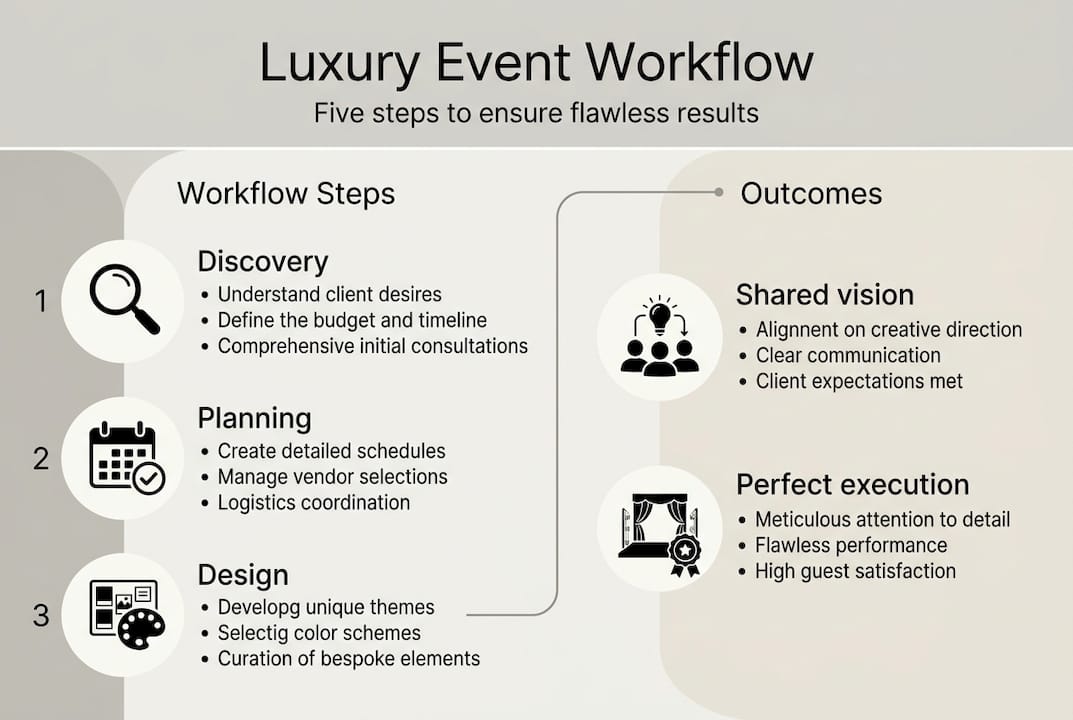
| Step | Core actions | Outcome |
|---|---|---|
| Discovery | Client briefing, vision mapping, goal setting | Shared understanding of expectations |
| Vendor and venue curation | Shortlisting, site visits, contract review | Aligned supplier team |
| Bespoke design | Mood boards, sensory planning, custom menus | Cohesive event identity |
| Logistics management | Timelines, run sheets, on-site briefings | Seamless execution |
| Quality verification | Walk-throughs, final checks, post-event review | Consistent excellence |
A well-executed workflow increases corporate engagement by 65%, which explains why structured planning is non-negotiable for high-stakes functions. The event coordination steps that professionals follow are designed to eliminate ambiguity and keep every supplier accountable.
Common pitfalls when steps are skipped include:
- Misaligned supplier expectations leading to last-minute substitutions
- Design inconsistencies that break the visual narrative of the event
- Timeline gaps that create awkward pauses for guests
- Budget overruns caused by reactive rather than proactive decision-making
- Post-event regrets from clients who felt their vision was only partially realised
Thinking of this framework as an architectural blueprint is useful. You would not build a luxury home without detailed plans. Your event deserves the same discipline.
Mastering luxury event budgeting and vendor strategy
With the workflow established, a strategic approach to budgeting and supplier selection ensures every rand delivers tangible luxury. The numbers matter, but so does where they go.
Budgeting best practices recommend allocating funds according to the type of event, with weddings and corporate functions having quite different priorities. For weddings, the venue typically absorbs 35 to 40 percent of the total budget, followed by catering at 25 to 30 percent and photography and videography at 10 to 15 percent. Corporate events, by contrast, tend to weight audio-visual production and entertainment more heavily, with venue and catering sharing a roughly equal split.
| Budget category | Wedding allocation | Corporate allocation |
|---|---|---|
| Venue | 35 to 40% | 25 to 30% |
| Catering | 25 to 30% | 25 to 30% |
| Photography and video | 10 to 15% | 5 to 10% |
| Audio-visual and entertainment | 5 to 10% | 20 to 25% |
| Décor and styling | 10 to 15% | 10 to 15% |
| Contingency | 10 to 15% | 10 to 15% |
Evaluating elite vendors requires more than reviewing a portfolio. Look for suppliers who communicate proactively, have verifiable references from comparable events, and carry appropriate professional indemnity. An experienced event planning coordinator will have established relationships with the region’s finest suppliers, which often means better pricing and guaranteed priority service.
The corporate event best practices that consistently deliver results always include a 10 to 15 percent contingency fund. This is not a sign of poor planning. It is a sign of professional planning. Last-minute upgrades, weather-related adjustments, and supplier substitutions are realities in high-end event management.
Pro Tip: Set your emotional spending limit before you begin vendor meetings. Enthusiasm in the room can lead to scope creep that quietly dismantles your budget. Agree on a decision-making process with your coordinator in advance and stick to it.
Designing experiences: Personalisation, mood and invisible logistics
Budget set, the design phase is where your event’s identity and its lasting memories are truly made. This is where good events become great ones.
The three pillars of exceptional event design are:
- Personalisation: Every detail, from table settings to welcome gifts, should reflect the client’s personality or the company’s brand values. Guests notice when something has been chosen specifically for them.
- Sensory design: Luxury events engage all five senses. Scent, sound, texture, taste, and sight work together to create an atmosphere that feels immersive rather than staged.
- Seamless logistics: The best logistics are invisible. Guests should never see the effort behind a smooth transition or a perfectly timed course.
Mood boards and sensory maps are practical tools that elevate the guest experience by giving the entire supplier team a shared visual and emotional reference. They prevent misinterpretation and ensure that the florist, the lighting designer, and the catering team are all working towards the same atmosphere.
“Prioritise personalisation over size for affluent clients, and focus on seamless invisible logistics.” This insight from wedding planning expertise in Cape Town captures what separates events that impress from those that genuinely move people.
The event styling workflow for luxury occasions also incorporates curated guest journeys. This means thinking about the experience from the moment an invitation arrives through to the farewell moment. Custom menus, personalised place cards, and thoughtfully sequenced entertainment all contribute to a narrative arc that guests feel, even if they cannot articulate why.
Pro Tip: Guests remember how they felt, not just what they saw. A warm, attentive welcome and a perfectly timed farewell gift will outlast any floral centrepiece in their memory.
Navigating risks and unpredictable scenarios with confidence
Even with perfect design, event day rarely goes entirely to script. Proactive risk management ties everything together and protects the experience you have worked so hard to create.
High-stakes luxury events carry heightened risk precisely because expectations are elevated. A minor catering delay at a casual gathering is forgiven quickly. The same delay at a black-tie dinner for 200 guests is remembered. The guest service solutions that professionals deploy are built around anticipating failure points before they occur.
Practical risk-mitigation measures include:
- The 48-hour rule: Enforce a decision freeze 48 hours before the event. Any last-minute changes must be approved by the lead coordinator and assessed for knock-on effects.
- A formal risk register: Document every identified risk, its likelihood, its potential impact, and the mitigation plan. Review it weekly in the lead-up to the event.
- Weather protocols: For outdoor events in the Cape Winelands, always have a credible indoor or covered alternative ready to activate at short notice.
- Contingency supplier lists: Maintain a shortlist of backup suppliers for catering, audio-visual, and transport in case of sudden unavailability.
- Communication trees: Ensure every on-site team member knows who to contact for which category of issue, without escalating everything to the lead coordinator.
Edge cases such as emotional spending, scope creep, vendor delays, and weather disruptions are far more manageable when they have been anticipated in writing. Well-planned crisis avoidance directly correlates with higher guest satisfaction scores, which is why professional coordinators treat risk planning as a core deliverable rather than an afterthought.
Pro Tip: Brief all on-site teams together on the morning of the event, even if they have separate run sheets. Shared context creates real-time adaptability when the unexpected happens.
What most luxury event guides overlook: Invisible details matter most
Most articles about luxury event planning focus on what guests can see. The floral arrangements, the table settings, the lighting design. These are important, but they are also the elements that clients and suppliers discuss most openly. What rarely gets discussed is the choreography happening just out of sight.
From our experience coordinating events across the Cape Winelands and beyond, the feedback that moves clients most deeply rarely mentions the décor. Guests talk about feeling welcomed, feeling cared for, and feeling that someone had thought of everything. That feeling comes from event management insights that are invisible by design: the coordinator who quietly redirects a confused guest, the supplier briefed to anticipate a dietary need before it is raised, the timeline built with deliberate breathing room so nothing ever feels rushed.
The uncomfortable truth is that logistical choreography is unglamorous work. It does not photograph well. But it is the scaffolding that holds every beautiful moment in place. Invest extra effort in the elements guests never see but always feel, and your event will be remembered long after the flowers have faded.
Bringing your luxury event vision to life with expert support
Ready to experience the difference that expert attention and proven coordination make at your next celebration?
Professional luxury event management transforms a well-funded idea into a genuinely unforgettable occasion. At Winelands Function, we apply the structured workflow, budgeting discipline, and invisible logistics precision outlined in this guide to every event we coordinate, from intimate Cape Town weddings to exclusive corporate launches. Whether you are beginning to explore possibilities or ready to move into detailed planning, our team of specialists is here to guide you. Discover our range of bespoke luxury celebrations or revisit our full coordination guide to take your next step with confidence.
Frequently asked questions
How far in advance should luxury events be coordinated?
Six to twelve months is ideal for luxury weddings, while corporate events generally require three to six months of lead time. Starting early allows for thorough discovery and planning across all five workflow stages.
What is the biggest budgeting mistake affluent clients make?
The most common mistake is not setting aside a 10 to 15% contingency fund to absorb last-minute upgrades or unforeseen costs, leaving no financial buffer when the unexpected occurs.
How can you ensure a personalised experience for every guest?
Use mood boards, guest surveys, and curated activities to tailor every element. Personalised event design ensures guests feel individually valued rather than part of a generic occasion.
What role does an event coordinator play during the event itself?
They oversee timelines, manage suppliers, resolve on-the-day challenges, and ensure a seamless guest experience. Their presence means clients can be fully present rather than managing logistics themselves.
Recommended
- Workflow for Luxury Event Coordination: Step-by-Step Success – Winelands Function – For Every Occasion, Your Celebration
- Corporate Event Best Practices: Elevating Luxury Experiences – Winelands Function – For Every Occasion, Your Celebration
- How to Elevate Guest Experience for Luxury Events Easily – Winelands Function – For Every Occasion, Your Celebration
- Event Planning Coordinator: Crafting Luxury Experiences – Winelands Function – For Every Occasion, Your Celebration