

TL;DR:
- Cape Town offers accessible luxury event options that build brand prestige and client relationships.
- Proper planning, cultural integration, and timing are key to achieving high ROI and memorable experiences.
- Early booking and local expert coordination are essential for securing venues and managing permits effectively.
Luxury corporate celebrations in Cape Town are not the exclusive territory of global multinationals with bottomless budgets. The reality is more accessible than most decision-makers realise, and the returns are measurable. Venue and catering alone account for 40–50% of a typical Cape Town gala budget, yet when those line items are managed expertly, they become the very elements that build brand prestige, strengthen client relationships, and drive pipeline growth. This guide breaks down the landscape, the numbers, and the planning process so that you can approach your next corporate celebration with genuine confidence and a clear strategic advantage.
Table of Contents
- Decoding Cape Town’s luxury event landscape
- Budgeting and ROI: What high-end planners must know
- Mastering the planning process: Timeline and execution essentials
- Creating memorable experiences: Engagement, culture, and impact
- What most planners miss about luxury events in Cape Town
- Streamline your next corporate celebration with Winelands Function
- Frequently asked questions
Key Takeaways
| Point | Details |
|---|---|
| Cape Town luxury advantage | Top venues, scenery, and cultural integration make Cape Town the ideal choice for elegant corporate celebrations. |
| Budget and ROI benchmarks | Allocate 40-50% for venues and catering, expect a 5.6x pipeline ROI, and monitor specific event metrics. |
| Expert planning process | Secure suppliers 12-18 months in advance, use step-by-step checklists, and ensure seamless logistics with experienced coordinators. |
| Memorable experiences | Integrating local culture and creative activities boosts guest engagement and long-term brand impact. |
Decoding Cape Town’s luxury event landscape
Cape Town occupies a genuinely rare position in the global events market. It combines world-class infrastructure with extraordinary natural scenery, a rich cultural heritage, and a sophisticated hospitality industry that punches well above its weight. For corporate planners, this means you are not choosing between prestige and practicality. You can have both.
The city’s premier venues fall into three broad categories. First, there are the large-scale convention facilities. The Cape Town International Convention Centre, for example, hosted 368 events for over 310,000 attendees in 2024 alone, demonstrating the scale and credibility that anchor-venue bookings can deliver. Second, Century City offers a sleek, urban setting with modern event infrastructure that suits tech sector and financial services clients particularly well. Third, and perhaps most distinctive, are the Winelands estates, which provide a sense of luxury celebration prestige that is almost impossible to replicate elsewhere.
Beyond the venue itself, what truly elevates a Cape Town event is cultural integration. Local cuisine, Cape Malay influences, indigenous art installations, and live performances rooted in South African musical traditions all contribute to a guest experience that feels genuinely memorable rather than generically polished. Planners who treat culture as decoration miss the point. Those who weave it into the event’s identity create something guests recall for years.
Key venue categories at a glance:
- Convention centres: High capacity, strong AV infrastructure, city access
- Century City hotels: Urban sophistication, proximity to business districts
- Winelands estates: Scenic grandeur, intimate luxury, internationally iconic settings
- Waterfront venues: Harbour views, cosmopolitan appeal, flexible configurations
Timing is another lever that experienced planners use to significant advantage. Cape Town’s shoulder season (typically April to June and August to October) offers reduced venue rates, greater supplier availability, and less competition for premium dates. Booking a luxury venue in the Western Cape during these windows can free up meaningful budget that is better directed toward entertainment, production, or upgraded catering.
“The prestige of a Cape Town event is not simply bought. It is curated through venue choice, cultural authenticity, and timing intelligence.”
Understanding the landscape is the foundation. Once you have a clear picture of what Cape Town offers, every subsequent planning decision becomes sharper and more purposeful. Learning the corporate gala format in detail will help you match your event format to the right venue tier from the outset.
Budgeting and ROI: What high-end planners must know
Having explored the event landscape, let us turn to the crucial issue of budget and returns. Corporate celebrations at the luxury end of the Cape Town market typically run between R450,000 and R700,000 for 200 guests. Food and beverage alone averages R2,000 to R4,000 per person, and that figure rises quickly when premium wine pairings or bespoke tasting menus are involved.
Understanding cost structure is essential before a single supplier conversation takes place.
| Budget category | Typical share of total budget |
|---|---|
| Venue and catering | 40–50% |
| AV and production | 15–25% |
| Entertainment | 10–20% |
| Décor and styling | 8–12% |
| Logistics and staffing | 5–10% |
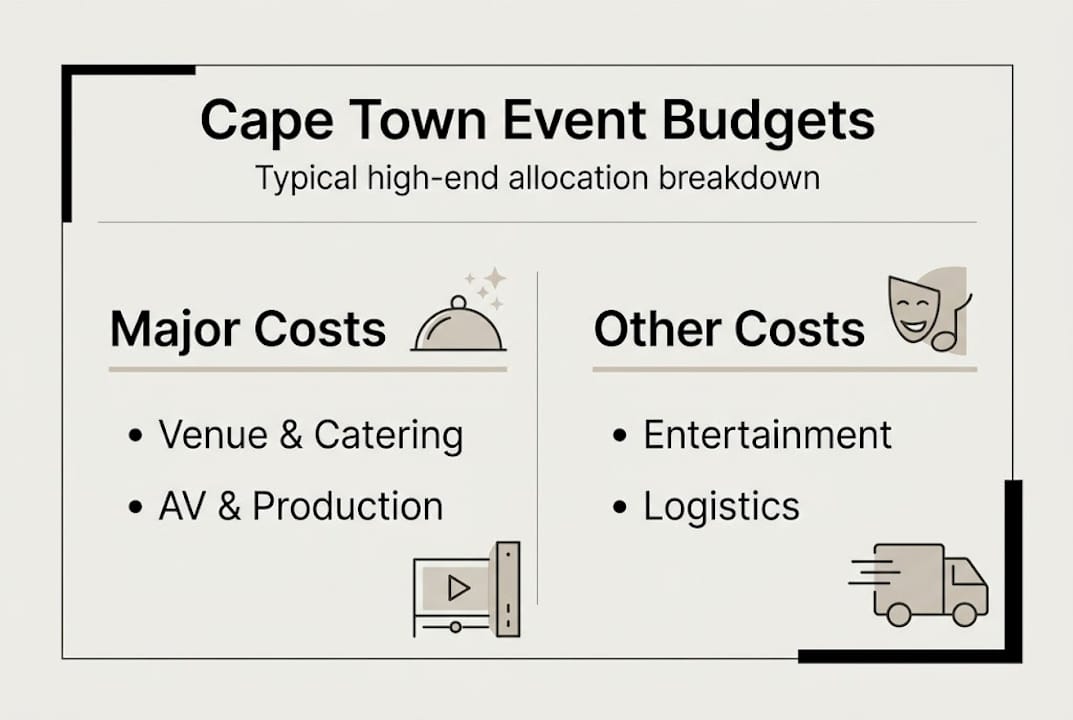
These proportions give you a working framework, but the actual figures shift based on your guest count, the formality of the event, and the calibre of suppliers you engage. The benefits of a Cape Town event planner become immediately tangible when you see how much negotiating leverage an established coordinator brings to supplier conversations.

Now, the returns. This is where many planners underestimate the strategic case for investment. Corporate events generate a 5.6x pipeline return, with approximately $1,253 in revenue attributed per attendee and a 74% improvement in brand impression reported after well-executed galas. These are not vanity metrics. They translate directly to commercial outcomes that finance directors and chief executives understand.
Pro Tip: Build your ROI measurement plan before the event, not after. Define which pipeline opportunities you want to accelerate, which relationships you want to deepen, and which brand perceptions you want to shift. Without pre-event baselines, your post-event data is interesting but not actionable.
Three budget disciplines that experienced planners follow:
- Allocate a 10–15% contingency from the outset. Luxury events surface unexpected costs.
- Prioritise guest-facing spend. What guests see, taste, and experience is what they remember.
- Evaluate suppliers on value, not just price. A cheaper AV company that underdelivers on the night costs far more than the saving suggests.
Reviewing event supplier comparisons before committing to any single vendor is time well spent, particularly for production and entertainment.
Mastering the planning process: Timeline and execution essentials
Now, let us map out the steps to ensure your corporate celebration achieves seamless luxury. The single most common mistake in Cape Town luxury event planning is underestimating how far in advance the process must begin. Lead times of 12 to 18 months are standard for high-end events, and that window exists for very good reasons.
Top venues hold their best dates tightly. Specialist suppliers, particularly celebrated chefs, bespoke décor studios, and headline entertainment acts, book out early. Permits for road closures, noise exemptions, and large-scale catering require municipal processing time that cannot be rushed. Every week you delay is a week of optionality you lose.
A structured planning timeline for luxury Cape Town events:
- 12 to 18 months out: Define event objectives, draft the brief, set the budget envelope, begin venue shortlisting
- 10 to 12 months out: Confirm the venue, appoint your event planning coordinator, begin supplier conversations
- 8 to 10 months out: Lock in catering, entertainment, and AV providers; begin permit applications
- 5 to 7 months out: Finalise the event programme, confirm guest list and invitations, complete logistics planning
- 2 to 3 months out: Final walk-throughs, detailed run-of-show, supplier briefings, contingency reviews
- 4 weeks out: Confirm all logistics, delegate day-of responsibilities, finalise guest communications
Supplier selection deserves its own attention. The local event planner services available in Cape Town vary considerably in quality and specialisation. When evaluating potential partners, look for demonstrated experience with events of comparable scale, evidence of strong supplier relationships, and a transparent approach to budget management.
Supplier evaluation checklist:
- Portfolio includes comparable luxury events
- References from corporate (not only social) event clients
- Clear process for permit and compliance management
- Transparent pricing with no hidden coordination fees
- Demonstrated ability to manage multiple suppliers simultaneously
Pro Tip: Request a detailed run-of-show document from any planner you are considering. How they construct and present that document tells you almost everything about how they operate on the day.
For inspiration on what to include in the event experience itself, exploring unique corporate event activities tailored to Cape Town settings can surface ideas that set your celebration apart from the predictable.
Creating memorable experiences: Engagement, culture, and impact
With your process mapped, next comes the heart of a celebration: how to ensure lasting impact. The most technically flawless event in the world fails if guests leave without a strong emotional impression. Engagement is not a nice-to-have. It is the mechanism through which business outcomes are achieved.
Natural and cultural integration can boost attendance by up to 30%, and 85% of C-suite executives consider in-person meetings critical to relationship development. These two facts together make a compelling argument for investing in the experiential quality of your event, not just its logistical execution.
Cape Town’s cultural richness is a resource that many planners underuse. Consider these engagement approaches:
- Cape Malay cuisine stations that invite guests to explore flavour while sparking conversation
- Live Afrobeat or jazz performances that create an authentic sense of place
- Indigenous art exhibitions curated from local galleries, which double as conversation starters and give guests something to remember
- Wine estate tours woven into the pre-dinner programme for smaller, relationship-focused events
- Sunset ceremony timings aligned with the Cape’s extraordinary light, which transforms photography and guest mood simultaneously
Corporate events are ranked as the top lead generation channel across industries, and the metrics that matter most are engagement depth, sentiment shift, pipeline attributed, and net promoter score among attendees. Collecting this data requires deliberate post-event follow-up, structured feedback mechanisms, and CRM integration.
“Guests do not remember what you spent. They remember how the evening made them feel and what it revealed about your brand’s values.”
Bringing guests into Cape Town’s landscape rather than simply hosting them within a venue creates an entirely different quality of experience. Use the city’s Cape Town prestige insights to inform decisions about timing, location, and cultural programming. The corporate gala engagement framework is a useful reference for structuring the evening’s flow to maximise these moments.
What most planners miss about luxury events in Cape Town
After working across many high-end celebrations in the Western Cape, we have noticed a consistent pattern: planners who focus exclusively on spend miss the deeper lever of synergy. A R700,000 event with misaligned cultural elements, a venue that does not suit the brand, and a programme that feels borrowed from another context will underperform a R450,000 event that is coherent, authentic, and perfectly timed.
Cape Town’s event prestige is often underestimated precisely because it comes from integration rather than expenditure. The Winelands setting, the local cuisine, the timing against the harvest season or the shoulder period: these are the ingredients that experienced local planners know how to combine. Bringing in a coordinator who does not have deep Cape Town relationships means you are paying for general event management, not for the specific advantage this city offers.
Permit and logistics oversights are the other silent budget killer. Traffic management, noise bylaws, and large-gathering compliance in the Cape Town municipality have specific requirements that catch out planners unfamiliar with local government processes. An experienced local coordinator manages these invisibly. Without one, they become visible at exactly the wrong moment.
Streamline your next corporate celebration with Winelands Function
For those ready to achieve seamless luxury, here is how expert support makes all the difference.
At Winelands Function, we work with corporate clients who understand that a great event is a business investment, not just an occasion. Our event planning coordinator team brings established relationships with Cape Town’s finest venues, caterers, and entertainment specialists, ensuring that every element of your celebration is sourced, negotiated, and executed at the standard your brand deserves.
Whether you are exploring the full scope of corporate event management or seeking inspiration for bespoke luxury celebrations that reflect your organisation’s values, our team is ready to guide you from brief to final guest departure. Get in touch to schedule a consultation and discover what a genuinely expert approach to Cape Town corporate events can deliver for your business.
Frequently asked questions
How far in advance should I begin planning a Cape Town corporate celebration?
For high-end events, begin planning 12 to 18 months ahead to secure top venues, specialist suppliers, and the necessary municipal permits without compromise.
What are the main budget items for a luxury corporate event in Cape Town?
Venue and catering typically claim 40 to 50% of the budget, followed by AV and production at 15 to 25%, and entertainment at 10 to 20%, with décor and logistics making up the remainder.
How do you measure the ROI of a corporate celebration?
Track lead generation, pipeline attributed, brand sentiment, and per-attendee revenue. Average event ROI reaches 5.6x pipeline when measurement is built into the event strategy from the outset.
What makes Cape Town corporate events so prestigious?
The combination of iconic scenery, world-class venues, and cultural integration is uniquely powerful. Natural and cultural elements boost attendance by up to 30%, and the city’s reputation attracts international delegates and senior decision-makers who respond to genuine prestige.
Recommended
- Why host corporate celebrations to boost engagement – Winelands Function – For Every Occasion, Your Celebration
- Why choose Cape Town events for luxury celebrations – Winelands Function – For Every Occasion, Your Celebration
- Elevate your corporate events: unique party ideas for SA – Winelands Function – For Every Occasion, Your Celebration
- Why choose Cape Town for events: 2026 prestige guide – Winelands Function – For Every Occasion, Your Celebration