

TL;DR:
- Truly bespoke weddings are fully personalized, reflecting the couple’s heritage, values, and emotional story.
- The planning process involves deep consultation, narrative building, and vendor curation to ensure coherence.
- In South Africa, understanding the difference between a custom wedding and a legal customary marriage is essential.
Many engaged couples in South Africa assume that a ‘custom wedding’ simply means picking a colour palette from a venue’s brochure or swapping the default menu for something slightly different. The reality is far richer and more personal than that. A truly bespoke wedding is built from the ground up around who you are as a couple: your heritage, your story, your values, and the emotional experience you want your guests to carry home. This guide unpacks what custom wedding planning genuinely involves, why it matters for both experience and lasting value, and how you can begin your own flawless planning journey with confidence.
Table of Contents
- What makes a custom wedding truly bespoke?
- The custom wedding planning process: steps and expert secrets
- Custom wedding service options and choosing your planning model
- Budgeting, timelines and special considerations for South African luxury weddings
- Avoiding confusion: ‘Custom wedding’ versus ‘customary marriage’ in South Africa
- Our perspective: what most couples miss about bespoke wedding planning
- Bring your bespoke wedding vision to life with expert help
- Frequently asked questions
Key Takeaways
| Point | Details |
|---|---|
| Bespoke means unique | A custom wedding is crafted to reflect your personal story, not just selected from a menu of options. |
| Plan well in advance | Securing top venues and vendors for your luxury event usually requires 12–18 months of early planning. |
| Choose your planning model | Deciding between full, partial, or day-of coordination impacts your experience and stress levels. |
| Budget for excellence | Expect to spend upwards of R200,000 for high-end South African weddings, with costs weighted towards venue and catering. |
| Legal clarity matters | A ‘custom wedding’ is an event concept—distinct from ‘customary marriage’, which carries legal meaning. |
What makes a custom wedding truly bespoke?
The word ‘bespoke’ comes from the tailoring world, where a suit is cut specifically for one person’s body. Applied to weddings, it means no two events are alike. A package wedding offers a curated set of choices within a fixed framework: a venue’s preferred caterer, a limited décor theme, a standard timeline. A bespoke wedding, by contrast, starts with a blank page.
Bespoke weddings are fully customised high-end experiences tailored to the couple’s unique story, background, and preferences. Every element, from the venue and menu to the entertainment and ceremonial traditions, is chosen because it reflects something true about you as a couple. There is no template to follow.
Elements typically personalised in a custom wedding include:
- Venue selection based on emotional resonance, not just availability
- Menu design rooted in cultural heritage or shared food memories
- Décor and floral concepts drawn from personal aesthetics and elegant bridal themes
- Entertainment curated to reflect the couple’s musical journey
- Ceremonial traditions woven in from family or cultural backgrounds
- Guest experience touchpoints such as personalised welcome gifts or bespoke stationery
This depth of personalisation is what separates bespoke and luxury celebrations from even the most generous package offering. The emotional storytelling dimension is what affluent couples genuinely seek. As one industry insight puts it, 80% of affluent clients value resonant, meaningful experiences over sheer scale or extravagance.
| Feature | Bespoke wedding | Package wedding |
|---|---|---|
| Customisation level | Unlimited, from scratch | Preset options only |
| Vendor choice | Fully curated | Venue-preferred suppliers |
| Emotional impact | Deeply personal narrative | Generalised experience |
| Cost control | Flexible, transparent | Fixed tiers |
| Template use | None | Standard framework |
The table above makes the contrast clear. A bespoke wedding costs more in planning time and often in budget, but it delivers something a package simply cannot: the feeling that the day was made entirely for you.
The custom wedding planning process: steps and expert secrets
Understanding what bespoke means is one thing. Living through the planning process is another entirely. The good news is that when it is managed by an experienced planner, the process feels less like a project and more like a creative collaboration.
The planning process for bespoke weddings starts with consultation and vision development, then moves through storytelling, mood boards, vendor selection, and finally flawless execution. Here is how that looks in practice:
- Deep consultation — Your planner listens to your story, values, cultural background, and non-negotiables before a single supplier is contacted.
- Narrative building — A written story of your day is developed, which becomes the creative brief for every vendor.
- Vision board and mood board creation — Visual references are aligned across all suppliers to ensure coherence.
- Vendor curation — Suppliers are selected based on their ability to serve your narrative, not just their availability.
- Logistics and timeline mapping — A structured master timeline is built, with contingency plans baked in.
- Execution and on-the-day management — Your planner ensures every detail runs invisibly, so you are fully present.
Pro Tip: Insist on a formal mood board sign-off session with all key vendors before any deposits are paid. Misaligned visual expectations are the single most common source of last-minute stress in luxury weddings.
Professional planners act as narrative architects, using hybrid Waterfall-Agile workflows that combine structured timelines with room for creative flexibility. This means your wedding has a firm backbone of logistics while remaining responsive to new ideas or changes along the way.
For personalised event coordination at this level, a 15-month planning timeline is considered standard. Booking your venue, photographer, and catering team well in advance is not excessive caution; it is simply how top-tier suppliers operate. The wedding planner services available in Cape Town reflect this reality, with the most sought-after vendors filling their calendars over a year ahead.

Custom wedding service options and choosing your planning model
Once you understand the process, you need to choose the right level of planning support. Not every couple wants or needs the same involvement from a planner, and the South African market offers genuine flexibility here.
Service types include full-service planning, partial planning, and day-of coordination; full-service is recommended for stress-free luxury experiences. Here is what each looks like:
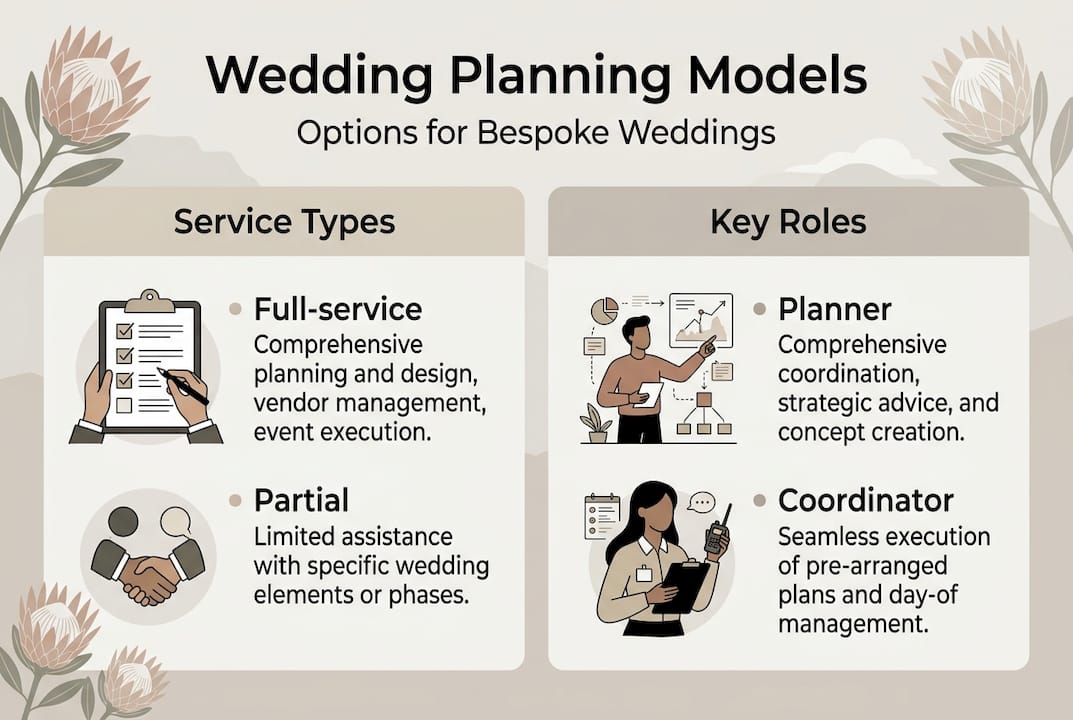
| Service model | What is included | Best suited for |
|---|---|---|
| Full-service planning | End-to-end management from vision to execution | Couples wanting a seamless, no-stress experience |
| Partial or à la carte | Selected services only (e.g., vendor sourcing, décor) | Couples with some suppliers already confirmed |
| Day-of coordination | On-the-day logistics management only | Couples who have planned everything themselves |
Factors to weigh when choosing your model:
- Event scale — Larger guest lists and multi-day events almost always benefit from full-service support.
- Your budget — Full-service planning is an investment, but it typically saves money through vendor relationships and avoided mistakes.
- Desired involvement — Some couples love being hands-on; others find decision-making exhausting.
- Existing vendor relationships — If you already have a trusted photographer or caterer, partial planning may suit you.
South African wedding culture adds a further layer of consideration. Many couples incorporate multi-generational family traditions, lobola negotiations, or cultural ceremonies alongside a contemporary celebration. A planner experienced in this context will help you honour those elements without logistical conflict. Reviewing a good wedding budget breakdown early in the process will also clarify which service model is financially realistic for your vision.
Pro Tip: Full-service planning is not a luxury add-on; for weddings above R200,000, it is a practical safeguard. The planner’s fee is typically offset by supplier discounts and the prevention of costly errors.
Budgeting, timelines and special considerations for South African luxury weddings
Budget conversations are often the most avoided part of wedding planning. They should be the first. Knowing your real numbers shapes every decision that follows.
Luxury wedding budgets in South Africa range from R200,000 to R500,000 for high-end events with 100 to 150 guests, and R500,000 and above for ultra-luxury celebrations. A typical cost breakdown looks like this:
- Venue: 30 to 40% of total budget
- Catering: 25 to 30% of total budget
- Photography and videography: 10 to 15% of total budget
- Floral and décor: 10 to 15% of total budget
- Entertainment, stationery, and other: remaining percentage
For couples planning smaller celebrations, micro-weddings can start from R40,000, while traditional multi-family events typically begin at R150,000. The event budgeting guide for 2026 offers detailed breakdowns to help you allocate with confidence.
Timeline milestones to keep in mind:
- 18 months out: Set your budget, choose your planner, and shortlist venues.
- 15 months out: Confirm your venue and begin vendor curation.
- 12 months out: Book your photographer, caterer, and entertainment.
- 6 months out: Finalise décor, confirm guest numbers, and review your wedding ceremony checklist.
- 3 months out: Confirm all logistics, finalise payments, and conduct supplier briefings.
South Africa’s unique context adds specific complications. Cape Town’s weather is famously unpredictable in spring and autumn, and destination weddings in the Winelands require a networked supplier base that not every planner can provide. As one experienced coordinator puts it: ‘Planning flexibility and back-up are key for Cape Town’s weather. Always have a contingency plan for outdoor ceremonies, no matter how confident the forecast looks.’
Avoiding confusion: ‘Custom wedding’ versus ‘customary marriage’ in South Africa
Before moving forward, there is one linguistic and legal distinction that every South African couple must understand clearly. The terms ‘custom wedding’ and ‘customary marriage’ sound similar but refer to entirely different things.
‘Custom wedding’ may be confused with ‘customary marriage’ under South African law, which is a distinct legal institution from bespoke event planning. A customary marriage is a traditional African union governed by the Recognition of Customary Marriages Act, with specific legal requirements:
- Both parties must consent to the marriage.
- The marriage must be negotiated and entered into according to customary law.
- It must be registered with the Department of Home Affairs.
- Lobola or another form of bride wealth may be part of the process.
A ‘custom wedding,’ in the event planning sense, simply means a uniquely designed celebration. As one legal commentator notes: ‘Custom weddings are about personal style; customary marriage is a legal formality with rights and obligations attached.’ If your celebration incorporates customary elements, seek legal advice early to ensure your union is correctly registered and recognised.
Our perspective: what most couples miss about bespoke wedding planning
After working with couples across the full spectrum of luxury weddings, one truth stands out above all others: the hardest part of bespoke planning is not choosing between options. It is staying anchored to your essential story when the options become overwhelming.
The wedding industry is extraordinarily good at presenting beautiful new ideas. Every week brings a new trend, a new venue style, a new floral concept. Couples who chase each new idea end up with a day that looks impressive but feels like a mood board rather than a marriage. Decision fatigue is real, and it quietly dilutes the very personalisation you set out to achieve.
Our contrarian view is this: true luxury is invisible. The most extraordinary weddings we have seen do not announce themselves. They feel effortless, intimate, and entirely right. That effortlessness is the result of precise logistics, ruthless vendor curation, and absolute clarity of vision, all working behind the scenes. You can see real luxury event results when that clarity is present.
Pro Tip: Let your narrative lead every decision. When a new idea arises, ask one question: does this serve our story? If the answer is not an immediate yes, it probably does not belong.
Bring your bespoke wedding vision to life with expert help
If this guide has clarified what a truly bespoke wedding involves, the natural next step is finding the right team to bring it to life. Planning a luxury wedding in South Africa is a significant undertaking, and the difference between a stressful experience and a joyful one often comes down to the expertise behind the scenes.
Winelands Function has guided countless South African couples through every stage of bespoke wedding creation, from initial vision to flawless execution. Whether you are beginning to explore ideas or are ready to commit to a planning model, our wedding planning experts are here to help. Explore our full range of bespoke celebration services and discover how we can shape a day that is entirely, unmistakably yours.
Frequently asked questions
What is the main difference between a bespoke and a package wedding?
A bespoke wedding is tailored from scratch around your story and preferences, while a package wedding offers preset options with minimal flexibility.
How far ahead should I start planning a luxury bespoke wedding in South Africa?
Plan at least 12 to 18 months ahead, especially to secure top venues and reputable vendors who fill their calendars well in advance.
What is a typical budget for a high-end custom wedding in South Africa?
Luxury weddings range from R200,000 to R500,000 for 100 to 150 guests, with higher budgets required for more elaborate or ultra-luxury celebrations.
Is ‘custom wedding’ the same as ‘customary marriage’ in South Africa?
No. A custom wedding refers to a uniquely planned celebration, while a customary marriage is a legal union with specific statutory requirements under South African law.
Are micro-weddings also considered bespoke?
Yes. Micro-weddings can be fully bespoke, focusing on intimacy and highly personalised details that reflect the couple’s story just as richly as a larger event.
Recommended
- Ultimate wedding ceremony checklist for luxury weddings in South Africa 2026 – Winelands Function – For Every Occasion, Your Celebration
- Why choose Cape Town for weddings: luxury venues guide – Winelands Function – For Every Occasion, Your Celebration
- Wedding Venue Cape Town: Creating Bespoke Luxury – Winelands Function – For Every Occasion, Your Celebration
- Luxury Wedding Planning Steps for an Elegant Cape Town Event – Winelands Function – For Every Occasion, Your Celebration