

TL;DR:
- A well-structured event styling workflow involves multiple phases, clear task ownership, and vendor coordination to prevent delays on event day. It emphasizes detailed planning, effective communication, and buffer time to handle complex installations and changes. Implementing a live run of show and staged vendor arrivals ensures smooth execution and minimizes last-minute crises.
Most people assume styling for events is about choosing pretty centrepieces and matching table linens. It is not. A well-executed event styling workflow is a multi-phase operational system that spans weeks, involves multiple vendors, and requires precise task ownership at every stage. Get it wrong and you are looking at florists arriving to find the furniture not yet in place, lighting rigs blocking floral arches, and a client standing in a half-dressed venue thirty minutes before guests walk in. This guide breaks down how to build a workflow that prevents exactly that.
Table of Contents
- Key takeaways
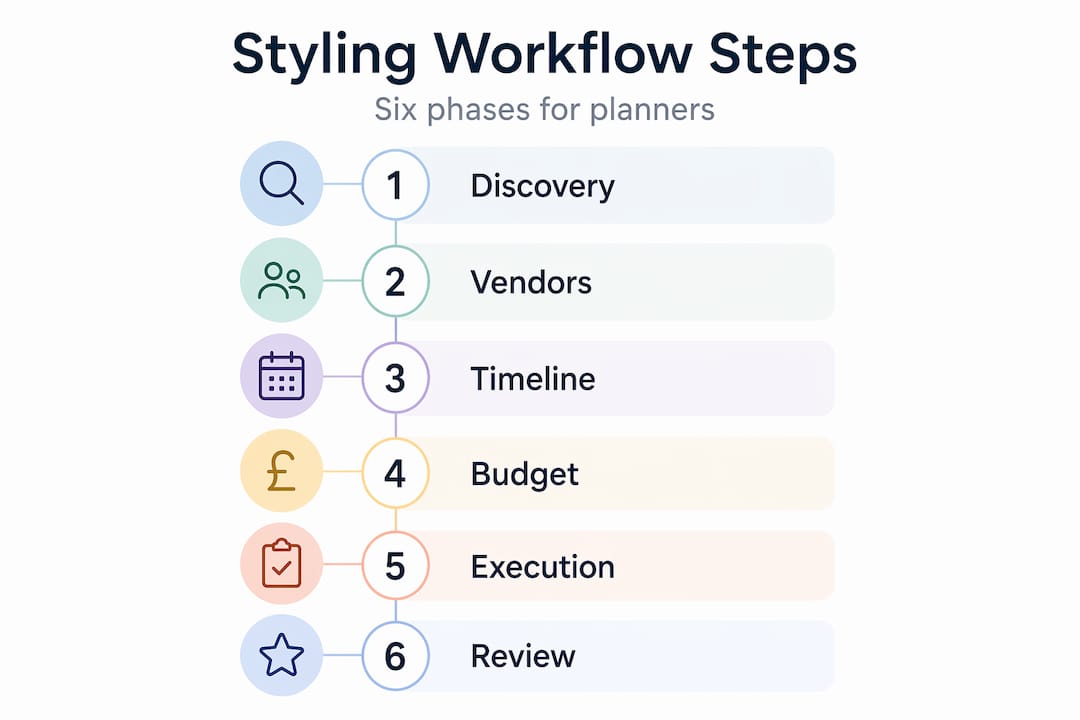
- The event styling workflow: six phases that keep you in control
- How to style an event from a blank canvas
- The run of show: your most powerful styling tool
- Vendor coordination and setup timing
- My honest take on where styling workflows break down
- Let Winelandsfunction handle the complexity
- FAQ
Key takeaways
| Point | Details |
|---|---|
| Phase your workflow clearly | Structure styling tasks into six defined phases, from discovery through to post-event review, to avoid missed steps. |
| Map task dependencies early | A delayed RSVP can push your florist timeline and trigger rush fees; dependencies cascade if left untracked. |
| Build in buffer time | Complex floral and decor installs regularly take longer than expected; always schedule a buffer block after each vendor window. |
| Use a live Run of Show | A shared, minute-by-minute document aligns decor and production teams and prevents costly timing mishaps on the day. |
| Review after every event | Post-event debriefs turn one-off mistakes into permanent workflow improvements across future celebrations. |
The event styling workflow: six phases that keep you in control
A solid event styling workflow does not happen by accident. Phased workflows with task ownership and regular check-ins are what separate planners who execute confidently from those who spend event day firefighting.
Phase 1: Discovery and scope definition
This is where you establish the creative and logistical boundaries. You need a clear picture of the client’s vision, the event theme, the guest count, and the budget before a single vendor is approached. Vague briefs at this stage cost money later. Document everything.
Phase 2: Vendor selection and booking
Once scope is confirmed, begin sourcing florists, rental companies, lighting suppliers, and decorators. Prioritise vendors who have worked in your venue before. Familiarity with the space reduces on-site surprises considerably.
Phase 3: Timeline and task assignment
Build your master timeline now, not the week before the event. Assign clear ownership to every task and map the dependencies between them. If the seating chart is delayed, the florist table plan changes. If the rental delivery shifts by two hours, your entire setup sequence is affected. Mapping these connections early prevents cascading delays later.
Phase 4: Budget tracking and change management
Styling creep is real. A client adds a floral wall, upgrades the chair hire, and requests an extra lounge area. Each change needs a formal impact assessment covering cost, logistics, and timing. Keep a running budget tracker that is updated after every client decision.
Phase 5: Execution week and day-of coordination
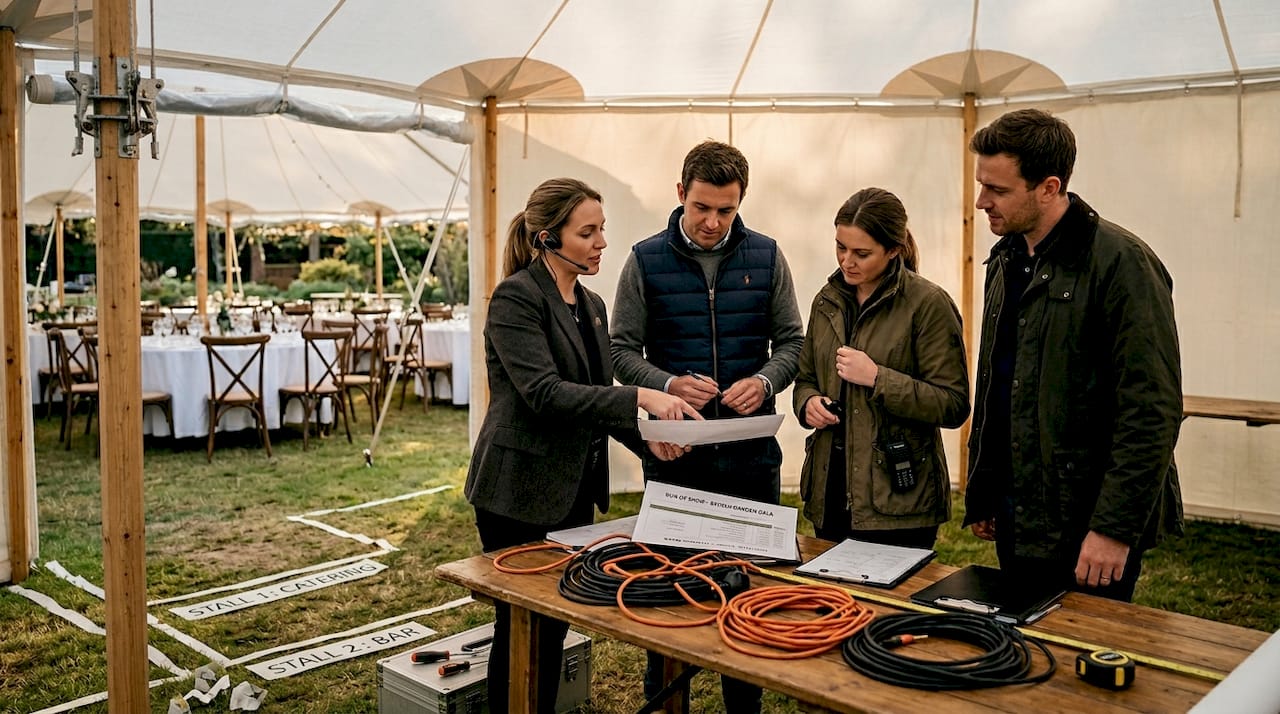
This phase covers your pre-event site walk, vendor confirmations, and the run of show document (more on that shortly). Your event setup checklist should be finalised by Monday of event week. Nothing new gets added without a formal review.
Phase 6: Post-event review
Book a debrief within 48 hours of the event while details are still fresh. Review what ran to time, what did not, and why. This is where your workflow gets better with every event you produce.
Pro Tip: Set a milestone meeting at 12 weeks, 8 weeks, and 2 weeks out. These check-ins force accountability and surface problems before they become crises.
How to style an event from a blank canvas
Creative event styling starts long before anything is ordered or booked. The foundation is a well-defined theme supported by a mood board that captures colour, texture, material, and atmosphere. A mood board is not a luxury for big-budget events. It is a practical alignment tool that stops client expectations and your execution from drifting apart.
Styling and decor planning begins with theme definition, venue assessment, and consulting rental partners early to avoid layout and scale mistakes. Here is how to approach the planning process practically:
- Assess the venue in detail. Measure ceiling heights, note ceiling and wall colours, identify natural light sources, and understand the flow between spaces. A gorgeous floral arch placed at the wrong entrance point can disrupt guest movement for an entire event.
- Designate clear zones. Define areas for dining, socialising, entertainment, and arrival reception before any decor decisions are finalised. Styling follows function. Not the other way around.
- Coordinate colour and material thoughtfully. Choose a primary colour, a secondary, and an accent. Apply these consistently across linens, florals, candles, and furniture. Inconsistency in material textures, such as mixing rustic wood with ultra-modern metallics without intention, reads as oversight rather than design.
- Consult your rental partner before the layout is locked. Scale mistakes are expensive. A centrepiece that looks perfect on a Pinterest board can overpower a small table or disappear on a large one. Your rental partner has seen this play out and can advise accordingly.
- Balance trend-driven styling with guest experience. Oversized installations make for great photographs, but they can block sightlines, trap sound, and create awkward circulation. The best creative event styling makes guests feel something, not just see something.
Pro Tip: Request scaled floor plans from your venue and overlay your decor zones digitally before finalising any rental or floral brief. It saves hours of back-and-forth and catches layout conflicts before they reach the build day.
The run of show: your most powerful styling tool
Most planners understand what a run of show document is. Far fewer treat it the way it deserves to be treated. The run of show acts as the backbone of event production, aligning every stakeholder and protecting timing across the entire event.
For styling purposes specifically, the run of show should include:
- Exact times for vendor load-in, with separate entries for each supplier type
- Cue points for furniture moves, such as clearing ceremony chairs into reception configuration
- Floral arch and installation readiness deadlines tied to guest arrival and photography windows
- Lighting and AV trigger points that interact with decor scenes, for instance when candles are lit or when a draping reveal is timed to a speech
- Buffer windows built in between decor completion and the first guest arriving
The power of this document multiplies when it is shared. Treating the Run of Show as a live document across decor, production, catering, and AV teams eliminates the moment where the lighting technician runs cable across the floor the florist is trying to dress. Everyone can see what is happening, when, and what needs to happen before they can begin their own work.
A well-built run of show does not just prevent timing mishaps. It removes the need for a planner to be in five places at once, because every vendor already knows the plan.
Give all key vendors access to the document and update it in real time as changes occur. A shared online format works far better than a printed sheet that becomes outdated by mid-morning.
Vendor coordination and setup timing
Getting all your vendors on-site, productive, and out of each other’s way is one of the most underrated skills in event production workflow. A master timeline with staged vendor arrivals improves build day predictability and reduces conflicts significantly.
The table below illustrates a practical approach to staggering setup windows for a mid-scale celebration:
| Vendor type | Typical arrival window | Recommended buffer | Notes |
|---|---|---|---|
| Tent or structure install | 6 to 12 hours prior | Add 25% to estimated time | Always first on-site; all other setup depends on this |
| Lighting and AV | 4 to 6 hours prior | 1 hour | Cable runs and rigging must be complete before decor dressing |
| Furniture and rentals | 3 to 5 hours prior | 45 minutes | Placement confirmed against floor plan before florist arrives |
| Florist (standard setup) | 2 to 4 hours prior | 30 minutes | Pre-built arrangements reduce on-site time considerably |
| Florist (complex install) | 4 to 6 hours prior | 1 hour | Ceiling installations, arches, and cascading arrangements take longer than expected |
| Catering and final dress | 1.5 to 2 hours prior | 30 minutes | Table dressing and final touches after all heavy installs are complete |
The critical lesson here is sequencing. Florists should never arrive before furniture is placed. Catering teams should never begin table service setup while decor installation is still in progress above or around them. Each vendor’s start time is dependent on the previous one completing their work.
Communication on event day requires one designated point of contact per vendor. Establish an escalation path before the event: who gets called if a vendor is late, if a delivery is damaged, or if a layout needs to change. Write this into your event setup checklist and distribute it at the pre-event briefing.
Pro Tip: Coordinating wedding vendors effectively means giving each supplier a personal call the day before, not just a WhatsApp in the morning. A two-minute conversation the evening before resolves more potential day-of issues than any number of group messages.
My honest take on where styling workflows break down
I have worked on enough events to know that the workflows which fail are not the ones with missing checklists. They are the ones where the checklist exists but nobody owns the dependencies between tasks.
In my experience, the single biggest risk in a styling workflow is undocumented change. A client requests a larger floral wall two weeks out. The florist is briefed. The rental company is not. Nobody updates the floor plan. On build day, the new installation does not fit the original furniture layout, and you spend two hours shuffling tables while the photographer waits. This is not bad luck. It is a missing change management step.
I have also seen planners dramatically underestimate buffer time for complex installs. Underestimating installation labour causes bottlenecks that compress every subsequent vendor’s window. When I plan an event with ceiling draping, hanging florals, or any overhead element, I double the florist’s estimated time and build my entire setup sequence from that anchor point backwards.
The other thing I cannot stress enough is the live Run of Show. I have worked events where the styling team and the AV team were operating on different versions of the same document. The result was a draping reveal that happened in the wrong lighting state entirely. Since moving to a shared live document, that category of problem has effectively disappeared from my events.
What I have learnt is that a well-structured event styling process is not about being rigid. It is about creating enough structure that you can flex without losing control when the inevitable change arrives.
— Coert
Let Winelandsfunction handle the complexity
A structured event styling workflow takes experience to build well. If you are planning a wedding, corporate function, or bespoke celebration and want the confidence that comes from working with a team that has done this hundreds of times, Winelandsfunction is ready to help.
From initial concept and step-by-step event planning through to vendor coordination, budget management, and day-of execution, the Winelandsfunction team brings the structure and creative vision your event deserves. For truly personalised luxury, explore their bespoke event services or connect with a luxury event coordinator to discuss your celebration.
FAQ
What is an event styling workflow?
An event styling workflow is a structured, phased system that organises all styling and decor tasks from initial concept through to post-event review. It includes timeline planning, vendor coordination, budget tracking, and day-of setup sequencing.
How far in advance should you start planning event styling?
For mid to large-scale events, begin your styling workflow at least 12 weeks out. This allows sufficient time for vendor booking, mood board development, floor plan confirmation, and a staged timeline with buffer windows built in.
What should an event setup checklist include?
A thorough event setup checklist should include vendor arrival times, task ownership assignments, floor plan sign-off, run of show distribution, escalation contacts, and a final walk-through schedule before guests arrive.
Why does floral setup timing matter so much?
Floral setup timing directly affects every other vendor working on the day. Complex installations can take four to six hours or more, and if furniture is not in position when the florist arrives, the entire setup sequence is delayed.
How do you coordinate multiple vendors on event day?
Assign a single point of contact per vendor, share a live run of show document with all teams, and sequence arrivals so that each vendor can begin only once the previous phase is complete. A shared master timeline is the single most effective tool for reducing day-of conflict.
Recommended
- Master the Event Styling Process for Elegant Celebrations – Winelands Function – For Every Occasion, Your Celebration
- Corporate event workflow guide: plan high-end events with ease – Winelands Function – For Every Occasion, Your Celebration
- Mastering Corporate Event Workflow for Seamless Success – Winelands Function – For Every Occasion, Your Celebration
- Complete Guide to Luxury Event Styling Workflow – Winelands Function – For Every Occasion, Your Celebration