

TL;DR:
- Personalised events customize experiences based on attendee data, boosting engagement and business outcomes.
- Effective personalisation requires strategic, structural changes rather than superficial tactics, supported by registration insights.
Personalised events are tailored experiences designed around individual attendee preferences, transforming generic gatherings into meaningful occasions that produce measurable business results. The industry term for this practice is event personalisation, and it has moved from a luxury differentiator to a baseline expectation. 96% of marketers report increased sales from personalised events, with 89% of decision-makers viewing personalisation as crucial for success. For event planners and hosts who want guests to leave with lasting impressions, understanding why personalised events work is no longer optional. It is the foundation of every successful event strategy.
Why personalised events increase attendee satisfaction
Event personalisation works because it addresses a fundamental human need: the desire to feel seen and understood. When an attendee receives a programme built around their professional interests, a networking suggestion matched to their goals, or a communication that reflects their past behaviour, the experience shifts from passive attendance to active participation.

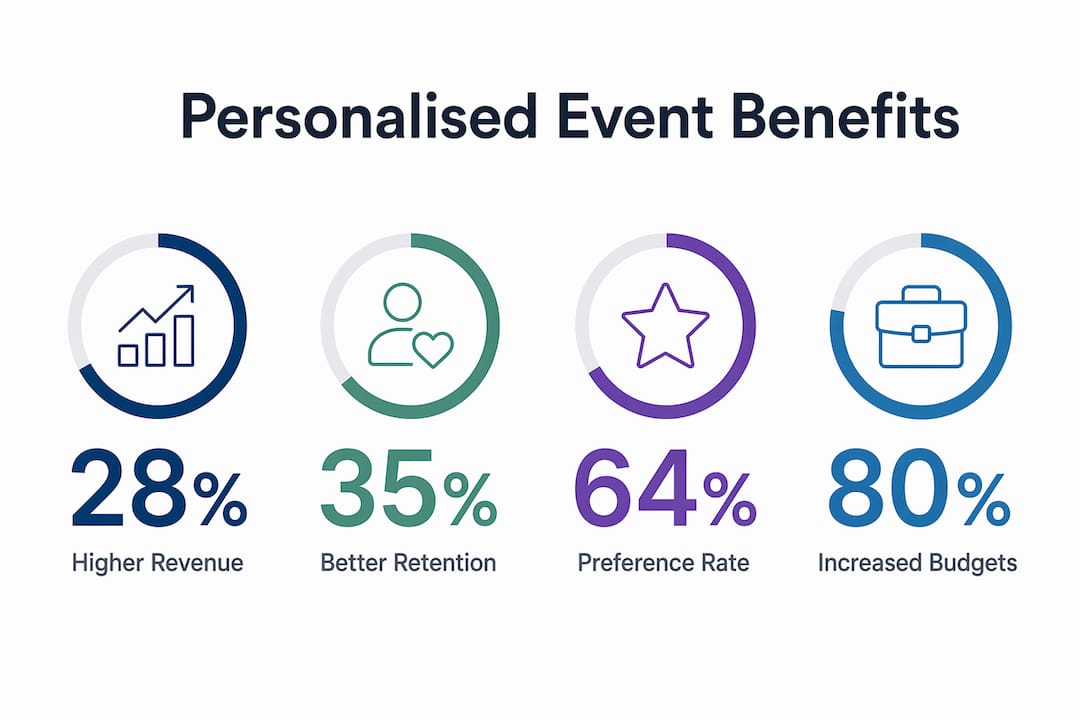
The numbers confirm this. 64% of attendees consider personalised recommendations critical to a positive event experience. That figure tells you something important: the majority of your audience is already judging your event against a personalised standard before they even arrive.
Personalised communications alone produce a significant lift. Personalised email subject lines achieve 25–40% higher open rates compared to generic messaging. Higher open rates mean more attendees who are informed, prepared, and engaged before the event begins.
Key areas where personalisation raises satisfaction include:
- Curated agendas: Attendees choose sessions relevant to their role or interest, reducing time wasted on irrelevant content.
- Targeted networking: Matching attendees by industry, seniority, or stated goals produces connections that feel purposeful rather than accidental.
- Personalised content delivery: Sending post-event resources aligned with sessions each attendee actually attended reinforces learning and extends engagement.
- Relevant communications: Pre-event emails that reference an attendee’s registration choices feel like a concierge service, not a mass broadcast.
Personalised experiences convert generic attendance into active participation and deeper connections. Events focused on attendee goals build stronger relationships and accelerate business momentum. That is the core value proposition of event personalisation, and it applies equally to a 50-person corporate dinner in Cape Town and a 5,000-delegate conference.
Pro Tip: Survey attendees at registration with three to five targeted questions. Use those answers to segment your communications and session recommendations immediately. The data you collect in those first moments shapes every personalised interaction that follows.
Surface-level vs structural personalisation: what is the real difference?
Not all personalisation delivers equal results. The industry distinguishes between surface personalisation and structural personalisation, and confusing the two is one of the most common mistakes planners make.
Surface personalisation includes tactics like inserting a guest’s first name into an email subject line or printing personalised name badges. These touches are pleasant but they do not change the experience in any meaningful way. An attendee who receives a “Dear Sarah” email but then navigates a one-size-fits-all agenda has not experienced personalisation. She has experienced mail merge.
Structural personalisation involves meaningful changes to event architecture itself. It includes customised agenda tracks, differentiated access levels, and networking opportunities built around individual data. The table below illustrates the contrast clearly.
| Feature | Surface Personalisation | Structural Personalisation |
|---|---|---|
| Communication | Name in subject line | Content matched to attendee profile |
| Agenda | Single programme for all | Custom tracks by role or interest |
| Networking | Open networking for everyone | Curated introductions based on goals |
| Access | Uniform entry for all attendees | Tiered access by registration data |
| Post-event follow-up | Generic thank-you email | Session-specific resources per attendee |
Structural personalisation strategically alters event access, recommended content, and networking opportunities based on individual data. The result is an event that feels bespoke at scale, rather than personalised in name only.
Artificial intelligence is now central to delivering structural personalisation at volume. Tools like Bizzabo and Swoogo use attendee data to generate dynamic session recommendations and personalised agendas automatically. However, AI helps scale personalisation but human-first design prevents algorithmic fatigue and preserves authentic connection. Algorithmic fatigue occurs when every interaction feels machine-generated, stripping the warmth from what should be a human experience. The most effective approach combines AI efficiency with deliberate human touches: a handwritten welcome note, a personally selected gift, or a host who greets guests by name.
Pro Tip: Before your next event, audit every attendee touchpoint and label each one as surface or structural. If the majority are surface-level, you have a clear roadmap for where to invest your personalisation effort first.
How registration data powers the entire personalised event journey
Registration is the highest-leverage moment in event personalisation. Registration is the data capture moment that enables dynamic personalisation across the entire event journey. What you learn at registration determines the quality of every personalised interaction that follows.
Most planners treat registration as an administrative step. The best planners treat it as the first handshake with each attendee. Here is how to use registration data effectively:
- Ask the right questions upfront. Collect role, industry, primary goals for attending, and session preferences. Avoid forms that feel like surveys. Keep questions to five or fewer and make each one count.
- Use progressive profiling. Rather than asking for everything at once, gather additional preferences through pre-event emails or a personalised attendee portal. This reduces friction at registration while building a richer profile over time.
- Let data drive the digital experience immediately. Registration flows should act as content filters that dynamically adjust attendee digital and onsite experiences upon completion. A corporate delegate who registers as a senior executive should receive a different welcome sequence than a first-time attendee.
- Integrate with your CRM. Connecting registration data to platforms like Salesforce or HubSpot means your marketing team can personalise follow-up communications based on actual event behaviour, not assumptions.
- Extend personalisation beyond event day. Personalisation encompasses communications from registration through post-event follow-up. An end-to-end strategy sustains engagement and drives repeat attendance.
The practical result of this approach is an attendee who feels guided rather than processed. From the moment they complete registration, every email, every session suggestion, and every onsite interaction reflects what they told you they needed. That continuity is what separates forgettable events from ones guests talk about for months.
What are the real business benefits of personalised events?
The business case for event personalisation is direct and well-documented. Up to 28% higher revenue and 35% better attendee retention are observed in events that prioritise personalisation. Those figures represent a substantial return on the investment required to build personalised systems and processes.
“Personalisation is now the primary differentiator to overcome attendee fatigue with generic events.” — MOI Global
84% of business leaders view in-person events as critical, with 80% increasing event budgets specifically for curated experiences. That investment reflects a clear understanding: generic events no longer justify the cost of attendance, travel, or time away from the office.
The financial benefits extend beyond ticket revenue. Personalised events attract sponsors who want targeted access to specific audience segments. A sponsor paying for visibility at a generic conference receives broad but shallow exposure. A sponsor at a personalised event can reach a precisely defined group, making the sponsorship more valuable and easier to justify internally. That dynamic allows planners to charge premium rates for sponsorship packages.
Attendee lifetime value is the longer-term prize. Guests who feel genuinely understood at one event are far more likely to return, refer colleagues, and engage with your brand between events. The guide to personalised event experiences at Winelandsfunction explores how this loyalty compounds over time, particularly in the luxury and corporate sectors where relationships drive decisions.
Personalisation also protects your reputation. In an era where Millennial and Gen Z attendees arrive with expectations shaped by Netflix, Spotify, and Amazon, a one-size-fits-all event feels like a missed opportunity. Meeting those expectations is now the price of entry for any event that wants to be taken seriously.
Key takeaways
Personalised events deliver superior guest experiences and measurable business outcomes by treating every attendee as an individual rather than a number on a delegate list.
| Point | Details |
|---|---|
| Personalisation drives revenue | Events with strong personalisation report up to 28% higher revenue and 35% better attendee retention. |
| Structural beats surface | Customised agenda tracks and curated networking outperform name merges and branded badges every time. |
| Registration is the leverage point | Collecting the right data at registration enables dynamic personalisation across every subsequent touchpoint. |
| AI needs human balance | Combining AI-driven recommendations with deliberate human touches prevents algorithmic fatigue and keeps events warm. |
| End-to-end strategy is required | Personalisation must span registration, event day, and post-event follow-up to sustain engagement and loyalty. |
Why i believe personalisation is the most underused tool in event planning
After years of working on events ranging from intimate Cape Winelands celebrations to large corporate launches, I have seen the same pattern repeat itself. Planners invest heavily in venue, catering, and production, then treat personalisation as a finishing touch rather than a structural priority. The result is an event that looks impressive but feels impersonal.
The most memorable events I have been involved with share one quality: guests feel that the experience was built for them specifically. That feeling does not come from a monogrammed napkin. It comes from a programme that reflects their interests, a conversation that was facilitated because someone thought about who they should meet, and a follow-up that references what they actually experienced.
The common pitfall I see is planners confusing effort with impact. Spending hours on bespoke table centrepieces while sending identical pre-event emails to every guest is misallocated effort. The guest experience in hospitality is shaped far more by relevance than by aesthetics.
My practical advice is to start with registration and work outward. Fix the data capture first. Once you have meaningful attendee data, every other personalisation decision becomes easier and more effective. Technology like Bizzabo or Swoogo can automate much of the delivery, but the strategy behind it must be human-centred from the start.
Personalisation is not a trend. It is the direction the entire events industry is moving, and planners who build it into their core process now will have a significant advantage over those who treat it as optional.
— Coert
How Winelandsfunction creates truly personalised luxury events
Winelandsfunction specialises in luxury bespoke events where personalisation is built into every stage of the planning process, from the first client consultation through to post-event follow-up. Based in Cape Town and serving both local and international clients, Winelandsfunction brings the same philosophy to weddings, corporate launches, and private celebrations: no two events should feel alike, because no two clients are alike.
Whether you are planning an intimate gathering in the Cape Winelands or a grand corporate event, the Winelandsfunction team applies expert event management principles to craft experiences your guests will remember long after the evening ends. Every detail, from curated guest journeys to personalised communications, is handled with precision and care. Contact Winelandsfunction to begin planning an event that is genuinely built around your guests.
FAQ
What are personalised events?
Personalised events are gatherings designed around individual attendee preferences, goals, and behaviours rather than a single generic programme. They use data collected at registration and throughout the event lifecycle to tailor content, networking, and communications for each guest.
Why do personalised events produce better business results?
Events with strong personalisation report up to 28% higher revenue and 35% better attendee retention compared to generic formats. Personalisation increases engagement, repeat attendance, and sponsorship value simultaneously.
What is the difference between surface and structural personalisation?
Surface personalisation includes cosmetic touches like name badges and mail-merge emails. Structural personalisation changes the event architecture itself, including agenda tracks, access levels, and curated networking based on individual attendee data.
How does registration data improve event personalisation?
Registration is the primary data capture moment that enables dynamic personalisation across the entire event journey. Collecting role, goals, and session preferences at registration allows planners to tailor every subsequent touchpoint automatically.
How do i personalise events without overwhelming my planning team?
Use event management platforms like Bizzabo or Swoogo to automate personalised communications and session recommendations. Combine that automation with deliberate human touches at key moments to maintain warmth and avoid algorithmic fatigue.
Recommended
- Personalised luxury events that guests never forget – Winelands Function – For Every Occasion, Your Celebration
- How to customise event experiences: your 2026 guide – Winelands Function – For Every Occasion, Your Celebration
- Personalization in event planning: your 2026 guide – Winelands Function – For Every Occasion, Your Celebration
- How to customise guest experience for luxury events – Winelands Function – For Every Occasion, Your Celebration