

TL;DR:
- South Africa’s events industry significantly contributes to the economy, with destination weddings playing a vital role in Western Cape tourism.
- Expert event consultants provide strategic guidance, curating suppliers and managing risks to create cohesive, memorable occasions for luxury clients.
South Africa’s events sector is far larger than most people realise. Weddings alone account for 42% of all events nationally, and destination weddings contribute 8% of Western Cape tourism, within an industry that adds R91 billion to the country’s GDP. Against that backdrop, the idea that professional event consultants are a luxury reserved for the ultra-wealthy simply does not hold up. Whether you are planning an intimate Winelands wedding or a landmark corporate launch, the right consultant transforms an occasion from merely impressive to genuinely unforgettable.
Table of Contents
- Understanding the value of expert event consultants
- How event consultants elevate weddings and corporate functions
- Navigating challenges in Cape Town’s luxury events
- Applying consultant expertise: Practical considerations for affluent clients
- Our take: What most luxury clients miss about hiring consultants
- Unlock truly extraordinary events with Cape Town’s leading consultants
- Frequently asked questions
Key Takeaways
| Point | Details |
|---|---|
| Role clarity | Event consultants provide strategic direction, not just logistics, for luxury occasions. |
| Elevated experiences | Consultants ensure weddings and corporate functions surpass expectations through bespoke refinement. |
| Local expertise | Cape Town consultants navigate venue, regulation, and supplier complexities with insider knowledge. |
| Value for investment | Affluent clients gain higher returns and unique memories by hiring event consultants early. |
| Actionable selection | Choosing the right consultant requires focused questions and alignment on luxury goals. |
Understanding the value of expert event consultants
Many clients arrive at their first planning conversation believing that an event consultant is simply someone who books venues and orders flowers. The reality is far more nuanced, and understanding that distinction is what separates a good event from a great one.
An event consultant operates at a strategic level. They listen to your vision, challenge your assumptions where necessary, and shape the entire experience before a single supplier is contacted. An event planner then executes that vision, managing timelines, logistics, and on-the-day coordination. A coordinator, meanwhile, focuses almost entirely on the event day itself. These three roles overlap but are not interchangeable, and conflating them is one of the most common and costly mistakes affluent clients make.
For luxury occasions in Cape Town, the consultant’s role is particularly critical. The city attracts internationally sophisticated guests who have attended extraordinary events around the world. Your occasion must not only meet their expectations; it must exceed them. Consultants who specialise as event coordinator for luxury weddings understand this pressure intimately and build their entire approach around it.
The services a luxury consultant typically provides include:
- Vision development and concept design that translates personal values into a coherent event narrative
- Supplier curation drawing on established relationships with Cape Town’s finest florists, caterers, lighting designers, and entertainment acts
- Budget strategy that prioritises spend where guests will feel it most, rather than spreading resources evenly across every line item
- Risk management covering everything from weather contingencies to backup power and supplier redundancy
- Guest experience architecture that maps every touchpoint from arrival to farewell
Pro Tip: Affluent clients frequently underestimate the value of engaging an event planning coordinator before setting a budget. Consultants who are brought in early can often negotiate superior value with suppliers and redirect spending towards moments that create lasting memories, rather than costly elements guests barely notice.
The scale of South Africa’s events industry means that Cape Town’s supplier market is highly competitive and increasingly sophisticated. Navigating it without expert guidance is time-consuming and, for busy executives or couples juggling demanding careers, genuinely impractical.
How event consultants elevate weddings and corporate functions
Understanding the consultant’s role is one thing. Seeing what it actually produces is another. The difference between a self-planned luxury event and a consultant-led one is most visible in two areas: coherence and emotional impact.

For weddings, coherence means that every element, from the invitation suite to the farewell gift, tells the same story. A consultant ensures that the colour palette, the floral design, the music programme, and the menu all speak the same visual and sensory language. Guests feel this even when they cannot articulate why. It is the reason some weddings feel effortlessly elegant while others, despite equal spending, feel disjointed.
For corporate functions, the stakes are different but equally high. A product launch or annual awards evening is a direct expression of your brand. A consultant ensures that every detail reinforces brand values, from the room layout that encourages specific conversations to the lighting temperature that flatters your key speakers on camera. Guest experience enhancement at this level is not incidental; it is the primary business objective.
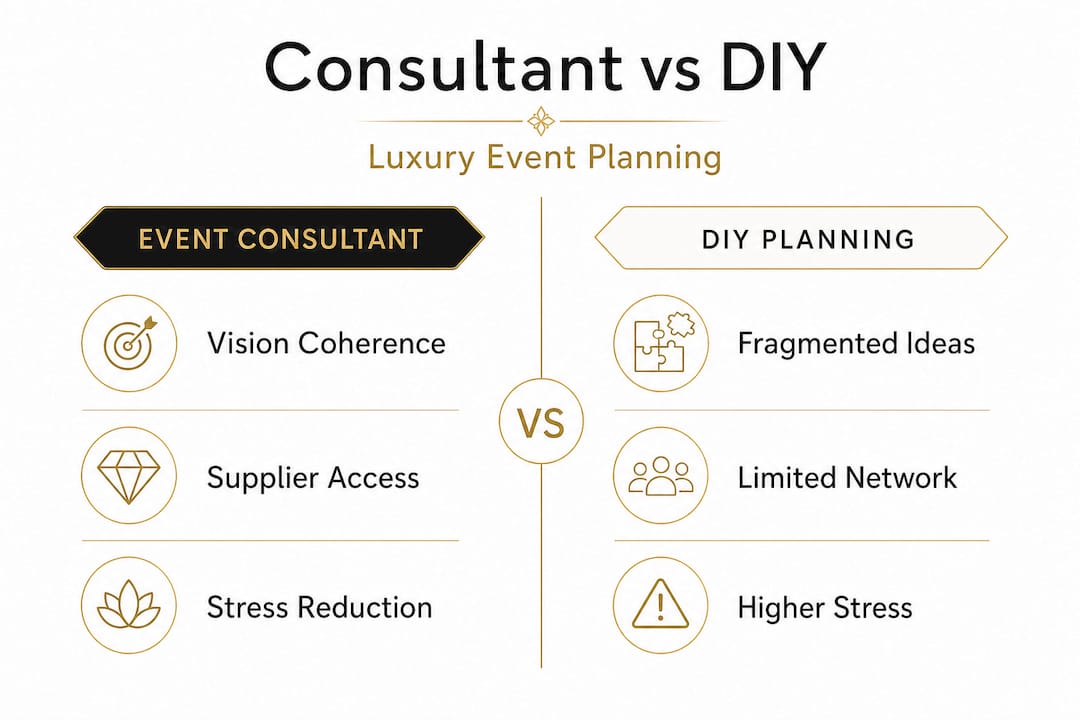
Here is a clear comparison of what the two approaches typically deliver:
| Factor | DIY planning | Consultant-led event |
|---|---|---|
| Vision coherence | Inconsistent, reliant on individual suppliers | Unified concept driven from inception |
| Supplier access | Open market, variable quality | Curated network with proven luxury track record |
| Budget efficiency | Reactive, prone to overspend | Strategically allocated for maximum impact |
| Risk management | Ad hoc, often discovered on the day | Systematic contingency planning |
| Guest experience | Functional | Emotionally resonant and memorable |
| Time investment | Enormous, often underestimated | Significantly reduced for client |
| Stress level | High, particularly in final weeks | Managed throughout, minimal on event day |
The Western Cape’s Winelands region is one of the world’s most sought-after destination wedding locations. With destination weddings comprising 8% of Western Cape tourism, the competition for premium venues and top-tier suppliers is intense. A consultant with genuine local connections will access options simply not available to the general public, including venues that rarely advertise and suppliers who reserve their best work for trusted referrals.
When it comes to truly elevating guest experience at a luxury event, consultants think beyond the obvious. They consider the temperature of the welcome drink, the scent in the entrance space, the pace at which courses arrive, and the moment the lighting shifts from cocktail warmth to dinner intimacy.
Pro Tip: Most luxury clients focus venue selection on aesthetics alone. Your consultant should assess acoustics, guest flow, catering kitchen capacity, and vehicular access just as rigorously as the mountain backdrop or wine cellar setting. The benefits of destination weddings in the Winelands are exceptional, but only when the operational realities of each venue are fully understood.
Navigating challenges in Cape Town’s luxury events
Cape Town is spectacular. It is also demanding. The city’s famous south-easter wind can arrive with little warning, outdoor ceremonies require credible wet-weather contingencies, and heritage venue regulations can restrict everything from amplified music times to the use of open flames. These are not theoretical problems; they are challenges that materialise at real events every season.
Understanding the frequency and impact of these challenges clarifies exactly why professional guidance is so valuable:
| Challenge | Frequency in Cape Town events | Potential impact without consultant |
|---|---|---|
| Extreme wind or weather | High, particularly October to February | Ceremony disruption, guest discomfort, décor damage |
| Supplier cancellation or underperformance | Moderate | Significant gaps in service quality |
| Noise regulation violations | Moderate at historic venues | Fines, early shutdown, reputational damage |
| Traffic and access delays | High during peak season | Delayed start times, frustrated guests |
| Power outages | Low to moderate | Complete disruption without backup systems |
| Permit and licensing issues | Moderate for large functions | Event held in breach of regulations |
“South Africa’s events industry contributes R91 billion to GDP, with destination weddings accounting for 8% of Western Cape tourism. At that scale, event risk management is not optional; it is foundational to any credible luxury event strategy.”
A seasoned consultant approaches these challenges through a structured process rather than hoping for the best. Here is how experienced Cape Town consultants typically manage risk:
- Conduct a thorough venue assessment at least six months in advance, reviewing all licences, regulations, and operational constraints specific to that property.
- Develop a tiered weather contingency plan that specifies exactly when and how transitions between outdoor and indoor spaces will be triggered, and rehearse the process with the venue team.
- Establish a primary and secondary supplier list for every critical service category, ensuring that a cancellation two weeks before the event does not become a crisis.
- Build a detailed run sheet that includes buffer time between key moments, preventing one delay from cascading through the entire programme.
- Coordinate with local authorities well in advance to confirm permits, noise curfews, and any event-specific requirements for the chosen venue or public space.
- Brief all suppliers collectively at least once before the event, ensuring that every team member understands the vision, the standards, and the escalation process if something goes wrong.
Using a thorough destination wedding checklist is one concrete way consultants ensure nothing critical falls through the gaps during the planning process. These checklists are not generic templates; they are living documents that evolve as each event’s unique requirements become clearer.
Applying consultant expertise: Practical considerations for affluent clients
Knowing that you need a consultant is one thing. Selecting the right one for your specific occasion requires a clear-eyed process that goes beyond reviewing a portfolio.
When evaluating potential consultants, prioritise the following:
- Demonstrated luxury experience at a comparable scale to your event, not simply a long list of general events
- Specific knowledge of your preferred venue or venue category, particularly for Winelands properties with their unique operational characteristics
- Transparent fee structures that clarify whether they work on fixed fees, percentages, or a combination, and what is included in each tier
- A genuine creative point of view, not just an ability to execute your brief but the confidence to improve it
- References from similar clients, ideally in the same industry segment or occasion type as your own
- Clarity on who actually manages your event on the day, since some firms send junior staff to execute a concept created by senior consultants you will rarely see again
Questions worth asking during your initial consultation include:
- How do you handle supplier relationships, and do you receive any referral fees we should know about?
- Can you walk us through a recent event where something went wrong and how you resolved it?
- What does your communication process look like during the planning phase?
- How many events do you manage simultaneously, and who is our primary point of contact?
Pro Tip: The single most impactful decision you can make is to engage your event planning coordinator for luxury events before you have committed to a venue. With South Africa’s events industry growing rapidly, the best venues book out 12 to 18 months ahead. A consultant who knows which properties are genuinely available and operationally suited to your vision will save you weeks of misdirected effort and potentially tens of thousands of rands in unsuitable deposits.
Our take: What most luxury clients miss about hiring consultants
Here is the uncomfortable truth that most advice in this space avoids. Many affluent clients hire consultants based on reputation and aesthetic portfolio, which are not the same thing as genuine expertise. A consultant with a stunning Instagram feed and a client list of well-known names may still be entirely wrong for your occasion.
The most valuable consultants we have encountered are often not the most visually prominent. They are the ones who push back. They ask difficult questions about your priorities. They tell you honestly when a venue you love is operationally unsuitable for your guest count. They redirect your budget away from the showpiece moment you are fixated on and towards the quieter details that your guests will actually remember.
Conventional wisdom says you should hire the most celebrated consultant in the market. Practical reality says you should hire the one who listens most carefully and has the professional confidence to disagree with you when the situation calls for it.
There is also a timing misconception worth addressing. Affluent clients frequently treat the consultant engagement as something that happens after the major decisions have been made. Venue booked. Approximate guest list decided. General date confirmed. Then the consultant is brought in to “handle the details.” This sequence is precisely backwards. The importance of destination weddings to the Western Cape economy means that competition for the best dates, venues, and suppliers is fierce. A consultant engaged from the outset shapes every one of those foundational decisions, and the return on that early investment is substantial.
Finally, do not underestimate the value of local relationships. Cape Town’s luxury events world is surprisingly intimate. The best suppliers reserve their finest work and their most favourable pricing for consultants they trust and respect. Arriving as a new client without an established intermediary places you in a weaker negotiating position, regardless of your budget.
Unlock truly extraordinary events with Cape Town’s leading consultants
If this article has clarified anything, it is that the right consultant does not simply manage your event; they fundamentally improve it from the first planning conversation to the final farewell.
At Winelands Function, we work with couples and corporate clients who want more than a well-run occasion. They want an experience that reflects their values, exceeds their guests’ expectations, and creates genuine memories. Whether you are exploring bespoke luxury events for a milestone celebration, working through the finer points of wedding planning in the Winelands, or looking for an event planning coordinator for luxury events who will be with you from concept to close, we would welcome the conversation. Reach out to our team and let’s begin shaping your next exceptional occasion.
Frequently asked questions
What is the difference between an event consultant and an event planner?
An event consultant offers strategic guidance, shapes the overall vision, and advises on decisions before execution begins, while a planner manages the operational logistics and delivery of that vision on the ground.
How do event consultants add value to luxury weddings in Cape Town?
They tailor every detail to your specific vision, apply deep local expertise to venue and supplier selection, and ensure your celebration feels genuinely bespoke rather than assembled from a standard template. Given that destination weddings drive 8% of Western Cape tourism, the competitive landscape rewards expert navigation.
Are event consultants necessary for corporate functions?
For high-profile functions where brand reputation and guest experience are both on the line, consultants manage the operational complexities while ensuring every element reinforces your business objectives. South Africa’s R91 billion events industry reflects just how commercially significant these occasions have become.
What should I look for when hiring an event consultant?
Prioritise proven experience at a comparable scale and occasion type, genuine knowledge of your preferred Cape Town or Winelands venues, transparent fee structures, and strong references from similar clients rather than just an impressive portfolio.
How early should I engage an event consultant?
Ideally before you have committed to any major decisions, since the best consultants in Cape Town’s competitive market shape the foundational choices that determine the quality of everything that follows, including venue selection, date confirmation, and supplier appointments.
Recommended
- Benefits of hiring event planners for Cape Town luxury events – Winelands Function – For Every Occasion, Your Celebration
- Why choose Cape Town events for luxury celebrations – Winelands Function – For Every Occasion, Your Celebration
- Why event stylists elevate luxury Cape Town weddings – Winelands Function – For Every Occasion, Your Celebration
- Why invest in event professionals for luxury occasions – Winelands Function – For Every Occasion, Your Celebration