

TL;DR:
- Event budgeting provides a financial framework that guides planning, controls costs, and ensures event success.
- A structured budget prevents scope creep, includes a contingency fund, and is treated as a living document for better outcomes.
Event budgeting is the financial framework that governs every decision in planning, managing, and executing a successful event. Without it, costs spiral, stakeholders lose confidence, and the gap between your vision and reality widens fast. Understanding why event budgeting matters is the first step toward running any occasion, from an intimate Cape Town wedding to a large corporate launch, with clarity and control. Platforms like Cvent and Eventbrite are built around this principle: financial structure is not optional, it is the foundation of every well-run event.
Why event budgeting matters for cost control
A structured event budget acts as a decision filter throughout planning, cutting requests that fall outside agreed limits before they become expensive commitments. This single function alone prevents the scope creep that derails most events. Without a category-based budget in place, final costs land 15–40% higher than original estimates. That is not a rounding error. It represents thousands of rands or pounds of unplanned expenditure with no recovery strategy.
The most reliable safeguard against overruns is a contingency fund. Industry best practice sets this at 10–20% of your total projected spend. Think of it as a financial buffer that absorbs the costs you did not see coming: a last-minute generator hire, a supplier price increase, or a weather-related venue change.
Hidden costs are where budgets most commonly fail. Planners who skip detailed budgeting routinely miss:
- Insurance and public liability cover
- Overtime fees for venue staff and technicians
- Delivery surcharges and fuel levies from suppliers
- Transportation costs for guests or equipment
- Permit and licensing fees for outdoor or public events
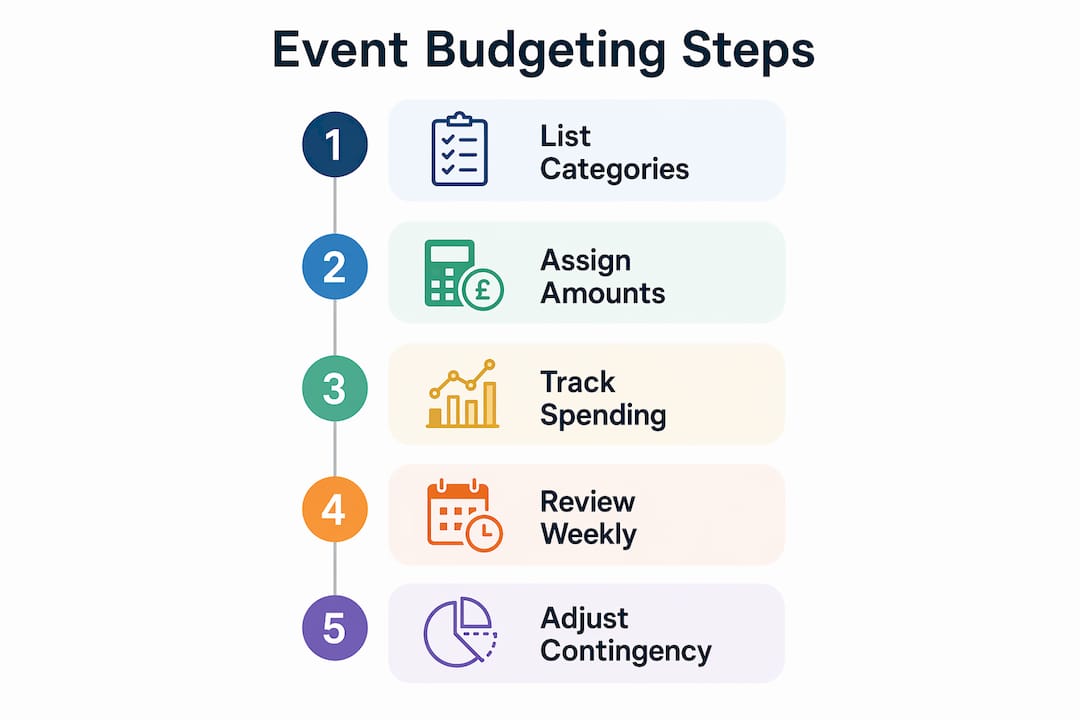
Pro Tip: Build your budget from categories first, not numbers. List every possible cost category before assigning a single figure. This top-down approach forces you to confront hidden costs before they ambush you on the day.
Tracking actual spend against committed spend weekly is equally critical. Weekly tracking of committed versus budgeted spend allows early adjustments before deadlines make changes impossible. By the time most planners notice an overrun, the contracts are signed and the flexibility is gone.
How does budgeting align spending with event goals?
Every rand or pound you spend on an event should serve a specific objective. A budget makes that connection explicit. Without it, spending drifts toward whatever feels urgent rather than what actually matters to your guests or stakeholders.

Typical budget allocations for events follow a clear priority structure. Venue and catering absorb the largest share because they define the guest experience most directly. The table below shows standard percentage ranges across key categories.
| Budget category | Typical allocation |
|---|---|
| Venue and catering | 45% |
| Décor and production | 20% |
| AV and entertainment | 15% |
| Photography and videography | 8% |
| Logistics and transport | 5% |
| Contingency fund | 7% |
These figures are not rigid rules. A corporate product launch may weight AV and production far higher. A luxury wedding in the Cape Winelands may prioritise florals and photography above all else. The point is that a budget forces you to make those trade-offs deliberately, not accidentally.
Budgets also serve as accountability tools across the entire planning team. When every category has an approved figure, there is no ambiguity about what is authorised. Finance teams approve faster when they see a structured budget linked to business outcomes. Stakeholders trust the process more when they can see exactly where their investment is going. For corporate events in particular, a well-structured budget is the foundation of any credible return-on-investment calculation. You can explore how this applies to luxury and corporate events in more detail through Winelandsfunction’s dedicated guide.
Is your event budget a living document or a locked spreadsheet?
Most planners build a budget once and then ignore it. That is the single most expensive mistake in event management. A budget treated as a dynamic operating system rather than a static document produces measurably better outcomes. It links every spending decision to the event’s objectives and flags problems early enough to fix them.
Treating your budget as a living document means following a clear process throughout the planning lifecycle:
- Set the total envelope first. Agree on the maximum spend before any supplier conversations begin. This prevents the common trap of falling in love with a venue or caterer before you know whether they fit your budget.
- Assign category budgets. Divide the total across all cost categories using benchmark allocations as a starting point, then adjust for your specific event priorities.
- Obtain at least three vendor quotes per category. Relying on a single quote is a recognised industry mistake. Multiple quotes give you realistic pricing data and genuine negotiation leverage.
- Track cash flow timing separately from totals. Cash flow timing is distinct from budget totals and critical to avoid cash shortfalls at payment milestones. A deposit due in month one and a final payment due in month three require different cash planning even if the total is within budget.
- Review and reforecast monthly. Compare committed spend against budgeted figures at regular intervals. Catch cost creep before it compounds.
Pro Tip: Use a shared budgeting tool, such as a Google Sheets template or dedicated event software like Cvent, so that all stakeholders see the same live figures. Misaligned versions of a budget are as dangerous as no budget at all.
The event budget planning process described above applies equally to a 30-person dinner and a 500-delegate conference. Scale changes the numbers. The discipline does not change.
What are the most common event budgeting mistakes?
Even experienced planners repeat the same errors. Recognising them is the fastest way to build a more resilient budget.
Ignoring hidden costs. As noted above, insurance, overtime, and delivery surcharges are the most frequently missed line items. A category-first budgeting approach is the most reliable defence against this.
Emotional overspending. Weddings and milestone celebrations are particularly vulnerable. Couples routinely approve upgrades in the moment without checking the cumulative budget impact. Each individual decision feels small. The total is not.
Undersizing the contingency fund. Many planners set aside 5% for contingencies when the industry standard is 10–20%. A 5% buffer disappears with a single supplier substitution or a weather event. Without a clear budget, vendors quote higher and stakeholders add requests, and final bills can exceed estimates by 30–40% with no recovery plan in place.
Booking vendors too late. Late bookings almost always carry premium pricing. Photographers, caterers, and AV companies charge more for short-notice availability. Locking in suppliers early, once your budget is confirmed, protects both price and availability.
Failing to separate budget from cash flow. A budget that balances on paper can still fail if three large deposits fall due in the same week. Plan payment timing explicitly, not just totals.
For a practical walkthrough of how to avoid these pitfalls in a luxury context, Winelandsfunction’s step-by-step budgeting guide covers the full process with real-world examples.
Key takeaways
Effective event budgeting requires a category-first structure, a contingency fund of 10–20%, and continuous tracking throughout the planning lifecycle.
| Point | Details |
|---|---|
| Budget as a decision filter | Approved categories prevent scope creep and unauthorised spending before it occurs. |
| Contingency fund is non-negotiable | Set aside 10–20% of total projected spend to absorb unexpected costs. |
| Category-first budgeting prevents surprises | List all cost categories before assigning figures to catch hidden costs early. |
| Cash flow timing matters separately | Plan payment milestones independently from total budget to avoid shortfalls. |
| Dynamic tracking beats static planning | Review committed versus budgeted spend weekly to catch overruns before they compound. |
The budget is where confidence comes from
I have worked on events where the brief was extraordinary and the vision was genuinely exciting. The ones that delivered on that vision almost always had one thing in common: a budget that was treated as a working document, not a formality.
The events that fell short were rarely let down by creativity or effort. They were let down by financial ambiguity. A client who does not know their true spend position cannot make good decisions. A planner who has not tracked committed costs cannot give honest advice. That gap between what was planned and what was spent is where trust breaks down.
What I find most interesting is that a well-structured budget does not constrain a luxury event. It enables it. When you know exactly what you have available in each category, you can make bolder choices within those limits. You can authorise a premium florist because you know the catering came in under budget. You can hold firm on a venue negotiation because you have the numbers to back your position.
The discipline of regular budget reviews also changes the client relationship. When stakeholders can see a live, accurate picture of where their money is going, they stop second-guessing and start collaborating. That shift from anxiety to confidence is one of the most underrated benefits of structured financial planning in events. For anyone planning a high-end occasion, the event cost optimisation guide from Winelandsfunction is worth reading before you commit to a single supplier.
— Coert
Plan your next event with professional budget management
Winelandsfunction brings structured financial planning into every event it coordinates, from intimate Cape Town celebrations to large-scale corporate occasions in the Cape Winelands. Every engagement begins with a clear budget framework aligned to your objectives, so you know exactly what you are committing to before any contracts are signed.
Whether you are planning a luxury wedding, a corporate launch, or a bespoke private celebration, professional event management in Cape Town means your budget works as hard as your creative vision. Winelandsfunction’s team handles vendor negotiations, cash flow planning, and real-time spend tracking so that your event arrives on brief and within budget. Contact Winelandsfunction to begin your planning conversation today.
FAQ
What is event budgeting?
Event budgeting is the process of creating a financial plan that allocates funds across all cost categories for an event. It controls spending, manages risk, and aligns expenditure with the event’s objectives.
How much should I set aside for contingencies?
Industry best practice recommends a contingency fund of 10–20% of your total projected budget. This covers unexpected costs such as supplier changes, weather events, or last-minute requirements.
What happens if I plan an event without a budget?
Without a structured budget, final costs typically exceed estimates by 15–40%. Vendors quote higher, stakeholders add requests, and there is no recovery plan when bills arrive over budget.
How often should I review my event budget?
Review your committed spend against budgeted figures at least once a week during the active planning phase. Weekly tracking allows early adjustments before payment deadlines remove your flexibility.
What is the biggest mistake in event budgeting?
The most common mistake is building a budget without listing all cost categories first. This bottom-up approach misses hidden costs like insurance, overtime fees, and delivery surcharges, which are among the most frequent sources of budget overruns.
Recommended
- Step-by-step guide to luxury event budgeting: 2026 – Winelands Function – For Every Occasion, Your Celebration
- Event budget planning explained for luxury events – Winelands Function – For Every Occasion, Your Celebration
- Event cost optimisation guide for planners – Winelands Function – For Every Occasion, Your Celebration
- Why Hire Event Planner: Complete Guide for 2025 – Winelands Function – For Every Occasion, Your Celebration