
TL;DR:
- A wedding portfolio is a curated collection of evidence that demonstrates a vendor’s ability to deliver under real wedding conditions. It provides insight into consistency, versatility, and full-day coverage, aiding couples in making informed hiring choices. Evaluating portfolios alongside full galleries, reviews, and direct questions helps ensure vendors meet expectations and align with the couple’s vision.
When you start planning your wedding, one of the first things vendors will show you is their portfolio. But a wedding portfolio is far more than a collection of pretty photographs. It is a curated body of evidence that tells you exactly what a vendor can deliver when the pressure is on and the day itself is unfolding in real time. Knowing how to read one, and what to look for beyond the obvious, can make the difference between hiring the right person and making a costly mistake.
Table of Contents
- Key takeaways
- What is a wedding portfolio, and what purpose does it serve?
- What to look for in a wedding photography portfolio
- What a wedding planner’s portfolio includes
- How to evaluate wedding portfolios effectively
- Using portfolios practically during planning
- My honest take on wedding portfolios
- Plan your wedding with Winelandsfunction
- FAQ
Key takeaways
| Point | Details |
|---|---|
| Portfolios prove real capability | A wedding portfolio is curated proof of a vendor’s skill, not just their best-looking work. |
| Photography and planner portfolios differ | Photographer portfolios show visual consistency; planner portfolios include mood boards, timelines, and testimonials. |
| Full galleries reveal more than highlights | Requesting complete wedding galleries shows how a vendor performs across an entire day, not just peak moments. |
| Consistency across conditions matters most | Strong portfolios demonstrate versatility across different venues, lighting, and guest sizes. |
| Combine portfolios with other research | Use portfolios alongside reviews, interviews, and vendor directories for the most informed decision. |
What is a wedding portfolio, and what purpose does it serve?
At its core, a wedding portfolio is a vendor’s curated set of work designed to prove real wedding-day capability, not simply to display their personal favourites. Think of it as the difference between a job applicant’s CV and a working sample. The portfolio selects and presents the strongest evidence that this vendor can handle your wedding specifically.
This is where many couples get confused. A portfolio is not the same as a full wedding gallery, nor is it the same as a vendor’s blog. Each serves a different role:
- A portfolio page is intentionally curated, showing range, style, and skill in a compact format.
- A full gallery contains every image from a single wedding, start to finish, and reveals operational consistency.
- A blog tends to feature storytelling and context, often written with SEO in mind rather than as a strict performance record.
The portfolio is the front door. It answers one question quickly: does this vendor’s work align with my vision? But it should never be the only thing you look at.
Different vendors use portfolios differently. A wedding photographer will lead with images arranged to reflect the day’s natural flow, from getting ready through to the first dance. A wedding planner, by contrast, will build a portfolio that communicates both creative vision and logistical skill, using photographs alongside design documents and client feedback. Understanding these distinctions helps you ask the right questions from the very first conversation.
What to look for in a wedding photography portfolio
A strong wedding photography portfolio does not simply contain beautiful images. It demonstrates consistent quality across wildly different conditions, and that consistency is what separates a truly reliable photographer from one who has had a handful of lucky days.
Here is what to assess when reviewing any wedding photography portfolio:
- Consistency across weddings. Look at multiple wedding features, not just one. Does the quality hold up at a small intimate ceremony as well as a large reception? Does the editing style remain coherent across different events?
- Coverage of the full day. Portfolios arranged by wedding day flow help you visualise whether the photographer captures all the key moments, not just the ones that photograph most easily.
- Natural and varied moments. A portfolio heavy on posed shots with very few candid, emotional moments suggests a photographer who relies on direction rather than observation. You want both.
- Lighting flexibility. Does the portfolio include dark reception rooms, bright outdoor ceremonies, and candlelit dinners? Versatility across settings and lighting is a strong indicator of reliability.
- High-resolution and coherent editing. Blurry images or a chaotic mix of editing styles in a portfolio is a red flag, not a stylistic choice.
Pro Tip: Always ask to see at least one full wedding gallery, not just the portfolio highlights. Full galleries reveal how vendors manage every part of a real wedding day, including the quieter moments that portfolios often omit.
The request for a full gallery is one of the most powerful moves you can make as a couple. Most photographers will agree readily. If a vendor is reluctant to share one, that hesitancy tells you something important.
What a wedding planner’s portfolio includes
A wedding planner’s portfolio looks quite different from a photographer’s, and understanding that difference helps you evaluate it properly. Where photographers lead with images, planners lead with evidence of process, decision-making, and coordination under pressure.
Planner portfolios function as strategic sales tools that reveal leadership and judgement, not just aesthetic taste. The most detailed planner portfolios typically include:
- Mood boards and design concepts that demonstrate the planner’s ability to translate a couple’s vision into a cohesive visual direction.
- Sample timelines and run sheets that show organisational skill and how they manage complex logistics across an entire wedding day.
- Client testimonials tied to specific weddings, which offer context about how the planner handled challenges and communicated under pressure.
- Vendor relationships and networks, often listed or implied through tagged collaborators, which indicate how well connected and respected the planner is in the industry.
- Styled shoot inclusions, which act as mock weddings giving the planner a controlled environment to demonstrate coordination skills when real wedding opportunities are limited.
The format matters too. Digital portfolio formats are preferred for accessibility and detail, allowing planners to layer photographs with documents, video walkthroughs, and embedded testimonials. A physical portfolio can feel impressive in a meeting room, but a well-built digital portfolio lets you review everything at your own pace, revisit it before signing a contract, and share it with family members who are part of the decision.
If you are working with a wedding venue selection guide that references specific planners or preferred supplier lists, compare those recommendations against what you see in each planner’s portfolio before proceeding.
How to evaluate wedding portfolios effectively
Looking at portfolios without a clear method leads to decisions based on gut feeling alone. Gut feeling matters, but it should be informed by evidence.
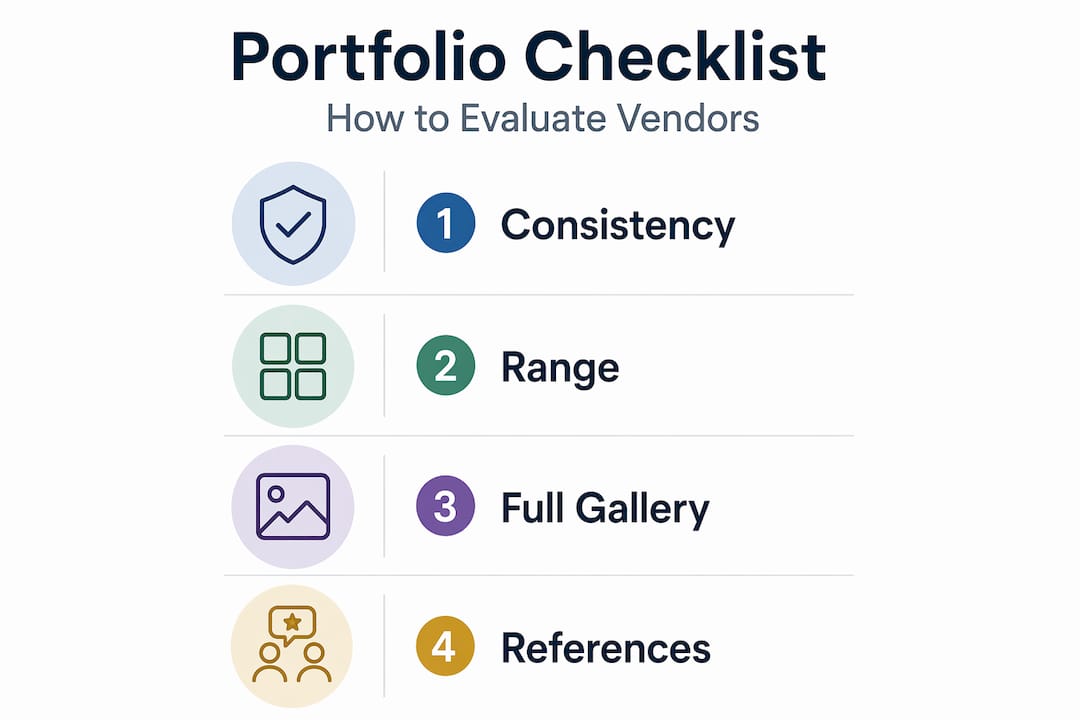
The single biggest mistake couples make is treating any portfolio as a highlight reel and taking it at face value. Portfolios that only show similar conditions are misleading. A photographer who has only shot outdoor summer ceremonies in golden-hour light may genuinely struggle at your indoor winter venue. You need to see range.
| What to check | Why it matters |
|---|---|
| Consistency across multiple weddings | Confirms skill is repeatable, not a lucky exception |
| Range of venues and lighting conditions | Reveals how the vendor performs outside ideal circumstances |
| Candid versus posed balance | Shows adaptability and observational skill |
| Process documents (for planners) | Demonstrates organisational depth beyond aesthetics |
| Client testimonials linked to specific events | Grounds praise in real, verifiable experience |
Beyond the portfolio itself, curated vendor platforms that bundle portfolios with reviews, interviews, and awards give you considerably more to work with. These platforms allow you to cross-reference portfolio claims against real wedding outcomes and client ratings, reducing much of the guesswork involved in vendor selection.
Pro Tip: When comparing vendors side by side, create a short checklist with your non-negotiables before you start reviewing portfolios. Looking at five or six portfolios without criteria in place quickly becomes overwhelming, and you end up defaulting to whoever showed you the prettiest image first.
Using portfolios practically during planning
Understanding what a wedding portfolio is only gets you so far. Knowing how to use it during your planning process is what actually saves you time, money, and stress.
- Request full galleries early. Before your first proper consultation with any vendor, ask to see a complete wedding gallery alongside their portfolio. This sets a professional tone and filters out vendors who cannot back up their highlight reel.
- Prepare questions based on what you see. If you notice gaps in a photographer’s portfolio (no dark reception shots, no large wedding coverage), ask about those directly. A confident vendor will welcome the specificity.
- Integrate portfolio review with other research. Combining portfolios with reviews and real weddings linked on vendor directories gives you a far fuller picture than either resource alone.
- Use the portfolio to test alignment. Show your mood board or inspiration images to the vendor during your meeting and ask them to point to examples in their own portfolio that relate to your vision. How they respond tells you a great deal about how they listen and collaborate.
- Revisit portfolios after your first meeting. First impressions shift after a conversation. Looking again at a portfolio once you have spoken to the person behind it often reveals things you missed or highlights work you now appreciate differently.
This process mirrors what you would do with any major investment decision, which is precisely what your wedding vendors represent. Treat wedding planning step by step as a structured process rather than a series of spontaneous choices, and portfolios become one of the most powerful tools you have.
My honest take on wedding portfolios
I have seen hundreds of couples arrive at vendor consultations utterly dazzled by a portfolio, and then find themselves disappointed when the delivered work felt nothing like what they were shown. The portfolio had been cherry-picked from the best moments of ten weddings spread over three years. What the couple actually booked was an average day’s work, not a highlight.
What I have learned is that the importance of a wedding portfolio is not in its beauty alone. It is in what it is willing to show you and what it quietly leaves out. Gaps in coverage, an absence of challenging conditions, a portfolio that all looks like it was shot at the same venue in the same light, these things matter far more than the number of stunning hero images at the top of the page.
Couples also tend to underestimate how much a planner’s portfolio reveals about character. A planner who includes sample timelines and vendor correspondence alongside their photographs is showing you that they are not just a creative person. They are a professional who can manage a complex day under pressure.
My advice is to use portfolios strategically rather than passively. Ask hard questions. Request more than you are offered. Compare what you see in a portfolio against the wedding design workflow and the practical realities of your specific day. The couples who do this consistently make better hiring decisions and, more often than not, end up with a wedding that genuinely reflects what they imagined.
— Coert
Plan your wedding with Winelandsfunction
If you are in the process of finding vendors whose portfolios genuinely match your vision, Winelandsfunction can take a great deal of that uncertainty off your plate.
As a luxury bespoke wedding planning service based in Cape Town, Winelandsfunction brings together a curated network of trusted vendors whose work speaks for itself. Every portfolio in their preferred supplier list has been reviewed for consistency, range, and real-wedding performance, not just visual appeal. Couples working with Winelandsfunction gain access to expert wedding planners who understand exactly what a strong portfolio should demonstrate and how to match vendor style to your specific vision. If you are ready to move beyond browsing portfolios alone and want professional guidance at every stage, Winelandsfunction is the place to start.
FAQ
What is a wedding portfolio in simple terms?
A wedding portfolio is a curated selection of a vendor’s past work, designed to demonstrate their skill, style, and ability to deliver on your wedding day. It differs from a full gallery in that it is deliberately edited to showcase the strongest examples rather than every image.
What should be in a wedding portfolio?
A strong wedding portfolio should include images or documentation from multiple real weddings, showing varied conditions, consistent quality, and full-day coverage. For planners, it should also feature mood boards, sample timelines, and client testimonials linked to specific events.
How is a wedding photography portfolio different from a full gallery?
A portfolio versus full gallery distinction comes down to purpose. The portfolio showcases range and style; the full gallery shows every moment from a single wedding, revealing how consistently the photographer performs across an entire day.
How do I evaluate a wedding vendor portfolio effectively?
Look for consistency across multiple weddings and varying conditions rather than focusing on hero shots alone. Requesting full galleries and combining portfolio review with verified client testimonials and vendor directory profiles gives you the most reliable picture.
Are wedding portfolios only for photographers?
No. Every major wedding vendor, including planners, florists, caterers, and venues, uses portfolios to communicate their expertise. Planner portfolios in particular benefit from showing process artefacts like mood boards and timelines alongside photographs.
Recommended
- Wedding Planning Step by Step: Your Complete Guide – Winelands Function – For Every Occasion, Your Celebration
- Wedding Planners Cape Town | Winelands Function
- Wedding Design Workflow: Complete Guide – Winelands Function – For Every Occasion, Your Celebration
- The Essential Guide to Wedding Planning Workflow – Winelands Function – For Every Occasion, Your Celebration