
TL;DR:
- Getting a VIP event right demands layered security, precise guest logistics, and attentive service. Proper planning of infrastructure, staffing, and personalized touches ensures a seamless, memorable experience for exclusive guests. Trusting a knowledgeable partner like Winelandsfunction can elevate every detail, from security protocols to departure protocols.
Getting a VIP event right is far harder than it looks. When you are dealing with high-profile guests, sponsor obligations, and the kind of scrutiny that comes with exclusive events, the margin for error is essentially zero. Mastering your vip event essentials before the day is not a nice-to-have. It is what separates a flawless, memorable experience from a costly, reputation-damaging failure. This guide breaks down every critical layer, from security and staffing to infrastructure and guest flow, so you go into your next luxury event fully prepared.
Table of Contents
- Key takeaways
- 1. Security essentials for VIP events
- 2. VIP guest logistics and access management
- 3. VIP event staffing for lounges and private areas
- 4. Event infrastructure and practical equipment essentials
- 5. Ticketing models and guest experience enhancements
- 6. Exclusive event supplies and curated finishing touches
- My honest take on what actually matters
- Let Winelandsfunction handle the details that matter most
- FAQ
Key takeaways
| Point | Details |
|---|---|
| Layered security is non-negotiable | Multi-zone protection with trained staff and biometric access keeps VIP guests safe without disrupting the atmosphere. |
| Guest list prep prevents costly delays | Sharing named VIP lists with security 24 hours ahead eliminates arrival friction and confusion at the door. |
| Staffing ratios define service quality | VIP lounges need one staff member per 10 to 15 guests to maintain the standard guests expect. |
| Infrastructure planning underpins comfort | Climate control, power, lighting, and furniture layout must be mapped before any equipment arrives on site. |
| Anticipatory service is the true differentiator | The best VIP staff refresh drinks before they are empty and remember names without being asked. |
1. Security essentials for VIP events
Multi-layered security is the single most critical foundation of any high-end private event. It works through three concentric zones: an outer perimeter with fencing and barriers, a middle zone with patrols and strategic lighting, and an inner core staffed by close protection teams. Each zone has distinct responsibilities, and failure in any one of them creates a gap that can unravel everything.
Access control in VIP areas has moved well beyond a clipboard and a pen. Biometric scanning and RFID badge verification now serve as the standard for credential verification in VIP zones, reducing the risk of fraudulent entry and keeping lanes moving quickly. When integrated correctly, these tools are nearly invisible to the guest but make a significant operational difference.
Pro Tip: Build a designated media zone well away from VIP areas. Unmanaged press access is one of the most common security breaches at high-profile events, and it happens through oversight rather than malice.
Emergency response planning deserves equal attention. Every security team member needs a clear communication protocol and a pre-assigned role during a crisis. VIP security staff require specialist training that goes beyond physical response. They need situational awareness, interpersonal communication skills, and bi-annual crisis drills to stay operationally sharp.
| Security zone | Key measures | Responsible team |
|---|---|---|
| Outer perimeter | Fencing, barriers, lighting | General security staff |
| Middle zone | Patrols, crowd monitoring | Supervisory officers |
| Inner VIP core | Close protection, biometrics | Specialist VIP unit |
| Media zone | Press credentials, designated area | PR and security liaison |
2. VIP guest logistics and access management
The most overlooked item on any private event checklist is also the simplest: sharing a named guest list with every entrance touchpoint at least 24 hours before the event. The vast majority of VIP arrival failures happen because entrance staff do not recognise guests, not because of any technical failure. That single briefing step eliminates most of the friction.
Treating your first-level barriers as guest experience design rather than pure operations changes how you approach every entry point. Reception desks, security checkpoints, and turnstiles should feel like a warm welcome, not an interrogation. The moment a VIP guest feels confused or delayed at the door, the tone for their entire experience shifts.
Here is a practical logistics sequence worth building into your workflow:
- Share the final named VIP list with all security and greeting staff 24 hours prior.
- Assign dedicated VIP entry lanes completely separate from general admission routes.
- Brief parking coordinators on reserved spaces and communicate arrival windows to each VIP directly.
- Set up a VIP green room or holding area with refreshments available 30 minutes before the event opens.
- Post a senior team member at the VIP entry to personally greet and usher guests through.
- Conduct a full pre-event walkthrough with security and venue staff to confirm every detail is in place.
Pro Tip: Send each VIP guest a personalised digital briefing pack the day before. Include arrival time, parking details, a named contact, and a photograph of their designated greeter. Guests who feel prepared feel valued.
3. VIP event staffing for lounges and private areas
Getting your staffing ratios right is one of the most direct investments you can make in guest satisfaction. For standard VIP lounges, one staff member per 10 to 15 guests is the recommended baseline. Sponsor lounges can operate at one per 20 to 25, while ultra-VIP or celebrity areas demand even higher densities. Drop below these thresholds and the experience degrades quickly, regardless of how beautiful the space looks.
Each staffing role carries a distinct function. A VIP captain oversees the entire lounge and acts as the point of escalation. The concierge handles personal requests and anticipates needs. Brand ambassadors represent sponsors and maintain messaging. Servers manage food and beverage with precision, and talent handlers coordinate any performers or keynote speakers. Mixing up these roles or leaving gaps between them is where most VIP service breakdowns occur.
The concept of invisible service is worth taking seriously. Anticipatory VIP service means staff who know guests by name before they arrive, refresh drinks before the glass is empty, and never hover. They maintain a discreet but attentive presence that communicates quality without drawing attention to itself.
Pro Tip: Run a role-play training session with your entire VIP team two days before the event. Simulate difficult guest scenarios, test knowledge of the programme, and reinforce confidentiality standards. The difference in team confidence on the day is immediately noticeable.
Key behavioural standards to enforce across all VIP staff:
- Posture, grooming, and uniform standards maintained throughout the entire event
- No personal mobile phone use in VIP areas under any circumstances
- Strict confidentiality regarding guest names, conversations, and arrangements
- Calm, warm, and measured communication at all times, even under pressure
4. Event infrastructure and practical equipment essentials
Your VIP infrastructure must be planned to the same standard as your programme. Furniture layout in VIP lounges should prioritise both comfort and flow. Guests need to move between areas without congestion, and seating configurations should encourage conversation rather than line-of-sight awkwardness.
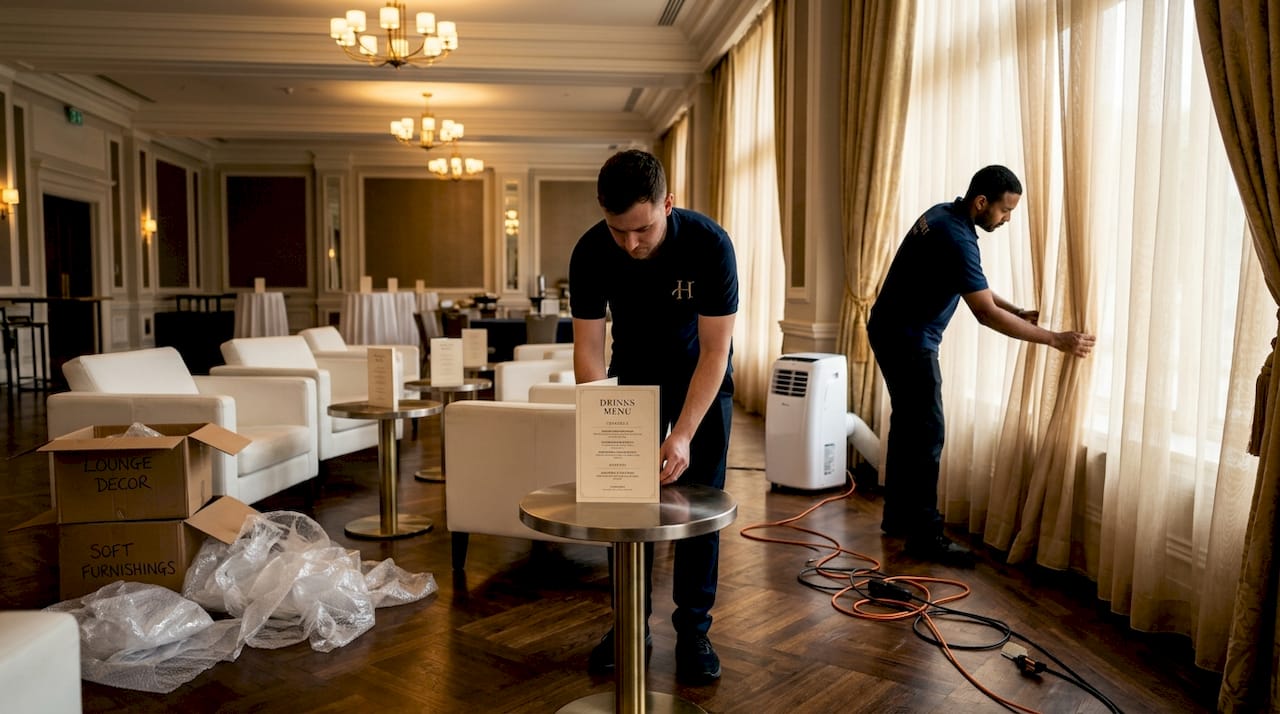
Climate control is a non-negotiable high-end event must-have that is regularly underestimated. Industrial fans, portable air conditioning units, and patio heaters all need to be factored into your floor plan and power load well in advance. First-aid tent placement should be close enough for immediate access but positioned so it does not disrupt the visual aesthetic of the space.
Below is a quick comparison of infrastructure priorities by zone:
| Infrastructure element | VIP lounge | Ultra-VIP area |
|---|---|---|
| Furniture quality | Premium rental pieces | Bespoke or owned pieces |
| Lighting | Layered ambient and spot | Fully customised rig |
| Climate control | Fan and AC unit | Dedicated HVAC system |
| Power access | Multiple concealed outlets | Dedicated power supply |
| First-aid access | Within 60 metres | Adjacent holding room |
Draping, power outlet placement, and lighting rigs all need to be installed before any furniture arrives on site. The removal schedule matters just as much as the setup. Vendor zones that are not cleared on time create chaos and compromise the security perimeter. Build strict delivery and removal windows into every supplier contract.
5. Ticketing models and guest experience enhancements
Staggered admission times are one of the most practical and underused tools in VIP event planning. Earlier VIP admission by at least an hour before general access does two things simultaneously: it reduces queuing pressure at peak entry times and it reinforces the sense of privilege for your VIP guests. The psychological effect of being inside a beautiful space while others are still waiting outside is genuinely powerful.
Credential verification at the gate must be both secure and swift. RFID wristbands, QR code scanning, and digital name verification all support fast throughput without creating bottlenecks. The guest experience workflow from credential check to seated arrival should take no longer than three minutes for a properly planned event.
Personalised touches are what transform a good event into a memorable one. Consider the following additions to your VIP offering:
- Bespoke welcome gifts tailored to each guest’s known preferences
- Personalised table name cards with a handwritten note from the host
- Curated entertainment that reflects the interests of your specific VIP audience
- A dedicated departure protocol so guests leave feeling as valued as when they arrived
- Post-event follow-up with a personal note or gift within 48 hours
The departure experience is one of the most consistently neglected aspects of any private event checklist. Guests who leave feeling forgotten rarely remember the event fondly, regardless of how well the middle portion was managed. Assign a specific team member to farewell management and make it as deliberate as your arrival protocol.
6. Exclusive event supplies and curated finishing touches
Exclusive event supplies are the physical expression of your event’s personality. The quality of your printed collateral, the weight of your glassware, the finish on your signage, and the fragrance in your VIP lounge all communicate something before a word has been spoken.
High-end event must-haves in this category include premium branded stationery, custom-printed menus, bespoke floral arrangements designed for sightlines rather than aesthetics alone, and curated gift bags that reflect the sponsor or host brand with precision. Generic giveaways undermine the entire VIP proposition. If the gift feels like an afterthought, it registers as one.
Technology integration is increasingly a standard VIP party essential rather than a luxury add-on. Real-time monitoring systems for crowd density, integrated communication platforms for your event team, and digital guest management tools all support a smoother operation. The best technology in this context is the kind that guests never notice because everything simply works.
My honest take on what actually matters
I have been involved in planning and managing VIP events across a range of formats, from intimate corporate dinners to large-scale luxury celebrations. The technical knowledge in this article matters. But if I am honest about what separates the events that guests remember forever from the ones that were merely well-organised, it comes down to one thing: whether the team genuinely cared.
Security protocols and staffing ratios are frameworks. What fills them with meaning is a team that has been briefed thoroughly, trusts each other, and feels ownership over the guest’s experience. I have seen technically flawless events fall flat because the staff were disengaged. I have also seen events with a minor logistical hiccup recover beautifully because the team was warm, responsive, and resourceful.
The other thing I would challenge is the assumption that more security means more safety. In my experience, visible, heavy-handed security makes VIP guests uncomfortable and signals to everyone that something could go wrong. Subtle, layered protection that guests barely notice is far more effective and far more consistent with the luxury venue atmosphere you have worked hard to create.
The future of VIP events belongs to planners who understand that exclusivity is an emotion, not a specification. You create it through every small decision, consistently, across every touchpoint.
— Coert
Let Winelandsfunction handle the details that matter most
Planning a VIP event in Cape Town or the Winelands region requires a team that already knows the terrain, the suppliers, and the standard expected by discerning local and international guests. Winelandsfunction brings that expertise to every event it manages, from bespoke luxury celebrations to major corporate launches with high-profile guest lists.
Whether you need a full step-by-step planning service for a private celebration or a professional coordination partner for a multi-day corporate event, Winelandsfunction offers the kind of personalised, detail-focused support that turns a good brief into an outstanding event. Every element covered in this guide, from security layering to departure protocol, is part of the standard Winelandsfunction approach. Reach out to begin planning your event with a team that takes the high-end event must-haves as seriously as you do.
FAQ
What are the most critical VIP event essentials?
The most critical VIP event essentials include multi-layered security with biometric access, a named guest list shared with all staff before arrival, appropriate staffing ratios, and a clearly structured arrival and departure protocol for each guest.
How far in advance should I share the VIP guest list with security?
Share the named VIP guest list with entrance security and all greeting staff at least 24 hours before the event. This single step prevents the majority of arrival delays and access confusion.
What is the correct staffing ratio for a VIP lounge?
The recommended ratio for a VIP lounge is one staff member per 10 to 15 guests. Ultra-VIP or celebrity areas require an even higher staffing density to maintain quality service throughout the event.
How do staggered ticketing times benefit VIP guests?
Staggered admission, where VIP guests enter an hour or more before general admission, reduces queuing, improves crowd flow, and reinforces the sense of exclusivity that high-end event guests expect.
What exclusive event supplies make the biggest impression?
Premium branded stationery, bespoke floral arrangements, custom glassware, and curated welcome gifts tailored to individual guests consistently make the strongest impression. Generic supplies undermine the VIP proposition entirely.
Recommended
- Event Planning Step by Step for Elegant Celebrations – Winelands Function – For Every Occasion, Your Celebration
- Corporate Event Preparation Guide for Elegance and Impact – Winelands Function – For Every Occasion, Your Celebration
- Complete Guide to the Role of Event Planners – Winelands Function – For Every Occasion, Your Celebration
- 7 Essential Event Management Tips 2025 for Luxury Planners – Winelands Function – For Every Occasion, Your Celebration