

Event planning shapes some of life’s most important moments, from vibrant festivals to high-stakes conferences. Yet behind the glitz and smooth running lies a staggering truth: over 90 percent of event professionals rank stress as their top challenge, according to industry research. Still, stress is not the real headline. The real story is how skilled planners turn chaos into captivating experiences that leave people talking long after the lights fade.
Table of Contents
- What Is Event Planning And Why It Matters
- Key Concepts In Event Planning: From Venue To Theme
- Understanding Your Audience: Tailoring Events For Different Milestones
- The Role Of Vendors And Collaborations In Event Success
- How Event Planners Navigate Challenges And Ensure Smooth Execution
Quick Summary
| Takeaway | Explanation |
|---|---|
| Event planning needs strategic thinking | Successful events require careful management of logistics, stakeholder communication, and creative problem solving. |
| Understanding your audience is vital | Tailoring events to audience demographics and expectations enhances engagement and satisfaction. |
| Choosing the right venue is crucial | Venue selection impacts guest experience, logistical considerations, and alignment with event objectives. |
| Effective vendor collaboration enhances success | Building partnerships with vendors involves transparent communication and shared goals to elevate event execution. |
| Risk management is essential for smooth events | Proactively identifying potential challenges allows for contingency planning, ensuring seamless experiences for participants. |
What is Event Planning and Why It Matters
Event planning represents a sophisticated professional discipline that transforms abstract concepts into tangible, memorable experiences. The event planners are strategic professionals who orchestrate complex logistical challenges, combining creativity, technical expertise, and meticulous organisation to deliver seamless gatherings that meet specific objectives.
The Fundamental Nature of Event Planning
At its core, event planning involves comprehensive management of all elements required to execute successful events. This process encompasses multiple critical dimensions beyond simple logistics. The event planners must navigate intricate requirements including venue selection, budget management, vendor coordination, guest experience design, and precise timing.
Key components of professional event planning include:
The following table outlines the key components of professional event planning, clarifying their purpose and importance.
| Component | Purpose |
|---|---|
| Strategic conceptualisation of goals | Defines event objectives and overall direction |
| Detailed project management | Ensures efficient allocation of resources and timelines |
| Risk assessment and contingency plans | Identifies potential issues and prepares solutions |
| Technical and creative problem solving | Addresses unique event challenges with innovation and expertise |
| Comprehensive stakeholder communication | Facilitates smooth collaboration among organisers and participants |
- Strategic conceptualisation of event goals
- Detailed project management and resource allocation
- Risk assessment and contingency planning
- Technical and creative problem solving
- Comprehensive stakeholder communication
According to public health research examining event management strategies, successful event planning requires systematic approaches that anticipate potential challenges and develop adaptive strategies.
Why Event Planning Matters
Professional event planning transcends mere organisation. These specialists create meaningful experiences that connect people, communicate messages, and achieve specific organisational or personal objectives. Whether designing a corporate conference, wedding celebration, or community gathering, the event planners transform abstract visions into tangible, impactful moments.
Events serve multiple crucial functions:
- Facilitating professional networking and knowledge exchange
- Creating emotional connections and shared experiences
- Supporting brand communication and marketing objectives
- Generating memorable interactions that resonate beyond the immediate occasion
The true value of professional event planning lies in its ability to convert complex logistical challenges into seamless, engaging experiences that leave lasting impressions on participants.
Key Concepts in Event Planning: From Venue to Theme
Event planning demands precision and strategic thinking across multiple critical domains. Professional the event planners understand that successful events are not accidents but carefully orchestrated experiences built upon foundational concepts that transform ordinary gatherings into extraordinary moments.
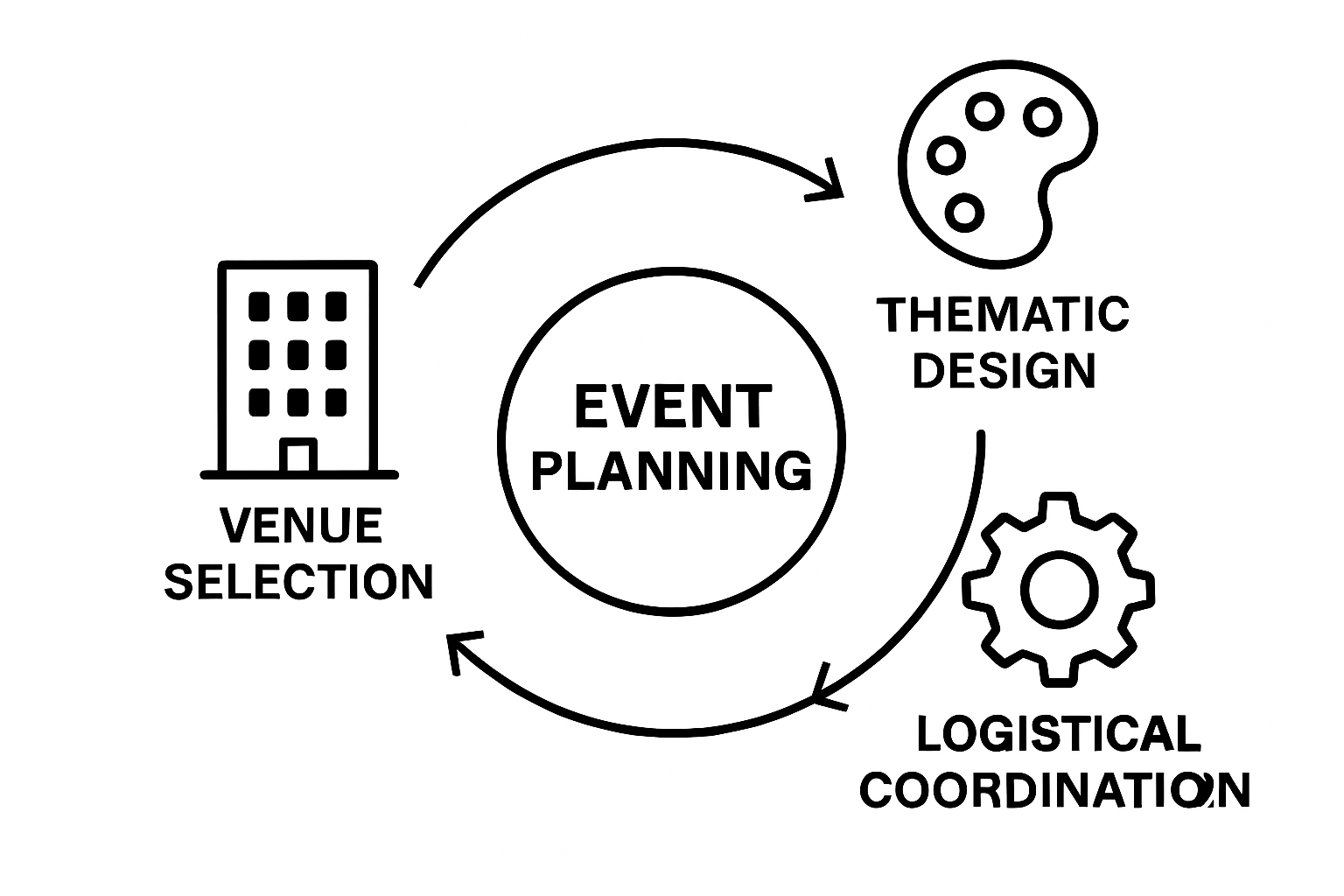
Venue Selection and Strategic Considerations
Choosing the right venue represents one of the most crucial decisions in event planning. The event planners must evaluate multiple dimensions beyond physical space, considering factors such as capacity, accessibility, technical infrastructure, aesthetic appeal, and alignment with event objectives.
Key venue evaluation criteria include:
- Total guest capacity and comfortable spatial arrangements
- Technical capabilities for presentations and entertainment
- Logistical accessibility for diverse attendee demographics
- Acoustic and visual environment conducive to event goals
- Cost effectiveness and budgetary alignment
Thematic Design and Experience Crafting
Event themes provide the narrative framework that transforms functional gatherings into memorable experiences. According to University of Florida research on event theming, successful themes should be visually compelling, conceptually coherent, and strategically integrated across all event elements.
Effective thematic design involves:
- Conceptual consistency across promotional materials
- Visual storytelling through decor and environmental design
- Emotional resonance that connects with target audience
- Subtle yet impactful narrative threads
Logistical Coordination and Execution
Behind every seamless event lies intricate logistical planning. The event planners must masterfully coordinate numerous moving parts, anticipating potential challenges and developing robust contingency strategies. This involves precise timeline management, vendor coordination, resource allocation, and real time problem solving.
Successful logistical coordination requires comprehensive understanding of interconnected systems, meticulous attention to detail, and the flexibility to adapt swiftly to unexpected developments. The ultimate goal transcends mere event execution it is about creating transformative experiences that leave lasting impressions on participants.
This table compares three critical domains of event planning, highlighting their unique roles and primary considerations in the planning process.
| Domain | Role | Primary Considerations |
|---|---|---|
| Venue Selection | Determines the physical space and context | Capacity, accessibility, technical support, budget alignment |
| Thematic Design | Creates a cohesive narrative and visual experience | Conceptual coherence, emotional connection, visual storytelling |
| Logistical Coordination | Ensures smooth operations and timely execution | Timeline, vendor management, contingency planning |
Understanding Your Audience: Tailoring Events for Different Milestones
Professional the event planners recognize that audience understanding represents the foundational cornerstone of exceptional event design. Each milestone demands a nuanced approach that resonates with participants’ unique expectations, emotional contexts, and anticipated experiences.
Demographic and Psychological Mapping
The event planners must conduct comprehensive audience analysis that extends beyond basic demographic information. This involves understanding psychological motivations, generational characteristics, cultural backgrounds, and specific milestone significance.
Critical audience mapping considerations include:
- Age range and generational communication preferences
- Cultural and professional context of participants
- Emotional significance of specific milestone events
- Expected interaction and engagement levels
- Personal and collective expectations
According to University of Florida research on audience engagement, successful event design requires deep understanding of audience dynamics and strategic alignment with participant expectations.
Milestone Event Typology
Different life and professional milestones demand distinctly tailored event approaches. Whether celebrating birthdays, professional achievements, corporate anniversaries, or personal transitions, each event requires a unique psychological and logistical framework.
Milestone event design principles:
- Recognizing emotional complexity of specific life transitions
- Creating personalised experiences that feel meaningful
- Balancing formal requirements with emotional authenticity
- Designing interactive elements that honour individual journeys
Customisation and Personalisation Strategies
Modern event planning transcends standardised approaches. The most successful the event planners create immersive experiences that feel individually crafted, understanding that participants seek genuine connection and recognition.
Effective personalisation involves understanding subtle nuances of human experience, transforming standard gatherings into memorable, emotionally resonant moments that celebrate individual and collective achievements.
The Role of Vendors and Collaborations in Event Success
Vendor relationships represent the intricate ecosystem that transforms event concepts from theoretical designs into tangible experiences. The event planners understand that successful collaborations are not merely transactional interactions but strategic partnerships that collectively contribute to exceptional event execution.
Strategic Vendor Selection and Management
Selecting the right vendors involves comprehensive evaluation beyond surface level capabilities. Professional event planners conduct meticulous assessments that examine vendor expertise, reliability, creative potential, and alignment with specific event objectives.
Critical vendor selection criteria include:
- Portfolio demonstrating relevant experience
- Proven track record of professional reliability
- Creative problem solving capabilities
- Technical and logistical competence
- Adaptability to unique event requirements
According to Global Business Travel Association research on event management technology, collaborative technologies are increasingly important in facilitating effective vendor interactions and event planning processes.
Collaborative Ecosystem and Communication Dynamics
Successful event planning requires establishing a collaborative ecosystem where vendors function as integrated partners rather than isolated service providers. This approach demands transparent communication, shared vision, and mutual understanding of event goals.
Effective collaboration principles involve:
- Clear articulation of expectations and deliverables
- Regular communication and progress tracking
- Flexible problem solving approaches
- Mutual respect for professional expertise
- Collective commitment to event success
Technology and Collaborative Platforms
Modern event planning leverages sophisticated technological platforms that enable seamless vendor coordination. The event planners utilise digital tools that facilitate real time communication, project management, resource allocation, and performance tracking.
These technological interventions transform vendor relationships from traditional hierarchical models to dynamic, collaborative networks that prioritise efficiency, transparency, and collective creativity. The ultimate objective transcends individual task completion it is about creating holistic, integrated event experiences that exceed participant expectations.

How Event Planners Navigate Challenges and Ensure Smooth Execution
Event planning represents a complex landscape where the event planners must anticipate, strategize, and swiftly respond to multifaceted challenges. Professional event management demands exceptional adaptability, strategic thinking, and proactive problem solving capabilities that transform potential disruptions into seamless experiences.
Risk Assessment and Mitigation Strategies
The event planners develop comprehensive risk management frameworks that systematically identify potential challenges before they manifest. This involves creating detailed contingency plans that address multiple scenario variations, ensuring operational resilience and minimal disruption.
Critical risk assessment considerations include:
- Comprehensive scenario mapping
- Financial buffer allocation
- Technical infrastructure redundancies
- Vendor backup planning
- Real time adaptive response mechanisms
According to academic research in event management education, integrating theoretical understanding with contextual problem solving enhances planners ability to navigate complex operational challenges.
Communication and Coordination Protocols
Effective challenge navigation relies on robust communication infrastructures that enable rapid information exchange and coordinated responses. Professional event planners establish clear communication hierarchies, ensuring every team member understands their role during potential disruption scenarios.
Key communication protocol elements involve:
- Establishing clear reporting mechanisms
- Creating real time communication channels
- Defining specific role responsibilities
- Implementing rapid decision making frameworks
- Maintaining emotional composure under pressure
Technological Integration and Adaptive Planning
Modern event planning leverages sophisticated technological tools that enhance predictive capabilities and provide real time operational insights. These technological interventions transform traditional reactive approaches into proactive, data informed strategic management.
Technological integration allows the event planners to monitor multiple variables simultaneously, anticipate potential challenges, and develop nuanced response strategies that maintain event integrity and participant experience.
The ultimate objective transcends mere problem management it is about creating resilient, adaptable event ecosystems that can gracefully navigate unexpected complexities.
Experience Seamless Event Mastery with Winelands Function
Struggling to turn your event vision into reality, despite careful planning and attention to detail? The article explored how true event success demands meticulous problem solving, personalisation, and flawless execution. Yet, many hosts face the pain of logistical complexity, the need for creative impact, or the challenge of ensuring every detail aligns with their original dream. At Winelands Function, we understand how overwhelming it can be to manage risk, coordinate vendors, and design an event that feels deeply personal and sophisticated.
Let us handle the complexity for you. Explore our portfolio of bespoke weddings, luxury corporate events, and private celebrations, each crafted with precision, elegance, and creativity. Visit the Winelands Function website to discover how our team can transform your milestone into a flawless occasion. Speak to our experts now and start planning an event that truly reflects your story. The perfect experience awaits – your vision deserves expert hands today.
Frequently Asked Questions
What is the role of an event planner?
An event planner is a professional who coordinates all aspects of an event, including logistics, venue selection, budget management, vendor coordination, and guest experience design, ensuring that events run smoothly and achieve their objectives.
How do event planners select the right venue for an event?
Event planners evaluate various factors such as venue capacity, accessibility, technical infrastructure, aesthetic appeal, and alignment with the event’s goals to select the most suitable location.
What are the key components of effective event planning?
Effective event planning involves strategic conceptualisation of event goals, detailed project management, risk assessment, problem-solving, and clear communication among all stakeholders involved in the event.
How do event planners tailor events to different audiences or milestones?
Event planners conduct audience analysis to understand demographic factors, psychological motivations, and the emotional significance of the event, allowing them to create personalised and relevant experiences that resonate with participants.
Recommended
- How to Convince Your Boss to Use an Event Planner for This Year’s Year-End Function – Winelands Function – For Every Occasion, Your Celebration
- Why Hiring an Event Planner Saves You Money – Winelands Function – For Every Occasion, Your Celebration
- Why Hire a Wedding Coordinator vs. Doing It Yourself? – Winelands Function – For Every Occasion, Your Celebration
- Event Planning FAQs | Winelands Function
- Master Creating a Content Calendar for 2025 Success
- Content Planning Guide 2025: Strategies for Growth Success