

TL;DR:
- Clear event vision and detailed guest lists are crucial for controlling luxury event costs.
- Budget allocations should follow industry benchmarks, prioritizing venue, catering, and contingency.
- Engaging professional planners enhances negotiation, risk management, and ensures disciplined spending.
Luxury events in South Africa carry enormous financial stakes. A single misaligned decision, whether it is a last-minute venue upgrade or an underestimated catering bill, can send costs spiralling well beyond what any couple or corporate team anticipated. The good news is that with the right structure, budgeting for a high-end wedding or corporate celebration does not have to feel overwhelming. This guide walks you through a proven, step-by-step framework, from clarifying your vision to tracking every rand in real time, so you can host an extraordinary event without the financial regret that so often follows unplanned luxury spending.
Table of Contents
- Clarifying your event vision and scope
- Breaking down the luxury event budget categories
- Step-by-step budgeting: From quotes to continual adjustment
- Avoiding pitfalls: Peak pricing, hidden costs and future trends
- A fresh approach: Why true luxury is disciplined, not extravagant
- Elevate your event with expert planning
- Frequently asked questions
Key Takeaways
| Point | Details |
|---|---|
| Start with vision | Aligning stakeholders on overall event goals and scale ensures smarter financial planning from the outset. |
| Use benchmarks | Industry percentages for categories prevent over- or under-spending in critical areas. |
| Build in contingency | A 10-15% buffer covers surprises and protects your standard of luxury. |
| Review routinely | Track your budget weekly and adapt as new quotes, risks or opportunities emerge. |
| Embrace value-led luxury | Intentional investment—not excess—delivers distinction and long-lasting memories. |
Clarifying your event vision and scope
Before a single quote is requested or a venue is toured, you need absolute clarity on what you are planning and why. This sounds obvious, but it is the step most clients skip in their excitement, and it is the one that causes the most expensive course corrections later.
Start by defining the purpose of your event. Is this a wedding that centres on intimate elegance, or a corporate launch that demands theatrical impact? The answer shapes every financial decision that follows. As the luxury event budgeting overview confirms, the first step is to define vision, objectives, guest list, and total budget before anything else.
Once the purpose is clear, separate your must-have experiences from the enhancements you would love but could live without. Must-haves are non-negotiable: they define the event. Enhancements are aspirational: they elevate it. Keeping these two lists distinct gives you a clear framework for trade-offs when the budget tightens.
Your guest count is arguably the single most powerful cost driver in any event. Every additional guest multiplies catering, seating, staffing, and often venue costs. Draft a preliminary list early and be honest about it. The Cape Town event appeal that draws so many international clients also means venues fill quickly, so knowing your numbers early secures your preferred space.
Key steps for this phase include:
- Define the event purpose and desired guest experience
- Separate non-negotiable elements from aspirational additions
- Draft a realistic guest list and stress-test it
- Set a top-line budget ceiling with all key stakeholders
- Agree on decision-making authority to avoid costly last-minute changes
Pro Tip: Create a shared digital vision board alongside a guest count spreadsheet. When everyone can see the visual ambition next to the practical numbers, unrealistic expectations surface early and can be addressed before they become expensive problems.
Building alignment among all stakeholders at this stage, whether that means a couple, a corporate committee, or a family, is not a soft skill. It is a financial discipline. Disagreements resolved now cost nothing. Disagreements resolved during execution cost a great deal.
Breaking down the luxury event budget categories
With your vision and guest numbers agreed, the next step is turning high-level intentions into a robust financial structure. This means assigning realistic percentage allocations to every major spending category before you receive a single quote.
For South African luxury weddings, wedding budget allocations typically break down as follows: venue at 30 to 40%, catering at 25 to 30%, photography and videography at 10 to 15%, décor at 8 to 15%, and contingency at 10 to 15%. For corporate events, the comprehensive category benchmarks shift slightly: venue at 15 to 30%, food and beverage at 25 to 40%, AV and production at 15 to 25%, décor at 5 to 15%, and contingency at 10 to 15%.
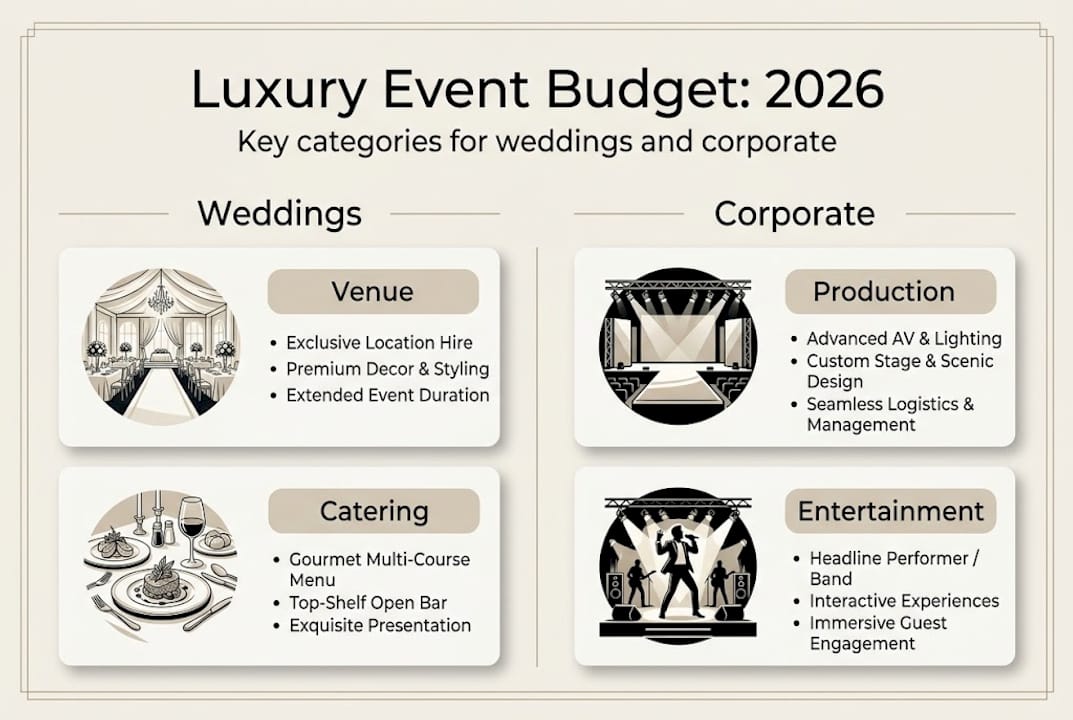
| Category | Luxury wedding (%) | Corporate event (%) |
|---|---|---|
| Venue | 30 to 40 | 15 to 30 |
| Catering and F&B | 25 to 30 | 25 to 40 |
| Photography and video | 10 to 15 | 5 to 10 |
| Décor and florals | 8 to 15 | 5 to 15 |
| AV and production | 5 to 10 | 15 to 25 |
| Contingency | 10 to 15 | 10 to 15 |
The rationale behind these allocations matters. Venue and catering consistently deliver the greatest guest impact, which is why they command the largest shares. Photography preserves the memory of the event long after the evening ends, making it a high-value investment even at a significant percentage. Décor transforms a functional space into an experience.
The contingency line is not optional. For South African events specifically, load shedding means a backup generator is often a necessity rather than a luxury. Corkage fees, additional security, and last-minute supplier changes are all real risks. A contingency of 10 to 15% protects you from these without derailing the entire event.

Luxury weddings in South Africa typically range from R200,000 to R500,000 and above for 100 to 150 guests, making structured allocation essential for maintaining control across every category. Explore the budget planning for luxury events resource for a deeper breakdown of how these percentages translate into actual figures at different budget levels.
Step-by-step budgeting: From quotes to continual adjustment
With your categories set, it is time to move from estimates to actionable numbers. This is where many clients either gain control or lose it entirely.
Follow this sequence to build a budget that holds:
- Request itemised quotes from at least three vendors per category
- Enter all quotes into a master spreadsheet with category totals and running grand total
- Compare top-down (does the total match your ceiling?) and bottom-up (does each line item reflect real market value?)
- Negotiate actively, particularly on packages, seasonal rates, and multi-service bundles
- Lock in confirmed figures and flag any provisional estimates clearly
- Review weekly and update actual spend against budget in real time
- Adjust allocations as confirmed costs come in, rebalancing across categories where needed
The choice between a fixed package and custom sourcing significantly affects both cost and control. Here is how they compare:
| Approach | Cost predictability | Flexibility | Typical saving potential |
|---|---|---|---|
| Fixed package | High | Low | Limited |
| Custom sourced | Medium | High | 10 to 25% with negotiation |
As the budgeting step breakdown makes clear, empirical benchmarking and vendor quoting are essential, with weekly review and active negotiation consistently delivering the best outcomes.
Pro Tip: Always ask vendors directly about seasonal discounts, off-peak rates, and package incentives. Professional planners routinely secure 10 to 20% reductions that individual clients rarely access, simply because of their ongoing supplier relationships. The saving vs splurging tips guide offers practical guidance on exactly where those trade-offs are worth making.
Digital spreadsheets with built-in conditional formatting alerts are your best friend here. Set a threshold at 90% of each category budget so you receive a visual warning before you overspend, not after.
Avoiding pitfalls: Peak pricing, hidden costs and future trends
Even the most carefully constructed budget can unravel if you are not watching for the costs that nobody mentions upfront. Now, even the best-laid budgets require vigilance against shifting market pressures and overlooked risks.
The most commonly underestimated costs in South African luxury events include:
- Power generators for load shedding cover (often R8,000 to R25,000 per day)
- Corkage fees when bringing your own wine or spirits to a venue
- Additional security for high-profile guest lists or remote venues
- VAT and service charges that appear only on final invoices
- Weather contingency for outdoor ceremonies, including marquee hire
- Overtime charges for vendors and staff when events run long
Peak season can add 20 to 40% to costs, which is a significant variable that catches many clients off guard. December and February are the most expensive months in the Cape Town events calendar. Booking during shoulder seasons, such as March to May or September to October, can unlock meaningful savings without sacrificing the quality of the experience.
The benefits of professional planners extend well beyond creative direction. Experienced planners bring negotiation leverage and risk management that protect your budget at every stage. They know which costs are fixed and which are negotiable, and they carry relationships that translate directly into financial advantage.
Looking ahead, sustainable planning practices are reshaping how luxury events are budgeted. Local supplier sourcing, reduced waste, and eco-conscious catering choices are no longer just ethical preferences. They are increasingly influencing client decisions and, in many cases, reducing costs through shorter supply chains. The broader SA events market outlook confirms this shift as a structural trend rather than a passing preference.
‘Invest in intentional enhancement, not excess. The most memorable luxury events are those with resilience and purpose.’
A fresh approach: Why true luxury is disciplined, not extravagant
Here is what most luxury budgeting articles will not tell you: the events that genuinely stand out are rarely the most expensive ones. They are the most intentional ones.
We have seen clients spend more than they planned and still feel underwhelmed on the day, because the spending was reactive rather than purposeful. We have also seen beautifully restrained budgets produce extraordinary experiences, because every rand was directed towards something that genuinely mattered to the people in the room.
True luxury is not about volume. It is about precision. When you apply discipline through structured allocation, regular review, and honest trade-offs, you free yourself to invest deeply in the elements that create lasting memories. As the luxury event management process demonstrates, intentional investment over excess is what separates forgettable events from ones people talk about for years.
Local sourcing and sustainability in events are not just trends. They are expressions of values that resonate with guests and reduce logistical complexity at the same time.
Pro Tip: Designate an experience curator within your planning team. This is the person empowered to make value-driven calls in real time, someone who understands both the creative vision and the financial boundaries, and who can say yes or no quickly when situations evolve.
Discipline is not the enemy of luxury. It is what makes luxury possible.
Elevate your event with expert planning
If you are seeking flawless budgeting and execution, professional guidance can help you realise your vision without financial missteps. At Winelands Function, we work with South Africa’s most discerning clients to integrate creative ambition with disciplined financial control, from the first vision conversation to the final invoice reconciliation.
Our team specialises in bespoke luxury celebrations that reflect your unique vision while staying firmly within your financial framework. Whether you are planning an intimate wedding or a large-scale corporate launch, our step-by-step event planning approach ensures nothing is left to chance. Explore our full range of event management services and take the first step towards an event that exceeds every expectation.
Frequently asked questions
What is the minimum recommended contingency for a luxury event budget?
A minimum contingency of 10 to 15% is advised to absorb unexpected costs, particularly for peak seasons, complex logistics, or South African-specific risks such as load shedding.
How are costs typically split between categories for South African luxury weddings?
Venue and catering typically account for 40 to 50% of budget; photography and videography take 10 to 12%; décor and attire each range from 8 to 15% depending on priorities.
Why should I hire a professional event planner for luxury budgeting?
Professional planners bring negotiation skills and risk management experience, and often secure 10 to 20% in vendor discounts that individual clients rarely access on their own.
What are typical total costs for luxury weddings and corporate events in South Africa?
Luxury weddings in South Africa range from R200,000 to R500,000 and above for 100 to 150 guests, with corporate events varying significantly based on production requirements and guest numbers.
How is sustainability influencing luxury event budgeting in 2026?
Local supplier sourcing and eco-conscious planning are increasingly prioritised, with sustainability via local suppliers now influencing both budget allocation decisions and overall event design in the South African luxury market.
Recommended
- Event budgeting guide 2026: luxury weddings and corporate – Winelands Function – For Every Occasion, Your Celebration
- Event budget planning explained for luxury events – Winelands Function – For Every Occasion, Your Celebration
- Best practices for flawless luxury event coordination – Winelands Function – For Every Occasion, Your Celebration
- Create a Luxury Event Planning Checklist Excel Guide – Winelands Function – For Every Occasion, Your Celebration
- Yacht chartering guide 2026: expert tips for luxury