

TL;DR:
- Experiential marketing events are immersive, interactive encounters that foster emotional connections with consumers.
- Effective events use multi-sensory design, personalisation, and real-time adaptation to stand out.
- Measuring success requires deep analytics, strategic KPIs, and capturing long-term brand impact.
Experiential marketing events have quietly overtaken traditional formats as the gold standard for brand engagement, yet many planners still treat them as a premium add-on rather than a core strategy. The numbers tell a different story: up to 85% of consumers are more likely to purchase after attending a brand experience. In Cape Town, where sophisticated local and international audiences expect more than a logo on a banner, immersive events are not merely impressive. They are essential. This guide breaks down what experiential marketing events are, how to execute them with precision, and what truly separates forgettable activations from those that move people and markets.
Table of Contents
- What defines experiential marketing events?
- The core mechanics: senses, participation, and personalisation
- Success factors and common pitfalls for luxury Cape Town events
- Proving value: ROI and impact measurement in experiential events
- What most event planners miss about experiential marketing in Cape Town
- Plan unforgettable experiential events with local expertise
- Frequently asked questions
Key Takeaways
| Point | Details |
|---|---|
| Immersion drives results | Multi-sensory, interactive events create emotional bonds and outperform traditional marketing for engagement and sales. |
| Personalisation is essential | Tailored experiences and active participation make attendees feel valued and inspire brand advocacy. |
| ROI is measurable | Experiential events deliver strong, trackable returns—when success metrics expand beyond simple attendance. |
| Local relevance matters | Cape Town’s unique culture and audience must shape every detail for maximum impact at luxury events. |
What defines experiential marketing events?
Not every event with a creative theme qualifies as experiential. True experiential marketing events are, at their core, immersive and interactive experiences designed to engage consumers directly with a brand. The defining difference lies in what the attendee does rather than what they see. Traditional event marketing pushes content outward. Experiential marketing invites the audience in, making them central to the story being told.
This shift matters enormously for high-end Cape Town audiences. Corporate executives and discerning clients are not moved by passive presentations. They respond to moments that feel crafted for them specifically, whether that is a private wine tasting blended with a product narrative, or a multi-room art installation where each space reveals a chapter of a brand’s journey.
The core mechanics of an experiential event include active participation, multi-sensory engagement, personalisation, and co-creation. Each of these elements works together to shift the attendee from observer to participant.
| Traditional events | Experiential events |
|---|---|
| Passive audience | Active participants |
| One-way messaging | Two-way dialogue |
| Product focus | Emotional narrative |
| Impressions measured | Connections measured |
| Standardised delivery | Personalised interaction |
What makes this format particularly powerful for luxury brands is the emotional imprint it creates. When a guest co-creates something during an event, whether mixing a bespoke fragrance or contributing to a live artwork, they associate that memory with your brand permanently. For planners designing immersive luxury experiences, this emotional architecture is the real deliverable.
The key distinctions of experiential events at a glance:
- Attendees participate, not just observe
- Senses are deliberately stimulated beyond sight and sound
- Brand narrative is woven into every touchpoint
- Content generated by guests extends reach far beyond the room
- Moments are designed to feel unique and unrepeatable
Understanding the luxury event branding process means recognising that brand identity must be embedded in the experience itself, not merely displayed on the walls.
“The most successful experiential events do not market at people. They invite people into something larger than themselves.”
The core mechanics: senses, participation, and personalisation
With the definition clear, it is essential to unpack the elements that make such events immersive and memorable. Multi-sensory design is the foundation. Interactive installations and AR/VR elements engage attendees at a neurological level, producing stronger memory retention than any static display ever could. Sight, sound, touch, taste, and smell each trigger distinct emotional responses, and elite event designers use all five with intention.
Consider how a Cape Town product launch might layer the senses: curated ambient sound tied to the brand’s origin story, tactile materials in the welcome gift, signature scents diffused through the venue, and locally sourced flavours at the catering stations. Each element is a deliberate signal, not a decoration.

| Sensory channel | Event application | Emotional response triggered |
|---|---|---|
| Sight | Lighting design, art installations | Awe, intrigue |
| Sound | Curated soundscapes, live music | Nostalgia, energy |
| Touch | Textured gifting, interactive surfaces | Trust, intimacy |
| Taste | Bespoke menus, branded tastings | Pleasure, belonging |
| Smell | Signature scents, floral environments | Memory, comfort |
Personalisation elevates the sensory experience into something guests feel is made for them. When you customise guest experiences at a granular level, from monogrammed items to individually curated seating arrangements, the message is clear: this event was designed with you in mind. That signal carries enormous weight for high-value clients and brand advocates.
Co-creation goes one step further. It hands a portion of the experience over to the guest and allows them to shape it. This could mean a live collaborative mural, a guest-blended cocktail served at dinner, or an interactive digital wall that responds to participant input in real time.
How to build a participatory event journey:
- Map the attendee journey from arrival to departure
- Identify three to five moments where guests can actively contribute
- Design sensory cues that reinforce the brand story at each stage
- Integrate digital touchpoints for real-time sharing and extended reach
- Capture guest-generated content as part of your post-event measurement
Pro Tip: Review emerging event trends for innovation before your concept is finalised. What feels fresh today may already be expected by your audience next season.
Success factors and common pitfalls for luxury Cape Town events
Understanding mechanics is not enough. Success relies on avoiding missteps and mastering the factors unique to Cape Town’s luxury landscape. The city draws a globally mobile audience with experience of the world’s finest activations. Standing out requires more than a spectacular venue.
High-end events must emphasise exclusivity, scarcity, bespoke gifting, and genuine integration with local culture to resonate with this audience. A Winelands setting means more than a beautiful backdrop. It signals provenance, craft, and a particular kind of understated prestige that cannot be faked with imported props.
Look at what brands such as Nike have achieved locally. The Nike Cape Town activation at the Two Oceans Marathon transformed a community sporting event into an immersive brand experience with music, storytelling, and participatory installations. The lesson is not to copy this format, but to understand how cultural alignment creates resonance that purely commercial events cannot replicate.
What separates successful luxury activations from mediocre ones:
- Deep research into audience psychographics, not just demographics
- Collaboration with local artists, makers, and cultural voices
- Scarcity mechanics that make attendance feel genuinely privileged
- Digital extensions that amplify the event beyond the guest list
- Seamless execution that makes complexity feel effortless
The event decor examples that leave lasting impressions are those where every visual choice reinforces the narrative. Decor is not wallpaper. It is a sentence in the story you are telling.
Failures in experiential events typically stem from poor execution, a lack of digital integration, or a fundamental misunderstanding of audience psychology. A visually stunning event that provides no social sharing moments wastes its own reach. An activation that ignores the specific values of its Cape Town audience will feel hollow regardless of the budget spent.
Pro Tip: Invest in event concept design before committing to a venue or theme. A strong concept shapes every subsequent decision and saves considerable cost during execution.
For planners evaluating locations, the case for why Cape Town events attract elite audiences rests on a combination of natural beauty, culinary excellence, and a creative community that is globally recognised.
Proving value: ROI and impact measurement in experiential events
Failure to demonstrate results can stall even the best-conceived plans, so how can you prove the value of experiential investment to a board or executive committee?
The numbers are on your side. Global spend on experiential marketing exceeded $128 billion in 2024, growing at 10% annually. ROI averages 3:1 to 5:1 across campaigns, with best-in-class activations reaching 10:1. And 85% of consumers report being more likely to buy from a brand after attending one of their events.
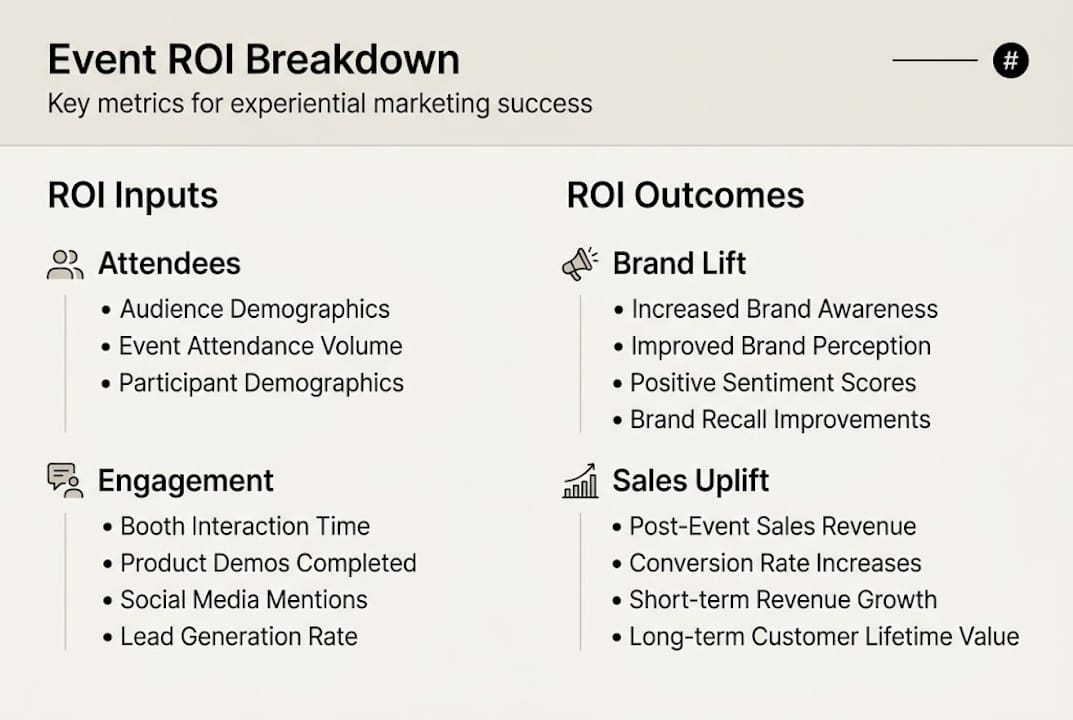
| Metric | Industry benchmark | Best-in-class |
|---|---|---|
| Average ROI | 3:1 to 5:1 | Up to 10:1 |
| Purchase intent lift | 85% post-event | Varies by category |
| Brand sentiment change | +11% average | +25% for targeted activations |
| Social amplification | 2x to 5x guest count reach | 10x+ with viral mechanics |
The challenge is measurement architecture. Most planners track attendance and social impressions, which are surface metrics. Executives need a deeper read. Multi-touch attribution models assign value to every point in the attendee journey, from initial invite response through post-event purchasing behaviour. This approach captures the true commercial value of an activation.
How to build a robust experiential ROI report:
- Define business objectives before the event, not after
- Set measurable KPIs: lead quality, conversion rate, sentiment shift, and media value
- Use post-event surveys within 24 hours for maximum recall accuracy
- Track CRM activity for 90 days post-event to capture delayed conversions
- Present findings as a narrative tied to strategic business goals, not just a spreadsheet
For corporate hospitality investment at the executive level, the measurement framework is often as important as the event itself. A compelling post-event report can secure increased budget for the following year.
“The brands that consistently win with experiential marketing are those that treat measurement as a creative discipline, not an administrative afterthought.”
What most event planners miss about experiential marketing in Cape Town
After working at the intersection of luxury events and brand strategy in Cape Town, we have noticed a persistent pattern: planners invest in spectacle but neglect emotional architecture. A drone light show is impressive. A moment where a guest contributes to something meaningful and leaves feeling seen is unforgettable. These are not the same thing.
The second blind spot is trend imitation. Cape Town’s luxury market is discerning enough to recognise when an activation is borrowed from another city’s playbook. What works in London or New York needs genuine local translation, not just a Table Mountain backdrop swapped in for a skyline. The brands that earn lasting loyalty are those that embed authentic local narrative into every layer of the experience.
The third and most underestimated factor is adaptive design. The best experiential events we have seen use live feedback, whether through staff observation, real-time sentiment tools, or simple guest interaction, to adjust the experience as it unfolds. A memorable event concept is not a fixed script. It is a responsive system. Invest in the team and the process that can flex with the room, and you will consistently outperform those who spent twice as much on a rigid production.
Plan unforgettable experiential events with local expertise
For those ready to turn insight into action, working with partners who understand Cape Town’s unique character makes all the difference. Executing a truly immersive brand experience demands more than creative vision. It requires deep vendor relationships, meticulous logistical planning, and an intuitive understanding of what resonates with elite local and international audiences.
At Winelands Function, we specialise in designing immersive luxury event solutions that engage every sense and leave guests with a lasting emotional connection to your brand. From concept to execution, our team manages every detail so you can focus on the relationships in the room. To understand how we approach the full scope of planning, explore our perspective on event management in Cape Town and take the first step toward an event that truly performs.
Frequently asked questions
What makes an event ‘experiential’ instead of traditional?
Experiential events immerse guests with personalised, interactive elements and multi-sensory design, building emotional connections rather than relying on passive attendance or one-way brand messaging.
How do you measure ROI at an experiential marketing event?
Measure ROI by tracking attendee engagement, social shares, sales lift, leads generated, and brand sentiment shifts. Experiential marketing averages 3:1 to 5:1 ROI and benefits from multi-touch attribution models to capture the full commercial picture.
What are common pitfalls to avoid when planning luxury events in Cape Town?
Avoid neglecting digital integration, failing to personalise experiences, and overlooking local culture. Poor execution and ignoring audience psychology are the most common reasons high-budget events underperform.
Why is personalisation important for high-end experiential events?
Personalisation and co-creation turn attendees into active participants who carry the brand memory long after the event ends, driving stronger loyalty and higher advocacy rates.
Can small brands use experiential marketing successfully?
Absolutely. With sharp creative focus and genuine audience insight, even modest activations can deliver meaningful results. Brand perception lifts of 25% and 11% conversion improvements have been recorded regardless of event scale.
Recommended
- Experiential Event Explained: Immersive Luxury Experiences – Winelands Function – For Every Occasion, Your Celebration
- Corporate Event Branding – Shaping Memorable Experiences – Winelands Function – For Every Occasion, Your Celebration
- Corporate Event Management: Elevating Brand Experiences – Winelands Function – For Every Occasion, Your Celebration
- Elevate every occasion: The luxury event branding process – Winelands Function – For Every Occasion, Your Celebration