

Most advice about event management misses one crucial detail: true sophistication is defined not by glittering venues or trend-setting décor but by strategic expertise that echoes the high standards of traditional British social and corporate gatherings. For affluent couples in Cape Town or corporate leaders seeking exceptional experiences, understanding that over 80 percent of memorable events require advanced design thinking is essential. Here you will discover how expert-led event management reframes every occasion as an extraordinary, bespoke journey.
Table of Contents
- Event Management Defined And Common Myths
- Types Of Events And Unique Requirements
- The Event Management Process Step By Step
- Legal Obligations And Risk Management
- Financial Considerations And Common Pitfalls
Key Takeaways
| Point | Details |
|---|---|
| Event Management is Multifaceted | Beyond logistics, effective event management involves strategic design, audience engagement, and psychological principles. |
| Understanding Event Types is Essential | Each event type has unique requirements, necessitating tailored planning and execution strategies. |
| Legal and Financial Acumen is Crucial | Proficient event managers must navigate complex legal obligations and maintain rigorous financial oversight to ensure success. |
| Risk Management Must Be Proactive | Anticipating potential risks and developing mitigation strategies is vital for maintaining safety and compliance during events. |
Event Management Defined and Common Myths
Event management is a sophisticated professional discipline focused on conceptualising, designing, and executing strategic experiences that transform gatherings from mere logistical exercises into memorable interactions. Beyond simple planning, event experiences integrate complex design principles that strategically influence attendee perceptions and emotional engagement.
Contrary to popular misconceptions, event management is not just about coordinating schedules and selecting venues. Modern event professionals operate as strategic designers who craft comprehensive narratives, carefully choreographing every element to create meaningful connections. Project management principles underpin sophisticated event execution, requiring professionals to simultaneously manage creative vision, technical logistics, brand representation, and participant psychology.
Common myths about event management often paint the profession as simple or superficial. In reality, successful event managers are complex strategists who must balance multiple intricate responsibilities. They must understand marketing psychology, technical production requirements, legal compliance, budgetary constraints, and audience experience design. Their work involves nuanced communication, precise timing, and the ability to anticipate and mitigate potential challenges before they emerge.
Professional Insight: Select event management professionals who demonstrate strategic thinking beyond basic logistical coordination, prioritising those who can articulate a clear vision for transforming attendee experiences.
Types of Events and Unique Requirements
Event management encompasses a diverse landscape of event types, each with distinctive characteristics and strategic requirements. Comprehensive event classifications range from intimate corporate gatherings to expansive international festivals, demanding nuanced approaches tailored to specific objectives and audience expectations.

Traditional event categories include corporate events, social celebrations, cultural festivals, and professional conferences. Each category requires unique planning methodologies. Corporate events, for instance, demand precise branding alignment and professional networking opportunities, while social celebrations prioritise emotional engagement and memorable experiences. Professional event formats encompass formal internal meetings, external conferences, virtual symposiums, and hybrid interactions, each requiring specialised technological and logistical considerations.
Understanding the intricate requirements of different event types is crucial for successful execution. Factors such as venue selection, technological infrastructure, audience demographics, cultural sensitivities, and desired outcomes significantly influence event design. Sophisticated event managers must adapt their strategies dynamically, recognising that a technology conference requires fundamentally different planning approaches compared to a wedding celebration or a cultural festival.
Professional Insight: Always conduct comprehensive audience research and develop a tailored engagement strategy specific to your event’s unique category and objectives.
The following table highlights contrasting requirements for different event categories, providing a concise reference for strategic planning:
| Event Category | Audience Focus | Key Strategic Requirement | Technology Use |
|---|---|---|---|
| Corporate Event | Professional networking | Strong brand alignment | Advanced AV systems |
| Social Celebration | Emotional engagement | Unique memorable experiences | Basic multimedia |
| Cultural Festival | Community participation | Inclusivity and cultural respect | Outdoor tech setup |
| Academic Conference | Knowledge exchange | Precise content scheduling | Hybrid platforms |
The Event Management Process Step by Step
Event management follows a strategic, multifaceted approach that transforms initial concepts into meticulously executed experiences. Comprehensive event management involves systematic planning that begins with conceptualisation and progresses through intricate stages of development, coordination, and evaluation.
The process typically unfolds across four critical phases. First, the initiation stage involves defining event objectives, conducting feasibility analysis, and establishing core parameters. This foundational phase requires detailed stakeholder consultation and preliminary budget mapping. The second phase focuses on detailed planning, where event managers develop comprehensive strategies, including venue selection, vendor negotiations, marketing approaches, and logistical frameworks. Structured methodologies guide professional event execution, ensuring every element aligns with the event’s core objectives.
Implementation and closure represent the final two crucial stages of event management. During implementation, event professionals orchestrate real-time coordination, managing unexpected challenges while maintaining seamless participant experiences. The closure phase involves comprehensive evaluation, financial reconciliation, stakeholder feedback collection, and strategic reflection to inform future event planning. This holistic approach transforms event management from mere logistics into a sophisticated strategic discipline that delivers meaningful, memorable experiences.
Professional Insight: Develop a robust documentation system that tracks every event detail, enabling continuous learning and improvement across future event management initiatives.
Here is a summary table outlining the main phases of the event management process and their critical objectives:
| Phase | Key Objectives | Typical Activities |
|---|---|---|
| Initiation | Define goals, assess feasibility | Stakeholder meetings, budget scope |
| Planning | Detailed logistical design | Venue selection, vendor contracts |
| Implementation | Execute and coordinate operations | Live management, issue resolution |
| Closure | Evaluate and document outcomes | Feedback analysis, financial review |
Legal Obligations and Risk Management
Event management requires a comprehensive approach to legal compliance and risk mitigation that goes far beyond simple procedural checklists. Risk management involves systematic identification and strategic mitigation of potential challenges that could compromise event safety, financial stability, and organisational reputation.
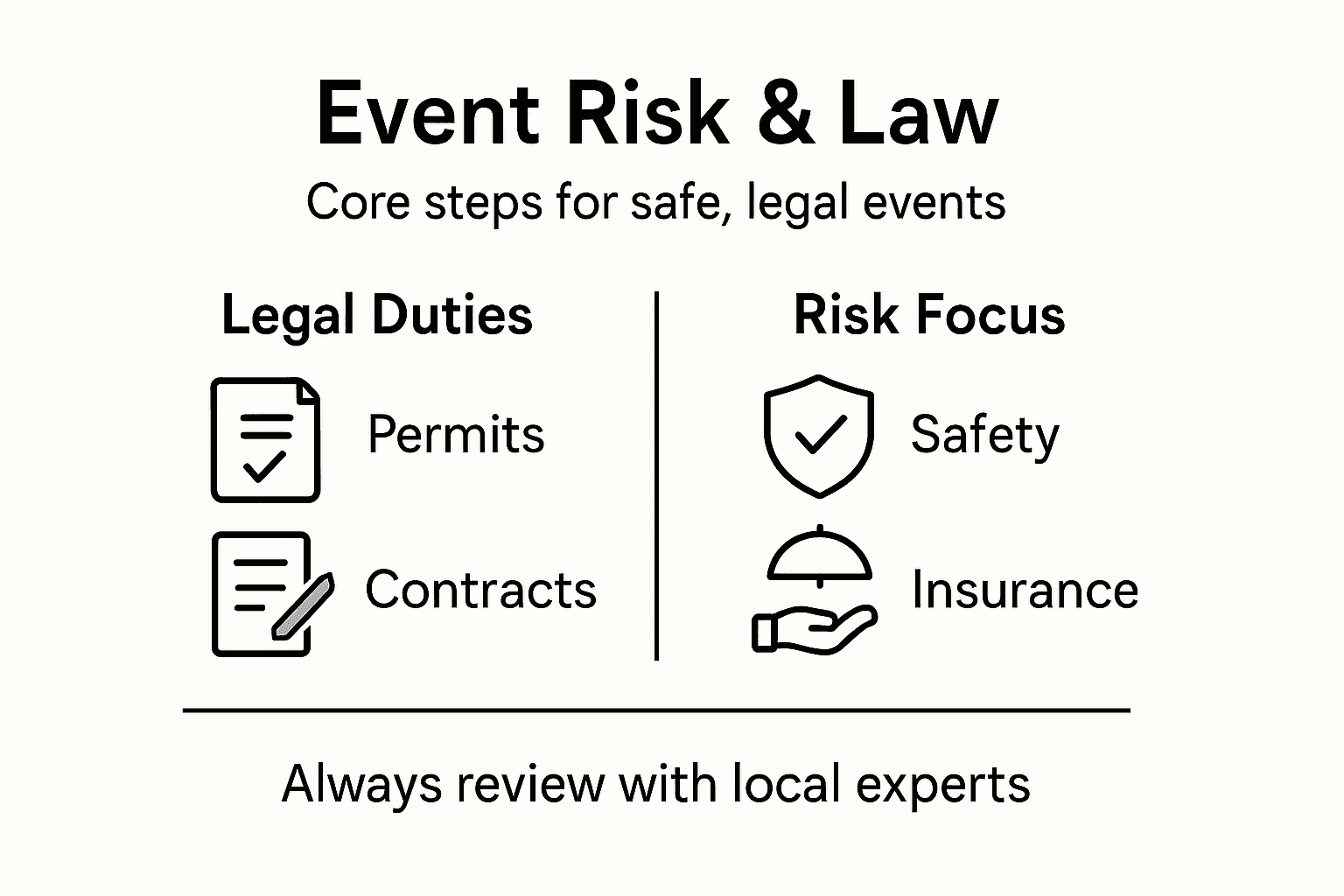
Legal obligations span multiple critical domains, including health and safety regulations, contractual responsibilities, insurance requirements, and participant protection protocols. Event managers must navigate complex regulatory landscapes that vary significantly across different jurisdictions. This involves comprehensive documentation, rigorous safety planning, and proactive risk assessment strategies. Professional event safety standards require meticulous emergency preparedness, encompassing crowd management, venue safety protocols, medical contingency planning, and comprehensive insurance coverage.
Effective risk management demands a holistic, multilayered approach that integrates legal compliance, strategic planning, and dynamic problem-solving. This includes conducting thorough venue risk assessments, developing comprehensive emergency response plans, ensuring appropriate insurance coverage, and maintaining transparent communication channels with stakeholders, local authorities, and participants. Successful event management requires anticipating potential risks, developing robust mitigation strategies, and maintaining the flexibility to adapt to unexpected challenges while maintaining legal and ethical standards.
Professional Insight: Develop a comprehensive risk management matrix that systematically documents potential scenarios, mitigation strategies, and response protocols well in advance of your event.
Financial Considerations and Common Pitfalls
Financial management represents a critical cornerstone of successful event planning, demanding precision, strategic foresight, and meticulous attention to detail. Modern event management requires sophisticated financial strategies that extend beyond traditional budgeting approaches, incorporating dynamic resource allocation and comprehensive risk assessment.
Event financial planning encompasses multiple complex dimensions, including budget development, vendor negotiations, revenue forecasting, and contingency management. Common pitfalls frequently emerge from inadequate financial preparation, such as underestimating expenses, failing to establish robust contingency funds, and overlooking contractual nuances that can significantly impact financial outcomes. Practical financial management involves comprehensive expense tracking and proactive risk mitigation strategies that anticipate potential financial challenges before they materialise.
Successful financial management in event planning requires a holistic approach that integrates detailed forecasting, transparent communication with stakeholders, and adaptive budgeting techniques. This involves developing comprehensive financial models that account for variable expenses, potential market fluctuations, and unexpected contingencies. Sophisticated event managers must balance creative vision with financial prudence, ensuring that every monetary decision supports the event’s strategic objectives while maintaining fiscal responsibility and long-term sustainability.
Professional Insight: Develop a dynamic financial tracking system that allows real-time budget monitoring and provides immediate alerts for potential financial deviations.
Elevate Your Event Experience with Expert Planning
Transforming an event from a simple gathering into a strategic and memorable experience requires more than just logistics. As detailed in “Event Management Explained: Transforming Experiences,” managing complex elements such as audience engagement, risk mitigation, and financial precision is essential. At Winelands Function, we understand the critical importance of combining strategic vision with meticulous execution to create events that resonate deeply with every attendee.
Whether you are planning a high-end corporate launch, an intimate wedding, or a bespoke celebration, our team specialises in personalised service that aligns perfectly with your unique objectives. Explore how our luxury offerings deliver on the promise of emotional engagement and flawless coordination by visiting Winelands Function and discover the art of creating meaningful, unforgettable moments.
Are you ready to take your event to the next level and ensure every detail embodies excellence and sophistication

Unlock the full potential of your event planning strategy with Winelands Function. Contact us today and start crafting a seamless event journey that blends creativity, precision, and reliability. Visit plan your luxury event now and let us transform your vision into reality.
Frequently Asked Questions
What is the primary role of an event manager?
The primary role of an event manager is to conceptualise, design, and execute events that create meaningful and memorable experiences for attendees, going beyond simple planning to include strategic design and effective execution.
What are the key phases in the event management process?
The key phases in the event management process are initiation, planning, implementation, and closure. Each phase involves specific objectives and activities designed to ensure the successful completion of an event.
How does risk management factor into event planning?
Risk management in event planning involves identifying potential challenges, ensuring legal compliance, and developing proactive strategies to mitigate risks related to safety, finances, and organisational reputation.
What are the common pitfalls in event financial management?
Common pitfalls in event financial management include underestimating expenses, failing to establish contingency funds, and overlooking contractual details that can impact overall financial outcomes.
Recommended
- Roles in Event Management: Elevating Luxury Events – Winelands Function – For Every Occasion, Your Celebration
- Understanding the Event Design Workflow for Stunning Events – Winelands Function – For Every Occasion, Your Celebration
- Guest Experience: The Essential Guide – Winelands Function – For Every Occasion, Your Celebration
- Complete Guide to Guest Experience Enhancement – Winelands Function – For Every Occasion, Your Celebration