

Most advice about british luxury event management overlooks the powerful impact of hyper-personalisation in Cape Town’s most exclusive gatherings. For affluent planners and corporate leaders, executing flawless weddings or high-profile functions requires more than just ambition. With nearly 90 percent of premier events now demanding bespoke details and seamless guest experiences, mastering the latest insights ensures your celebration stands among the world’s elite. Discover what distinguishes truly remarkable events from the ordinary.
Table of Contents
- Event Management Defined For Luxury Events
- Distinctive Types Of High-End Functions
- The Event Planning Process Unveiled
- Legal, Safety And Regulatory Essentials
- Key Challenges And Risk Management
Key Takeaways
| Point | Details |
|---|---|
| Luxury Event Management | Encompasses meticulous planning and strategic execution to exceed client expectations through immersive experiences. |
| Distinctive Event Types | Features unique approaches for corporate events, weddings, product launches, and gala celebrations, each requiring specialised expertise. |
| Risk Management | Necessitates comprehensive strategies to address logistical, financial, reputational, and legal challenges to ensure seamless execution. |
| Proactive Preparation | Emphasises the importance of developing contingency plans and maintaining rigorous documentation to navigate potential disruptions effectively. |
Event Management Defined for Luxury Events
Luxury event management represents a sophisticated professional discipline that orchestrates extraordinary experiences through meticulous planning, strategic execution, and unparalleled attention to detail. Unlike standard event coordination, luxury event management transforms gatherings into immersive narratives that engage all sensory dimensions while meeting the exacting standards of discerning clientele. Event management principles from international research demonstrate that successful luxury experiences require deep understanding of both strategic frameworks and nuanced client expectations.
At its core, luxury event management encompasses a comprehensive approach that integrates multiple disciplines including project management, creative design, hospitality, logistics, and psychological understanding of client desires. Strategic portfolio management becomes critical in this context, ensuring each element harmonises seamlessly to create a cohesive, memorable experience. The interdisciplinary approach to event portfolio management highlights the complexity of coordinating diverse stakeholder requirements while maintaining an elevated standard of excellence.
The defining characteristics of luxury event management include hyper-personalisation, anticipatory service, exclusive design elements, and flawless execution. Professionals in this field must possess a blend of technical skills and emotional intelligence, capable of translating abstract client visions into tangible, breathtaking realities. This requires not just operational expertise, but an intuitive understanding of aesthetic composition, cultural nuances, and the psychological impact of carefully curated environments.
Pro Tip for Success: Strategic Preparation Key – Always develop a comprehensive event blueprint that includes contingency plans for every potential scenario, ensuring seamless execution and the ability to adapt instantaneously to unexpected challenges.
Distinctive Types of High-End Functions
Luxury event management encompasses a diverse range of sophisticated functions, each requiring unique strategic approaches and specialised expertise. Corporate events, weddings, product launches, and gala celebrations represent the primary categories of high-end functions, each demanding intricate planning and exceptional delivery. Event portfolio management techniques reveal the critical importance of understanding the nuanced requirements inherent in different event genres, ensuring tailored experiences that exceed client expectations.
Corporate high-end functions typically include international conferences, executive retreats, brand activation events, and milestone celebrations. These events demand precise logistical coordination, cutting-edge technological integration, and a comprehensive understanding of corporate branding strategies. Luxury wedding functions, in contrast, focus on creating deeply personalised, emotionally resonant experiences that reflect the unique narrative of each couple, incorporating bespoke design elements, exclusive venue selections, and meticulously curated guest experiences.
Product launch and brand showcase events represent another distinctive category of high-end functions, requiring a blend of theatrical presentation, strategic communication, and immersive experience design. These events often incorporate multimedia presentations, interactive technology, and carefully choreographed narratives that transform product introductions into memorable cultural moments. Advanced classification techniques demonstrate the complexity of managing such diverse event portfolios, highlighting the need for adaptive, sophisticated event management approaches.
Pro Tip for Versatility: Strategic Genre Mastery – Develop comprehensive expertise across multiple event categories, cultivating the ability to seamlessly transition between corporate, social, and cultural event requirements while maintaining an unwavering commitment to luxury standards.
Here’s a comparison of the main categories of luxury events and the specialist focus required for each:
| Event Type | Core Focus | Specialist Expertise |
|---|---|---|
| Corporate Functions | Brand positioning | Advanced logistics, tech setup |
| Luxury Weddings | Emotional personalisation | Design curation, guest journey |
| Product Launches | Immersive storytelling | Multimedia, strategic comms |
| Gala Celebrations | Prestigious experiences | Hospitality, protocol mastery |
The Event Planning Process Unveiled
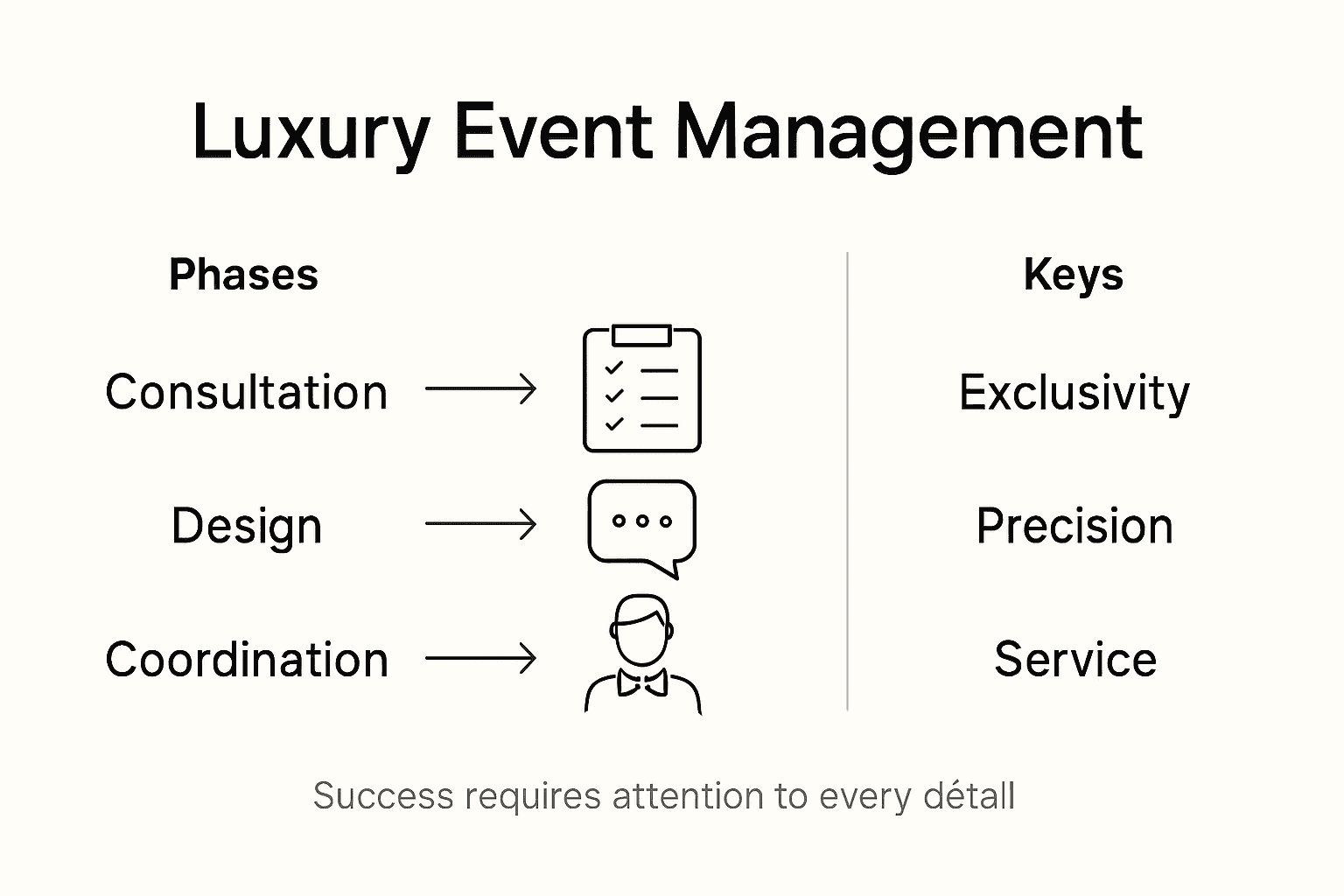
Luxury event planning represents a meticulously structured journey that transforms abstract concepts into extraordinary experiences, requiring comprehensive strategic thinking and precision execution. Comprehensive event management frameworks reveal a sophisticated multi-stage approach that encompasses initial conceptualisation, strategic design, detailed coordination, and flawless implementation. This intricate process demands not just technical expertise, but a holistic understanding of client expectations, aesthetic sensibilities, and logistical complexities.
The event planning process typically unfolds through several critical stages. Initial consultation involves deep client engagement, where event professionals conduct thorough discovery sessions to understand precise vision, preferences, and emotional narratives. Design conceptualisation follows, where creative teams develop comprehensive visual and experiential blueprints that translate client aspirations into tangible design concepts. Detailed project planning then emerges, involving precise timeline development, vendor selection, budget management, and intricate logistical coordination.

Advanced event portfolio management techniques underscore the importance of interdisciplinary integration throughout the planning process. This approach recognises that luxury events require synthesising multiple professional disciplines – from creative design and hospitality management to technological integration and psychological understanding of client experiences. Successful execution demands continuous communication, adaptive problem-solving, and an unwavering commitment to exceeding client expectations through every planning stage.
Pro Tip for Precision: Strategic Foresight Mastery – Develop a comprehensive contingency planning approach that anticipates potential challenges, creating flexible yet detailed backup strategies for every critical event element.
Legal, Safety and Regulatory Essentials
Luxury event management demands rigorous attention to legal, safety, and regulatory frameworks that protect both organisers and participants. International sustainability standards for event management provide comprehensive guidelines that encompass critical aspects of risk mitigation, legal compliance, and ethical event production. These standards establish a sophisticated approach to managing potential vulnerabilities while maintaining the highest levels of professional integrity and client protection.
Key legal considerations include comprehensive liability insurance, detailed contractual agreements, venue-specific regulatory compliance, and thorough risk assessment protocols. Event professionals must navigate complex legal landscapes that involve multiple stakeholders, including vendors, venues, performers, and guests. This requires meticulous documentation, clear communication of responsibilities, and proactive management of potential legal challenges. Regulatory compliance extends beyond mere paperwork, encompassing health and safety regulations, accessibility requirements, alcohol licensing, noise restrictions, and emergency preparedness standards.
Advanced event chain methodology techniques offer sophisticated approaches to identifying and managing potential risks throughout the event lifecycle. These analytical frameworks enable event professionals to create comprehensive contingency plans, anticipate potential disruptions, and develop adaptive strategies that ensure seamless event execution while maintaining strict adherence to legal and safety requirements. The methodology involves detailed network analysis, allowing for precise mapping of potential risks and developing targeted mitigation strategies.
Pro Tip for Legal Preparedness: Comprehensive Documentation Strategy – Develop a robust digital and physical documentation system that centralises all legal agreements, insurance documents, and risk management protocols, ensuring instant accessibility and comprehensive protection for every event scenario.
Key Challenges and Risk Management
Luxury event management confronts a complex landscape of potential risks and challenges that demand sophisticated, proactive strategies for mitigation and resolution. Advanced cross-city visitor flow analysis reveals the intricate dynamics of managing large-scale events, highlighting the critical importance of understanding potential disruptions and developing comprehensive risk management approaches that anticipate and neutralise potential complications before they escalate.
The primary challenges in luxury event management encompass multiple interconnected domains. Logistical complexities include precise venue coordination, vendor management, technological integration, and seamless guest experience curation. Financial risks involve budget management, unexpected expenditure, and maintaining profitability without compromising event quality. Reputational risks represent perhaps the most delicate challenge, where any minor deviation from expected standards can potentially damage long-term professional credibility and client relationships.
Utilising event chain methodology techniques provides event professionals with a robust framework for systematic risk identification and management. Uncertainty modelling becomes crucial in developing adaptive strategies that can quickly respond to unexpected scenarios. This approach involves creating detailed risk matrices, developing multiple contingency plans, and establishing flexible communication protocols that enable rapid decision-making during potential disruption scenarios. The methodology emphasises creating resilient event frameworks that can absorb and adapt to unexpected challenges while maintaining the highest standards of client experience.
Pro Tip for Risk Mitigation: Strategic Scenario Planning – Develop a comprehensive digital risk management dashboard that continuously maps potential challenges, assigns probability ratings, and creates pre-emptive mitigation strategies for each identified risk scenario.
The table below summarises key risk domains in luxury event management and suggested mitigation strategies:
| Risk Category | Common Challenge | Recommended Mitigation Approach |
|---|---|---|
| Logistical | Venue or vendor disruption | Detailed timeline, backup vendors |
| Financial | Unexpected costs | Contingency fund, regular reviews |
| Reputational | Service failure | Real-time problem solving, staff training |
| Legal/Regulatory | Non-compliance or incidents | Ongoing compliance checks, documentation |
Elevate Your Luxury Event with Expert Planning and Seamless Execution
Luxury event management demands precision, strategic foresight and an unwavering commitment to excellence—qualities that every discerning client seeks when crafting unforgettable experiences. The challenges of detailed logistics, bespoke design and risk mitigation highlighted in the article call for expert guidance to transform your vision into reality without compromise. At Winelands Function, we understand the importance of hyper-personalisation and flawless execution, offering services tailored to sophisticated weddings, corporate functions and bespoke celebrations throughout Cape Town.
Why trust Winelands Function?
- Deep expertise in managing complex event portfolios ensures every detail harmonises seamlessly
- Strategic contingency planning guarantees your event runs smoothly despite unexpected challenges
- Commitment to legal compliance and safety lets you enjoy your event with confidence
Discover how our luxury event planning services can bring your extraordinary event to life with ease and elegance. Visit Winelands Function now to start your journey towards a meticulously curated celebration defined by sophistication and personalised service. Reach out today for a consultation that prioritises your unique vision and delivers exceptional results.
Frequently Asked Questions
What is luxury event management?
Luxury event management is a professional discipline that focuses on creating extraordinary experiences through meticulous planning, strategic execution, and attention to detail. It transforms gatherings into immersive narratives that meet the high expectations of discerning clients.
What are the key characteristics of luxury events?
Key characteristics include hyper-personalisation, anticipatory service, exclusive design elements, and flawless execution. Professionals in this field blend technical skills with emotional intelligence to turn abstract client visions into breathtaking realities.
What types of functions fall under luxury event management?
Luxury event management encompasses various high-end functions, including corporate events, weddings, product launches, and gala celebrations. Each category requires unique planning strategies and specialised expertise to ensure an exceptional experience.
How does the planning process for luxury events differ from standard events?
The planning process for luxury events involves comprehensive strategic thinking and multiple stages, including initial consultation, design conceptualisation, and detailed coordination. It requires a holistic understanding of client expectations, aesthetic sensibilities, and logistical complexities to create extraordinary experiences.
Recommended
- Understanding What Makes an Event Luxury – Winelands Function – For Every Occasion, Your Celebration
- Complete Guide to Guest Experience Enhancement – Winelands Function – For Every Occasion, Your Celebration
- High-End Event Production: Creating Unforgettable Experiences – Winelands Function – For Every Occasion, Your Celebration
- What is a Curated Event Experience? An In-Depth Explanation – Winelands Function – For Every Occasion, Your Celebration