
TL;DR:
- A corporate gala planning workflow is a structured process that guides event creation from objectives to post-event review. Coordinating multiple vendors and investing in production elements is essential for guest experience and success. Starting 12 months in advance and following defined phases ensures a polished and memorable event.
A corporate gala planning workflow is the structured series of coordinated steps that takes an event from initial concept through to post-event analysis, covering every production, logistical, and guest experience decision along the way. Planners who treat this process as a formal discipline, rather than a loose checklist, consistently deliver galas that feel effortless to guests and measurable to executives. The workflow matters because a high-end gala involves 10–20 specialist vendors across production, catering, AV, entertainment, and security, all of whom must operate in precise sequence. Get the structure right and every detail falls into place. Miss a phase and the gaps show on the night.
What are the key phases of a corporate gala planning workflow?
The gala planning process, known in the industry as event production management, follows nine distinct phases. Each phase has a defined owner, a deadline, and a set of deliverables. Skipping or compressing any phase creates risk that compounds as the event date approaches.
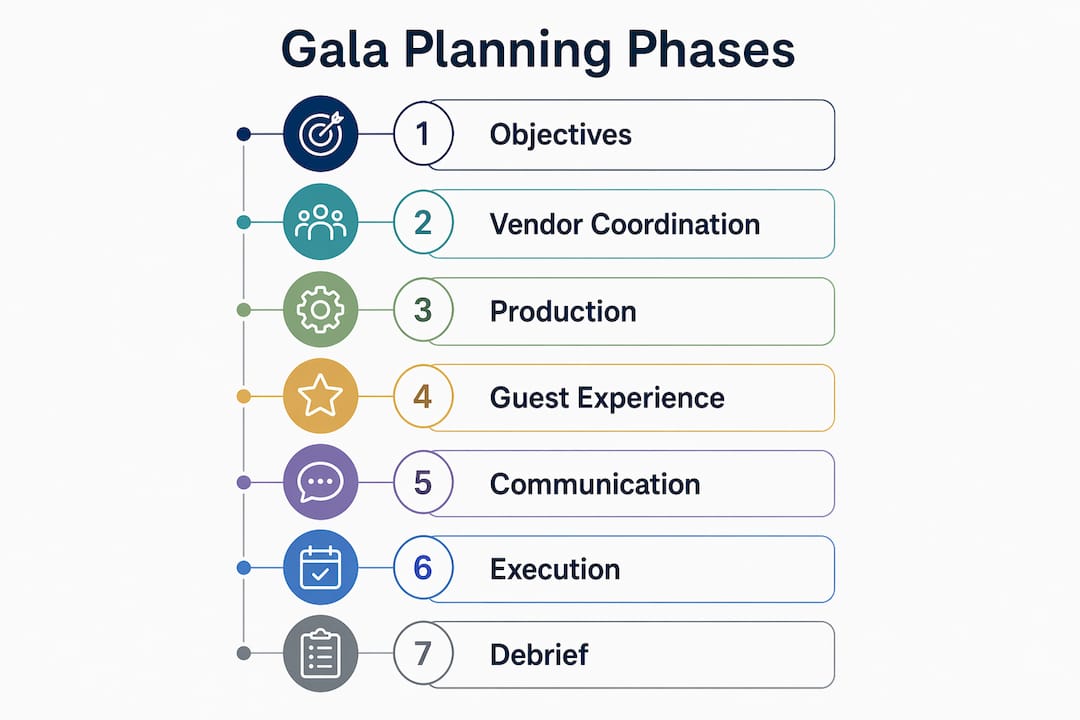
A detailed milestone timeline starting 12 months out is the single most effective tool for keeping all phases on track. That timeline becomes the backbone of every team meeting and vendor conversation.
| Phase | Description | Recommended lead time |
|---|---|---|
| 1. Objectives and outcomes | Define measurable goals: attendance, media coverage, business outcomes | 12 months |
| 2. Budget and resource allocation | Set total budget, allocate by category, build contingency fund | 11 months |
| 3. Venue selection and site assessment | Shortlist, inspect, and contract the venue | 10 months |
| 4. Creative theme and design direction | Agree on visual identity, colour palette, and décor concept | 9 months |
| 5. Entertainment and programme scheduling | Book headline acts, speakers, and emcee | 8 months |
| 6. Invitations and guest management | Issue formal invitations with dress code at least 6 weeks in advance | 6 weeks before event |
| 7. Run-of-show and technical rehearsals | Finalise minute-by-minute production document and rehearse | 2 weeks before event |
| 8. Day-of execution and coordination | Manage load-in, set-up, and live event delivery | Event day |
| 9. Post-event analysis and reporting | Debrief within 2 weeks, review data, document lessons | Within 2 weeks after |
Pro Tip: Book your venue before finalising your entertainment. Acoustic properties, ceiling height, and load-in access all determine which production elements are actually feasible.
The objectives phase is where most planners underinvest. Vague goals like “impress stakeholders” produce vague results. Define attendance numbers, target media mentions, and specific business outcomes before a single supplier is contacted. Every subsequent decision then has a clear filter.
How does vendor coordination and production management enhance gala workflow?
Coordinating 10–20 specialist vendors is the operational core of any high-end gala. Each vendor operates on their own schedule and communicates in their own format, which creates friction unless the lead planner imposes a single communication protocol from the outset.

The production layer is what separates a corporate gala from a standard dinner. Lighting, staging, and sound design require specialist investment that standard hotel packages rarely cover. This is where budgets escalate and where the guest experience is most visibly shaped.
| Vendor type | Role | Critical timing |
|---|---|---|
| Event production company | Overall production design and technical direction | Contracted 9 months out |
| Caterers | Menu design, service flow, dietary management | Contracted 8 months out |
| AV and lighting specialists | Sound, lighting rigs, screens, and control systems | On-site 8–12 hours before event |
| Entertainment | Headline acts, bands, speakers | Contracted 8 months out |
| Decorators | Floral, table design, and thematic installations | On-site 6–8 hours before event |
| Security and transport | Guest safety, VIP transfers, and crowd management | Briefed 2 weeks before event |
Production teams require full venue access 8–12 hours before the event starts. That window covers stage construction, rigging, sound checks, and lighting programming. Any venue contract that does not guarantee this access creates a production risk that no amount of planning can fully mitigate.
Sound quality is the single point of failure most frequently cited by post-event surveys. Professional external sound engineers consistently outperform in-house hotel AV teams in large ballrooms because they bring calibrated equipment and room-specific tuning expertise. Budget for this from the start rather than treating it as an optional upgrade.
Pro Tip: Assign one named point of contact per vendor and require all day-of communication to pass through a single production manager using intercoms or a shared radio channel. This eliminates the crossed-wires confusion that derails even well-planned events.
For gala styling inspiration that complements your production direction, corporate décor ideas from specialist designers can sharpen your theme brief before you brief your decorator.
What are the essential elements of the gala programme and guest experience flow?
The programme is the guest’s lived experience of the event. A poorly sequenced programme drains energy from the room regardless of how impressive the production looks. The goal is to build momentum, not fill time.
Speeches are the element most likely to derail a gala. Limit speeches to 3–4 sessions of 3–5 minutes each and brief every speaker on their exact time allocation in writing. An emcee who can gracefully cut a speaker short is worth every penny of their fee.
- Arrival and drinks reception: 45–60 minutes for networking before guests are seated
- Welcome address: 3–5 minutes maximum, sets tone and acknowledges key guests
- Starter and first entertainment segment: Live music or ambient performance during service
- Main course: The longest uninterrupted dining window; avoid speeches during service
- Toasts: After the main course, before dessert to maintain momentum and focus
- Headline entertainment: Post-dessert, when energy peaks again after the meal
- Closing remarks and farewell: Brief, warm, and timed to the minute
Lighting and audio cues signal segment changes without the emcee needing to announce every transition. A shift from warm amber to cooler white light tells guests that a speech is beginning. A music fade signals that dinner service is resuming. These cues reduce the verbal clutter that makes programmes feel laboured.
The formal dress code does more than set appearance standards. It signals the event’s seriousness and shapes guest conduct from the moment they arrive. Specify black tie or formal attire on the invitation, not in a follow-up email, so guests have adequate preparation time.
Pro Tip: Walk the seating plan with your emcee before the event. Identify which tables are furthest from the stage and adjust microphone levels and sightlines accordingly. Guests who cannot see or hear disengage quickly.
Seating arrangements deserve as much attention as the programme itself. Round tables of 8–10 guests placed within clear sightlines of the stage create natural conversation clusters while keeping the room connected to the main action. Read more about corporate event best practices for high-end seating and staging configurations.
Which tools and communication strategies optimise the gala planning process?
The run-of-show document is the master blueprint that synchronises every team on the night. For a 500-person gala, this document typically runs 15–20 pages and covers every lighting cue, sound transition, catering beat, and entertainment entry point, minute by minute. Every vendor lead receives a copy and is expected to follow it without deviation unless the production manager authorises a change.
Digital RSVP systems replace paper-based guest lists and give planners real-time attendance data. Platforms such as Eventbrite, Cvent, and RSVPify allow dietary requirement collection, table assignment, and name badge generation from a single database. This removes the last-minute scramble that plagues manual guest management.
- Task management tools: Asana, Monday.com, or Notion for tracking milestone completion across the planning team
- Guest management platforms: Cvent or Eventbrite for RSVP tracking, dietary flags, and seating allocation
- Communication protocols: Dedicated radio channels or intercom systems for day-of production coordination
- Checklist templates: Phase-by-phase checklists reviewed at weekly progress meetings
- Post-event survey tools: Typeform or SurveyMonkey for structured guest feedback within 48 hours of the event
Pro Tip: Send your post-event survey within 24–48 hours while the experience is fresh. Response rates drop sharply after 72 hours, and the qualitative feedback you lose is exactly what you need to improve the next event.
The event planning process for a high-end gala also benefits from a shared cloud folder structure where every vendor can access the latest run-of-show, floor plan, and contact list without requesting it from the planner directly. This single change eliminates dozens of email threads in the final two weeks before the event.
How to apply the gala planning workflow for efficient, elevated outcomes
Starting 12 months out is not excessive for a gala of 300 or more guests. The best venues, headline acts, and specialist vendors book up quickly, and late engagement means compromising on quality or paying premium rates for availability. Build your planning calendar backwards from the event date and assign a named owner to every milestone.
- Set objectives before anything else. Attendance targets, media goals, and business outcomes must be agreed by the executive sponsor before venue search begins.
- Build a contingency fund of 10–15% of total budget. Production costs, in particular, escalate when technical requirements exceed initial estimates.
- Establish a decision-making hierarchy. Identify who has final sign-off on venue, creative direction, and programme changes. Ambiguity here causes delays that cascade through the entire timeline.
- Hold fortnightly progress meetings with the core planning team and monthly check-ins with key vendors from 6 months out.
- Conduct a full guest journey walkthrough of the venue, covering parking, entrance, sightlines, and acoustic dead zones, at least two weeks before the event.
- Run a formal technical rehearsal with all AV, lighting, and entertainment teams present. This is where timing errors, sound problems, and staging conflicts surface safely.
- Debrief within 2 weeks post-event. A structured post-event review covering attendance, media coverage, and guest feedback creates the institutional knowledge that makes each subsequent gala better than the last.
Pro Tip: Simulate the guest journey yourself on the day of the walkthrough. Arrive at the car park, follow the signage, find your seat, and check the sightline to the stage. You will find at least three things that need fixing.
For a deeper look at what defines a corporate gala and how planning standards differ from other corporate events, the distinction between a gala and a standard dinner is worth understanding before you begin.
Key takeaways
A corporate gala planning workflow succeeds when objectives are defined first, production is treated as a non-negotiable investment, and every phase has a named owner and a firm deadline.
| Point | Details |
|---|---|
| Start 12 months out | Book venue and key vendors early; late engagement means compromised quality or inflated costs. |
| Production layer is non-negotiable | Lighting, staging, and sound design define the guest experience and must be budgeted from the outset. |
| Run-of-show document is the master tool | A 15–20 page minute-by-minute blueprint synchronises every vendor and eliminates day-of confusion. |
| Guest journey walkthrough is critical | Walk the full guest route at least two weeks before the event to identify bottlenecks and acoustic issues. |
| Debrief within two weeks | A structured post-event review within 14 days captures the data and feedback needed to improve future galas. |
What I have learned from planning high-end galas
The production layer is where the real work happens, and it is the part most executives underestimate when they first see the budget. Every time I have seen a gala fall short of expectations, the cause traces back to one of two things: a compressed production timeline or a decision to use the venue’s in-house AV team to save money. Both choices cost more in reputation than they save in rands.
The guest journey walkthrough is the step I defend most fiercely when timelines get tight. Planners who skip it always discover something on the night that a 90-minute walkthrough would have caught. Acoustic dead zones, a registration desk that creates a bottleneck at arrival, a stage that half the room cannot see clearly. These are fixable problems before the event and embarrassing ones during it.
Programme discipline is the other area where I push back hardest. Executives often want more speeches. The data, and the room, consistently say otherwise. Three to four speeches of five minutes each is the ceiling. Beyond that, you are testing guest patience, not honouring your speakers.
The planners who consistently deliver exceptional galas share one trait: they treat the workflow as a living document, not a template. They adapt it to the venue, the guest profile, and the event objectives. They also build genuine relationships with their specialist vendors, which means those vendors go the extra mile when something unexpected happens on the night. That relationship capital is not on any checklist, but it is what separates good events from great ones.
— Coert
Winelandsfunction’s approach to corporate gala management
Winelandsfunction brings a full-service approach to luxury gala event management that covers every phase of the planning workflow, from initial concept and objective setting through to post-event analysis and reporting.
The Winelandsfunction team coordinates multidisciplinary vendor teams across production, catering, AV, entertainment, and guest experience design, applying the same structured workflow outlined here to every event. For planners and executives who want a step-by-step luxury event workflow built around their specific objectives, Winelandsfunction offers personalised consultations from its Cape Town base, serving both local and international clients. Contact the team to discuss your next corporate gala.
FAQ
What is a corporate gala planning workflow?
A corporate gala planning workflow is the structured, phase-by-phase process that takes an event from objective setting through to post-event debrief, covering budgeting, vendor coordination, programme design, and production management.
How far in advance should corporate gala planning begin?
Planning should begin 12 months before the event date for galas of 300 or more guests. This lead time secures preferred venues, specialist vendors, and headline entertainment before availability closes.
How many speeches should a corporate gala programme include?
Limit speeches to 3–4 sessions of 3–5 minutes each. Exceeding this threshold reduces audience engagement and disrupts the energy of the evening.
Why is a run-of-show document necessary for a corporate gala?
A run-of-show document coordinates every production element minute by minute. For a 500-person event, this document runs 15–20 pages and serves as the single source of truth for all vendor teams on the night.
When should the post-event debrief take place?
The post-event debrief should occur within 2 weeks of the gala. This window captures accurate data on attendance, media coverage, and guest feedback before institutional memory fades.
Recommended
- Mastering Corporate Event Workflow for Seamless Success – Winelands Function – For Every Occasion, Your Celebration
- Corporate Event Preparation Guide for Elegance and Impact – Winelands Function – For Every Occasion, Your Celebration
- What defines a corporate gala: a complete guide – Winelands Function – For Every Occasion, Your Celebration
- Corporate event workflow guide: plan high-end events with ease – Winelands Function – For Every Occasion, Your Celebration