

Set your wedding ceiling first, divide what’s left of your timeline into months, then automate the transfer before you can spend it elsewhere. Venue, catering, and guest count decide most of your final bill, so trim there before touching flowers or favours. Build a 10–15% contingency buffer into the ceiling from day one, because vendors, gratuities, and last-minute extras always find a way in.
TL;DR:
- Prioritize reducing venue and catering costs by trimming guest numbers, booking off-peak dates, and choosing non-traditional or shared venues to cut expenses significantly.
- Set a realistic wedding ceiling based on local quotes, and automate monthly savings transfers into a dedicated account rather than relying on spontaneous or leftover funds.
- Build a contingency buffer of 10–15 percent into your budget to cover vendor fees, gratuities, and unforeseen expenses without risking debt.
- Focus on guest-facing categories like food, drinks, and photography for meaningful savings, while making small, invisible cuts in stationery and decor to preserve overall experience.
- Avoid borrowing for the wedding by adjusting your timeline, ceiling, or savings tactics, since interest on loans rarely benefits long-term financial health.
Table of Contents
- How to set a realistic wedding budget and calculate your monthly savings target
- The biggest cost drivers: venue, catering and guest count
- Practical saving tactics by category
- How to save for the wedding: accounts, automation and side income
- Credit, loans and financing: safe uses and long-term risks
- A 12–18 month timeline for saving and booking vendors
- Practical tips from experienced planners
- Tips for involving family members in contributing to the wedding fund
- Strategies for supplementing savings through side income or selling items
- Tracking and adjusting your savings progress over time
- Balancing splurges and savings without losing what matters
- How Winelandsfunction helps you protect your budget and avoid costly mistakes
- Sources
- FAQ
How to set a realistic wedding budget and calculate your monthly savings target
Your wedding ceiling is the single number everything else depends on, and it should come from three sources: what you already have saved, what family has offered to contribute, and what you can realistically put aside before the date. Guessing at a figure and hoping the maths works out is how couples end up with credit card balances they didn’t plan for.
Start with local reality. UK wedding costs reported in 2025 sat around £20,600 to £21,990 on average, and a 100-guest wedding typically lands between £15,000 and £25,000 depending on region and supplier tier. Those figures are a starting reference, not a target. Your own ceiling should reflect actual quotes from your area, not a national average.
Once you have a ceiling, the formula is straightforward:
(Total ceiling − current savings − confirmed family contributions) ÷ months remaining = monthly savings target
Two worked examples show how much timeline matters:
| Scenario | Ceiling | Already saved | Months remaining | Monthly target |
|---|---|---|---|---|
| 18-month plan | £20,000 | £2,000 | 18 | £1,000 |
| 12-month plan | £20,000 | £2,000 | 12 | £1,500 |
A monthly savings planner puts it in similar terms: saving £20,000 over 18 months works out to roughly £1,111 a month, while the same total over 12 months pushes that closer to £1,667. The gap between those two numbers is the real argument for starting early. Six months of extra runway can lower your monthly burden by a third.
Once you have your target, allocate it properly rather than letting spending drift category by category. A widely used framework recommends putting 85–90% of the ceiling into named categories, holding back 10–15% purely as contingency. That reserve exists because vendors add fees, gratuities creep up, and small extras appear that nobody budgeted for at the outset.
A basic allocation might look like this before you fine-tune it:
- Venue and catering: 30–35% of the ceiling
- Attire, hair, and beauty: 8–10%
- Photography and videography: 10–12%
- Flowers and decor: 8–10%
- Music and entertainment: 8–10%
- Stationery, favours, and miscellaneous: 5–8%
- Contingency buffer: 10–15%
If your monthly target comes out higher than your household can comfortably manage, don’t quietly resign yourself to debt. Adjust one of three levers: push the date further out to lower the monthly figure, lower the ceiling itself, or increase what you’re saving through the tactics later in this guide. All three are better than treating the shortfall as tomorrow’s problem.
The biggest cost drivers: venue, catering and guest count
Venue and catering together typically account for 30–35% of the total wedding ceiling, which makes this the category worth attacking first. Cutting £500 from your stationery order feels productive, but it’s a rounding error next to what a smarter venue choice or a trimmed guest list can save.
Guest count drives cost with brutal simplicity: catering, favours, invitations, and often venue minimums are all priced per head. Cut your list from 150 to 100 guests and you’re not just saving on fifty dinners. You’re often dropping a tier of venue minimum spend, needing a smaller room, and ordering less of everything else that scales with numbers.
A quick example: if catering runs £85 per head, trimming 50 guests saves £4,250 before you’ve touched a single other line item. That’s often more than the entire flowers and decor budget for a mid-sized wedding.
Beyond guest count, a handful of choices move the needle more than any amount of haggling over centrepieces:
- Weekday or off-peak dates. Friday and Sunday weddings, or ceremonies held outside peak summer months, routinely come with lower venue rates and more negotiating room.
- One venue for ceremony and reception. Splitting the two means paying two site fees, hiring two sets of staff, and often covering transport between locations.
- Non-traditional venues. A restaurant, a private garden, or a working farm can undercut a dedicated wedding venue while giving you a setting nobody else’s wedding looks like.
- Buffet or family-style service instead of plated dinners. Planner and finance guides consistently flag this as one of the simpler ways to shave catering costs without visibly downgrading the meal.
- A limited or cash bar. Full open bars for the entire event are one of the most expensive line items relative to guest satisfaction gained.
When you sit down with a venue coordinator, ask directly about the food and beverage minimum, whether corkage is charged if you bring your own wine, and what’s actually included in the room hire fee versus billed separately. Many couples discover the quoted “package price” excludes service charges, cake-cutting fees, or overtime staffing, and those extras can add 15–20% to the number they thought they’d agreed.
Practical saving tactics by category
Once the big three levers are locked in, category-level tactics chip away at the rest of the ceiling without anyone at the wedding noticing a downgrade. Some of these save meaningfully; others save a little but cost nothing in guest experience, which makes them worth doing regardless of scale.
- Attire. Sample sales, trunk shows, and end-of-season clearance events regularly cut gown prices by half or more compared with a full-price custom order. Hiring a suit or tuxedo rather than buying one, and considering pre-loved or resale wedding dresses, are now mainstream choices rather than compromises.
- Flowers and decor. Choosing in-season, locally grown blooms avoids the import premium that peonies or ranunculus carry out of season. Repurposing ceremony arrangements as reception centrepieces, and using rented silk or dried florals for less visible spaces, keeps the visual impact while cutting the flower bill sharply.
- Photography. Booking fewer coverage hours, choosing a talented photographer earlier in their career rather than an established name, and opting for a digital gallery instead of a printed album all reduce cost without sacrificing image quality. Photography and video together typically claim 10–12% of the ceiling, so a modest trim here compounds.
- Music and entertainment. A skilled DJ with a well-curated playlist usually costs a fraction of a live band and, for many receptions, delivers the same energy on the dance floor. If a band matters to you, consider a smaller ensemble for cocktail hour and a DJ for the reception rather than a full band all evening.
- Drinks. A limited bar (beer, wine, and one or two signature cocktails) instead of a full open bar cuts beverage costs substantially while still feeling generous to guests.
- Cake. Order a small cutting cake for photos and ceremony, paired with a sheet cake in the kitchen to actually serve. Guests rarely notice, and bakers charge considerably less per slice for sheet cake than for elaborately decorated tiers.
- Stationery. Digital invitations and RSVPs, or a hybrid approach with printed save-the-dates and digital follow-ups, remove printing, postage, and reprint costs almost entirely.
- Decor rentals. Renting statement pieces (arches, lounge furniture, lighting) instead of buying them once often costs less overall and avoids storage problems after the day.
Not every tactic carries equal weight. Guest-facing choices like the bar, cake, and flowers affect what people actually experience on the day, so trim there thoughtfully. Photography style, stationery format, and decor sourcing are largely invisible to guests once the day is underway, which makes them the easiest places to save without anyone clocking the difference. For more ideas on where Winelandsfunction typically recommends spending versus cutting, see how to cut wedding costs without cutting the joy.
How to save for the wedding: accounts, automation and side income
A dedicated wedding savings account, kept entirely separate from your everyday spending money, removes the daily temptation to dip into funds meant for a caterer’s deposit. Choosing a high-yield savings account rather than a standard current account means your balance earns meaningfully more in interest over a 12 to 18 month runway, and every pound of interest is one less pound you need to save from income.
Automating the transfer is what actually makes the plan work. Paying yourself first by setting up an automatic transfer the day your salary lands, rather than saving whatever happens to be left at month end, consistently produces better results because it removes willpower from the equation entirely.
A few practical structures worth setting up:
- Payday transfers. Schedule the transfer for the same day wages arrive, before other spending has a chance to compete for the money.
- Weekly or biweekly splits. If your income arrives more than once a month, smaller, more frequent transfers feel less disruptive than one large monthly hit.
- Sinking funds for specific payments. Rather than one lump sum, create separate mini-funds for the venue deposit, the second payment, and the final balance, so each due date has its own ring-fenced money waiting.
- Temporary spending cuts. Pausing subscriptions, cooking at home more often, or delaying a non-essential purchase for a few months can free up £100–£200 monthly without any lasting lifestyle change.
- Side income. Freelance work, weekend shifts, selling unused items, or tutoring can add a dedicated stream that goes straight into the wedding fund rather than blending into general income.
A buffer is not optional. A 10–15% contingency reserve built into your ceiling absorbs the vendor add-ons, gratuities, and small extras that appear almost without exception as the date approaches.
Set milestones along the way rather than waiting for the final total to check progress.
Credit, loans and financing: safe uses and long-term risks
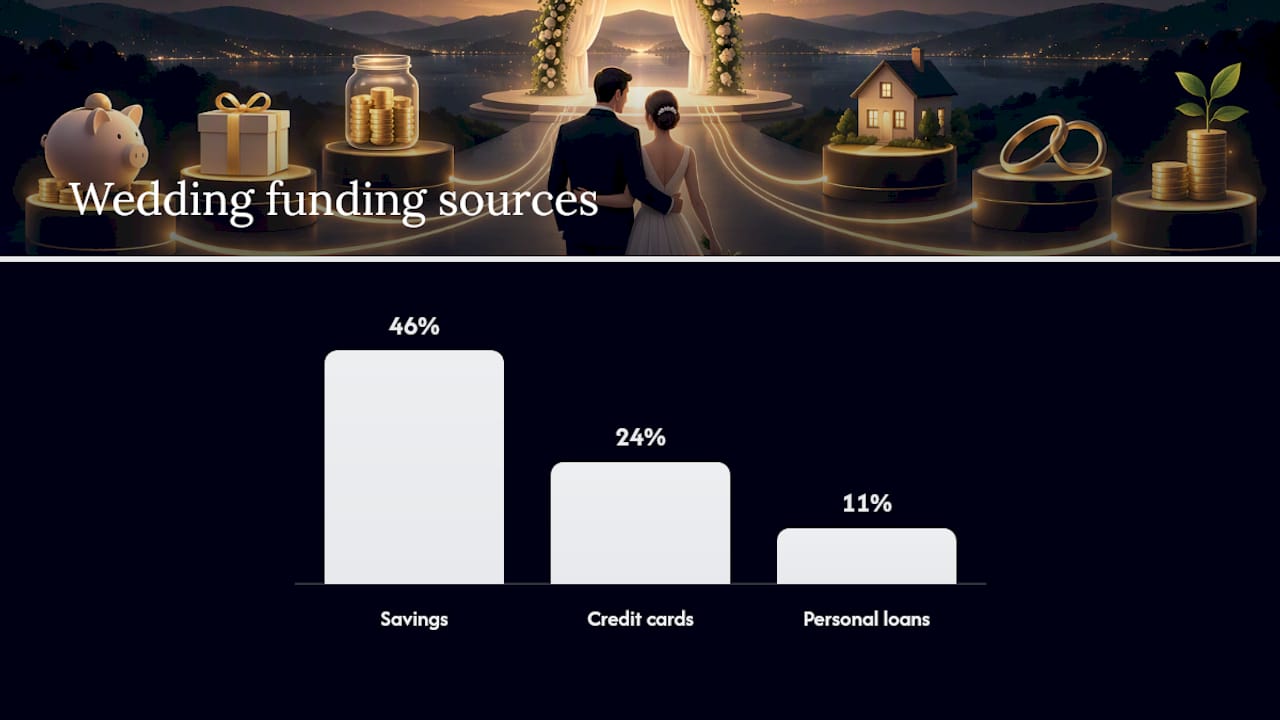
Borrowing for a wedding is common, but that doesn’t make it free. A 2025 LendingTree survey found that 67% of newlyweds took on some form of debt to cover their wedding, with funding split across 46% savings, 24% credit cards, and 11% personal loans. The prevalence of borrowing doesn’t mean it’s the cheapest route. It usually means the ceiling was set too high for the timeline available.
Interest-bearing debt on a one-off event is a genuinely different risk than debt taken for something that generates ongoing value, like a home. Every pound of interest paid on a wedding loan is money that produces no lasting benefit once the day is over, and that cost compounds the longer the balance sits unpaid.
If you do use credit, some methods carry meaningfully less risk than others:
- 0% APR promotional credit cards, used only with a firm, written payoff plan before the promotional period ends, can bridge a short-term gap without costing extra.
- Short-term personal loans are workable if you have a strong credit score and a clear, realistic repayment schedule, since advisors note that scores below roughly 670 typically attract higher rates, which increases the total cost of borrowing significantly.
- Vendor card surcharges often get overlooked. Many suppliers add 1.5–3% for card payments, which quietly inflates your bill if you’re paying every invoice by credit card.
- Wedding insurance protects against supplier failure, extreme weather, or postponement, and is worth the modest premium relative to the financial exposure of losing a deposit.
None of this rules out borrowing entirely. It simply means treating credit as a tool with a repayment date attached, not a way to avoid setting a realistic ceiling in the first place.
A 12–18 month timeline for saving and booking vendors
Booking early does more than secure your preferred date. It locks in today’s prices before inflation or seasonal demand pushes them higher, and it gives your monthly savings target the longest possible runway to stay manageable.
- 18 months out: Set your ceiling, run the monthly savings calculation, and open your dedicated savings account with an automated transfer already scheduled.
- 15 months out: Confirm your guest list range, since this number drives venue capacity requirements and per-head catering costs.
- 12 months out: Book venue and caterer, having gathered at least three quotes per category to compare like-for-like. MoneySavingExpert’s guidance on cheaper weddings makes this three-quote habit one of its central recommendations, because pricing for the same package can vary considerably between suppliers.
- 9 to 10 months out: Secure photography, videography, and entertainment, paying deposits from your sinking funds rather than dipping into the general savings pot.
- 6 months out: Finalise attire, order invitations or set up digital RSVPs, and review your savings progress against the milestone you set at this stage.
- 3 months out: Confirm final headcount, lock in the catering order, and pay any remaining deposits due before final balances.
- 1 month out: Settle final vendor balances and confirm your contingency buffer still covers any last-minute additions.
A few habits protect your budget throughout this window:
- Compare quotes on identical terms (same hours, same headcount, same service style) rather than letting suppliers quote against different assumptions.
- Read every contract for what’s excluded, not just what’s included, since hidden fees usually live in the fine print.
- Ask about price-lock guarantees when booking more than a year ahead, since some suppliers raise rates annually.
- Treat any deadline more than three months before the wedding as flexible, but treat anything inside three months as fixed, since late changes almost always cost more.
A wedding cost checklist keeps every payment date and category spend visible in one place, which matters more than it sounds once five or six vendors are all invoicing on different schedules.
Practical tips from experienced planners
Planners spend their careers watching where couples overspend without realising it, and where a small adjustment protects the moments that actually matter on the day. The recurring pattern is reallocation, not blanket cutting: protect the categories guests remember, like photography and the food itself, and pull from areas with lower visible impact, like elaborate stationery or oversized floral installations that photograph the same as a smaller arrangement.
A few negotiation levers planners use routinely with vendors:
- Bundling services. Booking florals, decor hire, and styling through one supplier often earns a discount that separate bookings never unlock.
- Off-peak timing. Vendors frequently hold flexibility on pricing for weekday or shoulder-season dates that they won’t offer for a peak Saturday.
- Adjusting staffing levels. Reducing the number of serving staff for a buffet-style meal, rather than a fully plated service, lowers labour costs without changing the menu.
- Asking about package inclusions before requesting add-ons separately. Vendors sometimes have flexibility to fold in an extra hour or service that would cost more if quoted as a standalone add-on.
Event planners work through exactly these trade-offs with couples planning weddings in various locations, identifying where a supplier relationship or timing adjustment can protect the budget without touching what matters most to the couple. For a deeper look at where to save and where to invest, see Winelands Function’s wedding budget tips on where to save and where to splurge.
Tips for involving family members in contributing to the wedding fund
Family contributions can meaningfully shorten your savings timeline, but the conversation works better with structure than with vague hints dropped over dinner.
Be specific and early. Rather than waiting for an offer, have a direct conversation about whether family intends to contribute, and if so, roughly how much and when. Knowing a contribution is coming (and when) changes your monthly target calculation, so this conversation belongs at the very start of your budgeting process, not halfway through.
Offer choice where you can. Some families prefer contributing a lump sum toward the overall ceiling; others would rather “own” a specific category, like covering the bar or the flowers outright. Letting relatives choose a category they feel connected to often makes the contribution feel more meaningful to them, and it gives you a cleaner way to track what’s covered.
Put agreements in writing, even informally. A simple text or email confirming “Mum and Dad are covering catering up to £X” avoids awkward misunderstandings closer to the date, when memories of a casual conversation months earlier can differ.
Set a boundary on decision-making. Contributions are generous, but they shouldn’t come with an unspoken expectation of veto power over every choice. Agreeing this upfront, gently, prevents tension from surfacing later over guest list size or venue choice.
Strategies for supplementing savings through side income or selling items
Boosting your monthly contribution doesn’t always mean cutting spending further. Sometimes it means adding a new stream of income dedicated entirely to the wedding fund.
Selling unused items is the fastest starting point for most couples. Furniture, electronics, unused hobby equipment, or designer items sitting unworn in a wardrobe can generate a useful lump sum with almost no ongoing time commitment, and that money can go straight into your dedicated savings account rather than blending into everyday spending.
Freelance or gig work suits couples with a skill they can package into short-term projects: graphic design, tutoring, photography for other events, or weekend hospitality shifts. The advantage over a permanent side job is flexibility. You can scale the hours up in months where the savings target feels tight and scale back once you’re ahead of schedule.
Turning a hobby into occasional income works for some couples too. If one of you bakes, crafts, or has a skill others will pay for, even sporadic income from that skill adds up over an 18-month runway without feeling like a second job.
Whichever route you choose, route the extra income directly into the wedding account rather than your main current account. Money that passes through general spending first has a habit of quietly disappearing before it reaches its intended purpose.
Tracking and adjusting your savings progress over time
A savings plan that isn’t reviewed monthly is really just a hope with a spreadsheet attached. Check your progress against your milestone targets (25%, 50%, 75%) at least once a month, comparing actual saved balance against where your monthly plan said you’d be.
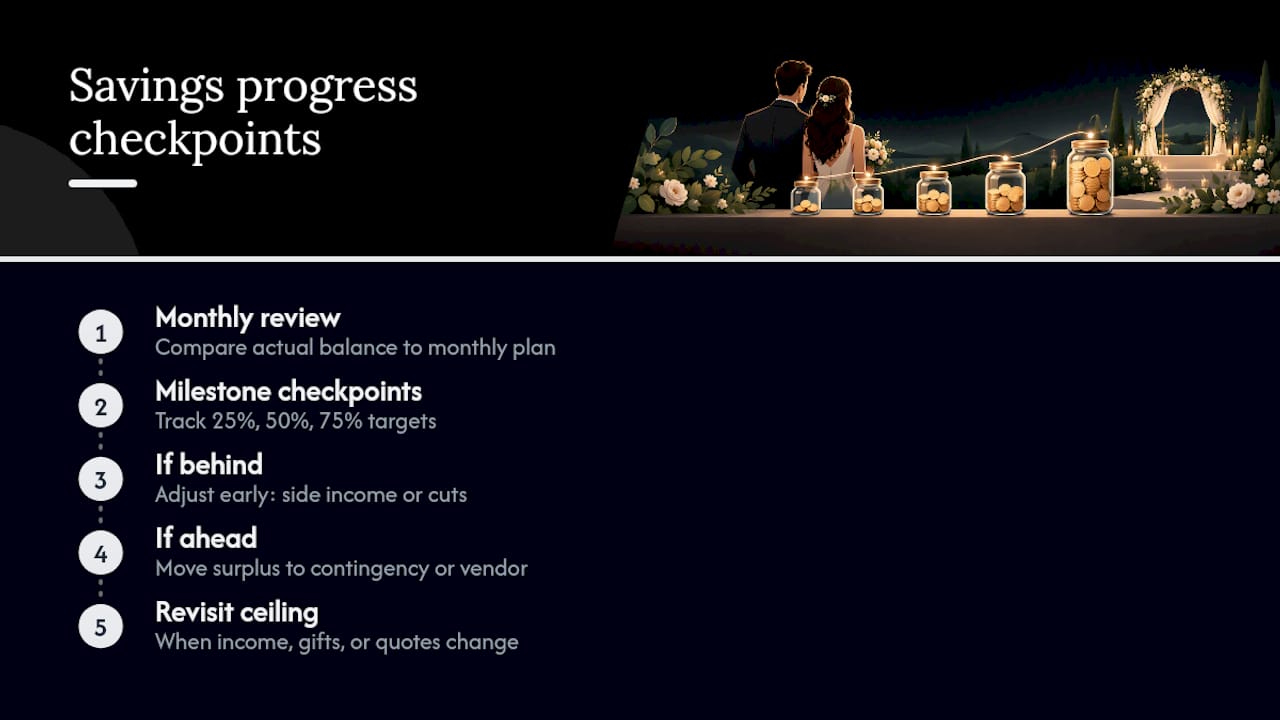
When you fall behind, address it early rather than hoping a future month makes up the gap. A small shortfall three months into an 18-month plan is easy to correct with a modest side-income boost or a temporary spending cut. The same shortfall discovered two months before the wedding leaves far fewer options, and most of them involve reaching for a credit card.
When you get ahead of target, resist the urge to relax the plan entirely. Consider redirecting the surplus into your contingency buffer, or use it to lock in a vendor payment early and secure current pricing before any seasonal increase.
Revisit your ceiling itself if your circumstances change meaningfully, whether that’s a change in income, an unexpected family contribution, or a venue quote coming in higher than expected. The plan should flex with reality rather than treating the original number as fixed no matter what.
A simple spreadsheet or a banking app with sub-account tracking is enough for most couples. The tool matters far less than the habit of actually opening it every month and comparing numbers honestly.
Balancing splurges and savings without losing what matters
The couples who finish wedding planning happiest aren’t the ones who cut everything evenly. They’re the ones who picked two or three things that genuinely mattered to them, funded those properly, and let everything else follow a more modest, sensible budget.
Maybe it’s the photography, because you know you’ll look at those images for decades after the guest list is forgotten. Maybe it’s the venue itself, because the setting is the memory you want walking back into every anniversary. Choose deliberately, early, before the budget starts filling itself with default choices nobody actually asked for.
Planners see the same pattern again and again: couples protect the visible, guest-facing splurges (the meal, the band, the dress) and quietly economise on the behind-the-scenes elements nobody photographs, like linen upgrades or elaborate signage. That instinct is usually correct.
What I’d push back on is the idea that debt is a reasonable price for getting this balance right. A wedding is one day. The interest on a loan taken to fund it doesn’t end when the last song plays. If the ceiling and the splurges don’t fit together within your actual savings capacity, the honest answer is to adjust the ceiling, not to borrow the difference and sort it out later.
— Coert
How Winelandsfunction helps you protect your budget and avoid costly mistakes
Every tactic in this guide works better with someone who negotiates vendor contracts for a living on your side. Professional full wedding planning services exist specifically to catch hidden fees, spot venue minimums buried in fine print, and use supplier relationships to secure terms that individual couples booking alone typically can’t access.

A planner reviewing your budget doesn’t just track spending; they actively reallocate it, moving money from categories with low guest impact toward the two or three priorities you’ve decided actually matter. That’s the same principle covered earlier in this guide, applied by someone who negotiates these contracts weekly rather than once. Experienced event planners blend international planning standards with local expertise, coordinating everything from vendor timelines to on-the-day management so nothing slips through during the final, most expensive weeks before the date.
If you’d rather have an expert review your ceiling and vendor shortlist before you sign anything, get in touch through the wedding planning services page or explore Winelandsfunction’s Cape Town wedding planning services to request a consultation.
Sources
The figures and framework in this guide draw on the following sources, worth checking directly if you want to run your own numbers or dig into the methodology behind any specific claim:
FAQ
What’s the best way to save money for a wedding?
Set a realistic ceiling based on local quotes, divide it by your remaining months to get a monthly target, then automate a transfer into a dedicated account the day your income arrives. Combine that with cutting guest count and choosing an off-peak date, since venue and catering typically make up 30–35% of the total budget.
What is a realistic budget for a 100-person wedding in the UK?
Most 100-guest UK weddings fall between £15,000 and £25,000, depending on region, venue type, and supplier tier. Rural or off-peak venues typically sit toward the lower end, while central-city or peak-season Saturday bookings push toward the upper end.
What is a realistic budget for a wedding?
There’s no single realistic figure, since it depends entirely on guest count, location, and priorities, but UK averages reported in 2025 sat around £20,600 to £21,990. The more useful exercise is building your own ceiling from actual local vendor quotes rather than anchoring to a national average that may not reflect your area or guest list.
Is £50,000 too much to spend on a wedding?
It depends entirely on whether that figure fits your savings capacity and timeline without borrowing. That figure sits well above UK typical ranges, so it usually reflects a larger guest list, a premium venue, or luxury styling choices, and it’s only a problem if it pushes you toward the kind of debt that 67% of newlyweds reported taking on in a 2025 survey.
How much does Winelandsfunction charge for wedding planning?
Pricing for Full Wedding Planning is available on request, since it’s tailored to the scale and complexity of each event. Contact Winelandsfunction through its signature services page for a quote based on your guest count, venue, and priorities.