

Every successful event runs on eleven core functions: leadership, coordination, budget, venue, logistics, marketing, sponsorship, programme content, technical/AV, guest experience, and risk and compliance. Smaller events combine several of these under one person; larger or hybrid events split them further. This guide sets out what each role owns, how they hand work to one another, and how to staff for the size of event in front of you.
TL;DR:
- Assign a single accountable owner for each core function to prevent decision confusion, especially during last-minute escalations.
- Use granular timelines and specific supplier briefs with exact timing to minimize day-of chaos and ensure smooth coordination.
- Smaller events can combine multiple roles under one person, but must still have clear accountable owners for critical functions like budgeting and guest experience.
- For hybrid or large events, assign dedicated owners to each function, including remote stream management, to maintain clarity and control.
- Hiring a full-service planner can effectively manage all eleven core functions, reducing the need for detailed internal staffing and coordination.
Table of Contents
- Event planning team roles: the 11 core functions to cover
- Detailed responsibilities: what each role actually does
- How the team coordinates: RACI ownership without the corporate overhead
- Staffing templates by event size
- A planner’s view on where role clarity actually breaks down
- Where a full-service planner fits into your staffing plan
- Sources
- FAQ
Event planning team roles: the 11 core functions to cover
Titles vary wildly between organisations, but the functions behind them don’t. Whether you call someone a “producer” or a “coordinator,” the same core responsibilities need an owner for the event to run smoothly.
- Event lead (manager or director) — sets the vision, owns the budget sign-off, and makes the final call when priorities clash. Best for events with more than one stakeholder to satisfy.
- Event coordinator — the operational executor who turns the lead’s decisions into schedules, supplier bookings, and checklists. Best for keeping dozens of moving parts on time.
- Budget and finance owner — tracks spend against forecast, approves invoices, and flags overruns before they become crises. Best for corporate events with strict reporting lines.
- Venue manager — negotiates contracts, manages floor plans, and liaises with the venue’s own staff on access, power, and capacity limits.
- Logistics coordinator — owns transport, deliveries, load-in and load-out, and the timing that connects every supplier’s arrival.
- Marketing and communications lead — handles invitations, registration, and public-facing messaging, often working closest with an organisation’s existing marketing team.
- Sponsorship and partnerships owner — manages sponsor deliverables, contra deals, and the relationships that fund larger events.
- Content or programme owner — builds the run of show, briefs speakers or performers, and owns pacing on the day.
- Technical and AV lead — owns sound, lighting, staging, and, for hybrid formats, the live stream itself.
- Guest experience and front-of-house lead — manages check-in, seating, hospitality touches, and the guest’s overall impression from arrival to departure.
- Risk and compliance owner — handles insurance, permits, accessibility, and safety briefings, often working from local authority checklists such as those issued by councils.
Fewer than eleven people ever fill eleven separate jobs. What matters is that each function has a named owner, even when one person wears three hats.
Detailed responsibilities: what each role actually does
Assigning a function is only half the job. Writing a brief means knowing what that person does before the event, during setup, and once guests walk through the door.
Event lead
- Sets overall budget and approves any variance above an agreed threshold.
- Signs off the final programme and any late changes to it.
- Acts as the single point of decision when suppliers, venue staff, or internal stakeholders disagree on the day.
Event coordinator
- Builds and maintains the master timeline, distributing it to every supplier and internal team.
- Chases contracts, deposits, and confirmations so nothing slips through the gaps between departments.
- Runs the on-site production schedule, minute by minute, once doors open.
Budget and finance owner
- Reconciles supplier quotes against the approved budget before contracts are signed.
- Owns the post-event financial report, including actual spend against forecast.
- Is the decision owner for any budget change above the threshold the event lead sets, not the coordinator chasing invoices.
Venue manager
- Negotiates room hire, catering minimums, and cancellation terms.
- Manages floor plans, capacity limits, and accessibility routes with the venue’s own facilities team.
- Owns the venue relationship on the day, including any last-minute space changes.
Logistics coordinator
- Schedules deliveries, load-in windows, and supplier arrival times against the venue’s access rules.
- Coordinates transport for VIPs, speakers, or equipment that needs specific handling.
- Owns the load-out plan, which is where most events lose time and money if nobody has thought it through in advance.
Marketing and communications lead
- Manages invitations, registration platforms, and guest communications before the event.
- Works with an organisation’s existing marketing or sales function when the event’s goal is lead generation, recruitment, or product education, since marketing staff frequently carry event duties already.
- Owns post-event follow-up messaging and attendee data handling.
Content, technical/AV, guest experience, and risk owners follow the same pattern: each owns their supplier briefs, their day-of checklist, and one clear decision point where they, not the coordinator, have final say. For guest-facing roles specifically, front-of-house planning has its own checklist logic worth building separately.
Escalation works best when it’s rehearsed, not improvised. If a supplier misses a load-in slot, the logistics coordinator should know exactly whether they can shift the schedule themselves or must escalate to the event lead within minutes, not after the problem has already cascaded.
Pro Tip: Write supplier briefs in hours, not days. A brief that says “arrive on Thursday” invites a 9am delivery when your load-in window closes at 8am. Specificity in timing prevents more day-of chaos than any contingency plan.
How the team coordinates: RACI ownership without the corporate overhead

A RACI matrix solves the most common team failure: multiple people believing they own the same decision, or worse, nobody believing they own it at all. The rule is simple and non-negotiable: every deliverable gets exactly one Accountable owner, even when several people are Responsible for doing the work. Others are Consulted for input or simply Informed after the decision lands, as RACI templates for event teams consistently show.
Here’s how that looks against real deliverables:
| Deliverable | Responsible | Accountable | Consulted | Informed |
|---|---|---|---|---|
| Overall budget sign-off | Finance owner | Event lead | Coordinator | All function owners |
| Venue contract | Venue manager | Event lead | Legal/risk owner | Coordinator |
| Programme running order | Content owner | Event lead | Technical/AV lead | Guest experience lead |
| Supplier logistics schedule | Logistics coordinator | Coordinator | Venue manager | All suppliers |
| Sponsor deliverables | Sponsorship owner | Event lead | Marketing lead | Finance owner |
| Live stream go/no-go (hybrid) | Technical/AV lead | Technical/AV lead | Event lead | All function owners |
| Guest check-in process | Guest experience lead | Coordinator | Venue manager | Event lead |
| Risk and safety sign-off | Risk owner | Event lead | Venue manager | All function owners |
For hybrid events, a single Accountable owner for the venue-to-stream handoff matters more than any other row on this table, since that person decides whether a live-to-stream element goes ahead at all. Small teams can combine Responsible roles across several rows. What they cannot do is leave a row without an Accountable name against it.
Staffing templates by event size
Headcount should follow function count, not the other way round. These templates give a starting point for budgeting people rather than guessing job titles.
- Small events (1 to 3 people) — one person usually holds event lead, coordinator, and budget together, outsourcing venue liaison and AV to contracted suppliers who bring their own briefs.
- Medium events (4 to 8 people) — a typical split gives one person the lead role, one the coordinator role, and dedicated owners for logistics, marketing, and guest experience, with technical and risk functions contracted out to specialists.
- Large events (9+ people, including hybrid) — every function on the eleven-role list gets its own owner, often split between on-site and remote teams, with a dedicated hybrid owner for the stream-to-room handoff.
- Non-negotiable owners regardless of size — every event, however small, needs a named event lead, a production or logistics owner, a guest experience owner, and someone accountable for finance. Skip one of these four and something on the day will have no clear decision maker.
A planner’s view on where role clarity actually breaks down
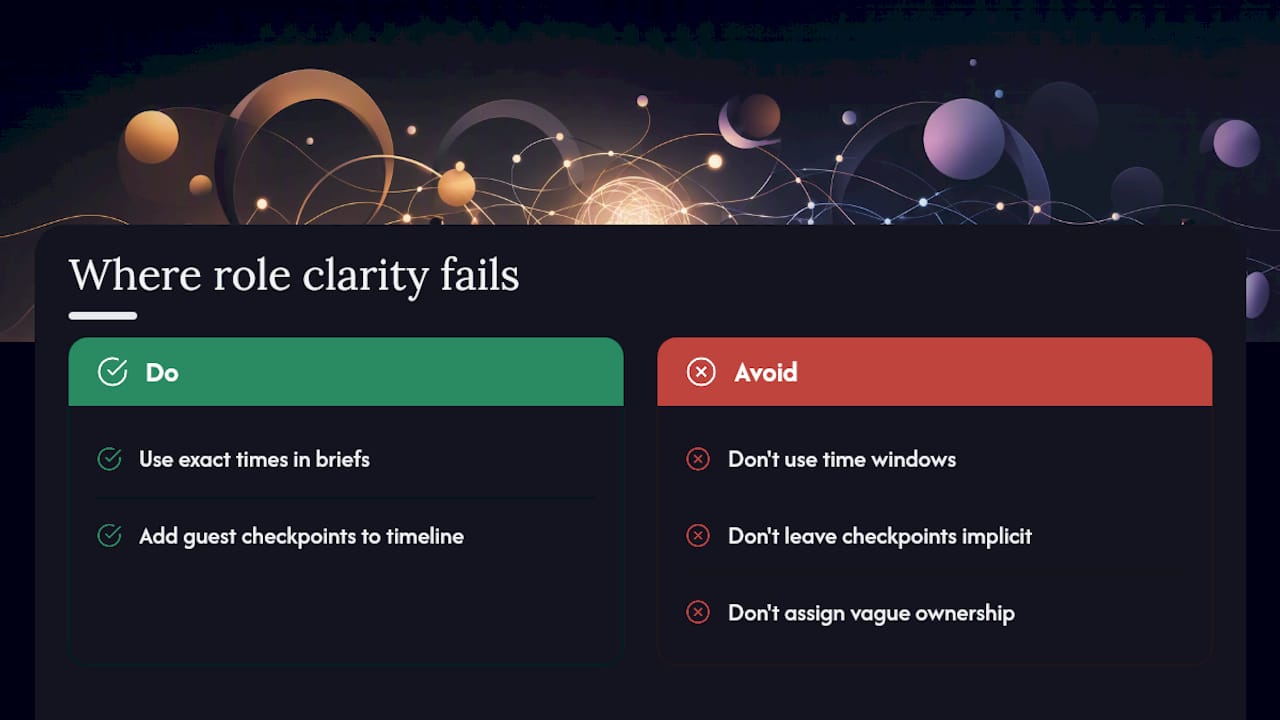
Role confusion rarely shows up in the planning phase. It shows up three hours before doors open, when a supplier calls the coordinator about a decision only the event lead can make. Vague ownership at the brief stage is the single most common cause of that call.
have consistently shown that granular timelines, not general ones, prevent most day-of escalations. point to the same pattern across weddings and corporate launches alike: guest experience checkpoints written into the schedule, not left implicit, catch problems before guests notice them. Data on event outcomes or client satisfaction reinforces this.
Two habits separate smooth events from strained ones. First, write supplier briefs with exact times, not windows. Second, build guest experience checkpoints into the timeline itself rather than trusting front-of-house staff to improvise them.
— Coert
Where a full-service planner fits into your staffing plan
If eleven roles for a wedding or launch sounds like more coordination than you want to manage yourself, that’s precisely the gap full-service planning closes. Winelands Function’s signature services cover the full staffing map this guide has walked through: one accountable lead, a coordination team, supplier and venue management, and on-the-day execution, all under a single point of contact rather than eleven separate briefs you have to write yourself.

For a wedding, that means dedicated wedding planning support across Cape Town and the Western Cape, from budget oversight to floral design to guest experience checkpoints on the day. For corporate launches and bespoke celebrations, the same principle applies: one team, blending international planning standards with local Cape Town expertise, owning every function so you never have to work out who’s accountable for what at 3pm on the day itself. If you’d rather hand off the staffing plan than build it, get in touch for a consultation and let a team map roles to your event’s scale before a single supplier brief goes out.
Sources
For deeper templates and checklists beyond this guide, consult the RACI matrix breakdown, council-issued role guidance, and hospitality customer service standards for guest-facing function benchmarks.
- Event planning: roles and responsibilities (Dover Council)
- Your guide to staffing, managing, and hiring your event team
- What are the 11 roles in an event management team? (CL Institute)
FAQ
What are the 11 roles in an event management team?
The eleven core functions are event lead, coordinator, budget/finance, venue manager, logistics, marketing and communications, sponsorship, content/programme, technical/AV, guest experience, and risk/compliance. Industry frameworks commonly cite this same eleven-function structure, though titles vary between organisations.
What are the typical roles in an event team?
Most teams centre on an event lead who makes final decisions, a coordinator who runs day-to-day logistics, and specialists for venue, budget, and guest experience. Smaller teams combine several of these functions into one or two people rather than hiring separately for each.
What are the 7 roles of an event organiser?
There’s no single fixed list of seven, since role frameworks vary by source and event type; the eleven-function structure above is the more consistently cited version across industry guidance. An organiser typically owns strategy, budget, venue, logistics, marketing, programme content, and on-the-day execution as a condensed set of responsibilities.
What are the 5 P’s of event planning?
Definitions of the “5 P’s” vary across sources, so there’s no single agreed framework worth stating as fact here. What matters more practically is assigning clear ownership across the core functions, planning, budget, venue, logistics, and guest experience, rather than memorising a mnemonic.
How do I combine roles for a small event without losing control?
Combine functions, never decisions. One person can hold the event lead, coordinator, and budget functions simultaneously, but each RACI deliverable still needs exactly one Accountable name against it. Outsourcing venue liaison and technical/AV to contracted specialists is standard practice for teams of one to three people.
When should I bring in outside help rather than assign roles internally?
Bring in specialists once a function requires technical expertise your internal team doesn’t have, such as AV production, floral design, or supplier negotiation at scale. Full-service planners like Winelands Function’s bespoke and luxury celebrations service exist for exactly this handoff, taking on the full staffing map rather than one isolated function.